
But eventually, the calendar fills up. You're spending 20+ hours a week on prospecting that could be spent on higher-leverage work — and the pipeline still feels thin.
That's when the question comes up: is it time to hire an SDR?
This guide walks through exactly that: how to know when you're genuinely ready, what to look for in a first SDR hire, how to run a hiring process that actually surfaces strong candidates, and how to set them up to succeed once they're in the door.
Key Takeaways
- SDRs handle top-of-funnel only — prospecting, qualifying, and booking meetings. They don't close.
- Don't hire one until you have 10–15 closed customers and a repeatable, documented sales process.
- A fully ramped SDR can generate 5 Stage 1 opportunities per month (Bridge Group, 2024).
- Budget around $60K base / $85K OTE for a full-time U.S. SDR.
- Pre-product-market fit or stretched thin on management? A fractional SDR is a lower-risk starting point.
What Does an SDR Actually Do at a Startup?
Before hiring anyone, get the role definition right. An SDR — Sales Development Representative — owns the top of the funnel. Their job is to find potential customers, qualify them against your ICP, and book discovery calls for you or an AE. They do not run demos, negotiate contracts, or close deals.
Daily activities for a startup SDR typically include:
- Cold outreach via email, phone, and LinkedIn
- Researching target accounts before reaching out
- Qualifying inbound and outbound leads against the ICP
- Scheduling discovery calls and handing off warm prospects
- Logging activity in the CRM and iterating on messaging
At an early-stage company, the SDR role carries extra weight beyond pipeline creation. A good SDR uncovers product-market fit data from real prospect conversations — the objections, misconceptions, and pushback that sharpen your positioning. Running dozens of outreach conversations a week, they pressure-test your value proposition at a volume most founders simply can't maintain.
According to Salesforce, SDRs are defined specifically as top-of-funnel reps focused on prospecting and lead qualification — not revenue ownership. That boundary matters when you write the job description — and even more when you set expectations on day one.
Is Your Startup Actually Ready to Hire an SDR?
This is the question most founders skip. Hiring an SDR before you're ready doesn't accelerate pipeline — it wastes three months of salary and learning.
The Repeatable Process Test
Forum Ventures puts it plainly: hire your first SDR only after you've personally closed several deals through a process that works outside your own network. If the only reason deals closed was your personal relationships or credibility, an SDR can't replicate that.
The SDR is a scaling function, not a discovery function. They execute a motion you've already proven.
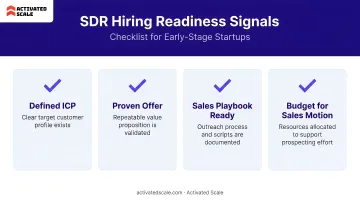
Four Readiness Signals to Check
| Signal | Ready? |
|---|---|
| Closed 10–15 customers through a documented process | Required |
| ICP is specific and data-backed, not guesswork | Required |
| Value proposition consistently resonates in cold conversations | Required |
| ACV is $5K–$10K+ (Forum Ventures' practical threshold) | Important |
The GTM Motion Fit
SDRs add the most leverage in direct outbound motions with mid-to-high ACV. If your product is self-serve or your ACV is below $5K, the math often doesn't work — the SDR's fully loaded cost won't be covered by the deals they unlock.
The Management Readiness Check
Managing a first SDR takes more time than most founders expect — especially with a junior hire. Plan to commit 3–4 hours a week to:
- Weekly 1:1 coaching sessions on messaging and objection handling
- Reviewing email and call quality with specific, actionable feedback
- Running consistent performance check-ins against activity targets
Skip this and the hire will underperform, regardless of how strong the candidate is.
If you've checked all four signals above, you're ready to move to the actual hiring process.
What to Look for in Your First Startup SDR
Experience level matters less than most founders think. What actually predicts SDR success in a scrappy startup environment is coachability, resilience, and the ability to build process on the fly — not just follow it.
Traits That Matter Most
RAIN Group's prospecting research — conducted across 488 buyers and $4.2B in purchases — found that top prospectors generate 2.7x more conversions than average performers. The differentiator wasn't activity volume. It was buyer targeting quality and the ability to create a compelling reason for the meeting.
Traits to screen for in a first SDR:
- Coachability — they'll be working with an incomplete playbook and need to iterate fast
- Curiosity about the product and market — not just reciting a script
- Process orientation — they'll help build the playbook, not just follow one
- Resilience — rejection is daily; how they handle it matters more than their resume
- Communication clarity — your SDR is often the first voice of your company to prospects
Junior vs. Experienced: How to Decide
| Junior SDR | Experienced SDR | |
|---|---|---|
| Cost | Lower ($50–60K base) | Higher ($65–75K base) |
| Ramp time | Longer | Shorter |
| Management needed | High | Moderate |
| Playbook building | Needs guidance | Can contribute independently |
| Startup fit | Good if you have time to coach | Good if you need faster autonomy |
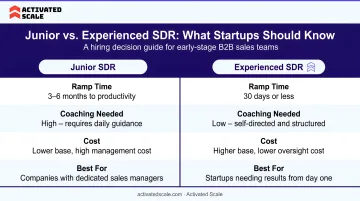
The honest answer: if you can invest 3–4 hours of coaching per week, a hungry junior SDR often outperforms an experienced rep who expects more infrastructure than a seed-stage startup can provide.
That decision framework also points to something founders sometimes underweight: cultural fit. Your SDR represents your brand in cold calls and emails before most prospects ever see your website. A candidate who genuinely believes in what you're building will close more first meetings than one with a better resume who's just running the motions.
The Step-by-Step SDR Hiring Process
Craft an SDR Job Description That Attracts the Right Candidates
The JD should lead with impact and growth opportunity rather than a list of tasks. Candidates want to know what winning looks like in this role and what career trajectory it offers.
Key elements to include:
- Realistic OTE range (target around $85K OTE based on current U.S. market benchmarks from RepVue)
- Clear breakdown of base vs. variable (70/30 split based on the $60K base / $85K OTE median)
- Honest description of the startup environment — incomplete processes, ambiguity, high ownership
- Must-have vs. nice-to-have qualifications listed separately
Transparency about the startup reality filters out candidates who need a polished enterprise environment and signals operational maturity to candidates who thrive in early-stage chaos.
Where to Source Your First SDR
According to Employ/Jobvite's 2024 Recruiter Nation report — based on 1,200+ TA professionals and 600M+ candidate records — 35% of organizations cite employee referrals as a top source for high-quality hires, and 71% of recruiters use LinkedIn.
Start with:
- Warm referrals from your sales network and advisors (highest quality, fastest)
- LinkedIn direct search and job posts
- Sales-specific communities: Bravado, RevGenius, RepVue job boards
- Sales bootcamp graduates (coachable, motivated, recent training)
- Fractional/contract-to-hire platforms like Activated Scale, which connect B2B SaaS startups with pre-vetted SDRs in 7 days or less — useful when speed matters or you want to test ROI before committing to a full-time salary
How to Interview and Evaluate SDR Candidates
Skip unstructured founder conversations. Google re:Work's structured interview research confirms that work samples and structured scoring have measurably higher predictive validity than informal chats.
Recommended assessment:
- Account research exercise — give 3–5 target accounts, ask them to identify the right contact and explain why
- Cold outreach sample — ask for a tailored email to one of those accounts
- Live objection handling: run a 5-minute mock call using a real objection your team hears
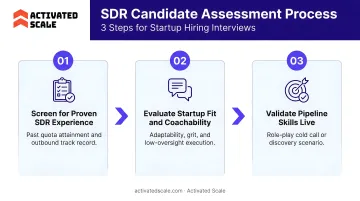
Evaluate beyond the output. How do they handle pushback? Do they ask smart questions about your product? Are they curious about your ICP or just going through the motions?
Setting SDR Compensation at a Startup
Once you've identified strong candidates, compensation structure will determine whether you close them. Use current market data as your anchor, then adjust for your cash position and local market.
U.S. SDR compensation benchmarks (RepVue, 2025):
- Median base: $60K
- Median OTE: $85K
- Implied variable: ~$25K (~70/30 base/variable split)
- Current quota attainment: 55.2% across SDRs
That 55.2% attainment rate matters for quota design. If you're building around $85K OTE, structure targets so hitting 55–60% still feels motivating, not demoralizing. Equity can supplement compensation at seed/Series A, but there's no standard SDR grant size — use it as a retention lever, not the headline offer.
How to Onboard and Set Up Your First SDR for Success
A bad onboarding plan wastes the ramp period. A bad onboarding plan wastes the ramp period. That ramp period has real dollar consequences. Bridge Group's 2024 SDR planning data puts average ramp time at 3 months, with a fully ramped SDR generating roughly 5 Stage 1 opportunities per month — which at $50K ACV translates to approximately $3M in annual pipeline.
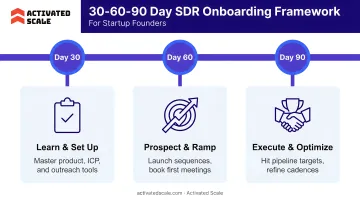
30/60/90-Day Onboarding Framework
- Days 1–30: Product immersion, ICP deep-dives, shadowing founder calls, no outreach yet
- Days 31–60: Supervised outreach with weekly feedback sessions on email and call quality
- Day 61–90: Independent sequences running, with clear KPI targets established
Minimum Tech Stack
| Tool Category | Budget Option |
|---|---|
| CRM | HubSpot (free up to 2 users; Starter at $7/seat/month) |
| Sales engagement/sequencing | Apollo (free tier available; includes contact data) |
| Contact enrichment | Hunter.io or Clay (free tiers available) |
| Meeting scheduler | Calendly (free tier) |
KPIs That Actually Matter
Don't track output metrics before the SDR has ramped. The progression should be:
- Weeks 1–8: Input metrics — sequences launched, calls made, emails sent, LinkedIn connections
- Month 2–3: Early output signals — reply rates, meeting acceptance rates
- Month 3+: True output metrics — meetings booked, Stage 1 opportunities created, qualified opportunity rate
Pushing for pipeline numbers before the SDR has found their rhythm leads to inflated activity and poor-quality meetings. Track the inputs first — the pipeline numbers will follow.
Full-Time vs. Fractional SDR: Which Is Right for Your Stage?
This decision comes down to one question: have you proven enough about your outbound motion to justify a long-term commitment?
Full-Time SDR
The right call when:
- You have a repeatable outbound process and consistent meeting demand
- You have the budget for $85K OTE plus benefits
- You can commit the management time to develop them
- You've already validated that SDR-generated meetings convert downstream
The risk: a mis-hire at this stage doesn't just cost salary. It costs 3–6 months of lost pipeline learning, plus recruiting time to restart.
Fractional SDR
The right call when:
- You're still validating whether outbound SDR activity converts for your specific motion
- Management bandwidth is limited
- Speed matters — you need pipeline movement in weeks, not months
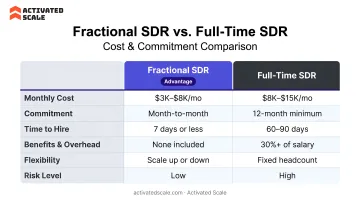
Platforms like Activated Scale connect B2B SaaS startups with pre-vetted, US-based fractional SDRs in 7 days or less (sometimes within 48 hours). SDRs go through a 3-step vetting process — application review, pitch assessment, and a video interview with a subject matter expert — with only the top 7% of applicants accepted into the network.
The economics compare favorably to a full-time hire:
- Cost: $4,500/month plus performance pay, vs. $7,000–$8,000/month fully loaded for a full-time hire
- Commitment: Month-to-month engagements with no termination fees
- Fit guarantee: Free rematching if the SDR isn't the right match
- Conversion: 18% fee on base salary to hire full-time, vs. the typical 20% of OTE charged upfront by traditional recruiters
The model has proven out in practice. Dresma.ai used an Activated Scale fractional SDR to build outbound messaging and tooling from scratch, resulting in a 5X increase in meetings with qualified prospects.
Decision Framework
| Situation | Recommendation |
|---|---|
| Pre-product-market fit, limited management bandwidth | Start fractional |
| Proven outbound motion, consistent demand, budget available | Full-time hire |
| Unsure if SDR ROI works for your ACV/motion | Start fractional, convert if it works |
Frequently Asked Questions
What is the difference between an SDR and an Account Executive (AE)?
An SDR focuses on the top of the funnel — prospecting, qualifying leads, and booking meetings. An AE runs the actual sales conversations and closes deals. They're distinct roles with different metrics: SDRs are measured on meetings booked and opportunities created, AEs on closed revenue.
When should a startup hire its first SDR?
When you have a repeatable sales process, a defined ICP, 10–15 closed customers, and enough founder bandwidth to run the meetings an SDR will generate. Hiring before those signals are in place typically produces meetings that go nowhere.
What should I pay my first SDR?
Current U.S. benchmarks from RepVue put median SDR compensation at $60K base / $85K OTE, with a 70/30 base-to-variable split. Early-stage startups can supplement with equity, though numbers should reflect your cash position and local market.
Should I hire a junior or experienced SDR first?
Junior SDRs cost less and are easier to mold, but require more hands-on coaching. Experienced SDRs can operate with more autonomy but may expect infrastructure a startup can't yet provide. The right answer depends on how many hours per week you can realistically commit to developing them.
What KPIs should I track for my first SDR?
Start with input metrics (activity volume, emails sent, calls made) for the first 60 days. Shift to output metrics — meetings booked, Stage 1 opportunities created, qualified opportunity rate — as they ramp up. A fully ramped SDR should generate around 5 Stage 1 opportunities per month.
What's the difference between hiring a full-time SDR and a fractional SDR?
A full-time SDR is a permanent hire with a full salary, benefits, and long-term commitment. A fractional SDR works part-time or on contract, letting startups validate whether SDR activity generates ROI for their specific motion before taking on a full headcount. Some platforms, like Activated Scale, also offer a contract-to-hire path if the engagement works out.