

Introduction
A bad sales hire doesn't just waste salary. It stalls pipeline, demoralizes the team, and burns months you don't have at the Seed-to-Series-A stage.
The numbers make this concrete. Based on Activated Scale's analysis of client engagements, a wrong sales hire with a $100K base salary costs at least $35,750 in direct expenses in just three months — salary, benefits, tools, and onboarding. Add a staffing agency, and you're looking at $55,000+.
The revenue impact is worse. A mismatched rep on a $1M quota can mean over $300,000 in lost pipeline.
The root cause isn't bad luck. Most early-stage B2B companies treat sales hiring as a reactive exercise — a recycled job description, a handful of gut-feel interviews, and a hopeful offer. That approach doesn't scale.
This guide covers a five-step framework designed for founders and sales leaders at Seed-to-Series-A B2B SaaS companies building or scaling their first sales team. Each step addresses a specific failure point in the standard approach.
Key Takeaways
- A bad sales hire can cost $35,000+ in direct expenses within three months — before pipeline losses are counted.
- Define exact role outcomes before writing a job description — "Account Executive" means nothing without context.
- Source proactively through referrals and targeted outbound, not just job boards.
- Use competency-based interview questions to gather evidence, not impressions.
- Evaluate contextual fit: how a candidate performs in your specific environment, not just on paper.
- A structured 30/60/90-day onboarding plan separates fast ramp from slow fade.
Step 1: Get Clear on the Role Before You Start Recruiting
Most sales hiring failures begin before the first interview. Companies start with a job title rather than a role definition, and "Account Executive" means vastly different things depending on deal size, sales cycle, buyer type, and available support.
Define Three Dimensions First
Before posting anything, get specific on:
- Company stage and culture — How structured is your sales process today? How much ambiguity will this person navigate daily?
- Team dynamics — Will this rep work alongside an SDR, or are they building pipeline solo from day one?
- Role mechanics — Is this person hunting net-new accounts or managing existing relationships? Working 6-month enterprise cycles or high-velocity transactional deals?
a16z's early-market sales framework makes this explicit: in early markets, the first sales rep isn't just closing pre-qualified demand. They're qualifying buyers, finding budget, mapping organizations, navigating procurement, and calling in founders when needed.
Hire for Outcomes, Not Role Profiles
There's a meaningful difference between hiring to fill a role profile ("we need a mid-market AE") and hiring for outcomes ("we need someone who can close five $50K deals per quarter from cold outreach alone, without SDR support").
Define what success looks like at 6 and 12 months before sourcing begins. Specific outcome targets attract the right candidates and keep your evaluation grounded in reality, not gut feel.
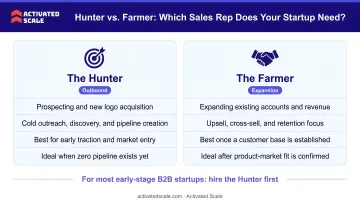
That clarity also shapes which type of rep you actually need — hunter or farmer.
The Hunter vs. Farmer Distinction Matters More at Early Stage
At Seed to Series A, most companies need a hunter — someone who can build pipeline from scratch without a recognizable brand, inbound demand, or marketing air cover. Research published in the Journal of the Academy of Marketing Science defines hunting as actively searching for and acquiring new customers, distinct from farming existing relationships. These orientations aren't interchangeable.
Before recruiting, answer these questions honestly:
- How structured is our sales process right now?
- How much of this rep's pipeline will come from marketing vs. their own prospecting?
- Are we hiring for what we need today, or the org we hope to have in 12 months?
- What does a successful 6-month outcome actually look like in numbers?
Hiring for a future state that doesn't exist yet — an "aspirational org chart" — is a common trap. It produces a rep who's overqualified for the scrappy work today and underqualified when the team actually scales. Nail the fourth question first, and the rest follow.
Step 2: Build Your Sales Talent Pipeline Strategically
Reactive hiring — posting a job and waiting — rarely surfaces top-performing sales talent. The best reps are employed, performing well, and not browsing job boards. As First Round Review notes, referral recruiting is the lowest-cost, highest-quality source of hire.
Three Sourcing Channels That Work
1. Referrals from your network Ask your best performers, advisors, and investors: "Who's the best salesperson you've worked with who sells into our buyer?" One warm introduction from a trusted source outperforms ten cold applications.
2. Targeted outbound recruiting Treat candidate outreach like a sales sequence. Search LinkedIn for reps with experience in your segment, ACV range, and sales cycle length. Filter for people selling similar deal sizes to similar buyers — and reach out directly with a specific, personalized message about the role.
3. Specialized sales talent platforms Platforms like Activated Scale connect B2B SaaS founders with pre-vetted, US-based fractional sales professionals in 7 days or less. The model works on a 3-month initial contract, letting you evaluate fit before committing to a full-time hire. About 65% of clients end up converting their fractional AE once they see results.
Write a Job Ad That Repels the Wrong Candidates
Radical transparency works better than aspirational copy. Be direct about:
- No SDR support, at least initially
- Early-stage ambiguity — there's no complete playbook
- Aggressive targets and what the ramp period looks like
- Comp structure and variable split
Candidates who self-select out of that description save you interview time. Candidates who lean into it are usually the right profile.
Step 3: Run a Structured, Competency-Based Interview Process
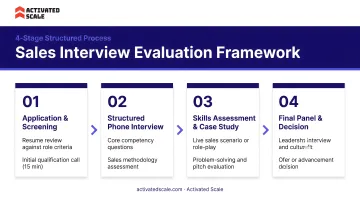
Most sales interviews test charisma and rehearsed answers, not actual selling competency. Questions like "sell me this pen" or "what's your biggest weakness" produce memorable moments, not predictive data. SHRM research found that many hiring managers make decisions within the first five minutes — before any substantive evaluation has happened.
Structured interviews fix this. When interviewers ask consistent, scored questions tied to specific competencies, the evaluation is evidence-based rather than impression-based. Structured interviews fix this. When interviewers ask consistent, scored questions tied to specific competencies, the evaluation is evidence-based rather than impression-based. The questions below are designed to do exactly that.
Competency-Based Questions That Surface Real Evidence
Ask candidates to describe specific decisions and outcomes from their actual sales history:
- "Walk me through how you handled a deal that stalled at 80% of the way through the process."
- "How do you calculate how many prospects you need at each pipeline stage to consistently hit quota?"
- "Tell me about a time you knew you weren't going to hit your number. What did you do next?"
- "How much of your pipeline did you build yourself vs. receive from marketing or SDRs?"
- "Describe the most complex objection you've faced consistently — how did you handle it?"
These questions reveal process thinking, self-awareness, and accountability — traits that are nearly impossible to fake across multiple rounds.
The Screening Stage
Before investing in full interviews, run a standardized 15–20 minute phone screen. Qualify or disqualify on:
- Demonstrated knowledge of your company and space
- Comfort with the comp structure and OTE expectations
- Prior prospecting approach (inbound-reliant vs. outbound-driven)
- Fit with the sales environment you've described honestly
Sales Aptitude Assessments
Standardized assessments complement interviews by surfacing traits that are hard to evaluate in conversation — deadline motivation, assertiveness, resilience under rejection, and coachability. Research by Vinchur et al. found sales ability inventories correlated at .45 with supervisor performance ratings; biodata reached .52 — both meaningfully predictive.
That said, assessments work best as one signal among several, not as a standalone filter. Pair them with structured interviews and reference checks to build a complete picture.
Reference Checks That Actually Help
Go beyond candidate-provided references. Backchannel references — reaching out to former managers or colleagues the candidate didn't list — reveal what polished answers won't.
When you connect with a reference, use this framework:
- Set context — describe the specific role and environment
- Ask where the candidate was strongest
- Ask where they struggled
- Ask the key question: "Would you hire this person again for this exact type of role?"
That last question cuts through polished answers faster than anything else.
Step 4: Assess Contextual Fit, Not Just Past Performance
A strong resume and impressive quota history don't guarantee performance in a different environment. A rep who thrived with a mature brand, inbound pipeline, SDR support, and a complete sales playbook may struggle at an early-stage startup where they're building from zero.
Consider this scenario: a rep spent three years at a well-known SaaS company, consistently exceeded quota, and managed a healthy inbound pipeline. At your Seed-stage startup, there's no brand recognition, no SDR, and no playbook. The skills transferred — but the context didn't.
Use these three question categories in your interviews to surface that gap before you make an offer.
Three Question Categories to Assess Contextual Fit
Category 1: Uncover what conditions enabled past success
- "How much of your pipeline did you source yourself vs. receive from marketing or SDR teams?"
- "What did your sales enablement look like — how much support did you have?"
Category 2: Probe adaptability
- "Tell me about a time you had to change your entire sales approach. What triggered it, and how did the shift go?"
- "Describe a role where the playbook didn't exist yet — how did you operate?"
Category 3: Anchor to your specific environment
- "In this role, there's no SDR support and the typical sales cycle runs 6–9 months. Walk me through how you'd approach building your first 90-day pipeline."
What to Listen For
Strong contextual fit signals include:
- Self-awareness about what specifically made them successful in past roles
- Ability to connect past skills to your current environment's requirements
- Ownership of past losses rather than blame-deflection
- Thoughtful questions about your sales process, ICP, and what's been tried already
Watch for the inverse too. Candidates who credit the company, the product, or the market for everything — and claim no ownership of pipeline generation — rarely perform well once those advantages disappear.
Step 5: Structure Onboarding to Shorten Ramp Time
Even a great hire can fail if onboarding is left to chance. Ramp time is directly tied to how structured the first 90 days are. Without clear milestones, underperformance is ambiguous, difficult feedback conversations get delayed, and both sides lose months before the situation resolves.
This is why Activated Scale builds a Statement of Work before each fractional engagement begins — setting measurable expectations from day one. The same principle applies to full-time hires.
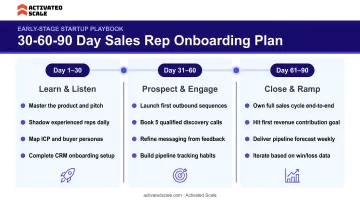
A 30/60/90 Framework for Early-Stage Startups
Days 1–30: Foundation
- Complete product and ICP training
- Map the competitive landscape
- Shadow at least 10 discovery and demo calls
- Milestone: Can independently run a discovery call and accurately describe the ICP
Days 31–60: Pipeline Creation
- Begin active prospecting using agreed sequences
- Conduct first independent discovery calls
- Create initial pipeline entries
- Milestone: 10–15 active opportunities in the pipeline; feedback loop established on messaging
Days 61–90: Full Cycle Ownership
- Own deals end-to-end
- Track quota pacing against agreed targets
- Contribute to early playbook documentation
- Milestone: On pace for month-3 quota; at least one deal at proposal stage
Set Explicit Expectations From Day One
Vague expectations produce ambiguous underperformance. Before the first day, define in writing:
- What does success look like at 30, 60, and 90 days?
- What are the non-negotiable activity metrics in the first month?
- At what point does the ramp period end and full accountability begin?
Without this clarity, managers and new hires spend weeks guessing whether performance is on track. Delayed feedback is one of the most common reasons strong hires stumble in their first role.
Frequently Asked Questions
What are the 5 C's of hiring?
The 5 C's commonly referenced are Competency, Character, Culture fit, Compensation alignment, and Coachability. For sales roles, coachability and competency carry extra weight — the best reps improve with feedback and have demonstrated evidence of learning from losses, not just celebrating wins.
What are the 4 P's of recruitment?
The 4 P's are Planning, Pipelining, Process, and Performance. In a sales hiring context, these map to role definition, proactive sourcing, structured interviewing, and ramp measurement — in that order.
What are the 7 stages of the recruitment process?
The seven stages are: identifying the need → job description → sourcing → screening → interviewing → offer → onboarding. For sales roles, screening and onboarding are the most commonly underinvested, and the most consequential.
What are the 4 pillars of recruiting?
The 4 pillars are generally Sourcing, Screening, Selecting, and Onboarding. These map directly to Steps 2 through 5 of the framework in this guide — each pillar is a distinct failure point if treated as an afterthought.
What is the most common mistake companies make when hiring salespeople?
Hiring on gut feel, charisma, or resume pedigree instead of a structured, competency-based process. SHRM research shows many hiring decisions happen within the first five minutes of an interview, well before any real evaluation occurs. A mismatched rep on a $1M quota can represent over $300,000 in lost pipeline.
When should an early-stage startup hire its first full-time salesperson?
Most practitioners recommend waiting until there's a repeatable sales motion and a validated ICP. Until then, fractional or contract-to-hire professionals offer a lower-risk path. Activated Scale's data shows 65% of clients ultimately convert their fractional AE to a full-time employee — having tested fit, skills, and cultural alignment before making a permanent commitment.