
Introduction
Hiring your first salesperson at pre-seed is one of the most consequential — and most frequently botched — decisions a founder makes. According to First Round Review, 30–50% of sales reps flame out on average, and delayed or failed sales hiring can mean $50K–$200K per month in foregone revenue.
The stakes at pre-seed are unforgiving. Carta's Q3 2024 data shows 42% of pre-seed rounds were under $250K, with a median post-money SAFE of just $275K. There's no room to absorb a failed $100K+ hire that burns four to six months of runway.
What makes this hire so hard at pre-seed specifically? No sales playbook, an unproven ICP, a founder who's been the only seller, and a ticking clock pushing the decision before conditions are ready.
This post covers five predictable mistakes founders make — and how to avoid each one.
Key Takeaways
- Founders who haven't personally closed deals have nothing concrete to hand off — no pitch, no ICP, no process.
- Hiring too junior or too senior both fail for structural reasons, not effort.
- Big-company sales experience rarely transfers to pre-seed environments.
- No ICP documentation before hiring means your new rep will chase the wrong prospects for weeks.
- Fractional or contract-to-hire models give you senior sales judgment without the full-time cost.
Mistake 1: Hiring Before the Founder Has Proven the Sales Motion
The Vacuum Problem
Founders with engineering or product backgrounds tend to treat selling as someone else's job — something to delegate as quickly as possible. But at pre-seed, you're the only person who understands the product, the customer pain, and why anyone would actually buy.
A16z's Martin Casado puts it plainly: if the product visionary can't sell the product, no one can. Sales starts with founders, not with sales hires.
If you haven't closed at least three to five customers yourself, there's no repeatable process to hand off. The new hire walks into a vacuum — no working pitch, no qualified ICP, no documented objections. They're left to figure out what the founder never did.
What Actually Happens
The typical outcome: the rep spends weeks building a process with no foundation, burns through cold outreach without converting, and both sides end up frustrated. A costly off-board follows, and you're back to square one — only now with less runway.
The question is: how do you know when you're actually ready to hand it off?
Christina Cacioppo's benchmark from First Round's ICP research is the clearest test available: founders are ready to hand off selling when they can predict 75% of what a customer will say in a meeting. Most pre-seed founders are nowhere near that bar when they hire.
The Readiness Test
Before posting a sales job description, ask yourself whether you can write a two-page sales process document that an intelligent outsider could follow. It should answer:
- Who is the buyer, and what triggers a purchase decision?
- What objections come up consistently, and how do you respond?
- How long is the typical sales cycle?
- What does a repeatable win look like?
If you can't write that document, you haven't done enough founder-led selling yet. That's the only real readiness test that matters.
Mistake 2: Picking the Wrong Experience Level
Three Ways to Get It Wrong
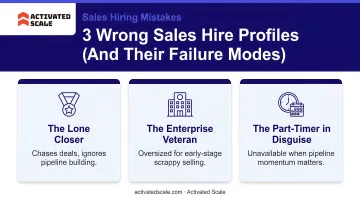
Most founders default to one of three hiring profiles. Each comes with predictable failure modes.
The junior SDR hire: The low base cost looks attractive, but 2024 Betts Recruiting benchmarks show entry SDR OTE runs $70K–$85K once variable is included. Without a functioning sales system, coaching structure, or defined ICP, a junior rep is an expensive experiment. They need infrastructure that doesn't exist yet.
The VP of Sales from a large company: A seasoned leader from a scaled organization expects inbound lead flow, marketing support, sales engineers, and an established CRM. None of that exists at pre-seed. As SaaStr notes, even at $3M ARR a VP needs to be willing to roll up their sleeves and do the scrappy prospecting work, and many can't or won't.
The mid-level AE with 2–4 years at one startup: This person will attempt to replicate what worked at their last company. Unless your buyer persona, deal size, and product category are nearly identical, the copy-paste approach takes months to unlearn.
What Actually Works
The profile that succeeds at pre-seed is a seller with 5–8 years of experience who has built sales motions from scratch before — someone who can set up the CRM, run outbound, close deals, and bring the founder along on process decisions. The problem: Bridge Group's 2024 SaaS AE benchmarks put median AE OTE at $190K, and senior enterprise-level AEs command $300K OTE. That's out of reach for most pre-seed budgets.
The Fractional Solution
A fractional or contract-to-hire model solves the budget problem directly. Fractional AEs on Activated Scale's platform typically engage at $6,500 per month plus performance pay — a fraction of full-time cost — with professionals drawn from companies like Salesforce, Oracle, Yelp, and Datadog. You get senior sales judgment without the full-time commitment, and 65% of clients end up converting their fractional hire to full-time after seeing results in the actual environment.
Mistake 3: Valuing Brand-Name Pedigree Over Startup Adaptability
Founders see "Salesforce" or "HubSpot" on a resume and assume the candidate must be strong. That's a trap. Big-company selling and pre-seed selling are fundamentally different jobs.
Large-company reps operate with:
- A recognized brand that opens doors
- Inbound lead flow from marketing
- Sales engineers and solution consultants
- Established objection-handling playbooks
- A CRM that's already configured and populated
None of those exist at your pre-seed startup. Betts' 2024 research shows 70% of AEs now face role crossover — expected to build pipeline, craft playbooks, and close simultaneously. That expectation aligns with startup reality, but it's a jarring shift for reps who've only run structured enterprise cycles.
What Startup-Fit Actually Looks Like
The behavioral signals that predict success at pre-seed:
- Comfortable moving without a defined territory or established process
- Handles customer success, support questions, and closing all in the same week
- Low ego around job titles and org structure
- Has built pipeline from scratch before — not stepped into one someone else created
The most predictive interview question is simple: Walk me through a time you built something from zero — a new territory, a vertical, a channel — with minimal support. The specificity and ownership in that answer tells you more than any company name on their resume.
Activated Scale screens for exactly this profile — prioritizing sellers who "successfully sold a product with minimal brand recognition and had to work hard to win deals." That's a meaningful filter that a resume scan won't catch on its own.
Mistake 4: Skipping ICP and Sales Process Definition Before Hiring
Hiring a sales rep without a defined ICP is like handing someone a territory with no map. They'll make reasonable-sounding guesses about who to target, spend weeks in conversations that go nowhere, and burn through your outreach budget chasing the wrong prospects.
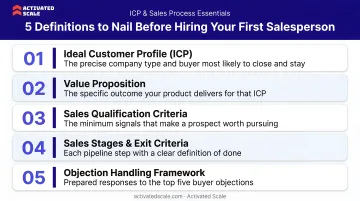
The Five Things You Must Define First
Before interviewing any candidates, write down answers to these questions:
- Target company profile — industry, headcount range, growth stage
- Buyer title and decision structure — who signs, who influences, who blocks
- Core problem your product solves — specific to that buyer's day-to-day reality
- Primary objection and your response — not a generic "it's too expensive" answer
- Rough sales cycle length — even a wide estimate (30 days vs. 180 days changes everything)
Rough answers are better than none. Even basic segmentation — company size, industry, buyer title — directly sharpens a rep's targeting and cuts wasted outreach. That's the ICP in its simplest form: the type of company and buyer most likely to close.
If you can't answer all five, spend two more weeks on founder-led outreach. These answers should exist before you post a job description, not after someone is already on payroll.
Mistake 5: Failing to Set Up the First Hire for Success
Compensation Mismatches
Pre-seed founders often build OTE structures on pipeline assumptions that don't exist. Telling a rep they can earn $180K OTE when there's no inbound, no brand recognition, and no CRM data is a retention problem from day one.
Use Bridge Group's 2024 benchmarks as a calibration point: median SaaS AE OTE is $190K against an $800K annual quota. Then honestly assess whether your current pipeline justifies that structure.
The No-Onboarding Trap
Expecting a first sales hire to onboard themselves is a fast path to an unfair evaluation. According to Bridge Group's 2024 report, the average AE ramp time is 5.7 months. Without structured ramp support, talented reps underperform for 60–90 days and get blamed .
A new hire needs:
- Access to recorded demos or prospect calls
- Product training with real objection scenarios
- Regular deal reviews with the founder
- A defined 30/60/90-day success scorecard written before day one
Measuring the Wrong Things
Founders who track activity (calls made, emails sent) instead of outcomes end up optimizing for noise. Set OKRs around:
- Qualified meetings booked per week
- Pipeline created by stage
- Conversion rate from meeting to proposal
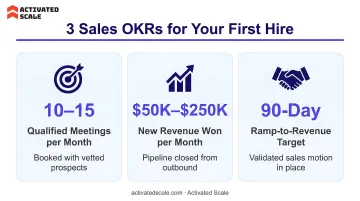
These metrics reflect whether the rep is generating real momentum — not just staying busy.
How to Get Your First Sales Hire Right at Pre-Seed
The Readiness Checklist
Before starting any search, confirm all four of these are true:
- The founder has personally closed several customers
- An ICP is documented and could be handed to an outsider
- At least one repeatable sales conversation has been recorded
- A 30/60/90-day success scorecard for the new hire is written and ready
These aren't afterthoughts. They're prerequisites.
Start Fractional, Then Convert
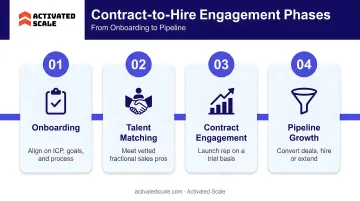
The contract-to-hire model exists precisely for this stage. It reduces the risk of a mis-hire, gives both parties time to validate real-world fit, and lets the startup preserve runway during the evaluation period.
Activated Scale's engagement model is built around this structure. A Statement of Work with clear KPIs is set before day one, then the work follows defined phases: days 1–15 for onboarding and sales process audit, days 16–45 for active outreach testing and iteration, and day 45+ for accelerated pipeline building. No ambiguity about what success looks like.
For pre-seed founders who need to move fast, Activated Scale connects startups with vetted, US-based fractional B2B sales professionals in 7 days or less — sometimes under 48 hours. With a try-before-you-hire model and a 65% conversion rate to full-time employment, it's a practical way to get experienced sales execution running while you're still validating what "repeatable" means for your business.
Frequently Asked Questions
When should a pre-seed startup hire its first salesperson?
After the founder has personally closed at least a few customers, can document a repeatable sales process, and can clearly define the ICP to an outsider. If you can't write a two-page sales process document, you're not ready to hire.
Should the founder sell before hiring a salesperson?
Yes, without exception. Founder-led selling validates the pitch, surfaces the real ICP, and creates the process a future hire will follow. Without it, your hire walks in with no foundation and no direction.
Is hiring a VP of Sales a mistake at the pre-seed stage?
Usually, yes. A VP from a large company needs marketing support, inbound leads, and established infrastructure that pre-seed startups can't provide. The hire is expensive and almost always set up to fail.
What's the difference between a fractional salesperson and a full-time first sales hire?
Fractional sellers work part-time or on a contract basis, giving startups access to senior sales talent at a fraction of full-time cost. The contract-to-hire model lets founders validate a salesperson's actual performance before committing to a permanent offer.
How do you know when your first sales hire isn't working out?
Watch for: no qualified pipeline after 60–90 days, inability to articulate why deals are lost, and no insights surfacing from prospect conversations.
What traits matter most when hiring a first B2B SaaS salesperson at pre-seed?
For AE roles: comfort with ambiguity, experience building pipeline from scratch, and relevant sector familiarity. For SDR roles: raw drive and coachability above all else. Low ego is non-negotiable at either level.