
Introduction
Most startup founders hit a wall around the same moment: revenue is growing, founder-led sales is working, but there aren't enough hours in the day to keep up. The obvious answer is to hire a salesperson. The harder question is who, when, and what role.
Each wrong move has a real cost:
- Hire too early and you burn cash on someone who can't sell a product that isn't ready
- Hire too senior and you get a VP building org charts before you have a repeatable deal
- Hire the wrong role — say, a pure SDR with no downstream closer — and you've built a pipeline that leads nowhere
This guide walks through each hiring stage — from your first rep to your first sales leader — with specific criteria so you make the right call at the right time.
Key Takeaways
- Close your first 10–20 customers yourself before hiring anyone in sales
- Your first hire should be a full-cycle rep who can prospect and close — not a pure SDR
- Hire two reps at once if budget allows — you get comparison data and avoid betting everything on one hire
- Sales leadership belongs after $1M–$2M ARR, not when you only have two reps
- Hiring too senior too early costs more than hiring too late
When Are You Ready to Hire Your First Salesperson?
Funding in the bank doesn't mean you're ready to hire sales. The real readiness signals are more specific.
The Four Signals That Actually Matter
- Paying customers from founder-led sales — SaaStr recommends founders close the first 10–20 customers themselves before bringing on a rep. If you haven't done it, you can't train someone else to do it.
- A generally available product — not a beta with five design partners. Reps need something they can actually sell.
- Early inbound signals — someone besides your network is showing up and asking questions unprompted.
- A minimum viable sales process — even a rough ICP, a documented cycle, basic call scripts, and a list of common objections. Hiring without this leaves your first rep without a playbook.
Why Founder-Led Sales Is Non-Negotiable First
A16z makes the point plainly: if the product visionary can't sell the product, it's unlikely anyone else will. And if someone else does figure it out before you, they may sell it to the wrong customer for the wrong reasons.
Without firsthand selling experience, you can't evaluate candidates accurately, set realistic targets, or coach a rep through a stalled deal. The founder's time in the field directly determines how effective that first hire will be. Three things break without it:
- You hire on personality, not process fit
- Quotas get set on optimism rather than data
- Your first rep has no one to turn to when deals go sideways
Stage 1: Your First Sales Hire — Choosing the Right Role
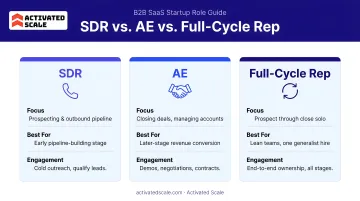
SDR vs. AE vs. Full-Cycle Rep
The two most common first-hire options are:
- SDR (Sales Development Rep) — focused on outbound prospecting and pipeline generation, hands off to an AE to close
- AE (Account Executive) — owns a territory, manages deals from discovery through close
- Full-cycle rep — handles the entire process: prospecting, discovery, proposal, negotiation, close
For most early-stage B2B SaaS startups, the full-cycle rep wins. A pure SDR without a downstream closer creates a bottleneck — qualified pipeline piles up with no one to convert it. A16z specifically recommends the first hire be a senior rep who carries a bag, qualifies opportunities, manages procurement, and closes deals.
What Makes This Role Different
Your first sales hire isn't just closing deals. They're doing several things at once:
- Helping define and refine your ICP through real conversations
- Feeding product feedback into engineering and product loops
- Building early process documentation so rep #2 doesn't start from scratch
- Representing the company externally while the founder is heads-down
This is why the experience profile matters. Look for someone with 2+ years at an early-stage startup — not enterprise. A rep who's only worked inside a structured 200-person sales org will struggle in an environment where the playbook doesn't exist yet.
Why Hiring in Pairs Works Better
If budget allows, hire two reps at roughly the same time. SaaStr calls this the A/B test principle: one rep's results are impossible to interpret in isolation. Did deals close because the rep is good — or because the market was pulling? Did deals stall because of the rep, or because of pricing? Two reps let you separate individual performance from product-market fit noise.
Track these metrics from day one for each rep:
- Conversion rates by stage
- Outreach volume and response rates
- Deal velocity (time from first touch to proposal)
- Time-to-first-close
A Lower-Risk Path to Your First Hire
If you're unsure whether you need an SDR, AE, or full-cycle rep, a fractional or contract-to-hire engagement lets you test before committing. Activated Scale connects startups with pre-vetted fractional B2B sales professionals in 7 days or less (sometimes under 48 hours), starting with a 30-minute consultation to assess your stage, buyer profile, and ACV.
The matching process prioritizes reps who've actually sold to your buyer type before — a more reliable filter than resume screening alone.
Stage 2: Building a Small Sales Team (2–5 Reps)
When to Move Into This Stage
The trigger isn't a headcount number — it's repeatability. You're ready to build a small team when:
- Revenue is growing predictably, not just occasionally
- Founder-led sales has proven the motion works
- Founder time on sales is now a bottleneck to growth
Andreessen Horowitz (a16z) recommends keeping a light configuration of 2–5 reps until repeatable sales is clearly established. Stay lean until you know what you're scaling — adding headcount before the motion is proven just amplifies the wrong behavior.
What Founders Still Need to Own
Even with 2–5 reps on board, founders must stay in the room. That means joining calls, attending pipeline reviews, and staying in feedback loops. Think of it as parallel selling, not a handoff. Reps need coaching that only comes from someone who has lived those customer conversations firsthand.
Infrastructure Before Headcount
Founder involvement also surfaces another reality quickly: reps can't perform without the right scaffolding. Before adding rep #3 or #4, make sure these exist:
- A basic CRM with pipeline visibility
- Documented sales stages with clear entry/exit criteria
- A compensation structure tied to deal size and close frequency
- An onboarding plan so new reps don't spend their first month figuring out the basics
Compensation Design at This Stage
Per Bridge Group's 2024 AE benchmark across 170+ B2B SaaS companies, median AE OTE sits at $190K with a 53:47 base-to-variable split and median annual ACV quota of $800K. Those are broad market benchmarks — not seed-stage targets — but they give you a reference point.
Don't finalize your variable pay structure before your first reps have run a few full cycles. Build it collaboratively once a deal pattern has emerged. Early mistakes in comp design — over-weighting short-term volume, under-weighting deal quality — are expensive to undo.
Stage 3: When to Hire Sales Leadership
The Timing Problem Most Founders Get Wrong
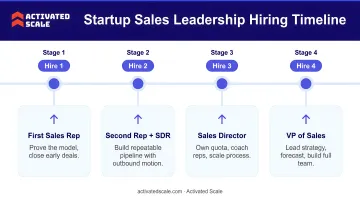
Hiring a VP of Sales when you have two reps is one of the most common and costly startup mistakes. A senior sales executive brought in too early will implement scaling processes before you have the deal volume to justify them. When the environment doesn't match their expectations, they leave — taking momentum and institutional knowledge with them.
SaaStr's guidance is specific: Head of Sales timing is generally after $1M–$2M ARR, with at least two reps consistently hitting quota. A16z cites a conventional benchmark of 80% of reps hitting quota set at 3x OTE before scaling leadership.
The Right Profile for a First Sales Manager
Your first sales manager should be a player-coach: someone who still sells while building process. Specifically, look for someone who:
- Came up as an individual contributor before moving into management
- Has managed teams slightly larger than yours is now (not 50-rep orgs)
- Can still run a deal, not just review pipelines
- Has experience building process in ambiguous environments
Avoid pure strategists or candidates who've only operated in mature, structured sales orgs. At this stage, the manager needs to be in the field as much as in the spreadsheet.
VP of Sales Threshold
A VP of Sales makes sense at 25+ reps with consistent ARR growth. At that point, you need someone accountable for:
- Org design and headcount planning
- Quota-setting and territory allocation
- Opening new channels and segments
- Developing individual contributors into managers
Until you hit that threshold, a fractional sales director can fill the strategic gap without the overhead of a full-time executive hire.
What Traits Actually Predict Success in Startup Sales Hires
Why the Classic Sales Profile Often Underperforms
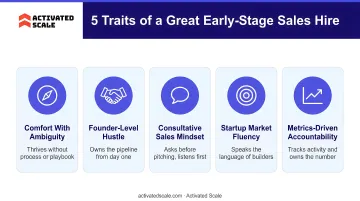
The traditional high-energy, quota-obsessed, closing-machine archetype rarely survives contact with early-stage startup reality. The role is too cross-functional and iterative for a purely transactional mindset. What you need is someone who thrives in ambiguity, not someone who needs a structured territory and a proven pitch to execute.
Five Traits That Consistently Differentiate Strong Early-Stage Hires
- Genuine curiosity — they ask better questions than they give pitches. Gartner's survey of 725 B2B buyers found 67% prefer a rep-free experience. Reps who make conversations worth having are the ones who survive that shift.
- Creative problem-solving — they adapt when the playbook doesn't work, because in early-stage selling, it often won't.
- Technical fluency — they can discuss the product credibly without hand-holding from engineering.
- Self-awareness — they know what they don't know and ask for help rather than bluffing through a demo.
- Accountability — they own results, not excuses. In a two-rep org, blame-shifting breaks everything.
The Listening Test
Curiosity matters most when it feeds back into the product. A rep who accurately captures prospect pain points and relays them to the product team is more valuable than one who gives a flawless demo. Discovery quality, not presentation polish, drives product-market fit iteration.
A Lightweight Interview Framework
Three questions that reveal more than any resume:
- "Tell me about a time you had to sell something with no playbook." — reveals comfort with ambiguity
- "What would you do in your first 30 days with no inbound leads?" Listen for whether they reach for structure or wait to be handed one.
- "Pitch our product after a 15-minute briefing." — reveals adaptability and genuine effort under pressure
How to Reduce Risk When Hiring for Sales
The Real Cost of Getting It Wrong
SHRM reports that many employers estimate the total cost to hire a new employee runs 3–4x the position's salary. For a $100K sales hire, that's $300K–$400K when you factor in recruiting fees, ramp time, benefits, and lost pipeline while the seat is open.
Activated Scale's internal data puts the cost of a wrong SDR hire at over $35,000 and a wrong AE hire at over $50,000 within the first 90 days — including recruiting fees, lost demos, and deals that never happened. If the hire fails after the 90-day guarantee period, you pay the recruiting fee again.
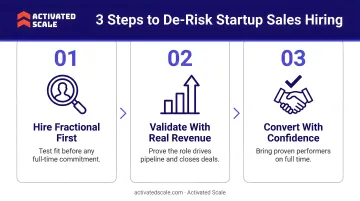
Three Practical Ways to De-Risk the Process
Use structured work trials: a paid "audition" project before extending a full-time offer. Have candidates do a discovery call role-play or a 15-minute pitch from a brief. Behavior under real conditions beats interview performance.
Set explicit 30/60/90-day ramp milestones — define what success looks like at each checkpoint before the rep starts. Unclear expectations are how underperformance lingers for months before anyone acts.
Use a fractional or contract-to-hire model: Activated Scale's 3-month contract period lets founders evaluate fit before committing to a full-time hire. The rep works on Activated Scale's payroll, so you avoid W2 costs, benefits overhead, and the full upfront fee.
Roughly 68% of Activated Scale's reps convert to full-time, and the conversion fee is 18% of base salary — below the standard 20%+ recruiter rate.
Once you've built your risk reduction framework, where you source candidates determines whether any of it holds up.
Where to Source Startup-Ready Sales Candidates
Not all sourcing channels are equal at this stage:
- Warm referrals from customers — people who've bought from you have likely interacted with good salespeople; ask them
- Founder peer networks — other founders at your stage have done this recently and know who's strong
- Specialized early-stage sales platforms — built for this exact context, not generic job boards that surface enterprise-optimized candidates who won't thrive without a support structure
Frequently Asked Questions
Is SDR an entry-level position?
SDR roles are entry-level by title, but startup SDRs operate differently: there's no marketing engine feeding leads, and the rep typically builds outreach process from scratch. Expect more self-direction than a comparable role at an established company.
When should a startup hire its first salesperson?
When you have at least 10–20 paying customers from founder-led sales, a generally available product, seed-stage funding or greater, and early signs of inbound demand. Funding alone isn't the trigger. A proven, repeatable sales motion is.
Should a startup hire an SDR or AE first?
Most early-stage B2B SaaS startups benefit more from a full-cycle AE or hybrid rep who handles both prospecting and closing. A pure SDR without a downstream closer creates pipeline that has nowhere to go, generating work without revenue results.
What should a startup's first sales hire be paid?
Compensation varies by market, deal size, and sales cycle. Bridge Group's 2024 benchmark puts median SaaS AE OTE at $190K (53:47 base-to-variable split), but that's a market-wide number, not a seed-stage target. Build your variable pay structure with your first reps once a deal pattern has emerged.
What is a fractional sales rep and is it right for startups?
A fractional sales rep is an experienced sales professional working on a part-time or contract basis. For early-stage startups that need proven talent without a full-time salary commitment, it's a practical way to test a rep's fit before converting — especially when the cost of a wrong full-time hire is high.
How long does it take to ramp a new startup sales rep?
Full-time reps typically take 60–90 days to reach full productivity in B2B SaaS. Fractional reps through platforms like Activated Scale often ramp in 2–4 weeks, given their prior experience selling to similar buyers and deal sizes.