
The challenge founders face is uniquely difficult: exceptional salespeople are masters at selling themselves during interviews, making it genuinely hard to distinguish real leadership ability from a polished pitch. A bad hire at this stage doesn't just cost money—it stalls revenue momentum, creates team confusion, and typically sets a company back by a full year or more.
This guide covers when to hire, what the role actually requires, how to evaluate candidates effectively, how to structure compensation, and which red flags demand your attention.
Key Takeaways
- Hire only after 1-2 reps prove a repeatable sales motion exists
- The VP builds and scales teams—not personally closes most deals
- Prioritize candidates with an active talent network and experience matching your deal size and complexity
- Run structured interviews and downward reference checks to cut through the sales pitch
When Is Your Startup Actually Ready to Hire a VP of Sales?
The Readiness Threshold
A VP of Sales is a force multiplier, not a miracle worker. According to Jason Lemkin of SaaStr, founders should close 10-20 customers themselves first, then hire 2 sales reps who hit quota before bringing on a VP. The VP cannot create traction from nothing—they need proven raw material to scale.
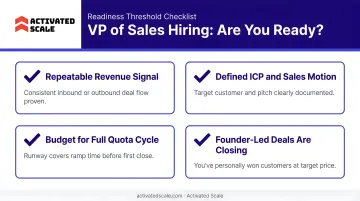
The readiness threshold includes:
- Founders have personally sold the product and understand buyer objections firsthand
- At least 1-2 reps are closing deals — not just booking meetings, but generating actual revenue
- The same sales motion has worked across multiple customers, showing early repeatability
- $1M ARR reached — the practical milestone where team-building becomes essential
The Cost of Hiring Too Early
Without a validated sales process, a VP has nothing to scale — just a blank canvas and a burn rate. Jason Lemkin identifies that 95% of VP Sales candidates cannot successfully handle the $1M to $10M ARR growth phase. Hiring before you're ready almost guarantees your candidate lands in that majority.
Early-hire failures typically manifest as:
- VPs who struggle to define ICP because no pattern exists yet
- Rapid team churn as new reps inherit an unproven process
- Founder frustration when revenue doesn't accelerate despite the executive hire
- Wasted runway that could have funded product development or customer acquisition
The Fractional Alternative as a Bridge
For startups not yet at that threshold, fractional sales leadership is a practical middle ground. Platforms like Activated Scale connect startups with experienced fractional sales professionals who help validate go-to-market strategy and build pipeline before you commit to a permanent $300K+ hire.
The contract-to-hire model gives founders a lower-stakes path to the right VP:
- Test leadership fit with real customers and live quotas
- De-risk the permanent hire decision
- Access experienced talent at $8K-$15K per month versus a $200K–$300K+ full on-target earnings package
- Convert to full-time employment once performance is proven
What a VP of Sales Actually Does at a Startup
Recruiting Is Job Number One
From $500K to $20M+ ARR, the VP's most critical function is recruiting, hiring, and developing sales reps. Predictable Revenue explicitly identifies hiring as the #1 priority for a VP Sales that most people get wrong.
Deal volume makes it mathematically impossible for one person to carry revenue alone. If your target is $5M ARR at $50K ACV, that's 100 deals — far more than one VP can personally close while building team infrastructure at the same time.
Team Performance Over Individual Contribution
The VP's success metrics are collective:
- Quota attainment across all reps, not personal bookings
- Ramp time for new hires (measured in months to first deal)
- Team retention and promotion rates
- Pipeline quality and conversion rates by stage
If your VP of Sales is consistently your top individual performer, they're failing at their actual job.
Sales Process Design and ICP Definition
The VP must build and enforce a repeatable sales process aligned to how ideal customers actually buy. That means defining an Ideal Customer Profile every rep follows on every deal — because in B2B SaaS, churn from bad-fit customers creates "sales debt": revenue that appears in bookings but erodes through cancellations.
Core process elements include:
- Stage definitions with clear entry/exit criteria
- Win/loss analysis to identify patterns
- Competitive positioning and objection handling frameworks
- Forecast accuracy standards
Sales Tactics and Strategy
Process design sets the foundation. From there, the VP owns both day-to-day execution and longer-horizon planning:
Daily/weekly focus:
- Pitch scripts and demo structure
- Competitive battle cards and objection handling
- Lead qualification criteria
- Collaboration with marketing on lead generation
Quarterly/annual focus:
- New market entry decisions
- Channel strategy (direct vs. partner)
- Sales team structure (territory, vertical, account size)
- Technology stack and sales operations
Cross-Functional Leadership
A startup VP of Sales must work across product, marketing, and customer success. They remove internal obstacles that slow reps down, advocate for product gaps that cause deal losses, and ensure post-sale success reinforces the sales motion.
At a startup, there are no handoff protocols or established silos to hide behind — the VP has to build those bridges themselves.
Key Qualities to Look for When Hiring a VP of Sales
Proven Track Record of Building, Not Just Selling
Great individual contributors rarely make great sales leaders. Look for candidates who can describe with specifics:
- How they recruited their team (sources, criteria, conversion rates)
- What their ramp process looked like (timeline, training content, success metrics)
- Which systems or methodologies they implemented (CRM structure, forecasting cadence, compensation plans)
Generic answers like "I built a high-performing team" without operational detail signal a candidate who may have been present during growth but not the architect of it.
A Talent Network They Can Activate Immediately
Strong VP of Sales candidates should already have 2-3 proven reps they could bring on board. This is one of the clearest early signals of real leadership credibility.
If nobody wants to follow them to your startup, that's a major warning sign. Top sales talent chooses their leaders—they don't just respond to job postings.
Experience Selling Deals of Similar Complexity
That network only matters if the VP can actually win the kinds of deals you need closed. Deal size, sales cycle length, and product complexity all shape whether a VP will succeed in your context. Jason Lemkin identifies 48 distinct VP of Sales types based on ARR stage, deal size, competitive intensity, and lead source, and hiring the wrong type is a primary cause of failure.
Why complexity match matters:
- Elephant hunters from enterprise deals often flounder in high-velocity inside sales environments ($10K–$50K products)
- Inside sales VPs rarely have the patience for 9-month enterprise cycles or the relationship depth they require
- Candidates from simpler products struggle to coach reps through technical or compliance-heavy deals
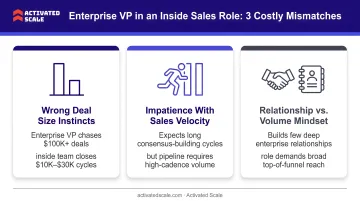
If your average deal is $50K ACV and your candidate comes from $5K ACV deals, that's a mismatch worth serious scrutiny.
Business Acumen Beyond Top-Line Revenue
Beware VPs who optimize purely for closed deals at any cost—deep discounting, poor-fit customers, or ignoring margin. The right candidate understands how sales decisions affect:
- Discounting habits that erode margin compound fast and quietly undermine unit economics
- Poor-fit customers churn early, turning revenue targets into a treadmill with no net gain
- Low-quality deals shrink your reference base and choke the expansion pipeline that drives long-term growth
Ask candidates how they've balanced velocity against deal quality in previous roles.
Ability to Operate in Startup Ambiguity
Candidates from well-resourced enterprise sales environments struggle without pre-built playbooks, marketing support, and ops infrastructure. Probe for their experience working in resource-constrained, high-ambiguity environments.
Questions that reveal this:
- "Describe a time you had to build sales collateral yourself because marketing didn't exist yet."
- "How have you closed deals when product features your customer needed didn't exist?"
- "Tell me about ramping a rep when there was no formal training program."
Vague or hypothetical answers here are disqualifying. You need someone who has already navigated this terrain, not someone who plans to figure it out at your expense.
How to Run a Rigorous VP of Sales Hiring Process
Build a Structured Evaluation Framework First
Gut-feel and unstructured interviews are terrible predictors of success. Research by Schmidt and Hunter shows resumes predict only approximately 3% of job performance variance (r = .18), while structured interviews achieve r = .51—making them approximately 2.5 times more predictive than unstructured conversations.
Before seeing any candidates, define:
- Role requirements specific to your stage and deal type
- Expected KPIs for 90 days, 6 months, and 12 months
- Non-negotiables (experience selling to your buyer persona, startup background, team-building track record)
- Evaluation scorecard with weighted criteria
Use Targeted Interview Questions That Reveal Real Capability
"How big a team do you think we need right now?" This reveals whether they understand unit economics and ramp timelines. Bad answer: "As many as you can afford." Good answer: specific math showing quota capacity, ramp periods, and hiring velocity tied to your ARR target.
"Who would join you from your last role?" This tests their talent network and leadership credibility. If they can't name 2-3 people with phone numbers, they don't have a real network.
"What will our revenues look like 120 days after you start?" This surfaces their expectations and planning instincts. Beware candidates who promise unrealistic hockey-stick growth without asking about current pipeline, ACV, or sales cycle length.
"Tell me about deals you've lost to competitors." Strong candidates dissect losses honestly and extract lessons. Weak candidates blame pricing, product gaps, or bad timing without owning their role.
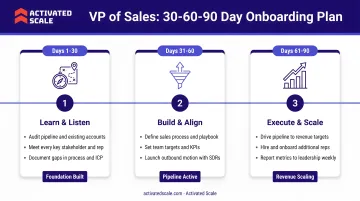
"Walk me through your 30-60-90 day plan." The answer tells you whether they can think structurally under pressure. Look for:
- Days 1-30: Learning — diagnostics, stakeholder meetings, process review
- Days 31-60: Strategizing — territory design, quota models, talent gaps
- Days 61-90: Executing — launching initiatives, forecasting, establishing reporting cadence
Involve External Validators in the Process
If your founding team lacks sales leadership experience, you're poorly positioned to evaluate a VP of Sales candidate alone. Bring in an advisor, peer CEO, or experienced operator with a sales background to ask the tough questions and see through polished presentations.
Founders often get charmed by confident storytelling. Someone who has hired a dozen sales leaders will spot inconsistencies, vague metrics, and inflated claims that first-time hiring managers miss.
Conduct Deep Reference Checks with Former Direct Reports
References from people the candidate managed reveal far more than upward references. Matrix Partners recommends 5-10 reference calls per candidate, allocating 10-15 hours total, with at least a few from direct reports.
Questions for downward references:
- "How did [candidate] handle underperformance on the team?"
- "What was their recruiting process like—how involved were they?"
- "Describe their management style under pressure."
- "Would you work for them again? Why or why not?"
Consistent negative themes across references—micromanagement, blame-shifting, poor follow-through—are disqualifiers no matter how strong the candidate's pitch.
De-Risk with Contract-to-Hire Evaluation
Contract-to-hire and fractional engagements let you evaluate a candidate against live customers and real quotas before making a permanent commitment. Activated Scale offers exactly this model — connecting startups with pre-vetted fractional sales leaders so you can test capability under real conditions, not just interview performance.
How to Compensate a Startup VP of Sales
The OTE Framework
Standard structure is 50% base salary, 50% variable tied to revenue targets. OTE at Series A/B B2B SaaS startups typically ranges from $250K to $400K, with later-stage companies reaching $500K+. The split may shift to 60/40 base-heavy as companies scale.
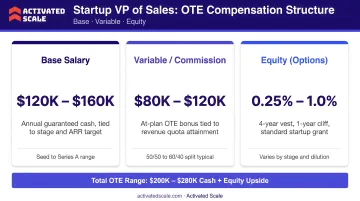
The total package must be competitive to attract talent who can drive revenue growth—lowballing OTE attracts candidates who couldn't command market rates elsewhere.
Tie Bonus to Company-Wide Revenue Goals
Align the VP's incentive to the same revenue target the whole company is chasing. This drives collaboration with marketing, customer success, and product rather than siloed deal-chasing.
Example structure:
- 100% of variable comp tied to company ARR target
- Quarterly payout schedule with annual true-up
- Clear attribution rules when revenue spans multiple quarters
Avoid complicated splits across bookings, pipeline, and activity metrics. Complexity creates confusion and misaligned behavior.
Include Meaningful Upside and Equity
Two elements separate competitive VP packages from forgettable ones:
- Above-quota acceleration: Offer uncapped or accelerated commissions above target. If the plan pays 100% of variable at quota, consider a 150% payout rate for revenue above plan — this rewards outsized performance without capping ambition.
- Equity: Early-stage equity typically ranges from 1% to 5%, vesting over four years with a one-year cliff.
At this level, equity is non-negotiable. Candidates who don't ask about it either lack confidence in your business or don't understand startup compensation norms.
Red Flags to Watch Out For When Hiring a VP of Sales
The Candidate Is Selling You, Not Showing You
Skilled salespeople run interviews like sales processes. Red flags include:
- Vague answers about team-building history ("I built a great culture")
- Inability to name specific reps they'd bring over
- Over-emphasis on personal deal wins rather than team outcomes
- Deflecting detailed questions with high-level inspirational language
Push past the pitch. Ask for names, numbers, timelines, and systems. If they can't provide operational detail, they likely don't have operational experience.
Mismatch Between Background and Your Sales Environment
Specific mismatches to watch for:
- Large company to startup: Candidates who have only sold at companies with full ops support, established brand recognition, and inbound lead flow
- Deal size mismatch: Candidates who have only closed simpler, lower-ACV deals than yours
- No early-stage experience: Candidates who joined after Series B and never built from scratch
Lemkin notes that candidates experienced at $10M-$20M ARR fail 95% of the time when placed in the $1M-$10M phase, and candidates from large SaaS companies "almost certainly fail" in early-stage roles.
Unrealistic Expectations About Resources or Timeline
Candidates who immediately demand large headcount budgets, extended ramp periods with guaranteed draws, or significant infrastructure upfront are often revealing something important: they can't operate without a safety net.
Warning signs:
- "I'll need at least six months before we see results"
- "I can't be effective without a full sales ops team in place first"
- "I need to hire 10 reps in my first quarter"
The best startup VPs close deals and build process with whatever is in front of them. No safety net required.
Frequently Asked Questions
When should I hire a VP of sales?
Hire after you've personally closed deals, validated a repeatable sales motion with at least 1-2 reps, and you're ready to scale headcount. The right timing is typically around $1M ARR, not before initial traction is proven.
What qualifications does a VP of sales need?
Look for candidates who demonstrate:
- Proven team-building experience — not just a strong personal sales record
- A track record of scaling revenue in deals matching your ACV and cycle length
- Active recruiting ability with a warm talent network
- Cross-functional leadership across marketing, ops, and customer success
Startup experience is a strong differentiator over enterprise-only backgrounds.
How much does a VP of sales make?
Total OTE varies by stage and geography. At Series A/B B2B SaaS startups, OTE typically ranges from $250K to $400K with a 50/50 base-to-variable split. Equity is a meaningful component, typically 1-5% vesting over four years with a one-year cliff.
What is the 30-60-90 rule in sales?
A 30-60-90 day plan maps what a new VP of Sales should accomplish in their first three months: learning the business (day 30), diagnosing gaps and building frameworks (day 60), and delivering early results with a reporting cadence in place (day 90). Requiring candidates to present one during interviews is standard practice.
What is the difference between a VP of Sales and a CRO?
A VP of Sales owns the sales team and pipeline execution. A CRO is a C-level role with broader accountability across sales, marketing, and customer success. Most early-stage startups start with a VP and evolve into a CRO structure as they scale past $20M ARR.
What are the biggest red flags when hiring a VP of Sales?
Watch for these warning signs:
- Can't name specific reps they'd recruit immediately
- Vague about past team-building with no operational detail
- Overemphasizes personal closes over team outcomes
- Background mismatched to your deal size, complexity, or stage
Candidates from large enterprises with no startup experience — or those used to selling very different deal sizes — are high-risk hires.