Most founders treat this hire like any other. It isn't. At the seed stage, you have no brand recognition, no inbound engine, no SDR team, and no margin for error. The wrong person in this seat doesn't underperform quietly — they burn through your most qualified prospects while you're watching.
This guide covers exactly what seed founders need: readiness signals, the right candidate profile, how to run the process, what to pay, and when fractional sales talent is the smarter starting point.
Key Takeaways
- Validate your own sales motion before hiring; you can't coach what you haven't closed
- Prioritize startup experience over brand-name logos; enterprise reps often can't perform without infrastructure
- Your first hire must be a full-cycle closer: prospect, demo, negotiate, and close without SDR support
- Keep comp simple — base plus performance pay, with equity as a long-term alignment tool
- Unsure of your ICP or ACV? A fractional sales pro lets you build the playbook before committing to a full-time hire
Signs You're Ready to Hire Your First Salesperson
Founder-Led Sales Comes First
Before you hire anyone, you need to have closed deals yourself — not just through warm intros from your network, but from cold outreach. Y Combinator's Pete Koomen puts it plainly: "If you aren't able to sell your product yourself at first, chances are you're not going to be able to hire somebody else to do it for you."
Founder-led sales is how you map the motion — which objections surface, which pain points land, how long the cycle takes, and what kind of buyer closes fastest. You cannot hand that knowledge off without earning it yourself.
SaaStr advises founders to close at least 10–20 customers themselves before bringing in a rep. Some go further. Pilot's co-founder Waseem Daher was the entire sales team for the first year, reaching roughly 60 customers and $250K ARR before making his first sales hire.
Three Concrete Readiness Signals
You're ready to hire when:
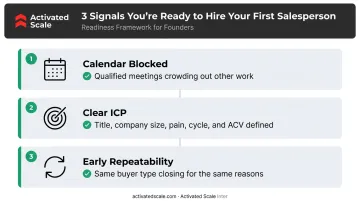
- Your calendar is blocking other work. Qualified meetings are crowding out product, hiring, and fundraising. Your time — not the market — has become the bottleneck
- You can describe your ICP precisely. You know the title, company size, pain point, typical sales cycle length, and average contract value — because these directly determine which type of rep you need
- You have early repeatability. One or two lucky closes aren't a pattern. You should see at least the start of a trend — the same type of buyer, buying for the same reasons
AE First, Not VP of Sales
A VP of Sales builds systems, hires teams, and manages a pipeline org. At seed stage, that structure doesn't exist yet. What you need is a full-cycle Account Executive — someone who can generate pipeline from cold, run their own demos, and close without anyone handing them leads.
Hiring a VP too early regularly derails seed-stage companies. SaaStr notes that the majority of first-time VPs of Sales don't survive past 12 months — and a failed VP hire can set you back a full year of recovery time.
The Ideal Profile for a Seed-Stage Sales Hire
Why Startup Experience Is Non-Negotiable
Candidates from large enterprises have had brand recognition, warm inbound queues, SDR teams generating qualified meetings, and support infrastructure on every side. At your seed startup, none of that exists.
That enterprise track record may not transfer. A rep who has only worked at Salesforce or Oracle knows how to run plays in a fully built machine — they often struggle when there's no playbook, no recognized brand, and no one handing them meetings.
OnStartups identifies hiring a senior leader as the number-one mistake founders make — the first hire needs to be someone willing to roll up their sleeves, operate without structure, and lay the foundation of your sales process themselves.
Look for candidates who have sold products with minimal brand recognition and had to work hard to build pipeline from zero.
What Full-Cycle Selling Actually Means
At this stage, you can't afford someone who only closes. Your first AE needs to:
- Prospect cold via email, phone, and LinkedIn without SDR support
- Run discovery calls and demos independently
- Handle objections they've never heard before
- Negotiate and close without escalating to a manager
Push for demonstrated evidence, not just claims. Find out where they ranked against peer reps, then walk through a specific deal: where the lead came from, what their role was, and how they handled a setback along the way.
Character Traits That Outweigh Pedigree
The traits that predict success at a seed startup aren't on a resume:
- Eyes that light up when you describe the founding story (mission matters to them)
- Comfortable operating without tools, structure, or a clear process
- Curious about buyers and the problems they're trying to solve — not just closing the deal
- Able to absorb rejection and keep going in an ambiguous, evolving environment
The Two-Hire Strategy
If budget allows, hire two reps simultaneously. When you hire only one, any underperformance creates an unanswerable question: is this a people problem or a product/market problem?
Two reps in parallel lets you separate those variables. SaaStr notes that most companies aren't ready for a real VP of Sales until at least two reps are consistently hitting quota, so starting with two makes that milestone reachable faster.
Screen out: candidates who have only worked warm inbound queues, those who need heavy management to self-direct, and anyone treating sales as a career ladder rather than a craft they want to get good at.
Running the Hiring Process from Search to Signed Offer
Where to Find Your First Sales Hire
Your first sales hire is unlikely to be browsing job boards. The best sources:
- Investor networks — ask explicitly; investors have placed reps before and want their portfolio companies to succeed
- Founder communities — Slack groups, YC forums, and startup networks surface warm referrals
- Current customers — someone who already bought your product may know reps in their network who'd be excited about it
Arm your investors with a one-page brief: your ICP, ACV, sales cycle, and what you're looking for in a rep. Make it easy for them to refer.
A Practical Screening Sequence
Define your evaluation stages before you post the role. A seed-stage process that works:
- 30-minute discovery call — assess communication style, early-stage appetite, and baseline curiosity about your product
- Mock sales exercise — have them sell your product back to you cold, with minimal prep
- Panel conversation — bring in a co-founder or investor to weigh in on judgment and cultural fit
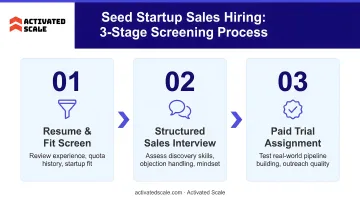
OpenView's research found that the top two predictors of new hire performance are structured interviews and a work sample test — which is exactly what the mock exercise provides.
How to Evaluate the Mock Sales Exercise
This is the most revealing step in the process. Watch for:
- Do they ask discovery questions before pitching, or do they jump straight to features?
- How do they handle an objection they haven't heard before?
- Do they adapt when their pitch isn't landing, or do they keep pushing?
Green flags:
- Asks questions before pitching
- Stays calm and adjusts when challenged
- Listens as much as they talk
Red flags:
- Runs a rehearsed script regardless of your responses
- Gets defensive when pushed back on
- Can't pivot when the prospect goes quiet
Reference Checks Are Non-Negotiable
Salespeople are skilled at selling themselves. Always conduct at least three reference calls — with former managers, not just peers. Ask:
- What was their quota, and where did they rank against peers?
- How did they handle rejection or a cold streak?
- Would you rehire them?
A former manager who hesitates before answering that last question is telling you something. An enthusiastic "absolutely, without question" means something different than "yeah, probably."
Compensation That Attracts Without Overcomplicating
Base Plus Variable Pay: Keep It Simple
Don't copy compensation structures from companies with mature sales orgs. Complex quota tiers and SPIFFs create confusion when there's no established baseline.
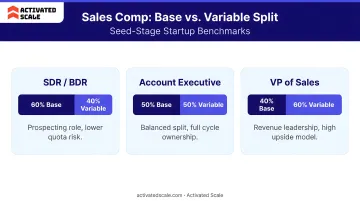
The Bridge Group's 2024 SaaS AE Benchmark Report shows median AE OTE at $190K with a roughly 53:47 base-to-variable split. Betts' 2024 data puts AEs in major metro markets (0–3 years experience) at $90K base / $180K OTE, with remote roles at $80K base / $160K OTE.
At seed stage, you'll likely land below these numbers — and that's fine. The goal is being competitive enough to attract someone who's betting on themselves, not just chasing stability.
Variable Component Design
How you structure the variable component sends a signal. Done right, it attracts candidates who back themselves to close — not ones hedging toward a safe paycheck.
A few considerations:
- 50/50 base-to-variable attracts high-performers comfortable with risk; it's also the most common structure at early-stage
- 70/30 offers more stability and may work better if your sales cycle exceeds 90 days
- Avoid paying full incentive upfront on annual deals if early churn or implementation failure is a real risk
Equity as an Alignment Tool
For seed-stage hires, equity isn't optional — it's part of the conversation. SaaStr suggests an early Head of Sales might receive 0.5%–1.5%. A first AE will typically receive less, but a meaningful grant signals they're joining a company worth owning a piece of.
Be upfront about your funding stage, runway, and vesting schedule. Candidates who ask sharp questions about these details are usually the ones worth hiring.
Common Mistakes to Avoid When Making Your First Sales Hire
Hiring for Pedigree Over Adaptability
Impressive logos don't guarantee startup survival. Ask directly: "Tell me about a time you built pipeline from zero with no brand recognition." If they can't give a specific answer, the logo on their resume doesn't matter.
Moving Too Fast Under Revenue Pressure
Urgency is the enemy of quality. A bad sales hire at a startup can cost 3–5x their salary when you account for lost deals, damaged relationships, and ramp time for a replacement. That said, don't over-deliberate on a candidate who checks every box — top sales talent moves fast and will accept other offers.
Skipping the Success Definition Step
If you can't articulate what good looks like at 30, 60, and 90 days before someone starts, you'll struggle to evaluate them. They'll also struggle to self-direct without clear targets.
Document ramp expectations, first milestone targets, and pipeline goals before day one. This isn't bureaucracy — it's how you set both sides up to win in month two.
The Fractional Sales Option: A Lower-Risk Starting Point
When Fractional Makes Sense
If your ICP isn't fully locked in, your ACV is still shifting, or you simply can't risk the cash burn of a full-time mis-hire, a fractional salesperson lets you run real pipeline and test your sales motion without the full commitment.
First Round describes fractional executives as part-time leaders who provide "horsepower and management muscle" without a long-term commitment — and crucially, that the evaluation process should be "much more trial-based than interview-based." That principle applies directly to fractional sales reps.
Fractional engagements typically run 15–20 hours per week on a contract basis, with a clear option to convert to full-time once performance is validated.
How Activated Scale Works for Seed Founders
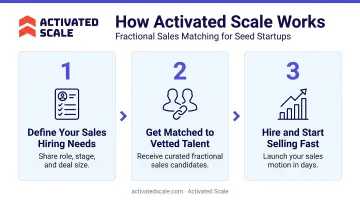
Activated Scale connects seed-to-Series A B2B SaaS startups with vetted fractional sales professionals (many with backgrounds at Salesforce, Oracle, Zendesk, and IBM) who can start within 7 days. The try-before-you-buy model, with a contract-to-hire option, means you validate sales fit before committing to a full-time hire.
The process is straightforward:
- 30-minute strategy call to align on your ICP, ACV, and goals
- Matching within 7 days with 2–4 vetted candidates from a network of 300+ pre-screened professionals (sometimes in as little as 48 hours)
- 3-month initial contract with defined KPIs. If the rep hits their targets, converting to full-time is the natural next step.
Clients using fractional AEs through Activated Scale have reported winning $50,000–$250,000 in net new revenue per month. Dresma.ai achieved a 5x increase in qualified meetings. Around 85% of startups on the platform convert their fractional rep to full-time after the initial contract period.
That conversion rate reflects a core advantage: you're not guessing on culture fit or ramp time. You've already seen the rep work your pipeline.
Fractional vs. Full-Time: How to Decide
| Situation | Recommendation |
|---|---|
| ICP is clear, wins are repeatable, budget supports full OTE | Hire a full-time AE directly |
| ICP still evolving, ACV fluctuating, or first sales hire | Start fractional, build the playbook, convert when ready |
| Need pipeline immediately but can't risk a 6-month ramp | Fractional AE with contract-to-hire option |
| Need to test outbound motion before scaling | Fractional SDR for 90 days |
Frequently Asked Questions
When is a seed startup ready to hire its first salesperson?
When the founder has personally closed deals from cold outreach (not just warm intros), can articulate a clear and repeatable ICP, and qualified meetings are crowding out other priorities. Aim for 10–20 founder-closed customers before handing off the motion.
Should I hire a VP of Sales or an Account Executive first at the seed stage?
Almost always an AE. A VP needs a team to lead and systems to manage — neither exists yet. Your first hire should be a full-cycle doer who can prospect cold and close independently without needing infrastructure around them.
What traits matter most in a first sales hire for a startup?
Startup experience (not just brand-name logos), demonstrated full-cycle selling ability, genuine mission passion, and resourcefulness in unstructured environments. These traits outperform pedigree at the seed stage.
How much should I pay my first salesperson at a seed startup?
Research market OTE for your ACV tier and geography, then keep the structure simple: base plus performance pay. Betts' 2024 data shows remote AEs at roughly $80K base / $160K OTE — add equity to align long-term incentives.
What is fractional sales and does it make sense for a seed startup?
A fractional sales rep works part-time on a contract basis — typically 15–20 hours per week — running real pipeline without the overhead of a full-time hire. It's a strong fit when your ICP is still evolving or you want to validate your sales motion first; marketplaces like Activated Scale let founders access vetted fractional AEs in under a week.
What are the biggest mistakes founders make when hiring their first salesperson?
The same mistakes surface repeatedly: prioritizing brand-name résumés over startup adaptability, moving too fast under revenue pressure, and never defining what success looks like before day one. Each one is avoidable — but only if you slow down before you post the role.