Introduction
Few decisions carry more weight at the early stage than your first sales hire. Get it wrong and you don't just waste a salary — you burn your best leads, hand off an unvalidated sales process to someone who can't execute it, and potentially set your company back a full year.
SaaStr reports that roughly 8 out of 10 first VP of Sales hires at startups fail, with failed hires averaging about 11 months before everyone admits it isn't working.
Most founders make one of two mistakes: they hire too early, before they can articulate a repeatable sales motion, or they copy advice from posts written for companies at a completely different stage.
Both mistakes are avoidable. This guide covers the four things that matter — knowing when you're ready, choosing the right seniority level, screening for the right profile, and setting your hire up to succeed.
Key Takeaways
- Only hire after you've personally closed 10–20 customers and can describe a typical deal from first call to close.
- The right first hire is rarely a VP of Sales or a junior SDR — hire a senior individual contributor who can both close and build process.
- Screen for startup-specific traits: product curiosity, extreme ownership, and comfort with ambiguity over resume polish.
- Not ready to commit full-time? A fractional or contract-to-hire model lets you validate fit before locking in.
How to Know You're Ready to Hire Your First Salesperson
Sell Before You Hire
Founders must sell before they hire. SaaStr recommends founders personally close the first 10, 20, or even 100 customers before transitioning sales to dedicated hires. The reason is practical: you can't hand someone a process that only exists in your head.
During founder-led sales, you learn which objections come up on every call, what your ICP actually looks like in practice, and how long deals really take.
Without that knowledge, you're not hiring a salesperson. You're hiring someone to figure out your sales motion for you, using your best leads as their test cases.
Readiness Signals Worth Tracking
Before you post the job, ask yourself these questions honestly:
- Have you personally closed at least 10–20 paying customers?
- Can you describe a typical deal in terms of steps, key objections, and timeline?
- Are most of your recent deals following a similar pattern, or does every one look different?
- Could someone else follow your steps and get the same result?
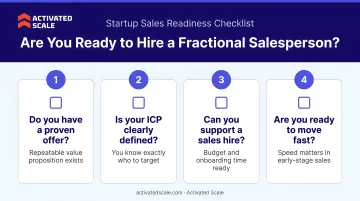
If the answer to that last question is no, a sales hire will struggle regardless of their background.
Operational Triggers That Say "Now"
Beyond readiness, watch for capacity signals:
- Your demo calendar is overloaded and deals are slipping through follow-up gaps
- You're losing deals not because of fit or price, but because you don't have time to respond
- Product development is suffering because sales is consuming your week
These are the signs that the constraint is capacity, not process. That's the right time to hire.
One caveat on lead volume: a closer needs qualified leads to close. If your weekly inbound is thin, the investment in a senior AE may be premature — a demand gen hire or fractional SDR might need to come first.
Who Should Your First Sales Hire Be?
The Two Most Common Failure Modes
Most founders either hire too junior or too senior, and both extremes are costly at the early stage.
Too junior (an entry-level AE or SDR): They need a functioning system — a CRM, playbook, and established lead flow — to operate effectively. At the seed stage, that infrastructure doesn't exist yet, and a junior hire won't build it.
Too senior (a VP of Sales): According to SaaStr, a VP's job is to scale what's already working — taking 2 reps to 20, not building a motion from zero. Hire a VP before you have repeatable rep performance and you've given them nothing to scale. Jason Lemkin is explicit: never hire a VP of Sales until at least two individual reps are genuinely closing and hitting quota.
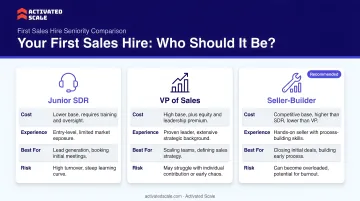
The Middle Path: A Seller-Builder
The right first hire is a senior individual contributor or Director-level rep who can do both: carry a bag and close deals today, while also building the sales process you'll hand to future hires.
A16z recommends exactly this profile for early-market companies — someone who finds strategically aligned customers, not just someone who executes a defined pitch. SaaStr calls this person a "Sales Magician": product-fluent, high-EQ, and comfortable operating without a playbook rather than relying on one.
Title matters less than function. Call them a Founding AE, Head of Sales, or Director — what counts is that they're closing deals on day one.
Hire Two, Not One
SaaStr's advice on this is underrated: hire two first reps, not one. With a single rep, you can't tell whether success or failure is caused by the person, the product, the process, or the market. Two reps give you an A/B comparison and redundancy if one doesn't work out.
When Fractional Makes Sense
Not every founder is ready to commit to a full-time hire. If you still need to validate your sales motion or don't have enough consistent lead volume to keep a full-time closer busy, a fractional sales professional is a lower-risk way to generate revenue while you figure it out.
Activated Scale connects early-stage startups with pre-vetted fractional SDRs, AEs, and sales leaders on a contract-to-hire basis. Professionals come with backgrounds at companies like Salesforce, Oracle, and Zendesk. Engagements typically start with a three-month contract, and roughly 85% of clients convert their fractional hire to full-time after seeing results — giving founders a way to run a real sales motion before committing to a permanent headcount.
What to Look for in Your First Sales Hire
Startup Experience Is Non-Negotiable
A rep who built their career at a large enterprise is accustomed to a refined CRM, established brand, and pre-existing lead flow. None of that exists at the early stage. SaaStr puts it bluntly: even Presidents Club-level reps can "melt and fail" as first reps if they lack founder-level passion and product fluency.
Screen for candidates who have sold at a similar-stage company — and specifically, who have won deals without brand recognition or marketing support. That experience is irreplaceable.
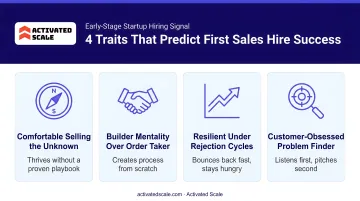
The Behavioral Traits That Actually Predict Success
Beyond experience, look for:
- Product curiosity — Do they ask sharp, substantive questions about your product in the interview? First reps have to sell on product fluency when brand and collateral aren't there yet.
- Extreme ownership — Do they take responsibility for past losses, or do they blame the territory, the CRM, or the marketing team?
- Adaptability — Can they talk coherently about pivoting mid-quarter when priorities shifted? Early-stage is nothing but shifting priorities.
- Price-point match — Have they closed deals at your ACV? Someone who's only sold $500K enterprise contracts will approach a $25K SMB deal very differently.
The "Would You Buy From Them?" Test
Jason Lemkin's test for first hires is simple: your first AEs have to be people you'd buy from. If you hesitate when you ask yourself that question, move on. Your leads at this stage are too valuable to hand to someone you'd have doubts about.
Don't rely solely on interviews. Assign a take-home exercise and watch how they approach it:
- Prepare a discovery call outline for a sample prospect
- Write a cold outreach sequence targeting your ICP
- Respond to a common objection in writing
A rep who does the work, asks a clarifying question before submitting, and presents a structured response is showing you exactly how they'll operate in the role.
Common Mistakes to Avoid
Hiring Before the Process Is Documented
If your sales motion only exists in your head, no one can replicate it. Before your hire starts, write down:
- The demo flow, step by step
- Key objections and how you handle them
- Your follow-up cadence
- Who your ICP actually is
This doesn't need to be a 50-page playbook — it needs to be enough for a new hire to follow on their first call.
Confusing Seniority With Startup Fit
A VP title from a 2,000-person company tells you very little about whether someone can sell your product to 10 prospects this month. What matters is what they actually did in their last two roles — were they personally closing deals, or were they managing and strategizing? Verify this with references. Two calls minimum.
The "Set It and Forget It" Mistake
Founders who hand off sales and step away are one of the top reasons first hires fail — not because the person was wrong, but because onboarding was neglected. Your new hire needs your context: why customers buy, what objections come up, which deals have been hardest and why.
Poor sales onboarding can create $50,000–$200,000 in foregone revenue per month for each underperforming rep, according to First Round Review. Neglecting it isn't an admin oversight — it's a direct hit to revenue.
How to Set Your First Sales Hire Up for Success
The First 30–60 Days Matter Most
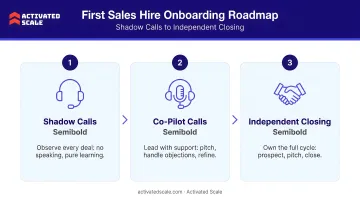
Structure the onboarding deliberately:
- Days 1–15: Shadow calls. Your new hire watches you run deals, not the other way around. They learn your language, your objections, your close.
- Days 15–30: Mock calls with you observing and giving direct feedback after each one.
- Days 30–60: They carry calls while you observe, then debrief. Document what works and why — this becomes your first sales playbook.
Set Ramp Expectations in Writing
SaaStr's guidance on AE ramp goes beyond a simple 90-day rule: expect a new AE to close something within 0.5–1.5 sales cycles. If they haven't put anything on the board within one full cycle, that's a signal worth acting on.
Define what success looks like at 30, 60, and 90 days before they start. Shared expectations prevent misalignment and make performance conversations far cleaner.
Give Them Tools Before Day One
Have these ready before the hire starts:
- A CRM (even HubSpot free tier works)
- A written ICP with firmographic and behavioral criteria
- Messaging guidelines and a positioning doc
- A documented demo flow with common objection responses
The less infrastructure you have in place, the more you're relying on your hire to build everything from scratch — and that only works if you've hired someone who has built a sales process from the ground up before.
Frequently Asked Questions
When should a startup founder stop doing founder-led sales and make their first sales hire?
When you've personally closed 10–20 customers, can describe a repeatable deal flow, and are losing deals specifically because of capacity — not because the process is unclear. If demo follow-up is slipping and your calendar is maxed out, it's time.
Should my first sales hire be a VP of Sales or an Account Executive?
Neither extreme is usually right. Hire a senior IC or Director-level rep who can close deals immediately and build process from scratch. A VP makes sense only once you have at least two reps hitting quota consistently and the budget to hire additional reps to support them.
How much equity should I offer my first sales hire?
SaaStr notes VP of Sales equity can range from 1%–5% depending on experience and stage, but individual contributor grants are lower. Benchmark with other founders at your stage, your investors, or a recruiting partner like Activated Scale who tracks current placement data across deal sizes and role scopes — equity ranges shift quickly and vary by deal size and role scope.
What is the biggest mistake founders make when hiring their first salesperson?
Two mistakes tied for first: hiring before the sales process is documented, and hiring someone they wouldn't buy their own product from. Both are common, both are costly, and both are avoidable with preparation.
How long does it take for a first sales hire to ramp up?
Ramp varies from 3–12 months depending on deal complexity, onboarding quality, and how documented your process is at the start. A useful benchmark: a new AE should close at least one deal within one full sales cycle. Clear 30/60/90-day milestones set on day one keep expectations aligned on both sides.
What if I'm not ready for a full-time sales hire yet?
A fractional or contract-to-hire arrangement is worth considering. Activated Scale places pre-vetted fractional AEs and SDRs on three-month contracts, so founders can validate fit and results before committing. Roughly 85% of clients convert to full-time — a lower-risk path to building a permanent sales team.