
Introduction
Building a sales team ranks among the most consequential decisions a B2B startup founder makes — and most approach it without a structured process. The result? Costly misfires that stall revenue right when momentum matters most.
The numbers are sobering. According to DePaul University's Sales Effectiveness survey, replacing a single salesperson costs an average of $97,690 — and that's before accounting for lost pipeline, burned relationships, and the three to five months it takes to fill the seat again.
Those costs don't accumulate because founders pick the wrong candidate. They accumulate because the work that should happen before posting a job description gets skipped entirely.
This playbook walks through each stage of that process: defining the role, building an evaluation scorecard, running interviews that surface real sales ability, and structuring onboarding for fast ramp-up. Work through these steps in order, and you'll make sales hires you can stand behind.
Key Takeaways
- Define specific tasks the role must own before writing a job description — seniority level should match a two-year horizon, not a ten-year vision
- Build a weighted scorecard so every interviewer evaluates the same criteria, not personal impressions
- Probe behind stated metrics in interviews — genuine performers know their numbers cold
- Two or more red flags in a single interview should disqualify a candidate, regardless of how strong they look on paper
- Structured onboarding cuts average ramp time from 9.1 months to 5.7 months
Why Most Sales Hires Fail (and What a Playbook Changes)
Two mistakes account for the majority of failed sales hires at early-stage startups.
Mistake 1: Overweighting industry experience over sales competence. A candidate who spent five years in your vertical but can't reconstruct their pipeline metrics or describe a structured sales process is not a strong hire. Domain knowledge accelerates ramp time — it doesn't replace selling ability.
Mistake 2: Hiring for the company you want, not the one you have. Bringing a VP-level leader into a $3M ARR startup often produces over-engineered processes, mismatched expectations, and an expensive exit within a year. SaaStr reports that roughly eight out of ten first VP of Sales hires at startups fail, averaging about 11 months before departure. The role that fits a $50M company is a completely different job than the one that fits a $5M company.
Why Unstructured Interviews Make This Worse
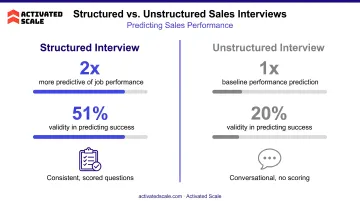
Generic interview questions — "Where do you see yourself in five years?" or "What's your biggest weakness?" — measure interview preparation, not sales talent. Decisions made on gut feeling lead to hires who perform brilliantly in the room and collapse in month three.
A meta-analysis of 86,311 individuals across 245 studies found structured interviews consistently outperform unstructured ones for predicting job performance. Google's re:Work program confirms they also reduce demographic bias by standardizing evaluation criteria.
A sales hiring playbook addresses both problems directly. It replaces gut-driven decisions with defined criteria, standardized scoring, and a process that produces consistent results — regardless of who's running the interview.
Step 1: Define the Sales Role Before You Post a Job Description
The biggest leverage point in sales hiring happens before the first interview: it's the clarity of thought that goes into defining the role.
Start With Tasks, Not Titles
Before writing a job description, list the specific tasks this person must own in the next 12–24 months. Be concrete:
- Outbound prospecting and pipeline generation
- Full-cycle closing from demo to contract
- Discovery process design and documentation
- Coaching and managing junior reps
- Territory prioritization and account mapping
Rank these by what the business genuinely needs to reach its next stage. A title without this list produces a job description that attracts the wrong candidates.
Match Seniority to Your Current Stage
Founders often hire ahead of where their company actually is. A VP who thrived at a $100M ARR company brings expectations, process preferences, and compensation requirements that a $3M ARR startup cannot support or absorb.
According to SaaStr's guidance on management team sequencing, the first VP of Sales belongs around $1M–$1.5M ARR — and only after at least two reps are consistently hitting quota. Hiring before that signal exists is hiring before you know what "good" looks like in your environment.
Validate the Role Before Committing Full-Time
For early-stage startups without an established sales motion, a fractional or contract-to-hire salesperson gives founders a way to test the role's scope and evaluate rep performance before making a permanent commitment.
Activated Scale's contract-to-hire model runs on a typical three-month engagement, during which both parties evaluate sales performance in the actual environment and cultural fit.
The model is structured around a clear statement of work and defined KPIs from day one, so the conversion decision gets made on evidence rather than gut feel. About 60% of clients converted their fractional hire to a full-time employee after the initial contract period in 2024.
What a Complete Role Definition Should Include
- Key tasks ranked by priority for the next 24 months
- Must-have vs. nice-to-have experience (keep the list short)
- Stage-appropriate seniority expectations
- ICP and average deal size the rep will work
- KPIs for the first 90 days, defined in hard numbers
Step 2: Build a Sales Hiring Scorecard
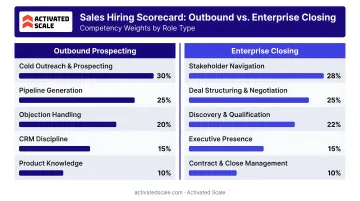
A scorecard is a structured document that translates role requirements into scorable criteria. Every interviewer evaluates every candidate against the same framework — not their personal read of the room.
Core Competency Categories
Weight these based on what the role actually requires:
| Competency | Weight for Outbound Role | Weight for Enterprise Closing Role |
|---|---|---|
| Pipeline generation / prospecting | High | Medium |
| Sales methodology knowledge | Medium | High |
| Coachability | High | High |
| Ownership mindset | High | High |
| Stakeholder management | Low | High |
| Quota attainment history | Medium | High |
CSO Insights found that sales process adoption above 90% corresponded to 72.4% quota attainment and 57.8% win rates — methodology isn't a soft skill, it's a performance driver.
Experience Filters to Apply at Screening
Identify five non-negotiable signals before candidates reach the interview stage. For most B2B SaaS roles, these include:
- Has carried a quota of a relevant size (and can describe exactly how it was structured)
- Has sold to a similar buyer profile (CIO, VP HR, CMO — whichever matches your ICP)
- Has operated in a high-rejection outbound environment
- Can name the average deal size they closed and how it relates to yours
- Has worked in a comparable sales cycle length
Activated Scale applies this same logic when matching fractional sales professionals to clients — screening specifically for prior experience with the client's ICP and ACV so the rep hits the ground selling, not learning.
Score First, Then Discuss
After each interview, every interviewer submits numerical scores before any group debrief. This prevents the first strong opinion in the room from anchoring everyone else. Skip this step and you risk groupthink: whoever speaks first shapes the hire.
Step 3: Run a Structured Interview Process That Reveals True Sales DNA
The interview process has one job: separate polished storytellers from actual performers. Four phases accomplish this.
Phase 1: CV Validation and Metrics Deep-Dive
Don't accept stated numbers at face value. When a candidate says they "hit 200% of quota," go deeper:
- What was the quota in dollar terms?
- What was their average deal size?
- How many calls and emails per week did they run?
- What was their conversion rate from first call to close?
- What tools tracked all of this?
Genuine high performers know these numbers without hesitation. Candidates who padded their resume cannot reconstruct the detail.
Phase 2: Scenario-Based Questions
These reveal how a candidate thinks under realistic pressure, not just what they've done before. Strong examples:
- "You have 500 accounts in your territory. Walk me through how you prioritize."
- "Your buyer's budget was just cut 50% in the final stage. What are your next steps?"
- "You've had no responses from an account for three weeks. What do you do?"
Look for structured reasoning. The specific answer matters less than whether there's a process behind it.
Phase 3: Ownership and Coachability Assessment
Ask for a specific example of something that went wrong that wasn't the candidate's fault, and what they did about it.
- Green flag: Takes ownership, describes what they changed, explains what they'd do differently
- Red flag: Blames the product, market conditions, or their manager — with no reflection
Follow with: "When were you last wrong about something important in your sales approach, and what changed as a result?" Coachability isn't a personality trait you can infer — you have to test it directly.
Phase 4: The Presentation Round
Ask the top two or three finalists to prepare a relevant deliverable: a 90-day ramp plan, a mock discovery call framework, or a territory prioritization approach.
Evaluate two things equally: the quality of the output and the quality of their process. Specifically, watch for:
- Whether they asked clarifying questions before starting
- Whether they researched your company, market, or ICP independently
- How they explained their reasoning, not just their conclusions
Candidates who treat the exercise like a real engagement — asking questions, doing homework — are showing you exactly how they'll approach your prospects.
Red Flags and Green Flags to Watch For in Sales Candidates
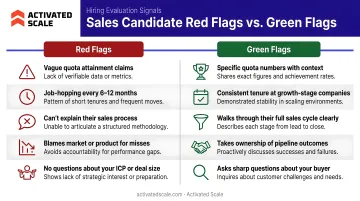
Red Flags That Predict Failure
- Vague or inconsistent metrics — can't reconstruct deal specifics when pressed
- Exclusive use of "we" language when describing wins, never "I"
- No describable personal sales process — just intuition and relationships
- Blames market conditions, product gaps, or management for missed targets
- Cannot articulate a specific failure with detail and reflection
The Pavilion/Ebsta 2025 GTM Benchmarks report found that 14% of sellers drive 80% of revenue growth, and top performers spend nearly 50% of their day actively engaging customers compared to the 21% average. Candidates who mirror that top-performer profile make it obvious in how they talk about their work — concrete numbers, clear process, no hedging.
Green Flags That Signal High Potential
- Uses specific numbers unprompted — call volumes, conversion rates, deal sizes
- Describes a clear, repeatable personal sales process they can articulate in steps
- Talks about losses with the same specificity as wins
- Arrived at the interview having researched your product, ICP, and competitive landscape
- Shows evidence of resilience — periods of low performance followed by specific course corrections
How to Apply This Within the Scorecard
Once you've spotted signals on both sides, the scorecard is where those signals become decisions. If two or more red flags appear in a single interview, treat that as a disqualifier — even if the candidate looks strong on paper or the founder chemistry is high. Gut feel is exactly what the scorecard is designed to override.
Onboarding Your New Sales Hire for Fast Ramp-Up
A strong hire with a weak onboarding structure will still underperform. The data on this is consistent: the Sales Management Association found that highly structured onboarding reduced average ramp time from 9.1 months to 5.7 months. Companies effective at onboarding also achieved 10% higher sales growth and 14% better achievement of sales and profit objectives.
The Core Onboarding Framework
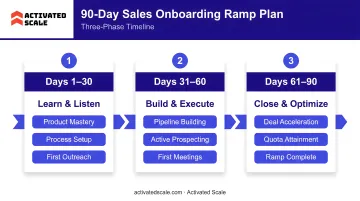
Structure the first 90 days around clear milestones:
Days 1–15: Immersion
- Product and ICP education
- Review of existing discovery and objection-handling framework
- Shadow calls with the founder or senior team member
- CRM access, tools setup, and messaging audit
Days 16–45: Execution Begins
- Outbound outreach launches (email, phone, LinkedIn)
- Iterates on messaging with founder feedback
- Carries a reduced ramp quota — enough to build competency without overwhelming
Days 46–90: Full Ramp
- Owns pipeline independently
- Hits defined pipeline coverage target
- Can run discovery calls without founder involvement
Protect the Investment with Weekly Check-ins
Weekly structured reviews against the 30-60-90 scorecard serve three purposes:
- Catch bad habits before they calcify
- Reinforce good behaviors while they're still forming
- Give the new hire a concrete picture of what success looks like from week one
One practical note: the Sales Management Association found that between one-third and one-half of salespeople lacked proficiency in 12 core selling skills even after initial onboarding. The biggest gaps were reengaging stalled deals (49% proficiency) and closing (54%). Build targeted reinforcement into weeks six through twelve, not just week one.
Frequently Asked Questions
What is the biggest mistake founders make when hiring their first salesperson?
Overweighting industry background over demonstrated sales competence, and hiring for a company stage they haven't reached yet. A VP-level hire at $3M ARR typically produces process overhead and cultural friction rather than revenue.
How do you know when it's the right time to hire your first sales rep?
The clearest signal is when the founder has personally closed enough deals — SaaStr suggests 10–20 customers — to articulate the ICP, value proposition, and sales motion clearly enough to train someone else. Without that foundation, there's nothing concrete to hand off.
What should a sales hiring scorecard include?
Three core components:
- Role-specific competencies weighted by priority (prospecting vs. closing vs. coaching)
- Five non-negotiable experience filters applied at the screening stage
- A numeric scoring system every interviewer completes before any group discussion
How do you evaluate a salesperson's real performance during an interview?
Probe behind stated metrics. Ask what the quota was in dollars, what the average deal size was, what the call volume looked like, and what the conversion rate was at each stage. Genuine performers reconstruct those specifics without hesitation — candidates inflating their numbers can't.
What red flags should immediately disqualify a sales candidate?
Inability to give specific metrics, using "we" exclusively when describing wins, blaming external factors for missed targets, and no describable sales process. When two or more of these appear in a single interview, disqualify — regardless of first impressions.
How long should it take to fully ramp a new sales hire?
It varies by deal complexity and ACV. SaaStr benchmarks suggest 3–6 months for SaaS deals in the $20K–$80K ACV range, and around 60 days for SMB deals under $10K. Of the factors you can actually influence, structured onboarding (a defined 30/60/90-day plan) and weekly call coaching move the needle most.