

Introduction
Hiring a sales leader is one of the highest-stakes decisions a B2B SaaS founder makes—and one of the most commonly botched. As Jason Lemkin has noted on SaaStr, the majority of first VP of Sales hires don't survive 12 months. That's not a minor setback. A bad hire at this level means a lost year, declining close rates, no strong team members added, and revenue that stalls when it should be compounding.
Why does this keep happening? Most founders start the search before they've defined what they actually need. They confuse a strong individual sales record with leadership ability. They hire on gut and urgency. The result: someone who crushed quota at a 2,000-person company can't build a pipeline from scratch.
This guide gives you a practical, founder-focused framework for defining the role before you search, finding the right candidates, and evaluating them beyond charisma or pedigree.
Key Takeaways
- The best sales leaders combine strategic vision, coaching ability, and adaptability—not just a history of closing deals
- Define success criteria (30/60/90-day outcomes) before you post the role, not after you meet a candidate you like
- Structured behavioral interviews dramatically outperform gut-feel conversations for predicting actual job performance
- 70% of the global workforce is passive talent, so build your pipeline before you have a vacancy, not after
- For early-stage companies, a fractional or contract-to-hire model lets you validate fit before making a full-time commitment
What Defines an Effective Sales Leader
The most common mis-hire pattern in early-stage SaaS is straightforward: founder promotes or recruits the best seller they know. That person was excellent at closing. They are not excellent at leading. These are different jobs.
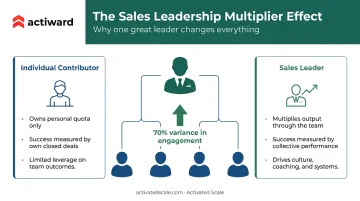
A great individual contributor optimizes their own output. A great sales leader multiplies everyone else's. That shift—from personal production to team production—is where most failed hires break down.
Strategic Vision and GTM Thinking
An effective sales leader doesn't just run plays. They design them.
At the early stage, this means identifying the right sales motion for your current product and market, building territory and quota frameworks from scratch, and connecting sales strategy to broader business objectives. Most importantly, they need to decide which motion to pursue—outbound, inbound, channel, PLG-assisted—rather than defaulting to what worked at their last company.
The distinction worth understanding: a playbook executor knows how to run an established process. A playbook builder creates one where none exists. Early-stage companies need the latter. Hiring someone who thrived inside a mature, well-resourced sales org and expecting them to build from scratch is a mismatch that surfaces within the first 60 days as missed ramp targets and frustrated reps.
Coaching, Team Development, and Culture
The multiplier effect of a great sales leader comes through the team they build—not the deals they close personally.
Strong coaching ability shows up in specific ways:
- Giving direct, honest feedback without making it personal
- Running structured one-on-ones that actually improve rep performance
- Diagnosing why a rep is underperforming before deciding what to do about it
- Developing reps who can eventually replace them
This matters more than most founders realize. Gallup research across 27 million employees found that managers account for at least 70% of the variance in employee engagement scores. The sales leader you hire doesn't just affect the two or three reps under them now—they shape the culture and output of every person you hire into that function over the next two years.
Adaptability and Problem-Solving Under Pressure
B2B sales environments shift fast. Buyer behaviors change, competitors emerge, and budget conditions turn without warning. A leader who produced strong results in a favorable market—growing category, strong brand, healthy pipeline—may not have been tested yet.
What you want to see is evidence the candidate has navigated something hard. Strong examples include:
- Losing a major account and rebuilding the pipeline within a quarter
- Retraining the team on a new motion after a product or market pivot
- Protecting pipeline during a downturn by adjusting approach rather than waiting for conditions to improve
Push for specifics in every case. A candidate who can only offer vague statements about "adapting to change" hasn't demonstrated it—they've described it.
Preparing to Hire: Getting Clear Before the Search
Most failed sales leadership searches start too early—before the founder has answered the foundational questions. The role gets opened because there's urgency, not because there's clarity.
Before you post anything, write down:
- What specific gap this person is filling — and why it can't wait
- What outcomes they must deliver in 12–24 months (not activities, outcomes)
- What "good" looks like at 30, 60, and 90 days
- What you're actually providing: budget, headcount, autonomy, tools
That last one matters as much as the first three. Many early leadership exits happen not because the hire was wrong, but because the founder and the sales leader had fundamentally different assumptions about decision-making authority and what support was available.
Matching the Role Level to Your Company Stage
Choosing the wrong title is its own category of mistake. Here's a practical framework:
| Title | What They Do | Best For |
|---|---|---|
| VP of Sales | Player-coach; writes the first playbook, closes deals, builds the initial team | Seed to Series A |
| SVP of Sales | Experienced operator; manages larger teams, metrics-heavy, less hands-on selling | Series B+ |
| CRO | Full GTM ownership; leads sales, marketing, and CS cross-functionally | Late Series B and beyond |
Bringing in a CRO or SVP at the early stage typically means hiring someone who is accustomed to managing layers of people rather than doing the foundational work themselves. The result: expensive, misaligned, and gone within a year.
SaaStr's guidance is clear—above $1M ARR with founder-led sales in place is the right foundation for bringing on your first Head of Sales. Earlier than that, you're usually solving a product or market problem, not a sales problem.
Defining the Success Criteria Before You Interview Anyone
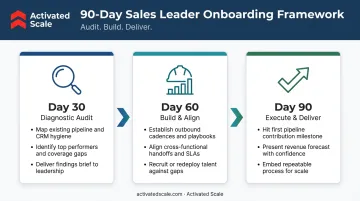
Most founders define the role in terms of responsibilities. Define it in terms of results instead — specifically, what this person must deliver in their first 90 days:
- 30 days: Completed onboarding, audited existing pipeline, identified the top 3 gaps in the current sales motion
- 60 days: First qualified pipeline built or rebuilt, initial playbook draft in progress, first rep hire identified
- 90 days: Measurable improvement in conversion metrics, initial team structure in place, first deals closed or significantly advanced under their ownership
Share these criteria with candidates before the interview. The ones who push back with their own questions — clarifying your current pipeline stage, rep tenure, or deal cycle — are showing you exactly how they think. The ones who just nod along aren't ready to own the outcomes.
Proven Strategies to Find and Hire Sales Leaders
A clear profile is necessary but not sufficient. You also need a deliberate sourcing and evaluation process. Here are four strategies that consistently produce better outcomes than the standard approach.
Strategy 1: Build a Proactive Talent Pipeline—Don't Wait for a Vacancy
The best sales leaders are not browsing job boards. LinkedIn's Global Talent Trends research found that 70% of the global workforce is passive talent—meaning they're employed, not actively looking, and reachable only through direct outreach or network connections.
Waiting for a vacancy to start sourcing means you're months behind where you need to be.
What to do instead:
- Maintain a short "bench list" of 5–10 sales leaders you respect—reach out quarterly, not just when you're hiring
- Attend SaaStr, revenue leadership meetups, and vertical-specific events where operators gather
- Ask your best-performing customers and investors who impressed them in a sales leadership role
- Use LinkedIn to track leaders at companies two or three stages ahead of yours
When a need arises, you want to be weeks away from conversations, not starting from zero.
Strategy 2: Write a Job Description That Attracts the Right Candidates
Most sales leadership JDs read like a wish list that no real person could satisfy—dozens of required qualifications, impossible experience thresholds, and no clear picture of what success actually looks like.
An effective JD for a sales leadership role includes:
- Clear must-haves vs. nice-to-haves—separate them explicitly. A long undifferentiated requirement list causes strong candidates to self-select out
- Outcomes language—"build and own the outbound motion" is better than "responsible for outbound sales activities"
- Honest scope of the challenge—if there's no playbook yet, say so. The right candidate finds that exciting. The wrong one needs to know early
- Inclusive, neutral phrasing—aggressive, competitive-combat language in JDs narrows the candidate pool
A candidate who reads your honest description and runs is not a candidate you wanted.
Strategy 3: Use Structured Interviews and Real-World Scenarios
Unstructured interviews are unreliable for leadership roles. Charismatic candidates outperform capable ones. Interviewers unconsciously favor people who remind them of themselves. Without consistent questions across candidates, you can't actually compare them.
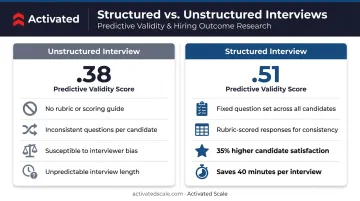
Structured interviews—fixed questions, asked in the same order, evaluated against a rubric—produce more predictive outcomes:
- Schmidt & Hunter's research puts predictive validity at .51 for structured vs. .38 for unstructured interviews
- Google's re:Work program found rejected candidates were 35% more satisfied when the process was structured
- Pre-built question sets save an average of 40 minutes per interview
Two questions worth including:
"Tell me about a time you inherited an underperforming sales team. What did you diagnose, and what did you change?" This reveals coaching instincts, diagnostic thinking, and whether they default to replacing people or developing them.
"Walk me through what you'd prioritize in your first 90 days to hit $X in new revenue." This tests strategic clarity, how they think about sequencing, and whether their plan is generic or specific to your situation.
Strategy 4: Validate Cultural Fit and Assess Beyond the Resume
Leadership IQ's research tracking 20,000 new hires found that 89% of hiring failures were caused by poor attitudes rather than lack of technical skill. Technical competence gets people hired. Attitude and cultural alignment determine whether they stay and perform.
Three practical tools to supplement interviews:
- Written 30-day plan — provide a brief context doc and ask candidates to submit their first-30-days plan. Strategic thinking and prioritization show up clearly on the page
- A coaching role-play — give them a rep scenario and ask them to run a coaching conversation. How they handle underperformance under observation tells you more than any behavioral question
- Cross-functional stakeholder interviews — have your head of product and a customer success lead meet finalists. How a sales leader interacts with non-sales functions matters enormously in a startup
These tools surface what interviews miss—but so do reference checks, if you run them properly. Don't treat them as a formality. Ask former direct reports specifically what it was like to be managed by this person. The references a candidate provides will be positive by design. Structure your questions to surface nuance anyway.
Mistakes to Avoid When Hiring Sales Leaders
Three mistakes account for a large share of early leadership misfires:
Hiring too early. Before $1M ARR and a repeatable process, you don't have a sales problem—you have a product-market fit problem. A sales leader can't fix what isn't working at the product or positioning level. Hire before you're ready and you waste both money and the leader's time.
Mistaking past company prestige for transferable skill. Someone who succeeded at Salesforce inside a fully resourced, established sales motion has not proven they can build from scratch at a 15-person startup. Look specifically for evidence they've operated in ambiguous, resource-constrained environments—no playbook, unclear ICP, limited brand recognition.
Skipping alignment conversations before the offer. Scope of decision-making authority, budget for team building, expectations around founder involvement in deals—these conversations feel awkward before an offer is signed. Starting the role with mismatched assumptions on any of these points is far more costly than a difficult pre-offer conversation.
De-Risking Your Sales Leadership Hire
Even with a rigorous process, a full-time VP of Sales hire is slow, expensive, and hard to reverse. According to the Center for American Progress, replacing a highly paid executive can cost up to 213% of annual salary when accounting for turnover and replacement—and that doesn't include the qualitative cost SaaStr describes as a "lost year" in revenue momentum.
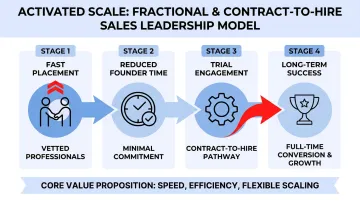
The fractional or contract-to-hire model addresses this directly. A fractional sales leader delivers real work—building pipeline, coaching reps, validating the sales motion—without the long-term commitment of a full-time hire. You see their work product, their approach to people management, and their cultural fit in a real context before making a permanent decision.
Activated Scale connects B2B SaaS founders with vetted, US-based fractional sales professionals (including Sales Directors and VPs of Sales with experience at Salesforce, Oracle, IBM, Zendesk, and Datadog) typically within 7 days.
The contract-to-hire structure makes the initial engagement a working trial. Founders evaluate real performance against defined outcomes and can convert top performers to full-time employees once the fit is proven.
For founders who've spent months on a full-time search only to watch the hire fail within a year, the model offers a direct alternative:
- Saves 20+ hours of founder interview time per hire
- Eliminates upfront recruiting fees
- Delivers the most reliable signal available: actual on-the-job performance before you commit
Frequently Asked Questions
Frequently Asked Questions
How to hire a good sales executive?
Define the role with specific 30/60/90-day success criteria before opening the search. Source proactively through your network, use structured behavioral interviews and scenario-based exercises, then validate fit through cross-functional conversations and reference checks with former direct reports.
What is a sales leadership role?
A sales leadership role is distinct from individual contributor work. The focus shifts from personal quota attainment to setting strategy, coaching the team, owning revenue targets, and building the processes that drive consistent performance across the organization.
When should a startup hire its first sales leader?
The standard benchmark is around $1M ARR, once the founder has a repeatable sales process in place and a small team already selling. Hiring before that point typically means asking a sales leader to solve a problem that isn't actually a sales problem.
What's the difference between a VP of Sales and a CRO?
A VP of Sales typically manages the sales team directly, often acting as a player-coach at early-stage companies: still closing deals while building the team. A CRO owns the full revenue function, including marketing and customer success, and is better suited to later-stage companies with established GTM infrastructure already in place.
What are the biggest mistakes founders make when hiring sales leaders?
The most common mistakes: hiring on big-company prestige without checking whether the candidate has operated at a similar stage, skipping success criteria before the search begins, and rushing the hire out of urgency rather than role clarity.
Should I hire a full-time or fractional sales leader for my startup?
Fractional works well for early-stage companies that need experienced sales leadership without the full-time cost and risk. A contract-to-hire model—like the one Activated Scale offers—lets founders validate fit through actual performance before making a permanent commitment, reducing the risk of a mis-hire.