Introduction
The way B2B deals get done has changed — and the numbers are stark. According to 6sense's 2024 B2B Buyer Experience Report, buyers are nearly 70% through the purchasing process before ever contacting a sales rep. And when they finally do reach out, Forrester's 2024 research shows the average decision involves 13 people.
For early-stage founders and startup leaders, this creates a specific problem: the old playbook — cold calls, generic pitches, one decision-maker — no longer fits the reality of how companies buy. Yet most founders lack a clear framework for building a repeatable sales process.
What follows is a practical framework — covering how the B2B sales process actually works, what's reshaping buyer behavior right now, and what early-stage teams can do to build predictable revenue from the ground up.
Key Takeaways
- B2B sales involves longer cycles, higher deal values, and multiple decision-makers — requiring a fundamentally different approach than consumer sales
- A repeatable process — ICP definition, prospecting, discovery, demo, close — is the foundation of consistent pipeline
- Buyers now do most of their research before talking to anyone; sellers must meet them with relevant content and strong social proof
- Account-based selling, consultative selling, and customer referrals consistently outperform generic outbound
- Fractional or contract-to-hire sales talent gives startups a lower-risk way to build a team without committing to full-time headcount upfront
What Is B2B Sales and Why Is It Complex?
B2B sales refers to selling products or services from one business to another. Compared to consumer sales, the transactions are larger, the decision timelines are longer, and you're rarely dealing with a single buyer. A typical deal touches multiple stakeholders — each with different priorities and different definitions of success.
Each stakeholder has a different agenda:
- Finance wants to see ROI and total cost of ownership
- IT focuses on integrations, security, and implementation lift
- Operations cares about usability and workflow disruption
- Executive sponsors want strategic fit with company priorities
A sales rep managing a complex deal has to address all of these concerns simultaneously — often without a clear picture of who's actually influencing the final decision.
That complexity is growing. Forrester reports that 89% of B2B purchases now involve two or more departments, and Gartner found that 74% of B2B buyer teams demonstrate unhealthy conflict during the decision process — meaning the internal buying committee often can't agree, even when they want to buy.
B2B vs. B2C Sales: The Core Differences
| Dimension | B2B Sales | B2C Sales |
|---|---|---|
| Deal size | High ($56K–$62K+ median ACV for SaaS) | Low to moderate |
| Sales cycle | Months (median 6 months for private SaaS) | Days to weeks |
| Decision-makers | Multiple stakeholders, often 10–13 people | Typically one individual |
| Relationship depth | Deep, ongoing relationship required | Often transactional |
Key Roles in a B2B Sales Organization
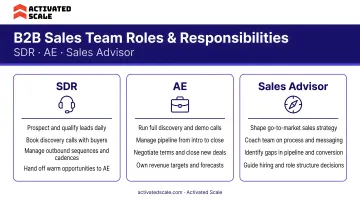
Three roles form the backbone of most startup sales teams:
- Sales Development Representative (SDR): Handles prospecting and outbound outreach — cold email, cold calls, LinkedIn. Goal: qualified meetings, not closed deals.
- Account Executive (AE): Owns the process from discovery through close — demos, objection handling, negotiation, and stakeholder management.
- Sales Advisor or Consultant: Guides prospects through complex evaluations, acting as a trusted expert rather than a traditional seller.
These distinctions matter in practice. Many founders stall growth by conflating prospecting capacity with closing capacity — hiring an AE who hates cold outreach, or an SDR without the authority to run discovery. Knowing which role to hire first is one of the most consequential early decisions a startup can make.
The B2B Sales Process: Key Stages
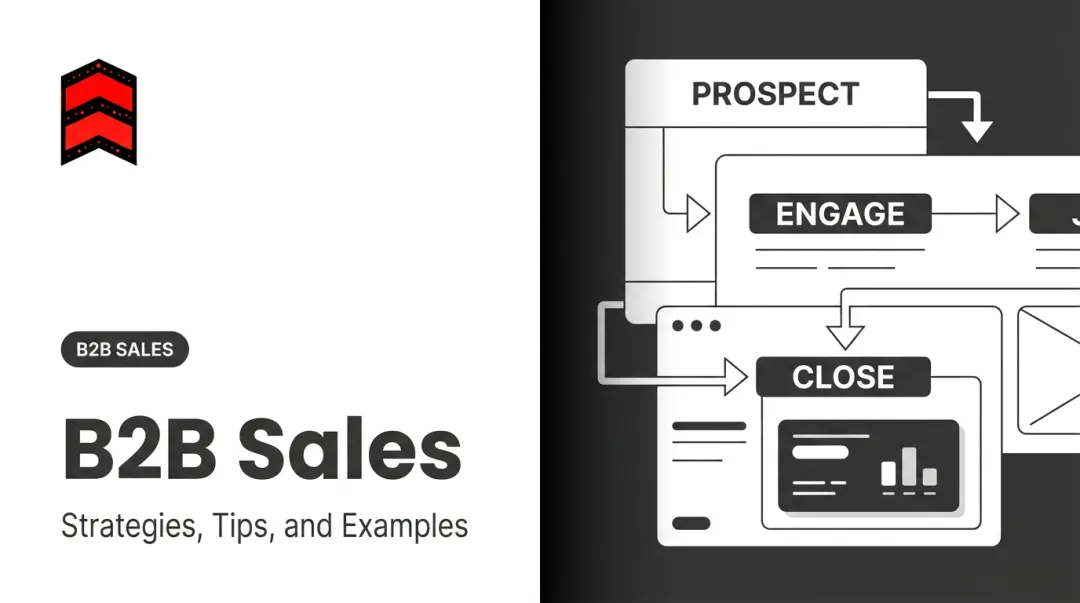
A sales process is a repeatable sequence that creates predictable pipeline when executed consistently. Skipping stages is one of the most common reasons deals fall apart late.
Research and ICP Definition
Before any outreach happens, you need to know exactly who you're targeting. The Ideal Customer Profile (ICP) defines the characteristics of accounts most likely to buy and succeed with your product — including company size, industry, tech stack, funding stage, and the titles of the decision-makers within those accounts.
Unfocused prospecting wastes time and produces low-quality pipeline. A tight ICP means every hour of outreach goes toward accounts that can actually convert.
Prospecting and Outreach
Cold outreach (email, phone, LinkedIn) remains a primary pipeline source for B2B startups. The goal at this stage isn't to sell. It's to earn the right to a discovery conversation.
Personalization is what separates effective outreach from noise. A message referencing a specific trigger (a funding round, a product launch, a LinkedIn post) outperforms a generic template every time.
Discovery and Qualification
The discovery call is the most important stage in the entire process. Done well, it uncovers the prospect's actual challenges, business objectives, timeline, budget, and decision-making structure — all of which determine whether this deal is worth pursuing.
Two frameworks commonly used to structure qualification:
- BANT — Budget, Authority, Need, Timeline
- MEDDIC — Metrics, Economic Buyer, Decision Criteria, Decision Process, Identify Pain, Champion
Consistency is the point: every rep asking the same questions on every discovery call, regardless of which framework the team chooses.
Demo, Pitch, and Objection Handling
A strong B2B demo is prospect-specific. It maps your product's capabilities directly to the pain points uncovered in discovery — a solution narrative, not a feature walkthrough.
Common objections should be anticipated and prepared before every call. In complex deals with multiple stakeholders, a single pitch often needs to address several different concerns at once. The reps who handle this without getting flustered consistently win more.
Objections worth preparing for in advance:
- Pricing: Know your floor and have ROI data ready
- Integrations: Map your tech stack compatibility before the call
- Timing: Understand their fiscal calendar and internal approval cycles
- Competition: Be clear on your differentiation without being dismissive
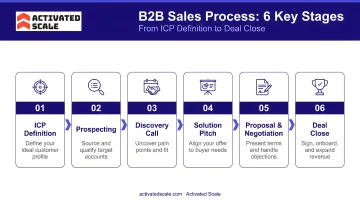
Negotiation and Closing
Negotiation is about aligning on value, not just haggling on price. That means reaching agreement on implementation timeline, support expectations, and contract terms rather than simply discounting to close.
A deal that sits unsigned for weeks is a deal at risk. Clear next steps after every conversation and a smooth handoff to onboarding protect the new relationship from going cold at the finish line.
Key B2B Sales Trends Shaping the Landscape
B2B buyer behavior has shifted faster in the last few years than in the previous decade. Startups that build their sales motion around current buyer behavior have a real advantage over those still running the 2015 playbook.
AI-Powered Sales Tools
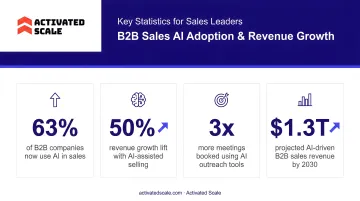
AI is now embedded across the sales workflow. Prospecting automation, real-time conversation intelligence, AI-generated outreach sequences, lead scoring — tools that once required a full operations team now run with minimal overhead.
According to Salesforce's 2024 State of Sales data, 81% of sales teams are experimenting with or have fully implemented AI, and 83% of teams using AI saw revenue growth versus 66% of non-AI teams. Sales reps also report spending 70% of their time on non-selling tasks — AI tooling directly attacks that problem.
Digital-First Buying Behavior
B2B buyers now do extensive self-directed research — reading reviews, watching demos, comparing competitors — before reaching out to a vendor. By the time a buyer contacts a sales rep, they often already have a shortlist and a preferred vendor.
This puts real pressure on startups to have strong content, visible customer proof, and a credible digital presence. Sellers who wait for inbound without building those assets are invisible to most of the buyers who would have been good fits.
Multi-Stakeholder Buying Committees
With an average of 13 people involved in the typical B2B purchase decision, single-threaded selling — building a relationship with one champion and hoping they push it through — is a fragile strategy.
Effective reps build multi-threaded relationships by engaging the right people across the account:
- Economic buyer — controls the budget and final approval
- Technical evaluator — assesses fit and integration requirements
- End users — whose adoption determines whether the deal sticks
- Executive sponsor — provides internal air cover for the purchase
Deals with multiple active champions close at significantly higher rates than those relying on a single point of contact.
Data-Driven Prospecting and Personalization
Intent data, CRM signals, and tools like LinkedIn Sales Navigator, Apollo, and ZoomInfo allow sales teams to prioritize accounts that are actively researching solutions — rather than blasting everyone in a target industry.
Reps who reach out to accounts showing active buying signals get more responses, have more relevant conversations, and close deals faster. Salesforce data shows that 59% of B2B buyers say sales reps don't take time to understand their specific challenges — data-driven personalization addresses that directly.
The Rise of Social Selling
B2B buyers trust peer recommendations and practitioner-created content more than traditional sales pitches. According to LinkedIn Sales Solutions, social selling leaders create 45% more opportunities than peers with lower social selling index scores, and are 51% more likely to reach quota.
Social selling doesn't replace outbound — it makes outbound more effective. A buyer who already recognizes your name from a LinkedIn post is far easier to book than one receiving a cold email out of nowhere.
Proven B2B Sales Strategies for Startups
Account-Based Selling
Account-based selling (ABS) is a targeted approach that suits early-stage startups well precisely because resources are limited. Rather than casting a wide net, you identify a short list of high-fit accounts and run personalized outreach across every stakeholder involved in the deal.
Momentum ITSMA's 2024 ABM benchmark found that 81% of organizations report ABM delivers 3–10% or higher ROI than traditional marketing, and 91% of surveyed organizations now run ABM programs. For startups with tight pipelines, concentrating effort on fewer, better-fit accounts beats volume every time.
Consultative Selling
In complex B2B deals — especially when selling to skeptical technical founders or CFOs — a rep who leads with product features loses to one who leads with business outcomes.
Consultative selling positions reps as trusted advisors. They ask sharper questions in discovery and anchor their pitch in the prospect's specific problems, framing value in terms buyers already track:
- Time saved on existing processes
- Revenue gained from faster execution
- Risk reduced by switching from the status quo
When multiple stakeholders have different priorities, this flexibility matters. The same deal logic can be adapted for a CTO focused on integration risk and a CFO focused on payback period.
Leveraging Existing Customers
Warm referrals, vertical-specific case studies, and co-marketed customer stories consistently outperform cold outreach in conversion rate. Yet most early-stage startups treat customer advocacy as a bonus rather than a deliberate pipeline strategy.
Building advocacy into the sales motion from day one creates a self-reinforcing pipeline. Two high-ROI tactics to start:
- Ask for referrals during onboarding, when enthusiasm is highest
- Capture case studies after early wins, before the moment passes
Building a High-Performing B2B Sales Team
When to Hire
The signals that indicate a startup is ready to bring on sales talent are clear:
- Founders have already sold the product themselves and have a repeatable process, even if informal
- There's product-market fit evidence — customers are buying, using, and renewing
- Growth has stalled not because of product gaps but because of prospecting or pipeline capacity
Hiring too early — before any repeatable process exists — means your first sales hire can't succeed because there's nothing to hand off. Hiring too late means you've already left revenue on the table.
What to Look for in Early Hires
Early B2B sales hires need a different profile than enterprise reps who've operated inside large, structured organizations:
- Proven experience closing deals with a similar ICP and comparable ACV
- Ability to build process independently, not just follow one that exists
- Strong discovery and consultative skills
- Adaptability to an unstructured, fast-moving environment
Quota numbers from large-company backgrounds can be misleading. A rep who hit $2M ARR at Salesforce with full marketing support, a mature brand, and 10 SDRs feeding them pipeline may struggle to generate their own meetings at a 10-person startup.
The Case for Fractional and Contract-to-Hire Talent
For early-stage B2B SaaS startups that need experienced sellers without the overhead of full-time headcount, fractional talent is a practical option. The try-before-you-buy model also significantly reduces the risk of a bad hire.
Activated Scale connects startups with vetted, US-based B2B sales professionals (SDRs, AEs, VPs of Sales) in as little as 7 days. Professionals come from companies like Salesforce, IBM, Oracle, and Zendesk, matched based on prior ICP and ACV experience. The standard engagement is a 3-month contract, and 65% of clients convert their fractional professional to full-time once they see results.
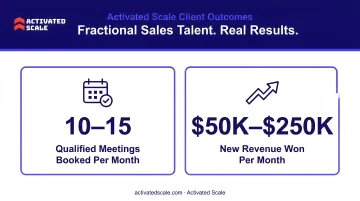
Client outcomes speak for themselves:
- 10–15 qualified meetings per month from fractional SDRs
- $50,000–$250,000 in new revenue per month from fractional AEs
- 5X increase in meetings with qualified prospects — Dresma.ai's result after pairing outbound tools with the right fractional salesperson
Frequently Asked Questions
What is a B2B sales advisor?
A B2B sales advisor is a sales professional who guides business buyers through complex purchase decisions, acting as a trusted expert rather than a transactional seller. Rather than pitching features, they focus on understanding the buyer's specific challenges and aligning the product to measurable business outcomes.
What is the difference between B2B and B2C sales?
B2B sales involves longer cycles, higher deal values, multiple decision-makers, and deep relationship-building. B2C typically features individual buyers, shorter timelines, and lower transaction values. The decision-making complexity in B2B — with 10+ stakeholders across multiple departments — has no real equivalent in consumer sales.
How long does a typical B2B sales cycle take?
For private SaaS companies, the median sales cycle is 6 months, according to the 2024 KeyBanc Capital Markets and Sapphire Ventures SaaS Survey. From the buyer's perspective, the full journey is often longer — 6sense reports an average buying cycle of 11.3 months, reflecting the self-directed research phase before seller engagement.
What metrics should B2B sales teams track?
The most important early-stage KPIs are lead-to-opportunity conversion rate, average deal size, sales cycle length, win rate, and pipeline coverage ratio. Early-stage startups should nail conversion rates and cycle time before optimizing for volume — scaling a broken process just burns budget faster.
How do early-stage startups build a B2B sales team without a large budget?
Start with founder-led sales to validate the process, then bring in fractional or contract-to-hire professionals for specific functions like prospecting or closing. Platforms like Activated Scale let startups hire experienced sales talent on month-to-month terms with no minimum spend — so you test fit before committing.
What are the biggest challenges in B2B sales today?
Longer buying cycles, inbox saturation, buyers who've already formed opinions before talking to a rep, and personalization that's hard to execute at scale. Solving these problems requires data-informed strategy, not higher outreach volume.