
Introduction
Most B2B SaaS founders hit the same wall somewhere between seed and Series A: the business needs a real sales motion, but a full-time hire feels like a massive bet.
According to The Bridge Group's 2024 SaaS AE benchmark report across 172 B2B SaaS companies, the average AE takes 5.7 months to ramp—before accounting for 30% median annual AE turnover that may have you starting over sooner than expected.
The math gets uncomfortable fast. Recruiting fees, base salary, benefits, equity, tools, and five-plus months of below-quota output add up quickly. A mis-hire at this stage costs money you can't afford to lose.
Outsourced sales talent offers a different path. This article covers what it actually means in practice, which models exist, the real benefits and risks, and the best practices that determine whether an engagement drives revenue or drains it.
TLDR
- Outsourced sales talent means engaging external sales professionals—fractional, contract, or agency—to generate pipeline and close revenue without full-time overhead.
- Models include outsourced SDR/BDR teams, fractional AEs, full-cycle reps, contract-to-hire arrangements, and full-service agencies.
- Key benefits: faster time to revenue, lower fixed costs, access to senior talent, and flexibility to scale.
- Common pitfalls like brand misalignment and weak accountability are avoidable with solid onboarding and clear KPIs.
- A try-before-you-buy structure is the most effective way to de-risk sales hiring at the early stage.
What Is Outsourced Sales Talent?
Outsourced sales talent means engaging external sales professionals to handle part or all of your sales function—rather than building an in-house team from the ground up. This is not a generic staffing arrangement. The right arrangement gives you access to experienced, sales-specific professionals who represent your brand, carry quota, and generate real revenue.
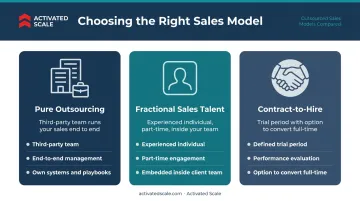
Three distinct forms exist in practice:
- Pure outsourcing — a third-party agency manages the sales function end-to-end with their own team, systems, and playbooks
- Fractional sales talent — an experienced sales professional works with your company part-time, embedded inside your team and operating within your processes
- Contract-to-hire — you engage a sales professional under a defined contract, evaluate real-world performance, then decide whether to bring them on full-time
Each of these models reflects a broader shift in how companies think about sales capacity. The B2B sales outsourcing services market was estimated at $96 billion in 2024 and is projected to reach nearly $180 billion by 2032—evidence that companies across sectors are moving away from the assumption that every sales function must be built in-house.
For early-stage B2B SaaS companies specifically, the driver is practical: the cost of a wrong hire is disproportionately high relative to your runway. You need experienced talent immediately, and your budget doesn't leave room for a six-month onboarding mistake.
Types of Outsourced Sales Talent Models
Not all outsourced arrangements are equal. Choosing the right model depends on your stage, what's already in-house, and where your pipeline bottleneck actually sits.
Outsourced SDR/BDR Teams
Outsourced SDRs focus exclusively on top-of-funnel work: prospecting, cold outreach, and booking qualified meetings. This model suits companies that have closers in-house but lack the capacity to generate consistent pipeline. The outsourced team handles volume outreach while your AEs focus on converting the meetings they receive.
Fractional Sales Executives and Account Executives
Fractional sales talent is senior-level: professionals who've carried quota at companies like Zendesk, Yelp, AT&T, or Glassdoor, working with your company part-time. They run the full sales motion — strategy, discovery calls, demos, proposals, and closes.
Unlike an agency rep, fractional talent embeds inside your team, operates in your CRM, and functions as a genuine extension of the company rather than an outside vendor.
Activated Scale's network, for example, sources from professionals with backgrounds across enterprise and high-growth technology companies, matching them based on prior experience with your specific buyer persona and ACV range.
Full-Cycle Outsourced Sales
A single outsourced rep or small team handles everything from prospecting through close. This model works best for pre-revenue or early-revenue companies with no in-house sales infrastructure. A proven operator can validate your sales motion, ICP, and messaging before you scale—giving you real data to build from.
Contract-to-Hire Sales Talent
The contract-to-hire model gives you a defined trial period—typically three months—to evaluate a sales professional against real performance targets before making a full-time employment decision. If they hit their metrics, you convert. If they don't, you haven't made a permanent commitment.
Platforms like Activated Scale are built around this structure. Founders can connect with vetted fractional sales professionals in under seven days, run them through a structured trial period, and convert top performers to full-time employees—paying a conversion fee only at that point. Roughly 65% of clients choose to convert after seeing results.
Sales Outsourcing Agencies
Full-service agencies bring a complete team: SDRs, managers, operations support. The setup is faster than building in-house, but the trade-offs are real:
- Brand integration tends to be weaker than with embedded talent
- Visibility into individual rep quality is limited
- Costs are typically higher than fractional arrangements
Agencies work best when speed of deployment matters more than deep brand alignment.
Key Benefits of Outsourced Sales Talent for B2B Startups
Faster Time to Revenue
A full-time AE takes an average of 5.7 months to ramp in B2B SaaS environments, with SDRs closer to three months. That's before accounting for recruiting timelines, which add weeks or months depending on the role.
Fractional and outsourced talent can be operational in days. Activated Scale, for instance, completes matches in under seven days—sometimes under 48 hours—because the network is pre-vetted and matched based on your specific ICP (ideal customer profile) and ACV (average contract value). The rep already understands the motion; they're not learning what "good" looks like from scratch.
Significant Cost Savings vs. Full-Time Hiring
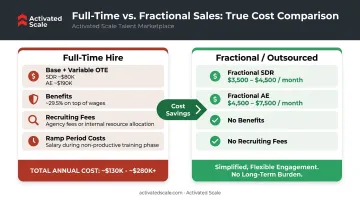
The fully loaded cost of a full-time sales hire goes well beyond base salary:
| Cost Component | SDR | AE |
|---|---|---|
| Base + variable (OTE) | ~$80K median | ~$190K median |
| Benefits (adds ~30% to wages) | ~$24K | ~$57K |
| Recruiting costs | Variable | Variable |
| Ramp period (below quota) | 3 months | 5.7 months |
The Bridge Group's 2024 data puts median SDR OTE at $80K and median AE OTE at $190K. BLS data from December 2024 shows benefits add roughly 29.5% on top of wages for private-sector employees.
Fractional arrangements convert these fixed costs into variable ones. Activated Scale's fractional SDRs start at $3,500–$4,500 per month; fractional AEs at $4,500–$7,500 per month. No benefits, no recruiter placement fees during the contract period, no equity.
Access to Experienced, Enterprise-Proven Talent
Early-stage startups often can't attract a senior AE with a strong enterprise track record as a full-time hire—the comp expectations and risk tolerance rarely align. Fractional arrangements remove that barrier. A rep who spent years at a high-growth SaaS company won't join a seed-stage startup full-time, but they will take on a fractional engagement.
That's the practical value of a curated network. Activated Scale's professionals come from companies like Zendesk, Yelp, Glassdoor, AT&T, and Intuit—bringing enterprise-grade experience to your sales process without requiring a full-time commitment from either side.
Scalability and Flexibility
Outsourced arrangements let you add or reduce capacity without the organizational complexity of headcount changes. Common scenarios where this matters:
- Testing a new vertical before committing to a dedicated hire
- Adding a product line that needs its own sales motion
- Bridging a gap while a full-time search is underway
- Validating a new ICP without long-term payroll risk
If the bet doesn't pan out, you haven't locked yourself into a full-time salary.
De-Risked Sales Team Building
The fear most founders have is real: a mis-hire at the first AE or VP of Sales level can cost six to twelve months of runway and momentum. Contract-to-hire models address this directly. You evaluate actual performance—meetings booked, pipeline generated, deals closed—rather than making a permanent decision based on interview performance. A rep generating consistent pipeline over 60–90 days gives you far more signal than any interview ever could.
Common Challenges and How to Avoid Them
Brand and Messaging Misalignment
Outsourced reps who aren't properly onboarded can misrepresent your product, ICP, or value proposition in early prospect conversations—a misrepresentation that's hard to walk back once a prospect forms a first impression.
Run a structured onboarding that covers your ICP, competitive positioning, objection handling, and call shadowing before the rep contacts a single prospect. Activated Scale's process dedicates the first 15 days entirely to this alignment before any outreach begins.
Accountability and Performance Gaps
Without outcome-based KPIs, outsourced engagements drift toward activity metrics: calls made, emails sent. Activity is easy to measure; results are what matter.
Set specific outcome targets from day one—qualified meetings booked per week, show rates, pipeline generated, conversion rates. Establish a weekly review cadence and don't wait until end-of-month to spot problems.
Data Privacy and CRM Integration Risks
Handing prospect and customer data to external parties carries compliance exposure if processes aren't defined. With at least 19 states now having comprehensive consumer privacy laws—and more adding legislation each year—this isn't a theoretical concern.
Require outsourced reps to operate inside your CRM from the start, not their own systems. Establish data handling agreements before the engagement begins, especially if you're operating in California under CCPA/CPRA frameworks.
Address these three areas upfront and most outsourced sales engagements run far smoother than companies expect.
Best Practices for Getting the Most From Outsourced Sales Talent
Define Your ICP, Sales Process, and Goals Before You Start
Outsourced talent is only as effective as the clarity you provide. Before engaging anyone, document:
- Ideal customer profile: company size, industry, buyer persona, specific pain points
- Your target ACV and typical deal structure
- The sales process you want to run (or validate)
- Specific pipeline and revenue targets for the first 90 days
Reps who start with clear direction consistently outperform those left to figure out the motion themselves.
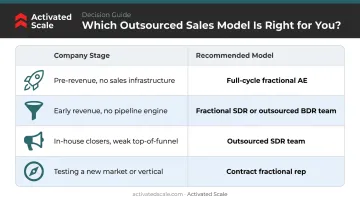
Choose the Model That Matches Your Stage
| Company Stage | Recommended Model |
|---|---|
| Pre-revenue, no sales infrastructure | Full-cycle fractional AE to validate the sales motion |
| Early revenue, no pipeline engine | Fractional SDR or outsourced BDR team |
| In-house closers, weak top-of-funnel | Outsourced SDR team for prospecting |
| Testing a new market or vertical | Contract fractional rep before full-time commitment |
Use a Try-Before-You-Buy Structure
Structure the initial engagement with a defined evaluation window—60 to 90 days is the standard—against clear performance benchmarks before committing to longer contracts or full-time conversion.
Activated Scale formalizes this through a Statement of Work that sets specific monthly targets by customer segment:
- SMB (1–100 employees): 13–22 meetings/month by Month 3
- Mid-market (101–1,000 employees): 10–14 meetings/month by Month 3
- Enterprise (1,000+ employees): 8–12 meetings/month by Month 3
When the 90-day window closes, the numbers tell you exactly where to go next—convert the rep full-time, extend the contract, or pivot to a different profile.
Integrate Outsourced Talent Into Your Internal Workflow
Outsourced reps should operate inside your CRM, attend team meetings, and be treated as genuine team members rather than external vendors. The closer the integration, the faster the feedback loops—and the better the messaging alignment over time.
On the oversight side, time-tracking tools like Toggl provide visibility into how hours are being spent without creating an adversarial dynamic.
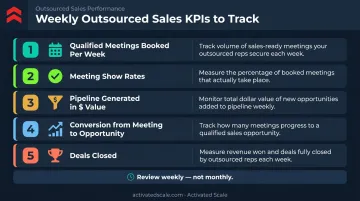
Set Outcome-Based KPIs and Review Them Weekly
Weekly reviews matter more than monthly rollups—issues caught early cost you a few days, not a full pipeline cycle. From day one, track:
- Qualified meetings booked per week
- Meeting show rates
- Pipeline generated ($ value)
- Conversion from meeting to opportunity
- Deals closed (where applicable)
If something is off, you want to know by Friday—not at the end of the month.
Frequently Asked Questions
What does outsourced sales talent mean?
Outsourced sales talent refers to engaging external sales professionals—on a fractional, contract, or agency basis—to handle pipeline generation, prospecting, or closing on behalf of your company. The key distinction from generic staffing is that these are experienced, sales-specific professionals operating within your brand and process.
What are the main types of sales outsourcing?
The main models are outsourced SDR/BDR teams, fractional sales executives and AEs, full-cycle outsourced reps, contract-to-hire arrangements, and full-service sales outsourcing agencies. Each suits a different company stage, budget, and pipeline objective.
Is outsourcing sales talent illegal in the USA?
No—outsourcing sales talent is entirely legal in the US. Companies must comply with worker classification rules (IRS Topic 762, DOL FLSA guidelines), data privacy laws, and any sector-specific regulations. Properly classifying independent contractors versus employees is the primary compliance consideration.
What is the 10-3-1 sales rule?
The 10-3-1 rule is a prospecting benchmark: for every 10 prospects contacted, roughly 3 engage in meaningful conversations and 1 converts to a customer. Bridge Group's 2024 data puts median AE win rates at just 19% in B2B SaaS, so most teams use the ratio to set outreach volume targets rather than as a hard conversion guarantee.
How much does outsourced sales talent typically cost?
Costs vary by model. Fractional SDRs typically run $3,500–$4,500/month on retainer plus commission; fractional AEs start at $4,500–$7,500/month. Full-service agencies usually charge a monthly fee per rep or a flat retainer—in either case, well below the $80K–$120K+ fully loaded cost of a full-time US sales hire.
What's the difference between outsourced sales and fractional sales talent?
Outsourced sales typically means an agency managing the sales function with their own systems, playbooks, and processes. Fractional sales talent is an experienced individual who embeds part-time inside your team, works within your CRM, and operates as a genuine team member rather than a separate vendor running a parallel process.