Introduction
Building great software is one challenge. Selling it consistently is another — and for technically strong founders, the sales problem often proves harder than the product problem.
The SaaS market is enormous. Gartner forecasts cloud application services will reach $299 billion in 2025, growing nearly 20% year-over-year. Yet company after company with genuinely good products stalls at the revenue stage — not because the product fails, but because the sales motion doesn't.
SaaS sales differs from traditional sales in three concrete ways:
- You're selling subscriptions, not one-time transactions
- You're selling outcomes to buyers who can't physically evaluate what they're buying
- The deal isn't done at contract signing — it's done when the customer renews
This guide covers the full picture: what makes SaaS sales uniquely challenging, the three core sales models, a practical breakdown of the sales process, proven strategies that work, the metrics you actually need to track, and how to build a team that scales.
TLDR:
- Churn is always a risk — post-sale success matters as much as closing
- Match your sales model (self-service, transactional, enterprise) to your ACV and buyer complexity
- Sales cycles run 14 days for sub-$2K ACV deals, 9+ months for enterprise
- CLTV:CAC ratio is the single most important indicator of sales model sustainability
- Validate your sales motion before committing to full-time sales hires
What Is SaaS Sales (And Why It's Uniquely Challenging)
SaaS sales is the process of selling cloud-based software on a subscription basis. Unlike a one-time software license, customers never truly "own" what they're paying for — they're continuously paying for value. That distinction reshapes how deals are structured, how reps build trust, and what success actually looks like after the contract is signed.
The Deal Doesn't End at Signature
In traditional sales, closing a deal is the finish line. In SaaS, it's where the real work starts. Revenue depends on retention, renewals, and expansion — which means every closed deal either earns its keep month after month or becomes a churn statistic.
This creates a feedback loop most founders underestimate: sell to the wrong customers, and you don't just lose the account. You inherit bad reviews, a poisoned pipeline, and wasted onboarding resources. The post-sale experience is a direct extension of the sales process.
Selling Something Intangible
Buyers can't hold software. They can't inspect it or immediately verify the claims being made. That means SaaS reps must sell outcomes and ROI — time saved, revenue increased, headcount avoided — rather than features.
It also introduces objections that don't exist in physical product sales:
- Data security and compliance concerns
- Integration complexity with existing tools
- Migration risk from current systems
- Switching costs (perceived and real)
The Early-Stage Problem
For startups, the challenge compounds quickly. No brand recognition. Limited case studies. A founder often acting as the only salesperson while also building the product.
Deal complexity grows with ACV, too. According to a 2024 survey by KeyBanc Capital Markets and Sapphire Ventures covering 100+ private SaaS companies, the median sales cycle sits at 6 months, with median ACV approaching $62K. That's a sustained organizational effort — one most early teams are ill-equipped to execute without dedicated sales talent.
The Three Core SaaS Sales Models
The right sales model depends on your ACV, product complexity, and buyer profile. Choosing wrong wastes resources — and stalls growth faster than almost any other early mistake.
Self-Service
Minimal or zero rep involvement. Users discover, sign up, and onboard themselves. Works well for:
- Low-complexity products with obvious value
- ACV under $10K
- Single-user or small-team buyers
Examples: Mailchimp, Notion. Both offer free tiers and paid plans purchasable without speaking to sales.
This model breaks down fast with complex products, multi-stakeholder buying committees, or deals where ROI requires explanation. You can't self-serve your way to a $50K contract.
Transactional
The most common model for mid-market B2B SaaS. Involves reps conducting discovery calls, demos, and negotiations — typically with 2–4 stakeholders involved. Marketing generates leads; sales converts them.
Examples: HubSpot, BambooHR. Both have sales teams that assist buyers through evaluation and procurement.
Most seed-to-Series A companies land here — and the ones who thrive are the ones who staff it intentionally rather than reactively.
Enterprise
High ACV, long cycles, large buying committees, custom contracts. Deals above $100K ACV average 3–9 months to close; deals above $500K ACV can take 6–18+ months.
Requires dedicated Account Executives, solutions engineers, security review processes, and robust customer success infrastructure. This is not where early-stage startups should begin — the resource requirements outpace what most seed-stage teams can sustain.
Examples: Salesforce, Microsoft 365 Enterprise.
PLG vs. SLG — A Modern Framing
Product-Led Growth (PLG) uses the product itself as the acquisition channel: free trials, freemium tiers, viral loops. Sales-Led Growth (SLG) relies on proactive reps to generate and close pipeline.
OpenView data shows PLG adoption among SaaS companies grew from 45% in 2019 to 55% in 2022. Yet the 2024 KeyBanc/Sapphire survey found 60% of private SaaS companies still identify field sales as their primary GTM motion. For most B2B SaaS startups at the seed-to-Series A stage, the practical reality is SLG or a hybrid — using PLG signals (free trial signups, product usage spikes) to prioritize which accounts a rep pursues.
The SaaS Sales Process: Cycle, Funnel, and What Happens at Each Stage
Two terms get confused constantly: sales cycle (what the rep does) and sales funnel (the buyer's journey from awareness to purchase). They're related but distinct. The funnel describes buyer psychology; the cycle describes rep activity. You need to manage both.
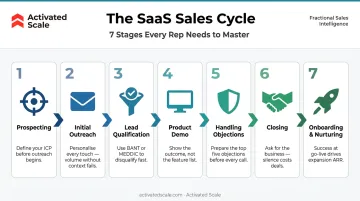
Stages of the SaaS Sales Cycle
| Stage | What the Rep Should Prioritize |
|---|---|
| 1. Prospecting | Build a targeted list based on firmographic and technographic ICP signals |
| 2. Initial Outreach | Lead with a specific, relevant pain point — not a product pitch |
| 3. Lead Qualification | Use BANT or MEDDIC to confirm budget, authority, need, and timeline before investing further |
| 4. Product Demo | Tailor the demo to the prospect's stated problem, not a generic feature walk |
| 5. Handling Objections | Treat objections as signals of interest, not rejection — address security, integration, and migration concerns directly |
| 6. Closing | Establish clear next steps and timelines; avoid "I'll think about it" as an outcome |
| 7. Onboarding & Nurturing | Hand off with detailed context; set accurate expectations that protect retention |
Qualification: The Stage That Determines Everything Downstream
Selling to the wrong customer profile is the single most common reason SaaS companies experience high early churn. A closed deal with a poor-fit customer isn't a win — it's a delayed loss with added damage.
Build your ICP using three signal types:
- Firmographic: Company size, industry, revenue, geography
- Technographic: Current tools, integrations, tech stack
- Behavioral: Buying triggers, recent funding, team growth signals
When teams at Activated Scale match fractional sales talent with early-stage SaaS clients, ICP clarity is consistently one of the first things they help founders establish — because without it, even the best rep burns leads.
The Demo: Where Most Deals Are Won or Lost
SaaStr benchmarks a healthy demo-to-paid conversion rate at 10–20% for SaaS startups, with 20%+ as a strong target. Below 8–10% typically signals a positioning or qualification problem.
A strong demo:
- Opens by restating the prospect's specific problem (not a company intro)
- Shows the solution in the context of their workflow, not a generic use case
- Keeps it focused — every extra minute risks losing the thread
- Ends with a clear, time-bound next step
The difference shows up in the numbers: reps who customize demos to the prospect's stated workflow consistently outperform those running the same slide deck on every call.
Post-Close: The Overlooked Revenue Driver
Reps who set inaccurate expectations during the sale plant the seeds of churn — and the damage rarely shows up until month three or four, when it's too late to recover the relationship. Document every commitment made before signing: implementation timelines, feature availability, support response times. Hand that list directly to whoever runs onboarding, not as a courtesy, but as a requirement.
Proven SaaS Sales Strategies to Close More Deals
Lead With Pain, Not Product
Open discovery calls by asking about the prospect's current workflow, frustrations, and goals — before mentioning the product at all. Frameworks like SPIN Selling (Situation, Problem, Implication, Need-Payoff) and the Challenger Sale work particularly well here because they position the rep as a problem-solver, not a vendor.
The outcome: prospects feel understood rather than pitched. That shift alone moves close rates in ways discounting never will.
Engineer the Free Trial for Fast Value
A free trial that doesn't deliver an "aha moment" within the first week rarely converts. The goal isn't just access — it's demonstrated value.
Tactics that work:
- Proactive outreach within 24–48 hours of signup
- Guided onboarding toward one core use case
- Milestone-based check-ins tied to product usage
Speed of follow-up matters enormously. Harvard Business Review research covering 2,241 U.S. companies found that companies reaching out within 1 hour were nearly 7x more likely to have a meaningful conversation with a decision-maker than those waiting even an hour longer.
Build Urgency Through the Cost of Inaction
Discounting to close deals trains buyers to wait for discounts. A better approach: Gap Selling. Identify the gap between the prospect's current state and desired state, then quantify what it costs them every month the problem goes unsolved.
If their current process wastes 10 hours per week per person across a team of five, that's 50 hours of labor cost every week — the real price of not buying, and far more compelling than a 20% discount.
Offer Annual Pricing With Real Incentives
Annual plans benefit both sides:
- Buyers get a lower effective monthly cost and budget predictability
- Sellers gain better cash flow and reduced churn risk
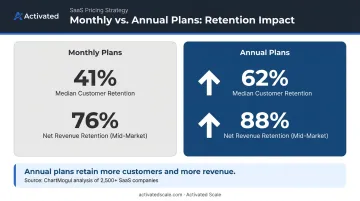
ChartMogul's analysis of 2,500+ SaaS companies shows median customer retention of 62% for annual plans vs. 41% for monthly plans at lower price points. At mid-market ARPA levels ($250–$500), net revenue retention was 88% on annual vs. 76% on monthly.
Present annual pricing as a value conversation, not a commitment pitch. Lead with what the buyer gains in cost savings and predictability — the close follows naturally.
Operationalize Referrals and Expansion
New logo acquisition and expansion revenue are the two engines of SaaS growth. Neither runs itself.
Referrals convert best when you time the ask at a value milestone — after a successful onboarding, a positive QBR, or a specific measurable win. Asking at renewal feels transactional; asking after a win feels natural.
Expansion opportunities announce themselves if you're watching. Usage spikes, headcount growth, and feature requests are buying signals — treat them that way, not as support tickets.
Key SaaS Sales Metrics Every Team Should Track
Revenue Health: MRR, ARR, and Churn
| Metric | Formula | What It Tells You |
|---|---|---|
| MRR | Sum of all recurring monthly revenue | Pulse of the business — directional health at a glance |
| ARR | MRR × 12 | Planning baseline for hiring, spend, and forecasting |
| Churn Rate | Churned customers ÷ total customers (start of period) | Signal of product-market fit and post-sale experience quality |
Both customer churn (logo count) and revenue churn (dollar value lost) matter. A company can have low logo churn but high revenue churn if it's losing its largest accounts.
Efficiency: CAC, CLTV, and the Ratio That Really Matters
| Metric | Formula |
|---|---|
| CAC | Total sales & marketing spend ÷ new customers acquired |
| CLTV | ARPA ÷ churn rate (or ARPA × gross margin ÷ churn rate) |
| CLTV:CAC Ratio | CLTV ÷ CAC |
The CLTV:CAC ratio answers a single critical question: is this sales motion economically sustainable? The widely cited benchmark, from David Skok's SaaS Metrics 2.0, puts the floor at 3:1: every dollar spent acquiring a customer should return at least three dollars in lifetime value.
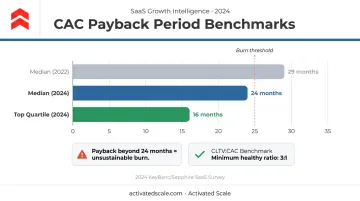
The 2024 KeyBanc/Sapphire survey found median fully loaded CAC payback of 24 months across private SaaS companies, improving from 29 months in 2022. Top-quartile companies achieved 16 months. If your payback period stretches beyond 24 months, the sales motion is burning cash faster than the business can sustain.
Pipeline Conversion Metrics
Track these stage-by-stage to identify exactly where prospects are dropping:
- Lead-to-demo rate: Are qualified leads agreeing to see the product?
- Demo-to-close rate: Is the demo doing its job? (Target: 10–20%)
- Average sales cycle length: Are deals moving at the pace the ACV justifies?
When conversion drops at a specific stage, you know exactly where to focus — whether that's tightening lead qualification, reworking the demo, or shoring up your close process.
How to Build a SaaS Sales Team That Scales
Core Roles and Sequencing
A functional SaaS sales team has three distinct functions:
- SDRs: Outbound prospecting, cold outreach, lead qualification — feeds the AE pipeline
- Account Executives: Discovery, demo, negotiation, close — owns revenue generation
- Customer Success: Onboarding, retention, expansion — protects the revenue already closed
For early-stage startups, these roles rarely exist as separate hires at first. The typical sequence: founder runs AE duties → hires first SDR or fractional AE to build pipeline → builds Customer Success as retention becomes a priority.
The Risk of Hiring Full-Time Too Early
The Bridge Group's 2024 benchmark of 170+ B2B SaaS companies puts average AE ramp time at 5.7 months — up from 4.3 months in 2020. Median AE OTE runs $190K, with median quota of $800K annually.
A bad hire costs more than base salary during a failed ramp. You're also burning leads from a pipeline that took months to build, and damaging relationships with prospects who'll remember the experience.
Many seed-to-Series A SaaS companies sidestep this risk by working with fractional sales professionals to validate their sales motion before committing to full-time hires. Activated Scale connects B2B SaaS startups with vetted, experienced fractional SDRs and Account Executives in 7 days or less, often within 48 hours.
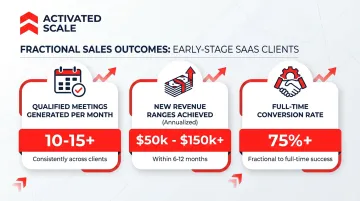
The results are concrete: clients average 10–15 qualified meetings per month through fractional SDRs, and those using fractional AEs win $50K–$250K in new revenue per month. Around 65% of clients eventually hire their fractional AE full-time after seeing results during the initial contract period.
What a High-Performing Early-Stage SaaS Hire Looks Like
Prioritize these traits over industry-specific experience:
- Operates independently — doesn't need a fully-built playbook to start generating pipeline
- Learns technical products quickly — can explain complex software to non-technical buyers
- Adapts messaging by buyer persona without losing core positioning
- Coachable and curious — early-stage sales requires constant iteration
The biggest mistake founders make is hiring for prior company prestige rather than the specific skills an early-stage environment demands. Someone who thrived at Salesforce with a massive marketing budget and established brand may struggle to generate pipeline from scratch at a seed-stage startup.
Frequently Asked Questions
What is software-as-a-service sales?
SaaS sales is the process of selling cloud-based, subscription software with a focus that extends well beyond the initial contract. Because revenue depends on renewals and retention, the customer relationship is ongoing, making it fundamentally different from one-time product sales.
What are examples of SaaS solutions?
Examples span all three sales models: self-service tools like Mailchimp and Notion, transactional B2B software like HubSpot and BambooHR, and enterprise platforms like Salesforce and Microsoft 365.
How hard is it to sell a SaaS product?
Selling SaaS is genuinely challenging, particularly at the early stage. Long sales cycles, intangible products, multi-stakeholder buying processes, and constant churn risk all compound. Success comes from building and following a repeatable process, not from persistence alone.
What is the most important metric in SaaS sales?
The CLTV:CAC ratio. While MRR tracks growth and churn tracks health, this ratio reveals whether the entire sales model is economically sustainable long-term. A ratio below 3:1 is a signal the motion needs fixing before scaling it.
What is the difference between PLG and SLG?
PLG (Product-Led Growth) uses the product as the primary acquisition driver — through free trials, freemium, or viral features. SLG (Sales-Led Growth) relies on a proactive sales team. Most B2B SaaS startups use a hybrid or start with SLG, particularly for deals above $10K ACV.
How long is a typical SaaS sales cycle?
It varies widely by deal size. Sub-$2K ACV deals can close in about 14 days; sub-$25K ACV deals average around 90 days; deals above $100K ACV typically take 3–9 months. Strong qualification and a well-run demo are the most reliable ways to shorten any cycle.