That challenges the common assumption that outsourcing is a cost-cutting measure for companies that can't afford "the real thing." It isn't. It's a strategic choice that the most sophisticated revenue organizations make deliberately.
This article breaks down the specific outsourced sales strategies Fortune 500 companies use to drive growth, why each one works, and — critically — how early-stage B2B companies can apply the same playbook without enterprise budgets.
TL;DR
- Fortune 500s outsource sales for speed, specialization, and market access — not just cost reduction
- Average B2B SaaS Account Executive ramp takes 5.7 months — outsourced teams deploy in days
- Six core strategies power enterprise outsourced sales: ICP definition, structured cadences, account-based selling, omnichannel outreach, optimization, and tech
- Access the same enterprise playbook through fractional and modular outsourced models
- Track three metrics above all: qualified meetings booked, pipeline value generated, and meeting-to-opportunity conversion rate
What Outsourced Sales Actually Means
Outsourced sales means delegating specific sales functions — lead generation, prospecting, appointment setting, pipeline management, or full-cycle selling — to an external team rather than handling them entirely in-house.
Unlike a freelancer hired for one-off tasks, a quality outsourced sales function runs as a structured engagement: aligned to the ICP, familiar with the value proposition, and accountable to defined pipeline metrics.
What Can Be Outsourced
The range is broader than most companies realize:
- Top-of-funnel SDR work — outbound prospecting, cold outreach, appointment setting
- Mid-funnel pipeline management — nurturing, follow-up sequences, qualification
- Full closing cycles — end-to-end revenue responsibility
- Hybrid models — outsourced prospecting while internal teams handle closing
Fortune 500 companies rarely outsource everything. Instead, they use modular outsourcing — assigning specific functions to external partners where internal capacity is constrained or where outside expertise accelerates results faster than building in-house would.
Why Fortune 500 Companies Outsource Sales
Outsourcing sales isn't a workaround — it's a deliberate response to three compounding pressures that internal hiring simply can't address fast enough.
The Ramp Time Problem
Hiring an internal sales rep isn't a fast solution. According to the Bridge Group's 2024 SaaS AE research, the average Account Executive takes 5.7 months to reach full productivity — up 32% from 2020. During that window, a company is paying full compensation with no full-output return.
Outsourced teams arrive already ramped. They bring tested outreach methodologies, existing tool configurations, and vertical knowledge that would take an internal hire months to accumulate.
Buying Complexity Demands Specialization
Forrester's 2024 State of Business Buying research found that modern B2B purchases are anything but simple:
- 86% of B2B purchases stall before closing
- 13 people participate in a typical buying decision on average
- 89% of purchases involve two or more departments
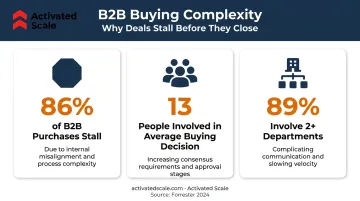
That level of complexity requires a dedicated outbound function built for multi-stakeholder engagement — not someone splitting time between sales and other responsibilities.
The Scalability Advantage
Enterprises face genuine constraints when entering new markets, launching products, or expanding geographically. Building an internal team from scratch for each initiative is slow and expensive. Outsourced models allow companies to deploy targeted capacity for defined periods, assess results, and scale based on evidence — no sequential hiring rounds required.
6 Core Outsourced Sales Strategies Fortune 500 Companies Use
These are the specific, repeatable strategies enterprise companies deploy through outsourced sales partnerships. Each one is adaptable to smaller businesses.
1. Rigorous ICP Definition and Pre-Sales Intelligence
Fortune 500 outsourced sales programs don't start with outreach. They start with a scientific analysis of who the right prospect actually is.
That means examining which existing customers are most profitable, what they have in common, and which customer types churn. Outsourced teams bring structured ICP mapping frameworks that internal teams rarely have dedicated time to build.
A sharply defined ICP eliminates low-probability prospects from the pipeline entirely, improving conversion rates at every subsequent stage. Outreach volume spent on bad-fit leads is some of the most expensive waste in sales.
2. Multi-Touchpoint, Persistence-Driven Outreach Cadences
Enterprise outbound sales requires sustained, structured follow-up across multiple channels and contacts. Research from TOPO's Sales Development Benchmark Report found that outbound SDRs averaged 21.3 touches per contact — persistence most internal teams find hard to sustain operationally.
The same research found that email, voicemail, and LinkedIn are all standard components of effective outreach programs. Bridge Group's 2024 data shows a median AE daily activity mix of 17 dials, 23 emails, and 12 LinkedIn touches — a genuine multi-channel effort, not a single-channel blast.
For outsourced SDR teams, this cadence discipline is second nature. They optimize channel weighting continuously based on response data, cutting what isn't working and doubling down on what is.
3. Account-Based Selling for High-Value Targets
Account-Based Selling (ABS) focuses outreach on a defined list of high-value target accounts rather than broad-spray prospecting. Each account receives hyper-personalized engagement — not a generic sequence.
Enterprise outsourced teams use ABS for their most important target segments because it requires:
- Multi-stakeholder mapping within each account
- Individual research on each decision-maker's specific pain points
- Sequenced engagement plans tailored per account, not per persona type
- Patience across longer engagement cycles without losing thread
This level of per-account investment would distract internal teams from revenue-closing activities. Outsourced teams handle the research and orchestration so internal closers stay focused on revenue.
4. Omnichannel Outreach Integration
Omnichannel outreach means prospects receive consistent, coordinated messaging across every touchpoint — phone, email, LinkedIn, and where applicable, events or in-person contact. The goal is a coherent narrative, not disconnected cold contacts.
Outsourced teams make this operationally feasible through dedicated technology infrastructure — CRMs, sales engagement platforms, and intent data tools that most companies would find cost-prohibitive to stand up independently. A Forrester Consulting study modeled a 250-user LinkedIn Sales Navigator deployment at $1.5M in risk-adjusted three-year costs including implementation, training, and management — that's a real number for a single tool in one stack.
Outsourced partners absorb that infrastructure cost and operational complexity so clients benefit from the output without managing the systems.
5. Continuous Testing and Messaging Optimization
The most effective Fortune 500 outsourced sales programs treat outreach as an ongoing experiment. They continuously A/B test:
- Subject lines and email openers
- Call scripts and value proposition framing
- Pain-point angles by persona
- Content offers and CTAs
When one approach outperforms another, the winning version becomes the new baseline. This produces compounding improvements over months that a static approach never achieves.
There's also a cross-client pattern recognition advantage. Outsourced teams working across multiple accounts simultaneously spot what messaging resonates in a given industry or with a specific persona far faster than any single-company internal team can.
6. Sales Technology and Data-Driven Prospecting
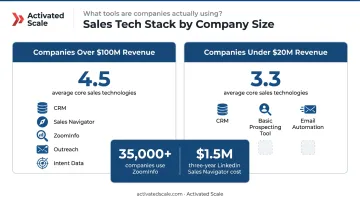
Fortune 500 outsourced sales teams arrive with fully configured tool stacks: platforms like LinkedIn Sales Navigator, ZoomInfo (which serves over 35,000 companies as a GTM intelligence platform), and sales engagement tools like Outreach. Bridge Group found that companies over $100M in revenue use an average of 4.5 core sales technologies, versus 3.3 for companies under $20M.
The operational advantage for clients: the outsourced team handles tool configuration, data hygiene, workflow optimization, and license management. Clients get the output of a mature sales tech stack — without building or maintaining any of it.
The Business Case: Cost, Speed, and Scalability
What Internal Hiring Actually Costs
The salary benchmarks alone are instructive. According to RepVue's 2026 Sales Salary Guide:
- SDR median base: $60K / OTE: $85K
- Enterprise AE median base: $135K / OTE: $265K
- Strategic AE median OTE: $300K
Add benefits (typically 25–30% of base salary), recruiting fees, onboarding costs, and tools — and a single SDR hire can easily exceed $120K in year-one costs before closing a dollar. That's before accounting for the 5.7-month average ramp period, during which output is partial at best.
Speed-to-Revenue
Outsourced sales teams can be deployed in days, not months, with pipeline activity starting almost immediately and no ramp risk to absorb. For a startup with a six-month runway or a product launch on a fixed timeline, that difference isn't marginal — it's the whole game.
Scalability Without HR Complexity
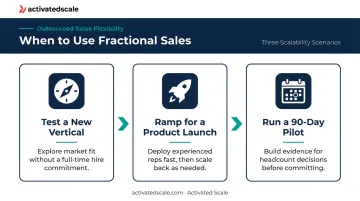
Outsourced models let companies scale volume up or down without hiring freezes, layoffs, or restructuring. During a market test or new product launch, a company can deploy outsourced capacity for a defined window, assess results, and make evidence-based decisions about permanent investment.
That flexibility matters most when the outcome is still uncertain:
- Test a new vertical without committing to a full-time hire
- Ramp up capacity for a product launch, then pull back after
- Run a 90-day pilot before making permanent headcount decisions
Risk Reduction
A bad full-time sales hire costs months of salary plus re-hiring time. An outsourced engagement can be adjusted, restructured, or concluded without the same organizational disruption. Instead of betting everything on one hire, companies can course-correct quickly — and cheaply.
How Startups Can Apply the Same Playbook
The Fortune 500 outsourced sales playbook isn't exclusively an enterprise tool. Early-stage B2B companies — particularly those at seed to Series A — often need it more, because they lack the internal sales infrastructure, brand recognition, and pipeline volume that large companies have built over years.
The Fractional Model as the Startup Entry Point
Rather than a long-term, high-volume outsourced engagement, early-stage companies can access experienced B2B sales professionals on a fractional basis — getting enterprise-caliber outreach capability without full-time overhead.
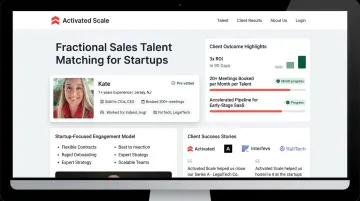
Platforms like Activated Scale connect B2B SaaS startups with pre-vetted fractional sales talent — SDRs, AEs, Sales Directors, and VPs of Sales — in 7 days or less, sometimes within 48 hours. Their talent network includes professionals with backgrounds at Salesforce, Oracle, IBM, Zendesk, Datadog, and ZoomInfo.
Activated Scale accepts only about 7% of SDR applicants and the top 5% for AE roles. The vetting is rigorous by design, not a formality.
The engagement model is built for startup risk tolerance:
- Initial 3-month contracts with a try-before-you-buy structure
- Clear KPIs established before outreach begins
- Option to convert to a full-time hire at any point
Roughly 85% of startups end up hiring their fractional professional full-time after the initial contract.
The results back this up. Clients like Dresma.ai reported a 5x increase in meetings with qualified prospects after hiring a fractional SDR. Flock Homes averaged 14 qualified meetings set per month over six months.
Where to Start
For resource-constrained startups, don't try to implement all six enterprise strategies simultaneously. Prioritize in this order:
- ICP definition — get rigorous about who you're targeting before outreach begins
- Structured multi-touchpoint cadence — build a repeatable sequence across email, phone, and LinkedIn
- Omnichannel integration and ABM — layer these in once the foundation produces results
Getting ICP definition and cadence right with an experienced fractional professional produces outsized early results. The complexity can come later.
What to Look for in an Outsourced Sales Partner
Non-Negotiable Vetting Criteria
- Sold to your specific ICP before, ideally at your deal size and buyer title
- Follows a repeatable process — not just a tool stack with no methodology behind it
- Reports on qualified meetings booked, pipeline value, and conversion rates (not just activity)
- Aligns on your ICP definition before the first outreach goes out
What Good Partnership Looks Like
The best outsourced sales partners don't just hand over leads. They collaborate on messaging, incorporate feedback from closed/lost deals, and continuously optimize based on discovery call learnings. That feedback loop is what separates a true partner from a vendor who's simply filling a calendar.
That distinction becomes easier to spot once you know what the red flags look like.
Warning Signs to Avoid
- Vague promises about lead volume without defined qualification criteria
- Unwillingness to share methodology, call recordings, or sample outreach
- No track record in your specific market segment or deal size
- Success metrics defined only by outreach volume, not qualified pipeline
Frequently Asked Questions
What does outsourced sales mean?
Outsourced sales means hiring an external team or partner to handle some or all sales functions — such as prospecting, SDR work, or full-cycle selling — instead of building that capacity in-house. It can cover a single function like lead generation or a full program spanning pipeline management and closing.
How big is the outsourced sales market?
Zion Market Research estimated the global outsourced sales services market at $2.71 billion in 2024, projected to reach $4.21 billion by 2034 at a 4.5% CAGR. That estimate covers both B2B and B2C outsourced sales services.
Can startups use the same outsourced sales strategies as Fortune 500 companies?
Yes. The core strategies — ICP definition, structured outreach cadences, and data-driven prospecting — are accessible to startups through fractional and modular outsourced models, often at a fraction of the cost of a single full-time sales hire.
What's the difference between outsourced sales and a fractional sales team?
Outsourced sales typically refers to engaging an agency or service provider for defined sales functions. A fractional sales team refers to individual experienced professionals who work part-time as embedded team members — usually more deeply integrated into daily operations than a traditional outsourced arrangement.
What sales functions do Fortune 500 companies most commonly outsource?
The most commonly outsourced functions include outbound prospecting and SDR work, appointment setting, market research and ICP mapping, and geographic or vertical expansion efforts. Account closing is typically retained in-house.
How do you measure the success of an outsourced sales program?
Key metrics include qualified meetings booked, pipeline value generated, meeting-to-opportunity conversion rate, and revenue attributed to outsourced activity. The emphasis should be on qualified pipeline, not raw outreach volume — activity metrics without qualification standards are misleading.