
Introduction
You've set revenue targets. Investors want to see growth. But building a sales function from scratch — hiring, onboarding, managing, coaching — pulls you away from the product work that got you funded in the first place.
Most B2B SaaS founders end up in the same position: running pipeline reviews between product sprints, managing rep performance without a sales background, and wondering why the revenue number keeps sliding despite having people on the floor.
The "just hire a VP of Sales" advice sounds clean until you price it out. Glassdoor's 2026 data puts average VP of Sales compensation at $306,542 — before equity, benefits, and the 3-4 months it takes to fill the role. For a seed-stage company, that's an enormous single-point bet.
Outsourced sales management offers a different path: experienced sales leadership at a fraction of that cost, available in days rather than months, with no long-term headcount commitment.
What follows covers what outsourced sales management actually is, the specific advantages it creates, and what early-stage companies risk by skipping it.
TL;DR
- Outsourced sales management delivers experienced sales leadership without full-time compensation costs or a 3-4 month hiring process
- It installs a repeatable sales process and accountability structure most early-stage teams are missing
- Founders reclaim time previously spent managing reps and chasing pipeline updates
- Revenue becomes more predictable when results are driven by a repeatable system rather than any single rep's performance
- Consistent coaching and process compound over time — typically outpacing what a single internal hire delivers at the same cost
What Is Outsourced Sales Management
Outsourced sales management is the practice of engaging an external, experienced sales leader to manage, coach, and build accountability within your sales function — whether as a fractional hire or through a scoped engagement.
It applies most directly to early-stage and growth-stage B2B companies that have salespeople or founders doing sales, but no dedicated sales leader above them to install process, drive performance, and own the revenue outcome.
Where It Fits in the Sales Stack
This is not a staffing workaround or a temporary fix. Outsourced sales management is a mechanism for building a consistent, repeatable revenue system at a stage when the business cannot yet justify a full-time VP of Sales — or when the risk of a bad hire is simply too high.
Platforms like Activated Scale make this concrete: startups can engage vetted, US-based fractional sales professionals — with backgrounds at Salesforce, Oracle, IBM, Zendesk, and Datadog — in 7 days or less. That's a different proposition than a 4-month executive search followed by a 9-month ramp.
The engagement model is specific: fractional sales managers typically work 15-20 hours per week, scoped to what the business actually needs. That scope covers the full management layer:
- Pipeline review cadences and forecast accountability
- Rep coaching and performance management
- Sales playbook development
- Hiring support and onboarding structure
All without adding full-time headcount.
Key Advantages of Outsourced Sales Management
The advantages below connect directly to metrics early-stage B2B startups are accountable to: revenue growth, cost efficiency, pipeline reliability, and founder bandwidth.
Cost-Efficient Access to Senior Sales Expertise
Hiring a full-time VP of Sales is expensive in ways that go beyond base salary. SHRM estimates that recruiting, hiring, and onboarding a single new employee can reach $240,000 — and that's before the salary itself. Add equity, benefits, and the opportunity cost of a 9-month ramp to full productivity, and the total exposure on a single VP of Sales hire becomes substantial.
The risk compounds at the early stage. SaaStr's operator data suggests roughly 8 out of 10 first VP of Sales hires at startups fail, averaging about 11 months before the relationship ends. For a seed-to-Series A company with under 10 salespeople, that failure isn't just expensive — it sets the team back by a year.
Outsourced sales management changes the math:
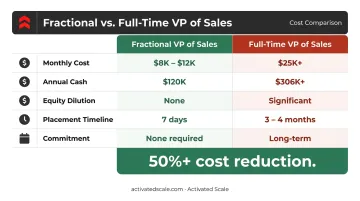
- Fractional VP of Sales engagements typically run $8,000-$12,000 per month
- Engagements are scoped to 15-20 hours per week — the leadership bandwidth the business actually needs
- No equity, no benefits overhead, no long-term commitment required upfront
- Placement in 7 days or less vs. a 3-4 month traditional hiring timeline
A fractional engagement at $10,000/month costs $120,000 annually in cash — less than half the base salary of a full-time VP, with none of the equity dilution or termination risk. That difference can go directly into pipeline activity, additional rep headcount, or product development.
Most relevant for: Seed to Series A companies with fewer than 10 salespeople, where a single leadership hire represents an outsized percentage of total payroll.
Accelerated Pipeline Consistency and Revenue Predictability
The most common sales problem in early-stage B2B startups isn't a shortage of salespeople. It's the absence of a repeatable process that produces predictable output.
When every rep runs their own version of the pitch, pipeline becomes a collection of individual habits. Forecasting is unreliable. Revenue is concentrated in one or two people who happen to be good. Growth looks like peaks and valleys rather than a trend line.
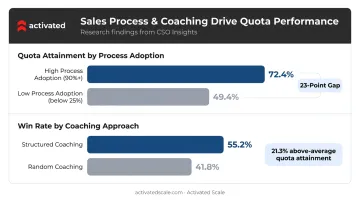
The data on this is direct. CSO Insights found that when sales process and methodology adoption exceeded 90%, quota attainment reached 72.4%. When adoption fell below 25%, attainment dropped to 49.4% — a 23-point gap driven entirely by process consistency, not rep talent.
The coaching dimension matters just as much. The same research found dynamic, structured coaching produced a 55.2% win rate versus 41.8% for random coaching. Quota attainment was 21.3% above average when coaching was systematic. That's not a marginal difference.
An outsourced sales manager addresses both sides of this:
- Defines the sales methodology from day one rather than waiting months for an internal hire to diagnose and build it
- Sets benchmarks for pipeline created, meetings booked, and conversion by stage — so problems surface in the data before they become revenue shortfalls
- Ties rep performance to behaviors, not just outcomes, catching issues before they compound
KPIs affected: Pipeline-to-close ratio, quota attainment across the team, forecast accuracy, average deal cycle length.
Most relevant when: Revenue is concentrated in one or two people, or pipeline results vary significantly rep-to-rep — both signals that the business has built a dependency, not a system.
Founder Time Reclaimed for Strategy and Growth
There's a pattern that plays out at almost every seed-stage B2B startup: the founder becomes the de facto sales manager. They're running 1:1s, reviewing pipeline, handling escalations, and coaching reps on calls — while simultaneously owning product, fundraising, customer success, and hiring.
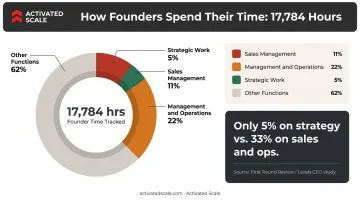
A five-year time-tracking study published by First Round Review puts numbers on this. Levels CEO Sam Corcos tracked 17,784 hours building the company.
Sales consumed 11% of total time. Management and operations consumed 22%. Strategic work — the work most founders believe they should be doing — accounted for just 5%.
That inversion is costly. Not just in hours, but in decisions not made.
When a founder is running pipeline reviews, they're not:
- Making product decisions that affect retention
- Building investor relationships ahead of the next round
- Leading hiring conversations that would compound the team
- Developing partnerships that open new market segments
Outsourced sales management eliminates this drain directly. An experienced external leader takes full ownership of the sales management function — coaching cadence, pipeline hygiene, accountability reviews, rep development — allowing the founder to engage with sales at a strategic level rather than an operational one.
Founders who exit the day-to-day of sales management don't just get time back. They accelerate across multiple functions simultaneously — because attention is no longer fractured across operational tasks that a dedicated manager should own.
Most relevant for: Seed-stage companies where the founder is the only person capable of driving product and fundraising simultaneously — and where operational sales management is the biggest drag on that capacity.
What Happens When Outsourced Sales Management Is Missing
Skipping structured sales leadership doesn't create a neutral outcome. It creates a specific set of problems that compound over time.
The Pattern That Emerges
Without a management layer, pipeline becomes a collection of individual rep habits. Top performers develop their own methods, process consistency drops, and forecasting becomes guesswork. Without a management layer, pipeline becomes a collection of individual rep habits. Top performers develop their own methods, process consistency drops, and forecasting turns into guesswork.
When a top performer leaves — and turnover hits harder than most founders expect — the revenue impact is immediate.
The data on turnover is concrete. DePaul University's sales research puts the average cost of replacing a single salesperson at $97,690, with annual inside sales turnover running at 26.9%. CSO Insights found that disengaged sales teams showed voluntary turnover of 10.2% versus 5.7% for engaged teams.
The Reactive Cycle
What follows is predictable. Founders step back in to manage sales every time something breaks: a missed quarter, a rep resignation, investor pressure. Short-term firefighting delays the structural fix, and the underlying process gaps remain.
Process problems that are manageable at 2-3 reps become organizational failures at 5-10 reps. Without a management layer in place early, adding headcount makes consistency worse. The compounding effects include:
- Inconsistent onboarding that slows new reps to full productivity
- No shared playbook, so each hire reinvents the approach
- Forecasting errors that erode leadership confidence
- Culture drift that accelerates further attrition
Rebuilding process and culture under pressure costs far more — in time, money, and momentum — than establishing that foundation before scaling.
How to Get the Most Value from Outsourced Sales Management
Outsourced sales management delivers the strongest results when the engagement begins with a clear diagnostic — understanding where the sales process is actually breaking down before building a plan. Organizations that skip assessment and jump to execution often fix the wrong problem.
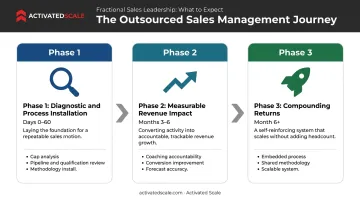
What the Timeline Looks Like
- Days 0-60: Diagnostic and process installation — identifying gaps in pipeline creation, qualification, conversion, and account development
- Months 3-6: Measurable revenue impact begins to appear as coaching and accountability take effect across the team
- Month 6+: Compounding returns as process becomes embedded and reps operate from a shared methodology
Evaluate progress against lead metrics (meetings booked, pipeline created, conversion rates) in the first 90 days. Revenue-level lag metrics reflect the change later, depending on deal cycle length.
Reducing Risk with the Right Engagement Model
For B2B SaaS startups specifically, a low-commitment, try-before-you-buy model reduces the risk of misalignment. Activated Scale's contract-to-hire approach lets startups validate fit before making a longer-term commitment. About 85% of clients who start fractional engagements convert that person to a full-time hire — a reflection of how consistently the match holds up in practice.
When evaluating partners, ask:
- Do they assess before prescribing, or jump straight to a playbook?
- Do they have experience with your specific stage and deal size?
- Is the engagement model flexible, or locked into a minimum term?
- Can they show real outcomes with companies at a similar growth stage?
Conclusion
Outsourced sales management delivers something most early-stage startups can't build fast enough on their own: expert leadership, repeatable process, and predictable revenue — without the six-figure salary commitment or the three-month search. Founders get their time back. The pipeline stops depending on one person's personality. And the business has a foundation worth scaling on.
For B2B SaaS startups, the real risk isn't moving too fast — it's committing to a full-time sales hire before the process, playbook, or pipeline is proven. Outsourced sales management lets you validate the model first, then scale with confidence.
The companies that grow fastest aren't the ones with the biggest sales teams. They're the ones that got the right sales leadership in place early. That's a decision you can make this week, not six months from now.
Frequently Asked Questions
What is the difference between outsourced sales management and a fractional sales manager?
A fractional sales manager refers to the individual engagement model — part-time, often shared across clients. Outsourced sales management is the broader practice, which may include fractional, contract, or program-based models. One describes the format of the engagement; the other describes the function.
How quickly can outsourced sales management start producing results?
Lead metrics — pipeline creation, meetings booked, conversion rates — typically begin moving within the first 60-90 days as process and accountability are installed. Revenue-level results generally reflect the change at the 3-6 month mark, depending on your deal cycle length.
Is outsourced sales management cost-effective for early-stage SaaS startups?
Yes, particularly compared to the total compensation and ramp cost of a full-time VP of Sales. Fractional engagements typically run $8,000-$12,000 per month, with no equity, benefits, or long-term commitment required — significantly less than a full-time hire at a comparable experience level.
Does outsourced sales management replace existing salespeople?
No. It adds the leadership layer above an existing team. The goal is to make current salespeople more effective through structured coaching, process, and accountability — not to replace them with outside resources.
How do I know if my startup is ready for outsourced sales management?
The clearest signals: you're still managing the sales team by default, pipeline is inconsistent across reps, revenue is concentrated in one or two people, or the team has sales talent but no consistent process or coaching cadence.
What should I look for when choosing an outsourced sales management partner?
Key things to evaluate:
- Do they assess your situation before recommending a solution?
- Do they have experience at your specific stage and deal size?
- How flexible is the engagement model?
- Can they show a track record with comparable companies?
References from founders at similar stages matter more than generic case studies.