Introduction
Your product works. Early customers are happy. But turning that traction into consistent revenue requires more sales capacity than you can personally provide — and hiring a full-time rep feels premature when you're still burning cash and refining your pitch.
This is the exact moment many B2B SaaS founders get stuck. A full-time SDR costs well over $80,000 fully loaded before you've even validated whether outbound can work for your product. The wrong hire sets you back six months. But doing nothing means the pipeline stays empty.
Outsourced sales reps offer a practical middle path: experienced sales professionals who work your pipeline on a contract or fractional basis, without the overhead of a permanent hire. Seed-to-Series A startups are increasingly turning to this model because it lets you move fast without locking into headcount you're not ready for.
What follows breaks down how outsourced reps actually work, what they cost, and what to look for when choosing one.
Key Takeaways
- Outsourced sales reps are external sales professionals working on contract or fractional terms — not full-time employees
- They handle prospecting, outreach, qualification, and in some cases full-cycle closing
- For early-stage B2B startups: faster pipeline, lower cost, and immediate access to experienced talent
- Pricing typically runs $3,500–$7,500/month for fractional SDRs and AEs, versus $80,000+ fully loaded for an in-house hire
- Qualified meetings typically start appearing within 30–45 days — with outreach launching in under two weeks
What Are Outsourced Sales Reps?
An outsourced sales rep is an experienced sales professional who works for your company on a contract or part-time basis — not a full-time employee, but not a vendor operating at arm's length either.
Done right, they function as an extension of your team: embedded in your workflow, using your CRM, selling your product to your market.
How This Differs From a Sales Agency
The distinction matters. A sales outsourcing agency is a vendor that manages your sales function as a service — typically at arm's length, with their own team, their own process, and limited day-to-day integration. An outsourced or fractional sales rep is an individual contributor working directly within your motion, reporting to you, and building on your playbook.
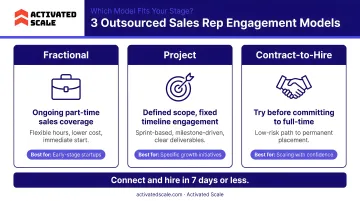
The Three Engagement Models
| Model | Structure | Best For |
|---|---|---|
| Fractional | Part-time, ongoing retainer (15–20 hrs/week) | Startups needing consistent pipeline without full headcount |
| Project-based | Defined scope, short-term | Testing outbound in a new market or segment |
| Contract-to-hire | Temporary role with full-time conversion option | De-risking a first sales hire before committing |
For most Seed-to-Series A B2B SaaS companies, fractional is the most common starting point. It provides consistent activity without locking in long-term employment costs. Contract-to-hire becomes relevant once you've seen the rep sell your product and want to bring them in permanently.
What Does an Outsourced Sales Rep Do?
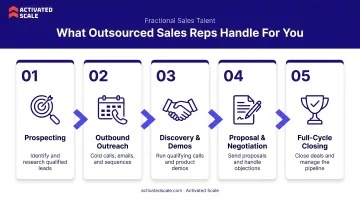
Outsourced sales reps can own nearly every stage of the revenue pipeline — from cold outreach to closed deals. Here's what that looks like in practice:
Prospecting and Outreach
Outsourced reps identify target accounts and decision-makers based on your ideal customer profile, then execute multi-channel outreach via cold email, LinkedIn, and cold calls. For early-stage SaaS, this means building lists, writing sequenced messaging, testing subject lines, and iterating on reply rates.
Plan for a 2–3 week ramp before outreach volume hits a consistent cadence.
Lead Qualification
Not every response is worth a founder's time. Outsourced reps evaluate leads against basic qualification criteria — budget, authority, need, timeline — so only sales-ready prospects land on your calendar. This is particularly valuable for technical founders who tend to spend discovery calls educating prospects rather than qualifying them.
Meeting Setting and Pipeline Building
The clearest success metric for an SDR-type engagement is meetings booked per month. Activated Scale clients booking through fractional SDRs report 10–15 qualified meetings per month by month three — from reps working 15–20 hours per week.
CRM Management and Reporting
Outsourced reps log activity in your CRM, maintain contact records, track pipeline stages, and report on outreach performance. Because all tools and data are client-owned (this is standard practice at Activated Scale), founders retain full visibility and ownership even if the engagement ends.
Full-Cycle Closing (AE Engagements)
Some outsourced reps are brought in specifically to own the full sales cycle — running demos, handling objections, and closing contracts. This is common at early-stage companies with no internal sales capacity. Fractional AEs at Activated Scale have helped clients win $50,000 to $250,000 in new revenue per month, depending on deal size and sales cycle length.
Key Benefits of Hiring Outsourced Sales Reps
Faster Time-to-Revenue
A full-time SDR hire typically takes 2–3 months to recruit and another 3–6 months to ramp to full productivity. An experienced outsourced rep can start outreach within two weeks of engagement start. For a startup that needs pipeline before a fundraise or growth milestone, that gap can determine whether you hit your numbers.
Activated Scale connects clients with pre-vetted fractional talent in 7 days or less — sometimes within 48 hours — with outreach beginning in the second week of engagement.
Access to Proven Talent Without Full-Time Risk
The fractional model gives startups access to reps who have already sold at companies like Zendesk, IBM, Salesforce, and others — without having to win a competitive offer process to hire them. Activated Scale's three-step vetting process (application review, pitch video assessment, subject matter expert interview) filters for actual sales ability, not just impressive titles. Founders also save 20+ hours of interviewing time per hire compared to running a traditional recruiting process.
Lower Overhead and Hiring Risk
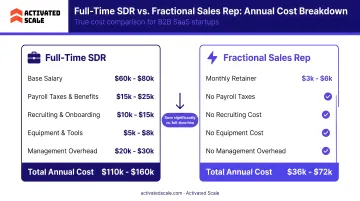
A fully loaded in-house SDR carries significant costs that most founders underestimate going in:
- Base salary: $50,000–$75,000 (Betts Recruiting, 2024)
- Variable pay: 33–40% on top of base
- Benefits: ~29.7% of total compensation (BLS, March 2025)
- Recruiting fees: 18–30% of first-year salary
- Tools, onboarding, management time: additional overhead
Compare that to a fractional SDR starting at $3,500/month plus commission — no benefits, no recruiting fees, no equity dilution.
HBR notes that replacing a bad hire costs anywhere from tens of thousands to hundreds of thousands of dollars. At the early stage, a wrong sales hire can cost $35,000+ in salary alone before you've even factored in lost pipeline and wasted ramp time.
Scalability and Validation
Two additional advantages that matter specifically at the early stage:
- Scale without headcount: You can add sales capacity during a growth push and pull back without severance, layoffs, or legal complexity
- Validate before committing: The contract-to-hire model lets you see a rep sell your product to your market before converting to full-time — eliminating the most common and costly early sales hiring mistake
About 85% of Activated Scale clients convert their fractional SDRs to full-time hires after the initial contract. The model is a low-risk onramp to permanent headcount — not a substitute for it.
Outsourced Sales Rep vs. In-House Sales Hire
| Dimension | In-House Hire | Outsourced/Fractional Rep |
|---|---|---|
| Time to start | 2–4 months (recruiting + notice period) | 7–14 days |
| Ramp to productivity | 3–6 months | Immediate domain expertise |
| Cost structure | Fixed salary + benefits + equity | Monthly retainer + commission |
| Flexibility | Long-term commitment | Month-to-month, scalable |
| Mis-hire risk | High — expensive to unwind | Low — easy to replace or end engagement |
| Cultural integration | Deep over time | Collaborative but independent |
When In-House Makes More Sense
- You've validated the sales motion and need someone deeply embedded in culture
- You're running a complex enterprise sale that requires long relationship-building
- You have budget for a 3–6 month ramp period with no guaranteed output
When Outsourced Makes More Sense
- You're still testing your messaging and need to validate whether outbound works
- You're running lean and can't absorb a full-time salary before revenue justifies it
- You need pipeline in the next 60–90 days for a fundraise or board milestone
- You want to validate a rep before making them permanent
The Hybrid Path
Many B2B startups use an outsourced rep to prove the sales motion and build the playbook, then convert that same rep to full-time via a contract-to-hire arrangement. The outsourced engagement builds the foundation — documented process, proven messaging, early pipeline — so the full-time hire inherits a working system rather than starting from scratch.
How Much Does It Cost to Hire an Outsourced Sales Rep?
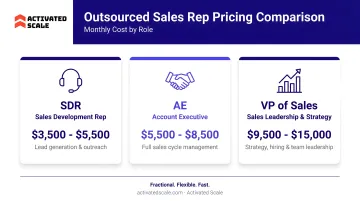
Pricing varies by role, experience level, and engagement model. Here are realistic 2024–2025 ranges:
| Role | Monthly Cost (Retainer + Commission) | Hours/Week |
|---|---|---|
| Fractional SDR/BDR | $3,500–$4,500/mo + commission | 15–20 hrs |
| Fractional Account Executive | $4,500–$7,500/mo + commission | 15–20 hrs |
| Fractional VP of Sales | $8,000–$15,000/mo + bonus | Varies |
These figures are based on Activated Scale's published pricing for US-based fractional sales talent.
What's Included vs. What You Provide
Typically included:
- The rep's time, expertise, and sales execution
- Matching and vetting (through platforms like Activated Scale)
- Free rematch if the initial fit isn't right
Typically provided by the client:
- CRM access and sales tools (email sequencing, LinkedIn Sales Navigator, data enrichment)
- Prospect lists and ICP criteria
- Onboarding materials, product information, and call scripts
Confirm scope upfront — tool costs can add $500–$1,500/month depending on what you're already running. Once you have a clear picture of total spend, the comparison to full-time hiring becomes straightforward.
The Full-Time Comparison
A mid-experience in-house SDR with a $65,000 base, OTE variable, benefits, and a 20% recruiting fee totals $100,000–$120,000 in year one — before tools and management overhead. A fractional SDR at $3,500–$4,500/month costs $42,000–$54,000 annually, with no benefits burden, no equity dilution, and no ramp risk.
How to Hire the Right Outsourced Sales Rep
Define Your ICP and Success Metrics First
Before any conversation with a rep or platform, get clear on:
- Who you're selling to (role, company size, industry)
- Target deal size and average sales cycle
- What success looks like in months 1, 2, and 3 (meetings/month, pipeline created, revenue closed)
The clearer your brief, the faster any rep can execute. Outsourced reps aren't substitutes for a founder who hasn't figured out the buyer yet — they accelerate a motion you've already started to prove.
Evaluate for Relevant Experience, Not Just Credentials
Look for reps who have sold to your specific buyer type at your deal size — not just impressive company logos. Ask for:
- Specific deals closed at comparable ACV
- Common objections they've encountered and how they handle them
- Pipeline metrics from prior engagements (meetings set per month, conversion rates)
Activated Scale matches clients based on buyer persona and ACV experience. The network includes talent from Zendesk, IBM, and other enterprise software companies, each matched to your specific market and deal size.
Start With a Pilot Period
Don't commit to a 12-month contract before you've seen the rep sell your product. Start with a defined pilot — typically 3 months — to validate fit, messaging, and output.
Activated Scale's try-before-you-buy model is built around this: fractional engagements run month-to-month, with a conversion fee only payable if you hire the rep full-time. No upfront staffing agency fees during the contract period.
By the end of a 3-month pilot, you should be able to evaluate:
- Outreach volume and response rates from real prospects
- Whether messaging is resonating or needs adjustment
- Pipeline quality — not just meetings booked, but qualified opportunities created
Frequently Asked Questions
What does an outsourced sales rep do?
Outsourced sales reps handle prospecting, multi-channel outreach, lead qualification, and meeting setting — acting as an extension of your team without a full-time employment commitment. In full-cycle engagements, they also run demos, manage objection handling, and close deals.
How much does it cost to hire an outsourced sales rep?
Fractional SDRs typically run $3,500–$4,500/month plus commission; fractional AEs run $4,500–$7,500/month plus commission. Costs vary by experience level, scope, and whether tools are included. Compared to a fully loaded in-house hire at $100,000–$120,000/year, fractional is significantly more cost-effective at the early stage.
Is it legal to hire an outsourced sales rep in the US?
Yes. Most outsourced reps are classified as independent contractors (1099) rather than employees (W-2), but classification hinges on behavioral control, financial control, and the nature of the relationship — not just what the contract says. The DOL's 2024 totality-of-circumstances rule means founders should consult legal counsel to confirm correct classification.
What's the difference between an outsourced sales rep and a fractional sales rep?
The terms are often used interchangeably. "Fractional" typically describes a part-time senior sales professional working across multiple clients, while "outsourced" can apply to any external sales resource regardless of seniority or hours.
How do I know if my startup is ready to hire an outsourced sales rep?
If you have a defined product, a clear target buyer, and pipeline generation is falling entirely on the founder, you're ready. You don't need a fully built sales playbook — an experienced fractional rep can help develop it. Most founders make this transition after closing their first 10–20 customers or reaching roughly $1M ARR.
How quickly can an outsourced sales rep start generating results?
Experienced outsourced reps typically begin outreach in week two and generate qualified meetings within the first 30–45 days. Activated Scale clients see 10–15 qualified meetings per month by month three — compared to 3–6 months for a new full-time hire to reach comparable productivity.