For Seed-to-Series A founders, this decision carries real consequences. Every dollar spent on the wrong model is runway you won't get back. Hire in-house too early and you're absorbing salary, benefits, and a 3–6 month ramp with no guarantee of results. Move too slowly while waiting for the "perfect" hire and your pipeline stalls while competitors close deals.
Neither model is inherently superior. But the right choice depends on where you are in your growth journey — and understanding the real tradeoffs before you commit can save you both money and months.
Key Takeaways
- In-house SDRs bring strong product knowledge, but hiring, onboarding, and ramp-up typically takes 3-6 months before pipeline appears
- Fractional SDRs start booking meetings in weeks, not months, with lower upfront cost and less hiring risk than a full-time hire
- True in-house SDR cost includes recruiting, benefits, tools, management time, and ramp-up — often 2x the base salary
- Early-stage startups with thin bandwidth typically get faster ROI from fractional talent before committing to full-time headcount
- The right choice depends on your growth stage, internal resources, and how urgently you need qualified meetings
In-House vs Outsourced SDR: Quick Comparison
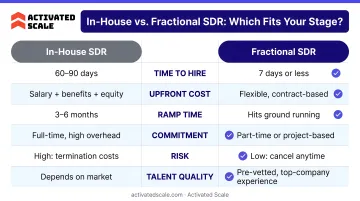
| Dimension | In-House SDR | Outsourced / Fractional SDR |
|---|---|---|
| Cost to Start | $85,000+ OTE plus benefits, tools, and recruiting fees | From ~$3,500/month (retainer + commission) |
| Time to First Meeting | 4–7 months (hiring + ramp) | 30–45 days |
| Scalability | Slow — each hire requires recruiting and ramp | Fast — add capacity without full-time headcount |
| Brand Control | High — direct oversight and cultural alignment | Moderate — depends on onboarding quality |
| Management Overhead | High — daily coaching, CRM hygiene, performance management | Lower — provider handles day-to-day operations |
| Flexibility | Low — termination is costly and disruptive | High — cancel or swap without long-term commitment |
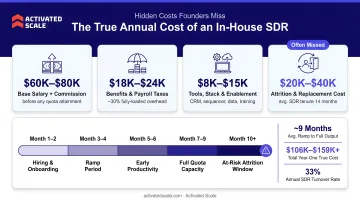
A note on "true cost": The in-house figures above don't include recruiter fees (often 15–20% of OTE), sales tool licenses, CRM costs, or the opportunity cost of 3–6 months with no pipeline production. The real first-year cost of an in-house SDR can easily exceed $120,000–$140,000 — before they've booked a single meeting.
In-House SDR Teams: Pros and Cons
An in-house SDR is a full-time employee you recruit, hire, onboard, train, manage, and retain. They work exclusively on your pipeline and represent your brand in every prospect conversation.
The Case For Building In-House
The core advantages are real — especially for technical B2B products with complex use cases or long sales cycles:
- Deep product knowledge: In-house reps develop nuance over time that translates directly in prospect calls and is hard to replicate externally
- Message control: Founders can shape how the company is represented, pivot messaging quickly based on market feedback, and stay aligned with the sales narrative
- Career path ROI: Strong SDRs can grow into AE, customer success, or sales leadership roles — investing early compounds as you build toward a larger org
The Real Cost Picture
This is where most founders underestimate in-house SDRs. According to RepVue's verified salary data, the median SDR base salary is $60,000, with a median OTE of $85,000 and only 55.2% quota attainment — meaning most SDRs won't hit their number in any given quarter.
Layer on:
- Benefits: The Bureau of Labor Statistics reports benefits add roughly 29.9% to employer costs on top of wages
- Recruiting: Agency fees typically run 15–20% of first-year OTE
- Sales tools: Sequencing software, CRM licenses, data enrichment — these add up fast
- Ramp time: The Bridge Group's 2024 research found the average SDR ramp is 3 months ± 2 weeks, with vacancy fill taking 25–30 days on top of that
That's roughly 4–5 months from decision-to-hire before you're seeing full productivity. For an early-stage company, that's a significant bet.
Attrition Is the Hidden Multiplier
SDR turnover is genuinely high. SaaStr's 2024 community poll put average SDR tenure at about 14 months, with 52% of companies not seeing their SDRs last even 12 months. The Bridge Group's planning guidance puts normal SDR attrition at 40–50% annually.
Every departure resets the ramp clock. For a startup without dedicated HR or an SDR manager, that recurring recruitment cost — in time and money — is a serious operational risk.
Outsourced SDR Teams: Pros and Cons
Outsourced SDR providers are external agencies or fractional sales professionals who manage prospecting, outreach, and pipeline-building on your behalf. They bring their own processes, tooling, and management — and you engage them on a contract or retainer basis rather than as full-time employees.
Why Outsourcing Moves Faster
The primary advantage is time-to-pipeline. Outsourced and fractional teams arrive with established workflows, trained reps, and existing tech stacks. Outsourced SDR programs can show pipeline within six weeks of launch — versus the 4–5 month timeline for in-house reps once you account for hiring and ramp (vendor-published figures; no independent analyst benchmark exists).
For startups that need to demonstrate pipeline to investors or validate ICP assumptions quickly, this speed difference is material.
Cost Structure and Flexibility
Outsourcing converts a fixed headcount cost into a predictable monthly fee. You avoid benefits, payroll overhead, and tool licenses — and you can scale engagement up or down without the friction of hiring or terminating employees.
Outsourced SDR retainers typically range from $3,000–$8,000/month (vendor-published figures — no independent analyst benchmark exists), compared to a fully loaded in-house SDR cost that can exceed $120,000 annually before accounting for turnover.
Activated Scale's Fractional Model
Those cost ranges reflect what most outsourced engagements look like. Activated Scale's fractional model sits at the lower end — and adds a structure most agencies don't offer. B2B SaaS startups access a network of vetted, US-based fractional SDRs on a try-before-you-buy basis, starting at $3,500/month plus commission, with no long-term commitment required.
Key mechanics of how it works:
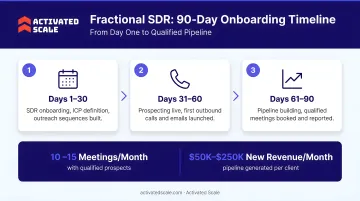
- Days 1–15: Onboarding — the fractional SDR learns your company, ICP, buyer personas, and why customers churn
- Days 16–45: Active outreach begins across email, phone, and LinkedIn; messaging is tested and refined
- Day 46+: Consistent qualified meetings appear on your calendar
By Month 3, most clients book 10–15 qualified meetings per month. Flock Homes' Director of Revenue Operations reported their fractional SDR averaged 14 new meetings set each month over 6 months. Althub's co-founder reported 11 qualified meetings per month.
Activated Scale accepts only about 7% of SDR applicants to its network, using a three-step vetting process that includes a pitch video, peer review, and a video interview with a subject matter expert.
Legitimate Concerns Worth Addressing
Outsourced reps work across multiple clients and may not internalize your product nuances without deliberate onboarding. The risks worth watching for: messaging that misses your buyer's language, shallow ICP understanding, and inconsistent positioning across touchpoints.
What strong onboarding looks like in practice:
- Clear ICP documentation before outreach begins
- Product training and a messaging playbook with objection-handling scripts
- Regular feedback loops (weekly check-ins, monthly performance reviews)
- Shared metrics tied to a Statement of Work
Transparency is the other concern. Unlike in-house reps you see daily, outsourced teams can feel like a black box. Look for engagements that include CRM integrations and defined KPIs in a signed SOW.
A weekly meeting cadence — where you review actual pipeline metrics together — closes most of that visibility gap.
Which Model Fits Your Stage?
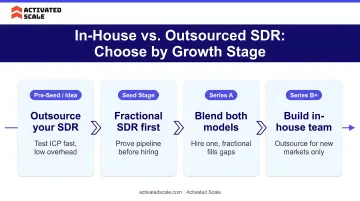
Growth stage and internal bandwidth are the most decisive factors here.
Choose In-House When:
- You've already validated outbound and know your ICP
- You have a dedicated sales manager who can coach and support SDRs daily
- You can absorb a 3–6 month ramp without it affecting growth targets
- You're building toward a larger, long-term sales organization and want internal career paths
SaaStr recommends early-stage companies hire a pair of SDRs rather than a single rep — the comparison creates better performance data and reduces dependence on one person. That said, pairing SDRs doubles your management overhead, tool costs, and hiring risk simultaneously.
Choose Outsourced or Fractional When:
- You're at Seed or Series A and need pipeline fast — not in five months
- You want to test messaging and ICP assumptions before locking in full-time hires
- You don't have RevOps infrastructure, a sales manager, or dedicated hiring capacity
- You're running lean and need to preserve runway while still building pipeline
As OpenView notes, sales hiring should happen "just in time" — not too early, not too late. Fractional models let you build pipeline momentum without over-hiring before you're ready to support a full team.
The Hybrid Approach
The most practical answer for many growth-stage teams is a hybrid model: fractional or outsourced SDRs handle high-volume outreach or new market testing, while in-house capacity focuses on strategic accounts or enterprise relationships.
This approach works because it matches resource intensity to opportunity type. As your pipeline matures and you hire full-time, the fractional layer can shrink — or stay in place for market expansion work.
Real-World Example: Dresma.ai
Before engaging Activated Scale, Dresma.ai's co-founding team had no repeatable outbound sales strategy. Pipeline was inconsistent, and the founders lacked the bandwidth to build sales infrastructure while simultaneously developing the product.
After hiring a fractional SDR through Activated Scale, Dresma.ai implemented structured outreach with customer-focused messaging tailored to their specific buyer personas. That shift produced a 5X increase in meetings with sales-qualified prospects.
Dresma.ai didn't spend months recruiting, interviewing, and ramping a full-time SDR to test whether outbound could work. They validated the channel first — then built from there. That's the practical case for starting fractional.
If you're an early-stage B2B SaaS founder weighing this decision, Activated Scale helps you reduce the risk of sales hiring by connecting you with vetted, fractional SDRs in 7 days or less — no long-term commitment required.
Conclusion
In-house SDRs build organizational depth and give you direct control over how your brand shows up in early prospect conversations. Outsourced and fractional models trade some of that control for speed, flexibility, and lower upfront cost.
For most early-stage B2B SaaS startups, the real risk is not choosing the wrong model — it's not moving at all. Waiting months to find and ramp the ideal in-house SDR while your pipeline sits empty costs more in lost revenue than any outsourcing fee.
Start by being honest about where you are in your growth journey and what your pipeline actually needs this quarter. If speed matters more than control right now, a fractional or outsourced model — like the pre-vetted SDRs available through Activated Scale — can get you into market in days rather than months. Match the model to the moment, and adjust as you grow.
Frequently Asked Questions
Which is better: outsourced SDRs or in-house SDRs?
Neither is universally better. In-house offers deeper product knowledge and brand control for teams with the infrastructure to support SDRs. Outsourced delivers speed and cost flexibility for early-stage companies that need pipeline without the overhead of full-time hiring. The right choice depends on your growth stage and internal bandwidth.
What is the difference between outsourced SDRs and in-house SDRs?
In-house SDRs are full-time employees you recruit, manage, and develop directly. Outsourced SDRs are managed by an external provider who handles recruiting, training, tooling, and day-to-day operations. The core tradeoff is control and cultural depth versus speed and flexibility.
How much does it cost to hire an outsourced SDR team?
Vendor-published retainers typically range from $3,000–$8,000 per month. Activated Scale's fractional model starts at $3,500/month plus commission. By comparison, the fully loaded cost of an in-house SDR — including salary ($85K OTE), benefits (~30% on top), tools, and recruiting fees — can exceed $120,000–$140,000 in the first year.
How long does it take for an outsourced SDR team to start generating results?
Most outsourced providers begin outreach within 2–4 weeks, with initial meetings appearing in the first 30–45 days. In-house SDRs, by contrast, typically take 4–5 months to generate productive pipeline once you factor in a 25–30 day hiring process and a 3-month ramp (per Bridge Group data).
What is a fractional SDR and how is it different from a fully outsourced SDR team?
A fractional SDR is an experienced sales professional working part-time or on contract, embedded with your team and operating like a part-time in-house rep. A fully outsourced agency manages the SDR on your behalf, with less direct day-to-day visibility.
Can I convert an outsourced or fractional SDR to a full-time employee later?
Yes. Activated Scale's contract-to-hire model lets you evaluate performance before committing, with a conversion fee of 18% of base salary — below the 20%+ of OTE most traditional agencies charge. Around 65% of clients make that conversion after seeing results.