Introduction
Every B2B founder hits the same wall eventually: the pipeline needs to grow, but hiring a full-time SDR feels expensive, slow, and risky — while outsourcing can feel like handing off something too important to trust to strangers.
For early-stage startups, this is a runway decision — not a philosophical one.
According to Bridge Group's 2023 SDR Metrics Report, the average in-house SDR takes 3.2 months to ramp to full productivity. For a seed-stage startup, that's three months of salary, benefits, and tech stack costs before a single qualified meeting hits the calendar.
Get this decision wrong and you're not just burning money — you're burning time you don't have.
This article breaks down the real costs, tradeoffs, and decision framework for choosing between in-house and outsourced sales development — specifically for B2B SaaS startups at the seed-to-Series A stage.
TL;DR
- In-house SDRs offer control and institutional knowledge but take 3+ months to ramp at significant total cost
- Outsourced or fractional teams can start generating meetings in 2–4 weeks, with no hiring overhead
- All-in cost of one in-house SDR routinely exceeds $120,000/year — far beyond base salary alone
- For early-stage startups without a dedicated sales manager, fractional sales development typically delivers faster ROI
- Stage, budget, product complexity, and management capacity all drive the right decision
In-House vs Outsourced Sales Development: Quick Comparison
| Dimension | In-House | Outsourced / Fractional |
|---|---|---|
| Setup Time | 2–4 months to hire + 3 months to ramp | Match in 7 days; meetings within 2–4 weeks |
| Annual Cost | $120,000+ all-in per SDR | $30,000–$54,000/year (fractional retainer) |
| Scalability | Slow — requires new hires | Flexible — scale up or down monthly |
| Control Over Messaging | High — directly managed | Moderate — depends on quality of brief |
| Product Knowledge Depth | Deep over time | Shallower initially; improves with tenure |
| Risk Level | High (wrong hire = $35K+ loss) | Low (cancel anytime, swap if needed) |
| Best Fit | Established sales function, 12+ month horizon | Early-stage, limited runway, needs pipeline now |
This table is a starting point. Cost matters, but it rarely tells the whole story. The sections below walk through what actually drives the right decision at each stage of growth.
What Is In-House Sales Development?
In-house sales development means hiring full-time SDRs or BDRs as employees — integrated into your culture, reporting lines, and day-to-day operations. They handle prospecting, outreach, lead qualification, and pipeline generation entirely within your organization.
Historically, most B2B companies defaulted to this model. The logic was straightforward: tighter alignment with sales and marketing, full visibility into daily activity, and the assumption that building internally was cheaper long-term.
For companies with technically complex products and long enterprise sales cycles, deep product knowledge genuinely matters. In-house SDRs develop that over time.
Pros of In-House Sales Development
- Full messaging control — internal SDRs can be trained on nuanced positioning, respond quickly to GTM shifts, and adapt without waiting on an outside party
- Long-term capability building — a seasoned SDR team develops institutional knowledge and often serves as a pipeline for future AE or sales leadership roles
- Cultural alignment — they sit in your Slack, attend your standups, and internalize your brand in ways external teams often can't match
Cons of In-House Sales Development
The real problem with in-house SDRs isn't the concept — it's the cost structure and failure rate that most founders don't account for upfront.
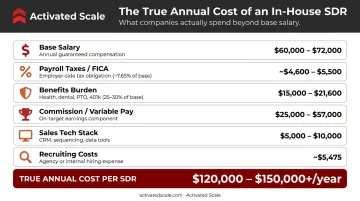
The true annual cost of one SDR adds up fast. Using current benchmarks:
- Base salary: ~$60,000 (RepVue median) to $72,000 (Glassdoor upper range)
- Employer payroll taxes (FICA): ~7.65% of salary
- Benefits burden: ~25–30% of base salary (BLS ECEC December 2024)
- Commission / variable pay: $25,000–$57,000 additional
- Sales tech stack (CRM, sequencer, data provider): $5,000–$10,000/year
- Recruiting costs: SHRM's 2025 data puts average cost-per-hire at $5,475
Add it together and a single SDR easily costs $120,000–$150,000+ per year — far more than the base salary figure most founders anchor on.
Beyond the sticker price, three hidden costs erode the ROI further:
- Ramp time: The Bridge Group pegs average SDR ramp at 3.2 months. For a startup with limited runway, that's a full quarter of payroll before the role contributes to pipeline.
- Turnover: Bridge Group's 2023 data reports average SDR tenure of just 15 months, with voluntary attrition at 40–50%. Each departure restarts the hiring cycle, adding 25–30 days of vacancy on top of another ramp period. A 10-person team with 50% attrition misses its annual production target by roughly 11%, even with timely backfills.
- Management drag: Without a dedicated SDR manager, reps drift into product demos, pricing calls, and internal meetings. Founders end up spending hours per week managing — a cost that never appears on a spreadsheet.
What Is Outsourced Sales Development?
Outsourced sales development means engaging a third-party provider to handle prospecting, outreach, and lead qualification on your behalf. The model has evolved well beyond the traditional offshore call center stereotype. Today it spans large SDR agencies, managed outbound services, and fractional sales professionals who operate as embedded, part-time team members.
The growth of this model reflects a real shift in how sales development works. Sequencing strategy, data sourcing, ICP research, and multi-channel outreach have all become specialized disciplines. For a startup without an existing sales infrastructure, building that expertise from scratch while simultaneously shipping product and closing customers is rarely the fastest path.
Grand View Research puts the global lead-generation BPO market at $4.1 billion in 2023, growing at a 10.1% CAGR through 2030, signaling that more companies are treating sales development as a specialized function worth accessing externally.
Pros of Outsourced Sales Development
- Faster pipeline: Fractional sales professionals through platforms like Activated Scale can be placed in 7 days or less (sometimes within 48 hours). After a 2-week onboarding period, clients begin seeing qualified meetings — a very different timeline from the 2–4 months of recruiting plus a 3-month ramp that in-house hiring requires.
- Lower cost: Activated Scale's fractional SDR retainers run $2,800–$4,500/month plus commission, putting annual cost between $34,000–$54,000. Compared to $120,000+ all-in for a full-time hire, there are no benefits, payroll taxes, or recruiting fees to absorb.
- Pre-vetted talent, less interview time: Activated Scale's network of 300+ sales professionals goes through a structured three-step vetting process (application review, pitch assessment, and video interview). Only about 7% of applicants are accepted. Clients typically interview 2–4 matched candidates and hire within a week, saving 20+ hours of founding team time.
- Month-to-month flexibility: Engagements run without long-term contracts. Clients can swap professionals or cancel if the fit isn't right.
Cons of Outsourced Sales Development
- Less daily visibility: You're not managing this person directly, which makes KPI clarity and regular check-ins non-negotiable from day one
- Output quality depends on your brief: A fractional SDR is only as effective as the ICP clarity, messaging, and lead definitions you hand them. Companies without these defined will struggle regardless of who they hire
- Provider quality varies: Not all outsourced sales services deliver consistent results. Evaluate providers on B2B SaaS specialization, engagement model (retainer vs. performance-based), and verifiable client outcomes — not just marketing claims
In-House vs Outsourced: Which Is Right for Your B2B Startup?
This is a situational decision, not a universal answer. The relevant factors:
- Growth stage — are you pre-product-market fit, or do you have repeatable sales motion?
- Budget and runway — can you absorb 6+ months of costs before seeing consistent pipeline?
- Product complexity — does your sales process require deep technical knowledge that takes months to transfer?
- Internal management capacity — do you have a sales manager available to run an SDR, or would the founder handle it?
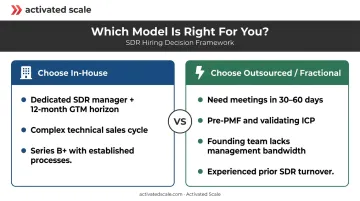
Choose in-house if:
- You have a dedicated SDR manager and a 12+ month GTM horizon
- Your product has a genuinely complex, technical sales cycle where deep product immersion matters
- You're at Series B+ with established sales processes and the budget to absorb ramp and turnover costs
Choose outsourced or fractional if:
- You need qualified meetings in the next 30–60 days, not six months from now
- You're pre-product-market fit and still validating your ICP and messaging
- Your founding team lacks the bandwidth to recruit, onboard, and manage an SDR
- You've already tried an in-house SDR hire and experienced the turnover cycle firsthand
Neither option is all-or-nothing, either. Many scaling B2B companies land somewhere in between.
The Hybrid Approach
Foundry's research found that 53% of tech organizations use a blended model — using outsourced SDRs to build pipeline and test new markets while developing internal capability over time. A later Foundry survey put that figure at 73%.
The logic is practical: start outsourced to validate your ICP and generate early revenue, then hire internally once you've proven the playbook.
Real-World Example: Kognitos
Kognitos, an AI automation platform, engaged Activated Scale when their founder needed to move from founder-led sales to a structured outbound motion. Binny Gill, Founder and CEO, put it plainly: "Activated Scale quickly understood my current stage and recommended an expert that has sold to my buyer to help me build my Sales GTM."
This is a common trigger pattern: a technical founder who's closed the first handful of customers through personal networks, but lacks the time and sales infrastructure to scale outreach.
Recruiting an SDR takes 2–4 months. Ramping one takes another 3. Kognitos skipped that timeline entirely by accessing an experienced professional who'd already sold to their exact buyer profile.
Activated Scale's fractional model is built for exactly this situation: match with a vetted SDR in under 7 days, test the engagement for a month, and convert to full-time only when you've seen real results.
Conclusion
The choice between in-house and outsourced sales development comes down to where your company is right now — not which model is objectively better.
Each model has a clear home:
- In-house wins on control, cultural depth, and long-term capability
- Outsourced wins on speed, flexibility, and cost efficiency when those factors matter most
- Fractional splits the difference — experienced talent, low overhead, no long-term commitment
For early-stage B2B SaaS founders, the immediate goal is qualified meetings and closed revenue — not building an org chart.
The fastest path to that outcome is a low-commitment fractional model — one you can scale up or convert to full-time once the playbook is proven. That's exactly what Activated Scale offers: pre-vetted, US-based fractional sales professionals who can start within days, not months.
Frequently Asked Questions
What is the difference between in-house and outsourced sales development?
In-house sales development uses full-time employees to handle prospecting and lead qualification, while outsourced sales development delegates those functions to a third-party provider or fractional professional. The key differences come down to cost structure, speed to productivity, and how much direct oversight you maintain.
When should a company outsource sales development instead of handling it in-house?
Outsourcing makes the most sense when you need pipeline quickly, lack bandwidth to recruit and manage an SDR, or are still validating your ICP. It's also a strong option if you've already experienced high SDR turnover in-house and want a lower-risk path to building pipeline.
Is outsourcing sales development better than in-house?
Neither is universally better. Outsourcing wins on speed, flexibility, and lower upfront cost. In-house wins on control and long-term brand depth. The right answer depends on your stage, budget, and whether you have the internal management capacity to make an in-house hire succeed.
What are the hidden costs of building an in-house sales development team?
Beyond base salary, expect to add payroll taxes, benefits (25–30% of base), commission, tech stack subscriptions, recruiting fees, and a 3–6 month ramp period before full productivity. When combined, the true annual cost per SDR typically exceeds $120,000.
Can you combine in-house and outsourced sales development?
Yes, and it's common. A typical blended approach uses outsourced or fractional SDRs for outbound prospecting while an internal AE handles closing and relationship management. Research suggests roughly half of tech companies already operate this way.
What is fractional sales development and how is it different from traditional outsourcing?
Fractional sales development involves part-time sales professionals (typically 15–20 hours per week) who work as embedded team members rather than outside agency contractors. Unlike a traditional agency retainer, fractional models like Activated Scale's offer month-to-month flexibility and a try-before-you-hire path to full-time employment.