Introduction
You've built a product that solves a real problem. You have early customers who love it. But between closing inbound leads yourself, managing the product roadmap, and keeping existing customers happy, building a consistent outbound pipeline keeps falling to the bottom of the list.
Hiring a full-time SDR feels premature. Seed-stage startups averaged just 5.3 employees in H1 2024, and a bad sales hire can cost well over $35,000 in lost time, recruiting fees, and missed deals — often before you realize the fit isn't right.
Outsourced sales development offers a middle path: experienced SDRs working on your pipeline without the full-time headcount risk.
This guide covers what outsourced sales development is, what an SDR team actually does, why it works for early-stage B2B SaaS companies, how it stacks up against building in-house, and what to look for in a partner.
Key Takeaways
- Outsourced SDRs handle prospecting, qualification, and appointment setting — not closing
- In-house SDR hiring takes 25–30 days to fill, then another 3 months to ramp; outsourced teams can begin outreach within weeks
- US SDR median total pay hits $103,000 — before benefits, tools, or recruiting costs
- Fractional models let you evaluate real sales talent before committing to a full-time hire
- Outsourcing fits best when pipeline is inconsistent, prospecting is consuming founder time, or you're validating a new ICP
What Is Outsourced Sales Development?
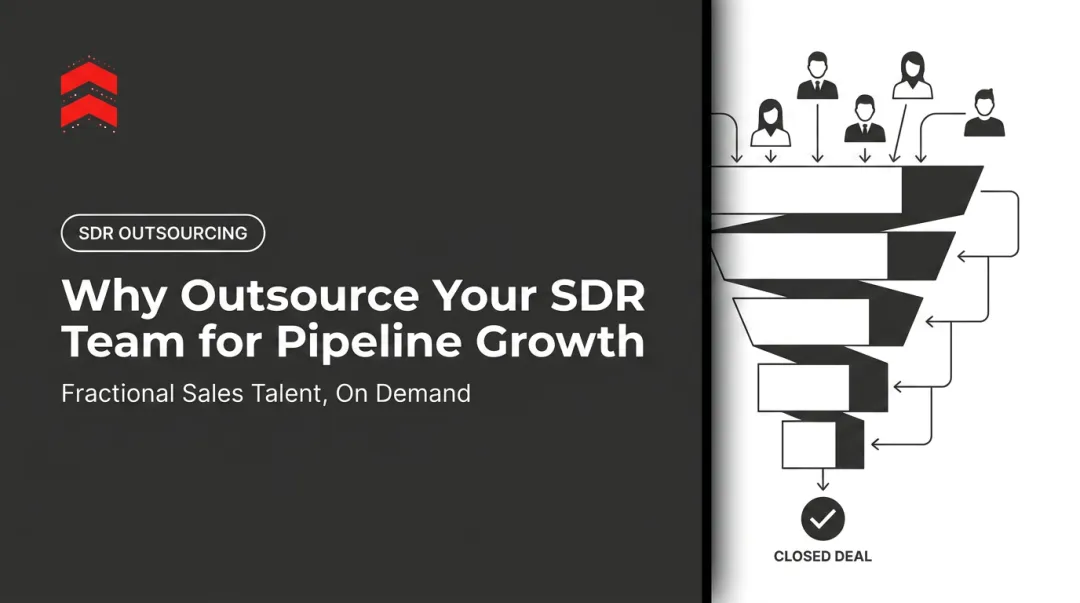
Outsourced sales development means engaging an external team of Sales Development Representatives (SDRs) to handle top-of-funnel pipeline work — prospecting, lead qualification, and appointment setting — on behalf of your internal sales or founding team. The SDR's job ends at the qualified handoff — discovery calls, demos, negotiation, and closing stay with your Account Executives or founders.
That distinction matters when evaluating how different delivery models are structured.
The Delivery Model Spectrum
The main models vary considerably in how much control you retain:
- Fully managed agency programs — you get a hands-off pipeline service, but typically own less of the process, data, and outreach infrastructure
- Fractional SDRs — experienced sales professionals who work part-time (typically 15–20 hours per week) embedded with your team. You manage them directly; all prospect data, templates, and sequences stay with you
- Contract-to-hire arrangements — fractional engagements with an explicit option to convert to full-time after validating fit
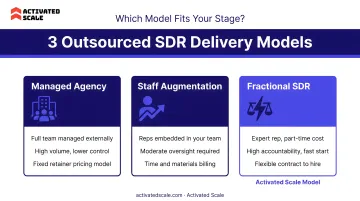
For early-stage B2B SaaS companies, the fractional model offers the best combination of speed, control, and flexibility. Activated Scale's fractional SDRs, for example, operate on month-to-month terms with no long-term contracts, and clients retain ownership of all outreach assets from day one.
What Does a Sales Development Team Do?
The SDR's core function is one thing: identify qualified prospects and book meetings for your sales team. They don't manage relationships, run demos, or close deals.
Prospecting and Outreach
SDRs build target account lists based on ICP criteria — industry, company size, role, and pain point fit — then initiate contact through multi-channel outreach.
Salesloft research found that response rates were 77% lower for email-only cadences and 91% lower for call-only cadences compared to integrated multi-channel approaches. Effective SDRs run cold email, phone, and LinkedIn in parallel — not because more channels look impressive, but because most buyers need multiple touchpoints before they respond.
Volume matters less than many founders expect. Personalized outreach tied to a specific challenge the prospect faces consistently outperforms generic templates blasted at high volume.
Lead Qualification
After initial contact, SDRs assess whether a lead is worth pursuing. Common frameworks include BANT (Budget, Authority, Need, Timeline), MEDDIC, and SPICED — the specific framework matters less than applying it consistently.
The qualifying conversation answers a few essential questions:
- Does this company fit the ICP?
- Is there an active pain or initiative this product addresses?
- Is the contact able to mobilize a buying decision?
- Is there a realistic timeline, or is this a "maybe next year" situation?
Only leads that clear the qualification bar get passed to the sales team. This keeps AE time focused on deals that can actually close, not just prospects who were willing to take a call.
Appointment Setting and Handoff
The final SDR output is a scheduled meeting with context attached. A clean handoff includes the prospect's pain points, what they said about timing and priority, and any relevant competitive context. Without this, the AE walks into the discovery call cold, negating much of the SDR's work.
Key Benefits of Outsourcing Sales Development for B2B SaaS Startups
Speed to Pipeline
Building an in-house SDR function takes longer than most founders plan for. According to The Bridge Group, SDR time-to-fill runs 25–30 days, followed by an average 3-month ramp before full productivity. That's roughly four months before your hire is contributing meaningfully to pipeline.
Outsourced programs compress this significantly. Activated Scale, for example, matches clients with vetted fractional SDRs in 7 days or less, with a structured 2-week onboarding period before outreach begins. By month three, clients typically see 10–15 qualified meetings booked per month.
Cost Efficiency
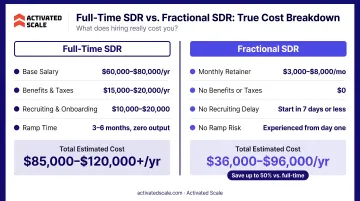
The $103,000 median total pay figure from Glassdoor is the starting point, not the full picture. Add:
- Benefits load — BLS data puts employer benefits at roughly 30% of total compensation costs
- Recruiting costs — SHRM reports hard cost-per-hire near $4,700, with total hiring costs potentially reaching 3–4x annual salary when soft costs are included
- Tools — CRM, sequencing software, data enrichment
- Management overhead — someone's time goes into hiring, ramping, and managing the rep
Fractional engagements typically range from $3,500–$4,500/month for an SDR, plus commission. That's a meaningful difference in fixed cost exposure, particularly when you're still validating which outbound motions work.
Access to Experienced Talent
The Bridge Group's data shows the average in-house SDR new hire has just 1 year of required experience, and median SDR tenure is only 1.4 years, with reps taking 16 months to reach full productivity. Most in-house SDR hires are early in their careers.
Activated Scale draws from a network of sales professionals with backgrounds at companies like Salesforce, Oracle, Datadog, Intuit, IBM, and Zendesk. These reps already know how to handle objections, run qualification conversations, and navigate B2B SaaS sales dynamics — no learning curve on your pipeline.
Activated Scale accepts roughly 7% of applicants, screening each candidate on:
- Buyer-type experience and ACV history
- Relevant vertical and deal size fit
- A live pitch assessment evaluated by sales peers
Scalability and De-Risked Hiring
Outsourced models flex with your needs. Raise a round and want to accelerate outreach? Scale up. Pivoting ICP? Adjust without managing a headcount reduction — no severance, no awkward conversations. This flexibility matters most during funding transitions or when entering a new market segment.
The try-before-you-buy dynamic is particularly valuable at early stage. Activated Scale's contract-to-hire model runs a standard 3-month period where the rep works on your pipeline on a fractional basis. If the fit is strong, conversion to full-time is straightforward — 65% of clients end up hiring their fractional SDR as a full-time employee after the initial contract period.
In-House vs. Outsourced Sales Development: Which Fits Your Stage?
The right answer depends on where you are, not a universal rule.
| Dimension | In-House SDR | Outsourced / Fractional SDR |
|---|---|---|
| Cost structure | Fixed — salary, benefits, tools regardless of output | Variable — month-to-month, scales with need |
| Ramp time | 4+ months to full productivity | Outreach begins in 2–3 weeks |
| Control | High process ownership once ramped | Shared playbooks; client retains data ownership |
| Scalability | Requires new headcount to scale | Add capacity without adding permanent overhead |
In-house makes sense when you have a validated sales motion, product complexity that requires deep institutional knowledge, and the budget to absorb a long ramp. Series A companies averaging 15.6 employees (per industry benchmarks) are typically better positioned to hire and manage a dedicated SDR.
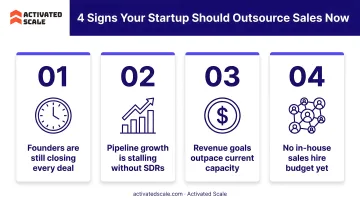
The calculus shifts when your situation looks more like this:
- The founding team is spending meaningful time on prospecting instead of closing and product
- Pipeline is inconsistent and deal flow is unpredictable month to month
- You're validating a new ICP segment before committing to a full-time hire
- You need outbound running in weeks, not quarters
Losing control is the most common objection — and a fair one. Well-structured outsourced programs address it directly: shared playbooks, CRM access, and regular reporting keep founders informed. With Activated Scale's model, founders manage the fractional SDR daily, with weekly one-on-ones and monthly performance reviews. The data and outreach assets stay with the client throughout.
The Outsourced Sales Development Process: What to Expect
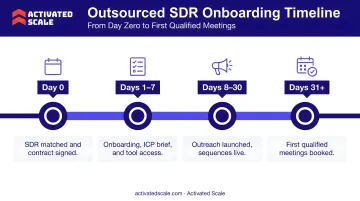
Onboarding (Days 0–15)
The foundation phase covers everything the SDR needs before touching a prospect: ICP definition, target account list, messaging and sequences, CRM setup, and qualification criteria. This period determines the quality of everything downstream. Rushing it produces generic outreach that gets ignored.
Outreach and Iteration (Days 16–45)
SDRs launch multi-channel sequences across email, phone, and LinkedIn, then gather reply data and refine based on what generates real conversations. Expect this period to function as calibration, not steady-state performance. Activated Scale treats the first 30–45 days as a messaging and targeting calibration window. Conservative expectations here lead to better long-term results.
Founders should be actively involved during this phase, providing feedback on which conversations look like the best ICP fit. That input is what separates a generic outbound motion from one that tightens around your real buyer.
What Good Reporting Looks Like
That feedback loop only works if your provider is reporting the right data. At minimum, expect weekly reporting on:
- Outreach activity by channel (emails sent, calls made, LinkedIn touches)
- Reply rates and bounce rates
- Meetings booked and meetings held
- Lead quality feedback and disqualification reasons
Avoid providers who report only on activity volume. Knowing that 500 emails went out tells you nothing without the reply rate and meeting conversion rate alongside it.
How to Choose the Right Outsourced Sales Development Partner
Three Evaluation Criteria That Actually Matter
1. Experience at your stage and in your vertical. Ask directly: have you run outbound for companies at my ACV range, selling into my buyer profile? A partner with that track record will qualify leads faster and waste less of your runway on generic playbooks.
2. Transparency in process and reporting. Request sample cadences and a clear definition of what counts as a qualified meeting — before signing. Vagueness on qualification standards pre-contract reliably turns into disagreements post-contract.
3. Engagement model fit. Decide whether you need a fully managed agency program or a fractional model where you retain direct oversight. For most seed-to-Series A founders, a fractional arrangement with a short initial period is lower risk than a 12-month retainer before you've validated fit with your ICP.
Starting With Lower Commitment
Once you've identified the right criteria, the next question is how much to commit upfront. Signing a long-term agency contract before you've proven the program works for your ICP is one of the more common early-stage mistakes.
A short pilot or fractional engagement gives you real performance data first. Activated Scale, for example, connects companies with vetted US-based fractional sales reps within 7 days on month-to-month terms, so you can evaluate actual qualified meeting output before deciding whether to extend or convert to full-time.
Questions to Ask Before Signing
- Where are your SDRs based, and what is their average experience level?
- What is your average ramp time to first qualified meeting?
- How do you define a qualified meeting, and who enforces that standard?
- What does your reporting cadence look like — weekly, monthly, both?
- Can I speak with a reference from a company at my stage?
Frequently Asked Questions
What is an outsourced sales team?
An outsourced sales team is an external group of professionals who handle prospecting, qualification, and appointment setting — no internal recruiting, hiring, or management required. Some providers also offer fractional Account Executives who handle full-cycle selling.
What does a sales development team do?
A sales development team works the top of the funnel: identifying potential customers, reaching out via email, phone, and LinkedIn, qualifying leads against ICP criteria, and booking discovery or demo meetings for the closing team. They do not run demos, negotiate, or close deals.
When should a startup outsource sales development?
Outsourcing fits best when the founding team is stretched thin on prospecting, pipeline is inconsistent, or you need to test a new market without committing to full-time SDR headcount. Most relevant from seed through Series A, before an in-house motion is fully justified.
What is the difference between a fractional SDR and a full-time in-house SDR?
A fractional SDR works on a part-time or contract basis, giving startups access to experienced sales talent at lower cost and commitment than a full-time hire. Some fractional models — like Activated Scale's contract-to-hire arrangement — include the option to convert the rep to full-time once fit and performance are validated.
How do you measure the success of an outsourced sales development team?
Track qualified meetings booked and held, meeting-to-opportunity conversion rate, pipeline volume generated, and cost per qualified meeting. Activity metrics like emails sent and calls made provide context, but only mean something when read alongside conversion data.