
Introduction
Revenue targets don't wait for hiring timelines. For B2B SaaS founders, the gap between "we need more pipeline" and "we have a functioning SDR motion" is often measured in quarters — not weeks.
Building an in-house SDR team sounds straightforward until you account for the full reality: 25–30 days to fill an open seat, another 3 months to ramp, and a 40–50% annual attrition rate that resets the clock regularly.
Meanwhile, your AEs sit idle or your founders prospect instead of close. Building a fractional SDR function is a direct fix — a measurable operational decision with real tradeoffs worth understanding. This article covers what a fractional SDR team actually delivers, what it costs compared to in-house alternatives, and how to extract genuine pipeline value from the model.
Key Takeaways
- Fractional SDR teams handle prospecting, qualification, and meeting-setting so your closers stay focused on revenue
- In-house SDRs take 3 months ± 2 weeks to ramp; fractional teams can begin outreach in weeks
- The true cost of an in-house SDR goes well beyond base pay — salary, benefits, tools, recruiting fees, and turnover add up fast
- Measure fractional SDR performance on held meeting rate, SQL conversion, and cost per qualified meeting — not raw dials
- Fractional SDR models let you try talent before committing — with a contract-to-hire path that cuts both hiring risk and ramp time
What Is a Fractional SDR Team?
A fractional SDR team is an external group of Sales Development Representatives who handle top-of-funnel prospecting, lead qualification, and meeting-setting on your behalf — using your ICP, messaging, and qualification criteria.
The model is most commonly used by:
- B2B SaaS companies at seed through Series A without an established outbound function
- Teams testing new markets or ICPs without committing to full-time headcount
- Founders still running sales who need to hand off prospecting before it consumes the business
Across all three scenarios, the expected output is the same: a consistent, qualified pipeline handed off to your account executives. That's the frame worth holding onto — because companies that treat a fractional SDR engagement as a cost play end up optimizing for activity metrics rather than pipeline, and that's a different game entirely.
Key Advantages of Building a Fractional SDR Team
Advantage 1: Faster Speed to Pipeline
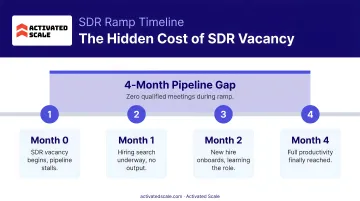
The hiring math works against in-house SDRs from day one. According to The Bridge Group, average SDR ramp time has held at 3 months ± 2 weeks since 2007 — and that clock doesn't start until after you've filled the seat, which itself takes 25–30 days.
In their model, a fully ramped SDR sources roughly 5 Stage 1 opportunities per month at a $50K ACV, or approximately $3M in annual pipeline. Every month that seat sits vacant or in ramp-up, that pipeline simply doesn't exist.
Fractional teams sidestep this by arriving with trained reps, outreach infrastructure, and defined processes already in place. For Activated Scale clients specifically, the matching happens in 7 days or less — sometimes within 48 hours — though the full onboarding and messaging preparation runs through a structured 45-day process before outreach peaks.
Where this matters most:
- Seed-to-Series A companies with narrow windows before a fundraise or product launch
- Founders currently handling prospecting themselves
- Teams entering a new ICP or geographic market and needing quick read on response rates
KPIs directly impacted: time-to-first-qualified-meeting, pipeline velocity, weeks from contract to active outreach
Advantage 2: Lower Total Cost vs. Building In-House
The sticker price of an in-house SDR is just the starting point. The fully loaded cost includes components that rarely appear in a single budget line.
Verified cost components for a US-based in-house SDR:
| Cost Component | Estimated Range |
|---|---|
| Base salary | $54K–$72K (Glassdoor, 2025) |
| OTE (with variable) | ~$80K median (RepVue, 2024) |
| Benefits load | ~24.7% of total comp (BLS, Dec 2025 data) |
| Recruiting cost | ~$4,700 average cost-per-hire (SHRM) |
| Training | ~$874–$1,254 per employee |
| Core SDR tools | $10K–$25K+ annually (CRM, sequencer, data) |
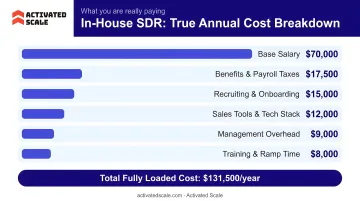
That's before factoring in management overhead, ramp time productivity loss, or the single largest hidden cost: turnover.
The Bridge Group notes SDR attrition runs 40–50% annually. When an SDR leaves, you don't just lose headcount — you restart a 4–5 month cycle of vacancy plus ramp while the pipeline gap compounds.
The fractional model bundles labor, tools, and management into a fixed monthly fee. Activated Scale's fractional SDR engagements are $4,500/month plus performance pay for 15–20 hours per week — with no recruiting fee, no tool procurement, and no ramp risk. A bad match gets replaced free within 7 days.
The metric that makes this comparison honest isn't monthly retainer vs. monthly salary — it's cost per qualified meeting, which accounts for how much pipeline each model actually delivers.
Advantage 3: Scalability Without Headcount Risk
Scaling an in-house SDR team means recruiting, onboarding, ramping, and managing — a 60–90 day cycle that locks in fixed costs before you have any evidence the new capacity will pay off.
The fractional model works differently. Need more capacity? Adjust the scope of an existing engagement. Need less? That's a conversation, not a termination. For startups where budget visibility is limited to 6–12 months, that flexibility is material.
Deloitte's 2024 global outsourcing survey found that 50% of executives used external services for front-office capabilities including sales and marketing — driven largely by the need for strategic flexibility without fixed-cost commitments.
This scalability advantage shows up most clearly in three scenarios:
- Run outreach into a new vertical for 60–90 days before committing to a full-time hire for that segment
- Increase capacity ahead of a product launch or sales push, then scale back when the push ends
- Avoid hard headcount decisions during quarters where revenue visibility is limited
Activated Scale's model includes an explicit try-before-you-hire path: 65% of clients eventually convert their fractional SDR to a full-time employee after seeing results — meaning the engagement also functions as a low-risk hiring pipeline, not just a pipeline-generation tool.
What Happens When the SDR Function Is Left Understaffed
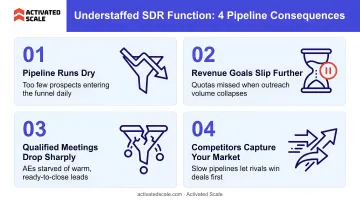
Without a dedicated SDR motion, the gaps show up fast — and they tend to reinforce each other.
Inconsistent pipeline. When prospecting defaults to founders or AEs, outreach happens in bursts. The result is a pipeline that looks healthy after a push and hollow two months later, making revenue forecasting unreliable.
Compounding vacancy cost. The Bridge Group found that at 40–50% annual attrition on a 10-person SDR team, a company misses its annual pipeline number by roughly 11% — before accounting for performance variance. For smaller teams, a single open seat hits even harder.
The founder time drain. When there's no SDR function, prospecting lands on the founding team by default. That time has a real opportunity cost — every hour spent on cold outreach is an hour not spent on product, hiring, or closing deals that are already in motion.
No institutional memory. When an in-house SDR leaves, they take their warm prospect relationships, their knowledge of what messaging worked, and their understanding of why deals stalled. A well-structured fractional engagement documents that knowledge as it's built. The client retains the playbooks and contact data outright — no matter what happens with the individual rep.
How to Get the Most Value from an Fractional SDR Function
Building a fractional SDR function works best when it's treated as an ongoing program — not a one-time campaign.
Before outreach begins:
- Align the fractional team on ICP, disqualification criteria, and messaging before week one
- Vague ICPs produce vague meetings; providers execute at speed, which amplifies whatever direction they're given
During the engagement:
- Track held meeting rate, not just booked meetings — no-shows and low-quality meetings erode AE trust quickly
- Review SQL conversion from fractional-sourced meetings monthly to catch quality issues early
- Monitor cost per qualified meeting as the primary efficiency metric, not raw dials or email volume
For early-stage teams:
- A fractional or contract-to-hire model (like Activated Scale's month-to-month structure) lets you evaluate the rep's performance and the outbound playbook before committing to a full-time hire
- Activated Scale clients typically see 10–15 qualified meetings per month by month three, with 80% of clients maintaining the engagement for 5+ months
That retention reflects a compounding effect: a well-run fractional SDR program produces better meetings in month six than in month one. By then, the ICP is sharper, messaging is refined from real response data, and the rep can qualify prospects accurately.
Conclusion
A fractional SDR team works when the fundamentals are in place: pipeline timing you can actually control, a cost structure that reflects real output, and the flexibility to scale capacity before you've committed to fixed headcount.
None of these are abstract. They show up in specific metrics:
- Weeks from contract to first qualified meeting
- Cost per qualified meeting versus the fully loaded in-house alternative
- Pipeline coverage ratio when you need to shift capacity quickly
The key is to treat the SDR function as infrastructure — something that requires consistent investment, regular feedback loops, and clear performance criteria. Done that way, an fractional SDR motion is one of the clearest levers for sustainable pipeline growth at the seed-to-Series A stage.
Frequently Asked Questions
How quickly can an fractional SDR team start generating pipeline?
Most fractional SDR programs begin outreach within 2–4 weeks, with first qualified meetings appearing shortly after. Activated Scale connects clients with vetted fractional SDRs in 7 days or less, then uses a structured 45-day onboarding period to optimize messaging before ramping volume.
How much does it cost to build a fractional SDR team?
Monthly retainers typically range from $2,000 to $9,950+ depending on program scope; Activated Scale's fractional SDR model is $4,500/month plus performance pay. Pay-per-meeting and hybrid structures are also common. The most meaningful number to compare is cost-per-qualified-meeting, not the headline monthly fee.
When does it make sense to use fractional SDRs rather than hire in-house?
A fractional model makes sense when pipeline is needed quickly, when the company lacks SDR management infrastructure, or when testing a new ICP before committing headcount. In-house hiring becomes the better option once a repeatable outbound playbook has been proven and the volume justifies full-time capacity.
What KPIs should I use to measure fractional SDR performance?
Focus on held meeting rate, SQL conversion rate from fractional-sourced meetings, cost per qualified meeting, and pipeline generated. Raw dials and booked meeting counts can mask quality issues — a high booked rate with poor show rates signals a qualification or targeting problem.
Is a fractional SDR team a good fit for early-stage B2B SaaS startups?
A fractional SDR team fits seed-to-Series A companies especially well. It eliminates hiring overhead, compresses time-to-pipeline versus the 3+ month in-house ramp, and frees founders from prospecting. The model works best once you have basic product-market fit and a defined ICP.
What's the difference between an fractional SDR and a fractional SDR?
An agency manages a fully fractional SDR team end-to-end, which limits your visibility into individual rep activity. A fractional SDR — placed through a platform like Activated Scale — is an experienced sales professional working part-time on your pipeline, giving you direct control, full data ownership, and the option to convert them to a full-time hire when ready.