
Hiring in-house feels like the "real" move — but a single SDR can cost well over $100K all-in before they book their first meeting. Outsourcing feels faster and cheaper — until you realize the agency doesn't understand your product and you don't own the data they generated. Neither answer is obviously right, and the wrong choice at the wrong stage can cost months of momentum.
This article breaks down the real costs, ramp timelines, and control trade-offs of each model — plus a decision framework for matching the right approach to your current stage.
Key Takeaways
- In-house reps offer culture fit and compounding product knowledge, but require 3–6 months to ramp and carry significant attrition risk
- Outsourced teams deploy in 2–4 weeks with lower fixed costs — the trade-off is weaker brand alignment and no retained institutional knowledge
- The right model hinges on your runway, ICP clarity, and capacity to manage a sales function
- Fractional sales — embedded, part-time reps without full-time overhead — is a growing middle path for Seed to Series A startups
- Match the model to your growth stage — a pre-PMF founder and a Series A team rarely need the same structure
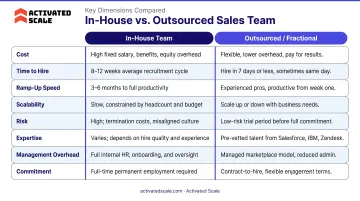
In-House vs. Outsourced Sales: Quick Comparison
Here's how the two models stack up across the dimensions that matter most to early-stage founders.
| Dimension | In-House | Outsourced |
|---|---|---|
| Upfront Cost | High (recruiting + salary + benefits + tools) | Lower (retainer-based, no benefits) |
| Ramp Time | 3–6 months to full productivity | 2–4 weeks to first outreach |
| Speed to First Revenue | Slow (months) | Faster (30–60 days) |
| Control & Oversight | Full visibility and daily management | Limited; activity filtered through vendor |
| Product Knowledge | Deep, compounds over time | Shallow; requires heavy upfront briefing |
| Scalability | Slower; tied to hiring cycles | Easier to scale up or down |
| Flexibility | Low (employment contracts, severance) | High (retainer-based, cancel or adjust) |
| Ideal Stage | Post-Series A, repeatable sales process | Seed stage, testing go-to-market approach |
What Is an In-House Sales Team?
In-house reps are full employees on your payroll, embedded in your operations, reporting to you or a sales leader. Compensation includes base salary, benefits, and often equity.
The Real All-In Cost
The gap between "posted salary" and actual employer cost is one of the most underestimated numbers in early-stage hiring. According to BLS Employer Costs for Employee Compensation data, benefits alone represent 29.9% of total private-industry employer compensation (rising to 35.6% in the information/tech sector) — and that figure doesn't include payroll taxes, recruiting, or tools.
Here's what one US-based SDR actually costs:
- Base salary: ~$60,000 median (RepVue SDR Salaries)
- OTE: ~$85,000 median
- Benefits burden: ~30–36% on top of wages
- Employer payroll taxes: 6.2% Social Security + 1.45% Medicare + FUTA
- Recruiting: $5,475 average cost-per-hire (SHRM, 2025)
- Onboarding/training: ~$874 per learner average
- Tools: Salesforce ($25–$175/user/month) + Apollo ($49–$119/user/month)
Total all-in cost for one SDR: $95,000–$115,000+ in Year 1 before they've booked a single meeting.
Ramp and Attrition Risk
Cost is only part of the picture. In-house hires take time to become productive, and that runway is shorter than most founders expect. Based on Bridge Group data across 406 B2B businesses (primarily SaaS), SDRs ramp in roughly 3.1 months and average a tenure of just 1.8 years — meaning you get about 17 months of full productivity before the cycle potentially restarts.
If they churn, you absorb recruiting costs, lost ramp time, and opportunity cost all over again. Gallup estimates replacement cost at 0.5x–2x annual salary for general employees.
Pros and Cons of In-House Sales
Pros:
- Full control over messaging, targeting, and scripts
- Deep alignment with company culture and values
- Rapid feedback loops with product and marketing
- Institutional knowledge that compounds over time
- Easier to course-correct messaging in real time
Cons:
- High total cost before first dollar of revenue
- 3–6 month ramp before meaningful contribution
- Attrition creates a repeating hiring treadmill
- Requires sales management capacity most early-stage startups don't have
What Is an Outsourced Sales Team?
Outsourced sales means engaging a third-party provider — an agency or outsourced SDR firm — whose reps prospect, qualify, and sometimes close on your behalf. Common models include SDR retainers, full-cycle outsourcing, and outbound agencies.
Speed and Infrastructure
The core appeal: outsourced teams arrive with established tech stacks, data sources, and outbound processes already in place. Vendor benchmarks suggest deployment in 2–4 weeks, with first meetings often booked in weeks three or four.
The global sales and marketing BPO market was valued at $24.12B in 2022 and is forecast to reach $45.16B by 2030 at an 8.2% CAGR (Grand View Research). That growth trajectory reflects real and sustained demand — outsourced sales has moved well into the mainstream for B2B companies.
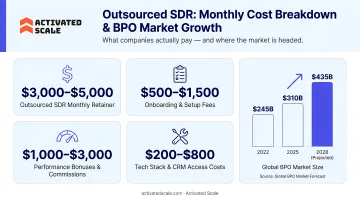
Typical agency pricing (vendor-published figures, not independent averages):
- Managed SDR retainers: $5,000–$15,000/month
- Dedicated onshore SDR: $7,000–$15,000+/month
- Pay-per-meeting models: $250–$1,200 per qualified meeting
Core Risks
That speed comes with meaningful trade-offs worth understanding before you sign a contract:
- Outsourced reps typically lack deep product knowledge — your ICP nuances don't transfer easily in a briefing document
- Brand voice alignment requires heavy upfront work, and even then, tone inconsistencies show up in outreach
- Provider quality varies enormously; a mediocre outsourcing partner burns budget without building anything
- When the engagement ends, the knowledge, data, and relationships often leave with them
Pros and Cons of Outsourced Sales
Pros:
- Rapid deployment — meetings bookable within 30 days
- Lower fixed costs (no benefits, equity, or payroll taxes)
- Scalable up or down based on need
- Access to specialized prospecting expertise and existing tech stack
Cons:
- Limited visibility into daily rep activity and messaging quality
- Brand and culture misalignment is hard to catch until it's already in prospects' inboxes
- Results depend heavily on which provider you choose — quality ranges widely
- No institutional knowledge stays behind when the engagement ends
Which Model Is Right for Your B2B SaaS Startup?
Before choosing, answer three questions honestly:
- What's your runway and monthly sales budget? Can you sustain 6+ months of full-time headcount before seeing ROI?
- Is your ICP defined and has your messaging been tested? Outsourcing is most effective when you already know who you're selling to.
- Do you have bandwidth to manage a sales function? In-house hires need coaching, pipeline reviews, and ongoing oversight — most early-stage founders don't have that capacity.
Your answers to those questions will likely point you in one direction fairly quickly.
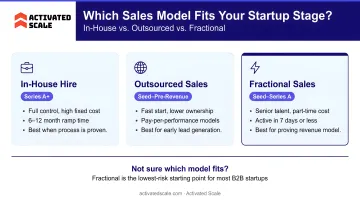
Choose In-House When:
- You're post-Series A with a proven sales playbook
- You have stable budget for 6+ months of salary and ramp time
- You're optimizing for long-term team capability and brand depth
- You have (or can hire) a sales manager to run the function
Choose Outsourced When:
- You're at Seed stage and need qualified pipeline in under 60 days
- Your messaging is still being tested and you want fast market feedback
- Your founding team cannot dedicate management time to sales oversight
- You want to validate GTM motion before committing to full-time headcount
The Cost of Getting It Wrong
Hiring in-house too early — before messaging clarity or product-market fit — burns runway and distracts founders from building. Choosing a weak outsourcing partner wastes budget with zero institutional learning. Getting the timing wrong on either side is expensive.
SaaStr reports that roughly 8 out of 10 first VP of Sales hires fail, churning out after about 11 months. The same pattern plays out at the rep level — hire before the conditions are right, and you're looking at 6-12 months of burned salary, lost ramp time, and a pipeline that has to be rebuilt from scratch.
What If There's a Third Option? The Fractional Sales Model
Fractional sales sits between the two models, and for many Seed to Series A startups, it's the more practical path.
A fractional sales rep is an experienced professional who works part-time or on a short-term contract, embedded into your team like an in-house hire. They follow your playbook, work inside your CRM, join your internal meetings, and represent your brand. No full-time salary overhead, no long recruiting cycles, no equity dilution.
Why It Bridges the Gap
Outsourcing gives you speed but costs you alignment. In-house gives you alignment but costs you time. Fractional sales gives you both:
- Speed: Placement in days, not months
- Alignment: The rep is building your pipeline and your institutional knowledge, not running generic sequences for an agency portfolio
- Flexibility: Part-time engagement with the option to convert to full-time once you've validated performance
Activated Scale connects B2B SaaS startups with pre-vetted, US-based fractional SDRs and AEs, typically within 7 days or less. Their network includes professionals with experience at companies like Salesforce, Oracle, Zendesk, Datadog, and IBM.
Each candidate clears a three-step vetting process — pitch video review, subject matter expert interviews, and reference checks. In 2024, Activated Scale accepted only the top 7% of applicants.
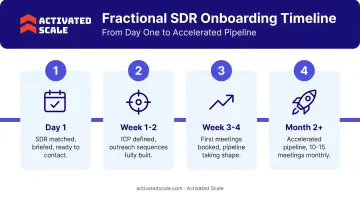
The three-month initial contract is structured so you can assess fit and performance before committing to full-time employment. Onboarding follows a defined timeline:
- Days 1–15: Product and ICP knowledge transfer
- Days 16–45: Iterating outbound messaging across email, phone, and LinkedIn
- Day 46 onward: Accelerating pipeline generation
Clients average 10–15 qualified meetings per month by month three.
65% of Activated Scale clients convert their fractional hire to a full-time employee after seeing real results — which means the engagement period is also a low-risk audition for your first permanent sales hire.
Who It's Built For
Fractional sales works best when:
- You're at Seed to Series A and need to prove traction before committing to full headcount
- Your founding team doesn't have time for a full hiring process (Activated Scale saves clients 20+ hours of interview time per hire)
- You want to test messaging and ICP fit without locking in a full-time salary
- You've been burned by an agency that missed your ideal customer or failed to deliver quality pipeline
Frequently Asked Questions
What is the difference between in-house and outsourced sales?
In-house reps are direct employees who give you full control over messaging, culture fit, and long-term knowledge building. Outsourced reps work for a third-party agency — faster to deploy but with less control, shallower product knowledge, and less data ownership.
Is outsourcing sales worth it for a B2B SaaS startup?
It can be, especially when speed to pipeline matters more than long-term team building. The key variables are provider quality and ICP alignment — a poor outsourcing partner burns budget without generating meaningful institutional learning.
How long does it take to ramp up an outsourced sales team?
Reputable providers typically deploy in 2–4 weeks and start booking meetings in the first month. That's significantly faster than an in-house hire, where SDRs take roughly 3.1 months to reach full productivity based on Bridge Group's B2B SaaS benchmarks.
What is fractional sales and how is it different from outsourcing?
Fractional sales reps are embedded part-time professionals who work inside your team — using your tools and building your playbook. Unlike an agency model, the rep is accountable to you directly, not to a vendor juggling a portfolio of clients.
Can you convert a fractional or outsourced sales rep to a full-time hire?
Yes — Activated Scale's contract-to-hire structure is specifically designed for this. Clients evaluate rep performance during the initial contract period before committing to full-time employment, and 65% ultimately make that conversion.
What are the real costs of building an in-house sales team vs. outsourcing?
A single in-house SDR typically runs $95,000–$115,000+ all-in for Year 1 when you factor in salary, benefits, recruiting, and ramp time. Outsourced retainers run $5,000–$15,000/month with infrastructure included. Activated Scale's fractional SDR engagements start around $3,500–$4,500/month plus commission.