Outsourced sales often gets dismissed as a stopgap. That framing misses the point. The real question isn't whether outsourcing is a "real" solution — it's whether it moves the numbers that matter. Pipeline velocity, revenue generated, and founder time recovered are the metrics worth measuring against.
This article breaks down the specific, measurable advantages of outsourcing sales and marketing — what changes operationally, financially, and in terms of your daily workload. No abstract efficiency claims.
TL;DR
- Outsourced sales = external professionals handling prospecting, outreach, and pipeline — partially or end-to-end
- The core advantages are lower cost structure, faster access to proven talent, and the ability to scale without permanent headcount risk
- Companies can start outreach within days versus the 60–90 day ramp of a typical full-time hire
- It requires a defined ICP, a clear value proposition, and at least one validated sales win to work
- Without it, founders stay trapped in sales bottlenecks, make expensive mis-hires, and lose growth windows they can't get back
What Is Outsourced Sales and Marketing?
Outsourced sales and marketing means hiring external sales professionals or a specialized firm to handle prospecting, outreach, qualification, and pipeline generation on your behalf — either partially or end-to-end.
It's most commonly used by B2B SaaS startups and seed-to-Series A companies that need to prove out their sales motion before committing to full-time hires.
How It's Evolved Beyond Call Centers
The modern version looks nothing like a traditional outsourced call center. The most relevant model for early-stage B2B companies is fractional sales — placing experienced individual contributors inside your company on a part-time or contract basis.
Activated Scale, for example, operates as a fractional sales talent marketplace. Rather than providing an agency team, they connect founders with individual US-based B2B sales professionals who work approximately 15–20 hours per week.
What sets this apart from traditional outsourcing:
- Selective vetting: In 2024, Activated Scale accepted only the top 5% of applicants into its network
- Proven track record: All fractional AEs carry 5+ years of B2B SaaS sales experience
- Individual contributors, not scripts: Each professional is matched for communication skills and sales performance — not assigned from a call center roster
This matters because the quality of your outsourced rep directly determines whether you validate your sales motion or waste months on the wrong approach.
Key Benefits of Outsourced Sales and Marketing
The advantages below are grounded in operational and financial outcomes — cost-per-hire, time-to-first-meeting, revenue generated, and founder hours recovered. These are the numbers early-stage companies actually track.
Cost Efficiency Over Full-Time Hiring
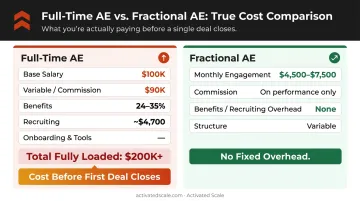
Building an in-house sales team means absorbing fixed costs before a single deal closes. According to The Bridge Group's 2024 SaaS AE benchmark, based on 172 B2B SaaS companies, the median AE OTE is $190K — split $100K base and $90K variable.
Stack on benefits (BLS reports these average 24–35% of total compensation for Information industry workers), recruiting fees (SHRM puts average cost-per-hire at nearly $4,700), onboarding time, and tools — and you're well past $200K fully loaded before anyone closes a deal.
Outsourced sales converts that fixed cost into a variable or fractional structure. You pay for active selling time, not bench time, ramp periods, or failed hires.
Why this matters for early-stage companies:
- A mis-hire isn't just a salary cost — it's 3–6 months of lost pipeline momentum that can't be recovered
- Variable cost structures let founders redirect capital toward product, marketing, or runway extension
- Fractional AE engagements through platforms like Activated Scale run $4,500–$7,500/month plus commission, versus $6,667–$12,500/month for a full-time AE before benefits
KPIs this affects: Cost per qualified meeting, revenue per sales dollar spent, cash runway preservation
When this matters most: Pre-Series A companies that haven't yet validated their full sales motion, and any company testing a new market segment before committing to permanent headcount.
Immediate Access to Proven, Specialized Sales Talent
Hiring a strong B2B sales rep in-house takes time most startups don't have. Workable's benchmark data for US tech roles puts average time-to-fill at 56 days, requiring 34 qualified candidates and 13 interviews per hire. Then comes the ramp: The Bridge Group reports the average SaaS AE takes 5.7 months to reach full productivity.
That's nearly seven months from job posting to consistent pipeline contribution — outsourced sales skips most of it. Platforms like Activated Scale connect companies with vetted fractional professionals in 7 days or less, sometimes within 48 hours. Active outreach typically begins by days 16–45 after an initial onboarding phase.
Speed matters, but the quality of who you bring in matters more. Most founders are domain experts, not sales professionals. Bringing in someone who has sold at Datadog, Zendesk, or Oracle doesn't just speed things up — it changes the quality of execution. These professionals know how to qualify leads, navigate objections, and run discovery, not just generate activity volume.
The gap shows up in attainment data too. Ebsta and Pavilion's 2024 B2B Sales Benchmarks found that 69% of sales reps missed quota in 2024, with 17% of reps generating 81% of total revenue. Bringing in pre-vetted, experienced talent shifts the odds considerably.
KPIs this affects: Time-to-first-meeting, qualified meeting rate, pipeline quality, sales cycle length
When this matters most: Critical for founders moving out of founder-led sales who need their first external rep to be net-positive quickly.
Flexibility to Scale Without Long-Term Headcount Risk
One of the biggest obstacles at the early stage is the irreversibility of full-time sales hires. Once someone is on payroll, scaling down is expensive, slow, and disruptive to morale and pipeline simultaneously.
The Bridge Group puts median annual SaaS AE turnover at 30%, with 19% involuntary. Carta adds another data point: 23.3% of all startup employees hired in 2022 left within one year. The same Carta data shows Series A headcount dropped from 17.6 in 2021 to 15.6 in H1 2024 — companies are running leaner, and each hire carries more risk.
Startups can't afford to get sales headcount wrong.
How outsourcing addresses this:
- Scale sales capacity up or down based on funding stage, market conditions, or pipeline demand
- No friction of layoffs or severance when conditions change
- Observe what "good" looks like in your sales motion before converting top performers to full-time
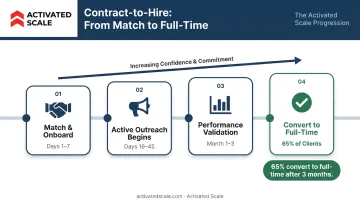
Activated Scale's contract-to-hire model runs a typical 3-month initial contract before clients can convert to a full-time offer. Roughly 65% of clients do exactly that after seeing real results. That try-before-you-hire structure lets founders validate skills, style, and cultural fit before making a permanent commitment.
KPIs this affects: Sales team attrition rate, cost per full-time equivalent, scalability of pipeline by headcount
When this matters most: Post-funding growth phases, geographic expansion, and the transition from founder-led to structured sales org.
What Happens When Outsourced Sales Is Ignored
The pattern is consistent: founders delay outsourcing, stay in founder-led sales longer than intended, and create a bottleneck where product, fundraising, and operations all compete for the same hours.
SaaStr's guidance is that founders should start getting sales help after closing 10–20 customers themselves, with scaling typically beginning around $1M–$2M ARR. But many wait far longer.
The downstream consequences of delayed action:
- Inconsistent outreach creates lumpy pipeline and unpredictable revenue
- Full-time mis-hires drain runway before delivering results — SaaStr estimates 70% of first-time VP of Sales hires don't survive their first year
- Longer ramp times mean lower quota attainment, higher sales team churn, and delayed insight into what's actually working
- Lost growth windows — competitors who moved faster have already captured the market share you're still building toward
The compounding effect makes delay especially costly. Six months without pipeline isn't just six months of lost revenue. It's product decisions made without customer input, fundraising conversations without revenue proof points, and runway burning while competitors pull ahead.
How to Get the Most Value from Outsourced Sales and Marketing
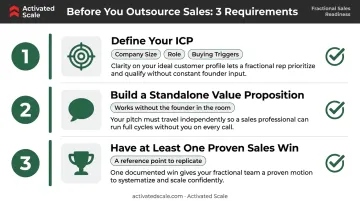
Outsourcing works best when three conditions are in place before you launch:
- Define your ICP: who you're selling to, what company size, what role, and what drives them to buy
- Build a value proposition your outsourced rep can deliver without you in the room
- Have at least one prior sales win the team can reference and replicate
Companies that get the most out of outsourced sales treat it as an ongoing practice. Regular pipeline reviews, feedback loops on lead quality, and iteration on messaging are what separate programs that compound over time from ones that stall after 30 days.
What to Look for in an Outsourced Sales Partner
- Specialization in your segment (B2B SaaS, not generalist)
- Transparent performance data with clear KPIs from day one
- A try-before-you-buy or contract-to-hire structure that limits risk if the fit is off
- Individual professional placement (not an agency team that cycles through reps)
Activated Scale structures each Statement of Work to define expected outcomes before engagement begins: meetings booked, demos conducted, revenue generated. Clients then measure fractional talent against those targets monthly, the same way they'd hold a full-time hire accountable.
Frequently Asked Questions
Frequently Asked Questions
What are the benefits of outsourcing sales?
The primary benefits are reduced hiring costs, faster access to experienced talent, and the ability to scale pipeline without full-time overhead. Companies can begin generating qualified meetings in weeks rather than months, while keeping costs variable instead of fixed.
How is outsourced sales different from hiring a full-time salesperson?
Fractional outsourced sales offers lower financial commitment, faster start times, and lower risk if the fit isn't right. A full-time hire means higher fixed costs, a 5–7 month ramp before peak productivity, and real exposure if the person doesn't work out.
Is outsourced sales a good fit for early-stage B2B startups?
Yes — it's particularly well-suited for seed-to-Series A companies that have product-market fit signals but lack a dedicated sales team. It works best when the company already has at least one proven sales win and a clear picture of who they're selling to.
How quickly can an outsourced sales team start generating pipeline?
With vetted reps and a clear ICP, an outsourced team can begin outreach within two to three weeks. That's a fraction of the 5.7-month ramp The Bridge Group reports for new full-time AEs. First qualified meetings typically appear within the first 30–45 days.
What does it cost to outsource sales and marketing?
Costs vary by model — fractional, agency, or contract-to-hire — but fractional AE engagements typically run $4,500–$7,500/month plus commission. That's substantially less than a full-time AE's fully loaded cost and structured as variable spending rather than a fixed salary commitment.
What are the risks of outsourcing sales, and how can they be managed?
The main risks are brand misalignment and inconsistent lead quality. Both are manageable through thorough onboarding, defined KPIs in a written Statement of Work, and regular performance reviews. Choosing a contract-to-hire partner gives you an additional safety net: convert top performers to full-time or exit engagements that aren't working.