Introduction
Most B2B SaaS founders reach a point where pipeline is the bottleneck — but hiring full sales and marketing teams isn't yet practical. Outsourcing fills that gap: you contract external specialists to handle functions like prospecting, cold outreach, content, and paid media, rather than building every capability in-house. This guide is written for founders and early-stage startup leaders who need to scale revenue without the cost or risk of full-time hiring.
The challenge is real. Hiring a single SDR means base salaries of $55,000–$75,000 before you factor in benefits, tools, management time, and ramp. Meanwhile, more than 4 in 10 U.S. hiring managers struggle to find candidates with the right skills.
Outsourcing seems like the natural answer — and it can be. Without structure, it burns budget quickly. With the right setup, it can put qualified meetings on your calendar within weeks.
What follows covers what to outsource, when the timing makes sense, how to structure it properly, and the mistakes that sink most programs before they gain traction.
TL;DR
- Outsource execution-heavy work (prospecting, outreach, content, paid media); keep strategy and key relationships in-house
- 49% of B2B companies already run a hybrid model — some in-house, some outsourced — per Sagefrog's 2024 B2B Marketing Mix Report
- Success requires ICP clarity and active internal ownership: outsourcing amplifies what's working, it doesn't create it
- Start with a focused 60-90 day pilot across one ICP and one offer before expanding scope
- Track meetings held, opportunities created, and pipeline generated — not just meetings booked
What to Outsource vs. What to Keep In-House
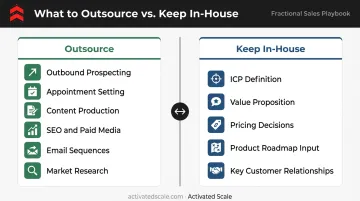
The core principle is straightforward: outsource execution-heavy, repeatable work. Keep strategy, positioning, and customer relationships inside the company. Blur that line and you'll either lose brand control or end up with pipeline full of poorly qualified leads — sometimes both.
What to Outsource
These functions transfer well to external specialists:
- Outbound prospecting and cold outreach (email, calling, LinkedIn) — specialized tooling and repeatable process make this easy to hand off
- Appointment setting — high-volume execution that doesn't require deep product knowledge
- Content production (blogs, case studies, white papers) — specialist writers deliver faster and at lower cost than most in-house hires
- SEO and paid media management — platform algorithms shift constantly; dedicated agencies keep up better than generalist teams
- Email marketing sequences — systematic and measurable, easy to transfer with a clear brief
- Market research — outside analysts bring benchmark data and objectivity your internal team can't replicate
What to Keep In-House
These functions must stay internal — outsourcing them produces generic positioning that no external partner can execute effectively:
- ICP definition and validation
- Core value proposition and messaging strategy
- Pricing and packaging decisions
- Product roadmap input derived from sales feedback
- Key enterprise or strategic customer relationships
The Hybrid Model in Practice
Most high-growth B2B SaaS companies settle into a stable hybrid. According to Sagefrog's 2024 B2B Marketing Mix Report, 49% of B2B companies use both in-house and outsourced marketing, with 35% fully in-house and only 16% fully outsourced. Among those outsourcing, 89% reported it was effective for their business goals.
That 49% aren't splitting the difference arbitrarily — they're keeping strategy internal while outsourcing execution for a specific segment, new geography, or product line. SDR coverage for a new market is the most common starting point.
Why B2B SaaS Startups Outsource Sales and Marketing
Two forces push founders toward outsourcing: talent scarcity and budget compression.
Betts Recruiting's 2025 compensation data puts entry-level tech SDR base salaries at $55,000–$70,000, with experienced SDRs commanding $60,000–$75,000 — and that's before OTE, benefits, tools, and the three-to-six months it typically takes a new rep to ramp.
The supply-side isn't any easier: more than 40% of U.S. SMB hiring managers report difficulty finding candidates with the required skills, according to SHRM's 2024 talent shortage research.
The result: building an in-house sales function from scratch is slow, expensive, and uncertain.
Situations Where Outsourcing Delivers the Most Value
Outsourcing works best in specific scenarios — not as a general solution:
- Inconsistent pipeline with no internal bandwidth to fix it
- New market or product launch without an established outbound motion
- Speed to revenue required before the next funding milestone
- Testing product-market fit before committing to full-time headcount
The Honest Caveat
SaaStr's survey of 1,200+ practitioners found that only 7% reported really getting outsourced SDRs to work. The common denominator in failed programs: an unclear ICP, an unvalidated value proposition, or no one available internally to run discovery calls when meetings land.
Before bringing in outside sales help, validate your ICP and confirm someone on your team can handle inbound meetings. Outsourcing scales a working motion — it can't create one from scratch.
How to Outsource Sales and Marketing Effectively
Effective outsourcing follows six steps: define, decide, select, vet, pilot, and optimize. Skipping the first two steps is the root cause of most failed programs.
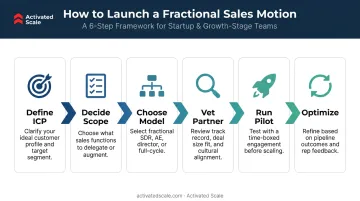
Step 1: Define Your ICP and Qualification Criteria First
Before any outreach begins, document:
- Target buyer profile: title, company size, industry, geography
- Minimum criteria that make a lead worth a call
- What a "qualified meeting" actually means in concrete terms
Any ambiguity here guarantees misalignment with your external partner. Write it down before you sign anything.
Step 2: Decide What to Outsource and in What Order
Start with the highest-leverage, most repeatable work. For sales, that's top-of-funnel prospecting and outbound outreach. For marketing, it's content production and SEO. Scope creep in the first 90 days is a common reason programs stall before they produce any signal.
Step 3: Choose the Right Model for Your Stage
| Model | Best For | Notes |
|---|---|---|
| Full-service outbound agency | Companies with validated messaging | Longer contracts, higher cost |
| Fractional sales talent | Pre-Series A with pipeline gaps | Faster to deploy, lower commitment |
| Marketing agency retainer | Content, SEO, paid media at scale | Works best with internal strategy owner |
| Pay-per-meeting | Testing a new ICP or offer | Risk of activity inflation |
For early-stage B2B SaaS founders, the fractional sales talent row above often offers the lowest-risk entry point. Platforms like Activated Scale connect startups with vetted, US-based fractional sales professionals (SDRs, AEs, and sales leaders) in seven days or less, on a try-before-you-buy basis.
Fractional SDR retainers run $2,800–$4,500 per month plus commission at roughly 15–20 hours per week — a fraction of the cost and ramp time of a full-time SDR hire.
Step 4: Vet and Select Your Partner
Ask every provider these questions before signing:
- What verticals have you run programs in, and can you share documented pipeline results?
- Is the delivery team dedicated to my account or shared across clients?
- What pipeline metrics do you track, and what does your reporting cadence look like?
- How do you adapt when early signal suggests messaging needs to change?
Red flags to walk away from:
- Guaranteed results within 30 days before understanding your ICP
- No case studies in your vertical
- Activity-based reporting only (emails sent, calls made) with no pipeline outcome data
- Long contract minimums without performance milestones
Step 5: Run a Focused Pilot
Structure the pilot around:
- One ICP, one region, one or two offers
- A 60-90 day window with no scope changes
- A shared scorecard agreed before outreach begins: meetings booked, meetings held rate, opportunities created, pipeline generated
Controlling variables is how you distinguish a partner who drives qualified pipeline from one who optimizes for activity metrics that look good on a dashboard.
Step 6: Build a Feedback Loop and Optimize
Two review layers separate programs that improve from programs that drift:
- Weekly activity coaching — review call quality, email performance, and objection handling
- Bi-weekly pipeline coaching — connect top-of-funnel activity to opportunity creation and closed-won outcomes
This rhythm is how messaging, targeting, and qualification tighten over time. Skip it and the program defaults to whatever the partner thinks is working.
Common Mistakes That Derail Outsourced Programs
Unclear Qualification Criteria
The most damaging mistake: AEs and the outsourced partner disagreeing on what a "good meeting" looks like. This creates immediate trust breakdown and is entirely avoidable. Write down your qualification bar before outreach begins. If you can't define a qualified meeting in two sentences, you're not ready to outsource.
Treating the Partner as a Black Box
Providing minimal onboarding and expecting the external team to "figure it out" guarantees wasted budget. Effective onboarding means sharing:
- Win/loss notes and competitive landmines
- Real objection patterns from previous calls
- Approved messaging and positioning
- Examples of what good and bad leads actually look like
Optimizing for the Wrong Metric
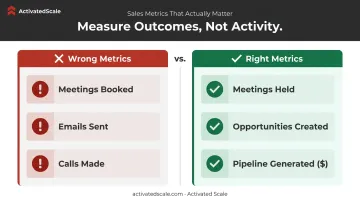
Meetings booked is easy to inflate. A partner can fill your calendar with calls that go nowhere — and that will look like progress right up until your pipeline review.
Measure outcomes, not activity:
- Meetings held (not just booked)
- Opportunities created from those meetings
- Pipeline generated in dollars
Programs that only track bookings drift into activity theater. The calendar looks full; the pipeline stays empty.
When Outsourcing Sales and Marketing May Not Be the Right Move
Outsourcing requires internal readiness conditions that many early-stage companies haven't met yet:
- A validated ICP with documented criteria
- Someone on the team available to run discovery calls when meetings land
- A defined value proposition the external team can actually execute against
- A CRM set up to track outcomes, not just activity
Without these, outsourcing produces noise, not pipeline.
Situations Where a Different Approach Makes More Sense
- You haven't found product-market fit yet — founders need to run these conversations personally to learn what resonates. No external partner can do that learning for you.
- You have less than 3-6 months of runway — the budget is better deployed elsewhere until you've validated the model.
- Your sales motion is highly novel and no external partner has relevant vertical or deal-size experience — in that case, you're paying for their learning curve, not yours.
Frequently Asked Questions
What is outsourced marketing?
Outsourced marketing means partnering with external agencies or specialists to handle some or all of your marketing functions — content, SEO, paid media, email campaigns — rather than managing them in-house. The company retains strategy ownership while the external partner handles execution.
Is it a good idea to outsource marketing?
It can be — if you have a clear strategy in-house, defined KPIs, and a partner with documented experience in your market. Sagefrog's 2024 data shows 89% of B2B companies that outsource marketing report it as effective, though that reflects companies that kept strategy ownership internally rather than delegating it alongside execution.
What is the difference between outsourcing sales and outsourcing marketing?
Outsourced sales focuses on pipeline generation — prospecting, outreach, qualification, and booked meetings measured by SQLs. Outsourced marketing covers demand creation and brand building — content, SEO, and paid media measured by traffic and MQLs. The two overlap in outbound programs but serve different outcomes and are evaluated differently.
How much does it cost to outsource sales and marketing?
Costs vary by model and scope. Sagefrog's 2024 B2B data shows most companies spend between $2,500–$20,000/month on outsourced marketing, with the largest share (26%) in the $10,000–$20,000 range. For fractional sales talent, Activated Scale's fractional SDR retainers run $2,800–$4,500/month plus commission at 15–20 hours per week.
What should you never outsource in sales and marketing?
ICP definition, your core value proposition, pricing decisions, and key customer relationships should stay internal. Handing these off typically produces generic positioning that no external partner can execute well — and it's hard to course-correct once the program is running.
How long does it take to see results from outsourced sales and marketing?
Most structured programs deliver first qualified meetings within a few weeks of launch. Consistent, predictable pipeline signal typically emerges in the 60–90 day window once targeting, messaging, and qualification have been calibrated against live market feedback. Programs that skip a structured pilot phase tend to take significantly longer to find their footing.