

Outsourced sales management is the practice of engaging an external professional or team to lead the sales function on your behalf—handling strategy, pipeline management, rep oversight, and performance reporting—rather than building a full in-house sales department.
This article explains what that actually looks like in a financial services context, how the process works from day one through active management, what factors shape results in this industry specifically, and when the model isn't the right fit.
TL;DR
- Outsourced sales management means an external professional runs your sales function—strategy, team leadership, pipeline, and reporting—without being a full-time employee.
- Financial services firms use it to access specialized sales expertise faster and at lower cost than a full-time VP of Sales hire.
- Two primary models exist: a complete outsourced department or a management-only fractional engagement; fractional is now the dominant choice.
- Success depends on the partner's regulatory literacy and understanding of your buyer—not just their general sales credentials.
- It's not right for every firm — pre-revenue companies, heavily restricted environments, or founders who can't delegate sales ownership will struggle to see ROI.
What Is Outsourced Sales Management?
Outsourced sales management is the engagement of an external sales leader or team to direct a firm's revenue-generating activities—including strategy development, pipeline management, rep oversight, and performance reporting—on a fractional or full-scope basis.
How It Differs from Adjacent Models
The category gets confused with related services, so the distinctions matter:
| Model | What it delivers | What it doesn't |
|---|---|---|
| Sales agency | Lead generation, appointments | Sales strategy or team leadership |
| Freelance closer | Individual deal execution | Pipeline management or rep coaching |
| Full-time VP of Sales | Full organizational accountability | Flexibility or reduced fixed cost |
| Outsourced sales management | Strategic leadership + execution oversight | Full-time headcount or benefits obligation |
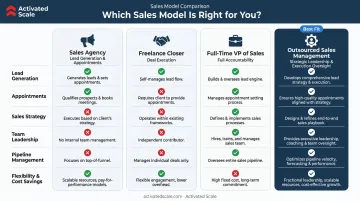
The outsourced model sits deliberately in the middle—senior sales leadership without the permanent overhead.
The Two Delivery Models
Complete department model: The provider supplies and manages the entire sales team. Useful for firms with no existing sales function.
Management-only fractional model: The provider leads your existing reps as an embedded fractional sales manager. This is the dominant choice for growing financial services firms. Most RIAs and FinTech companies already have sales activity in motion—what they're missing is leadership and structure, not a replacement team.
Why Financial Services Firms Turn to Outsourced Sales Management
Financial services sales is its own discipline — and the buyers reflect that. Thorough investment manager selection can take three to six months or longer, according to Bank of America Merrill Lynch's hedge fund manager selection guide, because institutional allocators run formal due diligence before they'll even take a meeting.
HNW individuals want advisors who share their values before they discuss returns. Compliance officers won't engage a vendor whose outreach hasn't cleared basic regulatory review.
A generalist sales hire walks into that environment cold. The knowledge transfer required to get them productive—fiduciary product nuance, buyer psychology, regulatory boundaries—takes months they don't have.
The Cost and Speed Reality
The Bureau of Labor Statistics reports a mean annual wage of $214,520 for sales managers in financial investment activities, before benefits, recruiting costs, or equity. According to Activated Scale, a fractional VP of Sales engagement typically runs $8,000–$12,000 per month. That's a substantial cost difference — and a fractional professional can be deployed in 7 days rather than the 5–9 months a new hire needs to reach full productivity (per Sales Management Association ramp-time research).

The Founder Bottleneck
Most RIAs, boutique wealth managers, and FinTech startups are founder-led. The founder knows the product, knows the clients, and has closed every meaningful deal personally. That works at early stages. It stops working the moment the firm needs to scale beyond what one person can manage.
An outsourced sales manager replaces the founder's day-to-day sales leadership role with a professional system:
- The founder's product expertise gets captured in a repeatable playbook
- A managed team extends relationship-building capacity beyond what one person can reach
- The founder refocuses on strategy, product, and high-value client relationships
That shift from individual contributor to growth infrastructure is what makes this more than a stopgap hire.
A Mainstream Strategic Choice
Deloitte's 2024 Global Outsourcing Survey of 500+ executives found that 50% already use outsourced services for front-office capabilities—including sales, marketing, and R&D—and 80% planned to maintain or increase that investment. Firms in this category aren't treating outsourced sales leadership as a stopgap. They're treating it as a growth infrastructure decision.
How Outsourced Sales Management Works in Financial Services
A typical engagement runs in three phases. Financial services adds a compliance-alignment layer that most other industries don't require.
Phase 1: Discovery and Alignment (Days 1–30)
The outsourced manager conducts stakeholder interviews, reviews existing pipeline and conversion data, and maps the firm's ideal client profile and buyer journey. In financial services, this phase includes:
- Identifying what communications require compliance review before outreach begins
- Understanding the distinction between institutional and retail buyer decision processes
- Reviewing any existing marketing rule or solicitation constraints that affect how reps can speak about products
- Documenting pipeline health and diagnosing where deals currently stall
The SEC's 2018 OCIE Cash Solicitation Risk Alert flagged common deficiencies in how advisers manage third-party sales relationships—including missing written agreements and incomplete solicitor disclosures. A competent outsourced manager surfaces these risks in Phase 1, before they become compliance events.
Phase 2: Process Build and Playbook Development (Days 30–60)
The manager documents a repeatable sales process tailored to the firm's offering. For financial services firms, this means:
- Compliant messaging templates that pass FINRA Rule 2210's fair-and-balanced standard
- Outreach sequences and follow-up cadences built for long sales cycles—not optimized for 30-day close rates
- Discovery call frameworks appropriate for HNW or institutional buyers
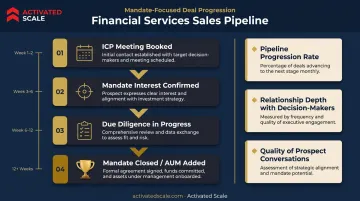
- CRM workflows that reflect the actual pipeline stages (ICP meeting → mandate interest → due diligence → close)
- KPIs aligned to the business model: AUM targeted, qualified meetings, mandates in progress—not just call volume
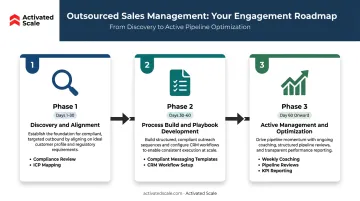
Phase 3: Active Management and Optimization (Day 60 Onward)
Once the playbook is live, the outsourced manager runs weekly sales meetings, coaches reps on active deals, monitors pipeline health, and adjusts strategy based on conversion data. By the end of week eight, most firms have their first pipeline reviews with qualified prospects already in progress.
Platforms like Activated Scale can accelerate this timeline. Their network of vetted fractional sales professionals includes individuals with financial services experience, and they can match a firm to a qualified candidate in 7 days or fewer.
For firms that have been running without structured sales leadership, reaching Phase 3 in under two months is considerably faster than any traditional hiring process allows.
Performance accountability should be established in writing before engagement begins. Key metrics for a financial services outsourced sales manager include:
- Meetings booked with qualified prospects (ICP-matched)
- Pipeline value generated and progression rate
- Proposal conversion rates
- New revenue or AUM mandates closed
Key Factors That Shape Results in Financial Services Sales
Compliance and Regulatory Literacy
This is the single most important qualification criterion. Unlike most B2B sectors, financial services sales operates within defined legal boundaries—the SEC's Marketing Rule, FINRA Rule 2210, and state-level requirements that vary by firm type and product.
An outsourced manager who doesn't understand these constraints won't just produce poor results. They can produce legal exposure. Outreach that triggers solicitation rule concerns, endorsement messaging that violates the Marketing Rule, or promotional language that fails FINRA's fair-and-balanced standard carry documented consequences. The SEC charged nine investment advisers in 2023 for Marketing Rule violations related to performance advertising alone.
Evaluate any prospective outsourced partner on their specific compliance knowledge, not just their general sales credentials.
Buyer Sophistication and Trust Requirements
CFA Institute research found that institutional investor trust in financial services rose to 86% from 65%—but that trust is earned through consultative, relationship-first engagement. Seventy-four percent of retail investors prefer human advice over automated guidance. Another 40% globally want an advisor who shares their values.
Outsourced managers must be briefed thoroughly on the firm's value proposition in fiduciary terms. Generic sales language—talking about "solutions" or "ROI" without engaging the actual investment philosophy or service model—signals immediately to sophisticated buyers that something is off.
Sales Cycle Length and Pipeline Discipline
Financial services deals don't close in weeks. Institutional mandates can take a quarter or more. This affects how KPIs get set, how pipeline health is measured, and how progress is reported to firm leadership.
A manager optimizing for short-term meeting counts will build a pipeline that looks active but produces little. KPIs need to reflect long-horizon deal progression, not just volume metrics:
- Movement through due diligence stages
- Depth of relationship with key decision-makers
- Quality of prospect conversations over quantity of outreach
Product Knowledge Transfer
Outsourced managers are process and leadership experts, not product experts. The financial firm must invest real time in knowledge transfer before any outreach begins.
That means covering:
- Product walkthroughs and fund or service mechanics
- Client case studies with real outcomes
- Competitive context and differentiation
- How the firm frames its investment approach or service model
Without this, even technically skilled sales managers will conduct discovery conversations that lack credibility. Buyers notice quickly when an intermediary doesn't fully understand what they're selling.
Common Misconceptions and When the Model Doesn't Fit
Myth: Outsourced means offshore or low quality. Modern fractional sales management—particularly in financial services—typically involves senior professionals with substantial leadership experience. Both Chief Outsiders and Sales Xceleration describe their fractional VP of Sales candidates as having a decade or more of executive leadership experience. These are not script-readers.
Myth: The outsourced manager will replace our team. The intent is integration and improvement, not replacement. For firms with no existing sales team, the outsourced model can help recruit and structure a founding sales function. The design is to lead and build, not substitute.
When It's the Wrong Fit
Outsourced sales management delivers poor ROI in financial services under specific conditions:
- No validated product-market fit. If the firm hasn't yet confirmed that qualified buyers want what they offer, an outsourced manager can't create that validation. They can build on existing traction, not create it from scratch.
- Extremely restricted communication compliance environments. Some firms operate under constraints where no external party can speak on the firm's behalf without individual licensing. In these cases, the outsourced manager may be limited to internal coaching and process work only.
- Founders unwilling to transfer sales ownership. Outsourcing management requires genuine trust and information-sharing. A founder who remains involved in every deal and overrides the playbook at every turn will undermine the engagement before it gains traction.
For firms with a clear ICP, a proven offering, and stalled sales activity, outsourced sales management is one of the fastest paths to a scalable revenue function. The critical filter is finding a partner who has actually worked in regulated, trust-driven environments—not just one who claims familiarity with them.
Frequently Asked Questions
What is the difference between outsourced sales management and a fractional sales manager in financial services?
Outsourced sales management is the broader term, covering any external management of the sales function. A fractional sales manager is a specific type: an outside professional who dedicates a set portion of their time to your firm as your sales leader. Most financial services engagements use this fractional model.
How do outsourced sales teams handle compliance requirements specific to financial services?
Reputable providers conduct a compliance briefing during onboarding to understand what the firm can and cannot communicate externally, then work within pre-approved messaging frameworks. The outsourced manager manages the process and pipeline—not the regulatory filings. Internal compliance or legal counsel retains decision authority on regulatory questions.
How long does it typically take to see results from outsourced sales management in a financial services firm?
Most engagements require 30–60 days of discovery and playbook development before active selling begins, with meaningful pipeline activity emerging at 60–90 days. Given the length of financial services sales cycles, revenue impact is typically visible in months 3–6.
What does an outsourced sales manager actually do day-to-day for a financial services firm?
Day-to-day work typically includes:
- Running weekly sales team meetings and coaching reps on active deals
- Reviewing pipeline health and refining outreach messaging
- Reporting KPIs to firm leadership and adjusting strategy based on conversion data
Is outsourced sales management only suitable for small or early-stage financial firms?
No. While it's especially valuable for founder-led and early-growth-stage companies, established mid-size firms also use it to manage specific segments, test new markets, or bridge a gap while recruiting a permanent sales leader.
How do I evaluate whether an outsourced sales management provider truly understands financial services?
Ask for specific financial services clients and what compliance constraints shaped those engagements. A knowledgeable provider will reference FINRA Rule 2210 or the SEC Marketing Rule unprompted, and frame buyer questions around investment mandates or fiduciary relationships—not just company size.