
This tension is where most seed-to-Series A founders get stuck. Traditional SDR hiring takes months to produce results, costs more than tight budgets allow, and fails often enough that the risk rarely feels worth it.
This guide covers what on-demand SDRs are, the strategies they use to generate qualified B2B pipeline, and how to deploy them without the risk of a full-time hire.
Key Takeaways
- Full-time SDR hiring costs $100K+ in year one with a 3+ month ramp before any pipeline appears
- On-demand SDRs are experienced, fractional sales professionals who can begin outreach within days
- ICP-focused list building, multi-channel outreach, and personalized messaging drive the strongest results
- Activated Scale matches B2B SaaS startups with vetted fractional SDRs on a try-before-you-buy basis — active in 7 days or less
- Track four metrics: meetings booked, qualified meeting rate, pipeline generated, and cost per meeting
Why Traditional SDR Hiring Fails Early-Stage B2B Startups
The math is brutal for early-stage companies.
Glassdoor's 2025 salary data shows the median total SDR compensation in the US sits at $103,000, with base pay ranging from $54K to $72K. Stack on top of that:
- Benefits: roughly 30% of base salary per BLS employer cost data
- Recruiting fees: SHRM puts average cost-per-hire at nearly $4,700, with total hiring costs potentially reaching 3–4x annual salary when internal time is factored in
- Tools: LinkedIn Sales Navigator alone starts at $1,079/year per license
- Onboarding and training: typically $1,500–$2,500 for the first 90 days
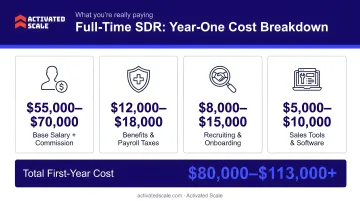
One wrong hire costs over $35,000 when you account for recruiting fees, salary burn during ramp, missed demos, and deals that never progressed. That's before you restart the process.
The Ramp and Turnover Trap
TOPO's benchmark research found the average SDR takes 3.2 months to reach full quota, with average tenure sitting at just 15.5 months. That creates a brutal cycle:
- 3 months to hire
- 3 months to ramp
- 12 months of productivity (best case)
- Then the whole process restarts
The turnover trap drains more than money — it resets your pipeline, your messaging, and every insight you've built about your ICP.
The Founder Time Cost
Activated Scale data shows that companies save 20+ hours of founding team time per salesperson just on interviewing. One client, Case Active, saved 25 hours in time-to-hire alone. For seed-stage founders, those hours translate directly into product decisions, customer conversations, and runway — not recruiting logistics.
What Are On-Demand SDRs and How Do They Differ?
On-demand SDRs are experienced, fractional sales professionals who work on flexible contracts to handle top-of-funnel prospecting, outreach, and appointment setting — without the overhead of a full-time hire.
They're not offshore call centers running templated scripts at volume. The table below shows exactly where the model diverges.
| Factor | On-Demand SDR | Offshore BPO |
|---|---|---|
| Location | US-based | Offshore |
| Experience level | 3+ years B2B sales | Varies widely |
| Buyer knowledge | Matched to your ICP | Generalist |
| CRM integration | Works in your stack | Separate system |
| Accountability | Embedded in your process | Volume-focused |
| Data ownership | You keep it | Often siloed |
The Try-Before-You-Buy Advantage
On-demand SDRs typically operate on an initial 3-month contract period. During that window, you evaluate two things: can they actually sell your product, and do they fit your team culture. No long-term commitment until you have evidence.
Activated Scale structures engagements this way intentionally. 65% of clients end up hiring their fractional SDR as a full-time employee after seeing results — which means the model works as a risk-free audition as much as a pipeline tool.
Speed to Deployment
A full-time hire takes roughly 90 days from job post to first day. A fractional SDR from Activated Scale can be matched, briefed, and executing outreach within days.
The talent network draws from professionals with backgrounds at Salesforce, Oracle, Zendesk, IBM, and Intuit — each matched based on prior experience selling to your specific buyer persona, whether that's a CIO, VP of HR, or CMO.
Who benefits most:
- Seed to Series A B2B SaaS companies without an established sales team
- Founders validating ICP and messaging before scaling headcount
- Companies that need pipeline now without inflating burn
On-Demand SDR Strategies That Drive B2B Pipeline
Deploying an on-demand SDR is only half the equation. The strategies they execute determine whether you get qualified meetings or just outreach noise.
Build a Laser-Focused ICP and Prospect List
Generic lists produce generic results. Start by identifying patterns in your existing customers — then build a "lookalike" prospect list from those signals. Look at industry, company size, tech stack, funding stage, and decision-maker title. Those patterns become your targeting blueprint.
From there, tools like LinkedIn Sales Navigator filter prospects by active buyer signals:
- Recently funded companies
- Hiring for roles that indicate relevant budget or initiative
- Decision-makers who posted recently on LinkedIn
This signal-based filtering separates prospects with real conversion potential from those who are just demographically similar.
Execute Multi-Channel Personalized Outreach
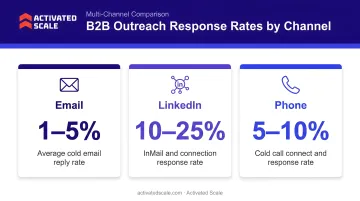
Email alone won't get you there on its own. Gong's analysis of 25 million cold emails found the average rep sends 344 cold emails to get one positive reply. That's the baseline with no personalization strategy.
More volume isn't the answer. Better context is.
Gong's research on 30,000+ prospecting emails found that:
- Individual personalization more than doubled replies for non-managerial buyers
- Company-specific topics tripled reply rates for executives
- Activity-based insights (referencing something the prospect did recently) tripled both replies and scheduled meetings
Effective on-demand SDRs combine this personalization with multi-channel sequencing. HubSpot's 2025 Sales Trends Report shows social media delivers 42% response rates versus 26% for email, with 35% of reps saying social produces their highest-quality leads. Cold email, LinkedIn connection and message, and phone calls work best when coordinated: run them in parallel, not as separate tracks.
Maintain Structured Follow-Up Cadences
Most pipeline dies in the follow-up gap, not the first touch.
On-demand SDRs use structured cadences — spacing follow-ups at increasing intervals across 2–3 weeks — to stay visible without overwhelming prospects. This is where most in-house attempts break down: founders and part-time sales efforts follow up once or twice, then move on. A dedicated SDR stays the course.
Create a Smooth SDR-to-AE Handoff
A meeting booked is only valuable if the AE walks in prepared. Before any handoff, on-demand SDRs should document:
- The prospect's stated pain points
- Objections raised during outreach
- Relevant company context (recent funding, growth signals, team changes)
- What the prospect expects from the next conversation
A poorly briefed AE wastes the SDR's work and loses the prospect's confidence. The handoff document is what separates a booked meeting into a real opportunity.
How to Deploy On-Demand SDRs Effectively
Before bringing on any on-demand SDR, make sure these foundations exist:
- A working CRM — all prospect data needs a home
- A basic ICP hypothesis — even unproven, you need a starting point
- A clear value proposition — one or two sentences that explain what you do and who it's for
- At least one reference customer or case study — proof that the product works
On-demand SDRs amplify what exists. They don't build the foundation from scratch.
Setting Realistic Expectations
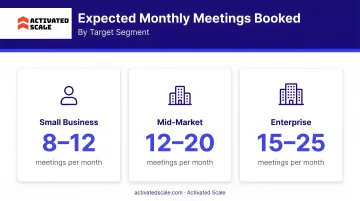
Once those foundations are in place, here's what Activated Scale's client data shows by month 3:
| Target Segment | Expected Meetings/Month |
|---|---|
| Small businesses (1–100 employees) | 13–22 |
| Mid-market (101–1,000 employees) | 10–14 |
| Enterprise (1,001+ employees) | 8–12 |
Allow 2–4 weeks for ramp before results stabilize. The first two weeks are intake: learning your product, ICP nuances, common objections, and competitive positioning. Outreach begins in week three.
Operational Best Practices
The startups that see fastest results treat on-demand SDRs as team members, not vendors:
- Brief them in week one — cover product positioning, your best customer stories, and the objections your prospects raise most
- Grant CRM access immediately — all prospect interactions get logged; no siloed spreadsheets
- Run weekly syncs — share feedback from meetings, iterate on messaging, flag what's resonating
- Commit to 30 days before pivoting — messaging patterns take time to surface; resist the urge to change course weekly
In practice, days 1–15 go toward onboarding and messaging development. Days 16–45 shift to active outreach across email, phone, and LinkedIn — with messaging refined continuously based on real prospect responses.
Measuring ROI from Your On-Demand SDR Program
Four metrics tell the full story:
- Meetings booked — raw output, segmented by week and month
- Qualified meeting rate — what percentage of booked meetings become real opportunities
- Pipeline generated — total deal value from SDR-sourced leads
- Cost per qualified meeting — total SDR spend divided by meetings that converted to opportunities
Track all four consistently and you'll know not just what your SDR is producing, but whether what they're producing is actually moving deals forward.
What the Numbers Look Like at Scale
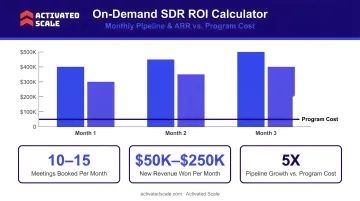
TOPO's benchmarks show SDRs in top-performing companies generated an average monthly pipeline of $415,000 and accounted for 57% of total pipeline. SDR-qualified leads converted to sales opportunities at 58%, with 22% of those opportunities resulting in closed business.
For early-stage context: if your ACV is $25,000 and your on-demand SDR books 12 qualified meetings per month with a 50% opportunity conversion and 20% close rate, that's roughly 1.2 deals per month. That works out to $30,000 in new ARR monthly from a program costing $4,500/month plus performance pay.
Signals It's Time to Scale
Look for these before adding headcount or extending contracts:
- Consistently hitting meeting targets for two consecutive months
- Pipeline-to-close rates showing healthy downstream conversion
- SDR running out of prospect capacity in their current list
- Messaging has stabilized and reply rates are predictable
At that point, the decision is straightforward: add a second on-demand SDR, extend the current contract, or convert the rep to a full-time hire. 80% of Activated Scale clients use fractional sales talent for 5+ months, which suggests most find the answer long before the initial contract expires.
Frequently Asked Questions
Is SDR or BDR better?
SDRs focus on inbound lead qualification and outbound prospecting to book meetings for AEs. BDRs typically focus on net-new outbound business development and new market expansion. For most early-stage B2B SaaS startups, the SDR function is the more immediate need — it directly feeds qualified meetings into the pipeline your AEs can close.
What is an on-demand SDR?
An on-demand SDR is a vetted, experienced sales development professional who works on a flexible or fractional basis, handling prospecting, outreach, and appointment setting without the cost or commitment of a full-time hire. They're a strong fit for startups still figuring out their sales process before committing to full-time headcount.
How much does an on-demand SDR cost compared to hiring full-time?
On-demand SDR engagements through platforms like Activated Scale are $4,500 per month plus performance pay. That's a fraction of the $100K+ first-year cost of a full-time SDR hire when salary, benefits, recruiting fees, and tools are factored in — with no long-term commitment.
How quickly can an on-demand SDR start generating pipeline?
On-demand SDRs typically begin outreach within days of deployment, compared to the 3–6 month ramp for a full-time hire. First qualified meetings often appear within 2–4 weeks once ICP targeting and messaging are aligned, with consistent volume building by month two or three.
What strategies do on-demand SDRs use to book meetings?
Most on-demand SDRs rely on a consistent set of core tactics:
- Build ICP-focused prospect lists targeting the right titles, industries, and company sizes
- Run multi-channel outreach across cold email, LinkedIn, and phone
- Personalize messaging using buyer signals — recent funding rounds, hiring activity, company news
- Maintain structured follow-up cadences across a multi-week window
When should a startup use on-demand SDRs instead of hiring in-house?
On-demand SDRs make sense when:
- You don't yet have a proven sales process to train against
- Limited runway makes a bad hire too costly to absorb
- You need pipeline in weeks, not months
- You want to test outbound as a channel before committing to permanent headcount