
Introduction
There's a moment every B2B SaaS founder recognizes: the product is working, early customers are genuinely happy, but you can't be the only person selling anymore. The problem is that traditional full-time hiring feels like the wrong answer — a median SaaS AE now carries a $190K OTE according to The Bridge Group's 2024 benchmark report, and that's before benefits, equity, or the 5.7-month average ramp time that comes with it.
You need sales capacity now. Not in six months.
That's the gap an on-demand sales team fills. The model gives you access to experienced sales talent on a fractional or contract basis: deployable fast, scalable deliberately, and without the overhead of a permanent hire you're not yet ready to support.
This guide covers what that looks like in practice — when to use it, how to build it right, and what mistakes to avoid early on.
Key Takeaways
- Only 5% of your B2B target market is ready to buy at any given moment — on-demand sales capacity lets you target that window without overstaffing
- Full-time AE hiring takes 40–45 days just to hire, then 5.7 months to ramp — fractional talent can be active in days
- Fractional AEs typically cost $6,500/month retainer plus performance pay, vs. $190K+ OTE for full-time
- Lay the foundation first: documented ICP, sales process, and basic assets before activating any rep
- Contract-to-hire arrangements create a natural bridge from fractional to full-time without restarting the search
What Is an On-Demand B2B Sales Team?
An on-demand B2B sales team is exactly what the name suggests: sales capacity you can activate, adjust, or wind down based on where your business actually is — not where you hope it will be in 12 months.
Instead of hiring full-time employees, you engage experienced sales professionals on a contract or part-time basis. The "on-demand" framing matters because it describes the flexibility, not just the format.
The Three Common Formats
- Fractional sales reps work part-time within a defined scope — typically 20 hours per week — handling prospecting, discovery, or full-cycle selling depending on your needs.
- Contract-to-hire lets a rep work under contract with an explicit option to convert to full-time. Most fractional engagements at the early stage should be structured this way: you're testing fit before committing.
- Outsourced SDR or AE functions place an external team on one part of your sales motion, usually top-of-funnel prospecting or a new market segment, without full pipeline integration.
Each format solves a different constraint — which is exactly why the underlying market math matters so much.
Why the 95/5 Rule Changes the Math
Research from the LinkedIn B2B Institute and the Ehrenberg-Bass Institute established what's now widely cited as the 95/5 rule: at any given moment, only 5% of your target market is actively in-market. The other 95% aren't ready to buy yet.
That single data point reframes the entire staffing question. You don't need a large, always-on sales team — you need focused capacity pointed at the right signals. An on-demand model is built for exactly that.
On-Demand vs. Full-Time Sales Hiring: When to Choose Which
The choice isn't permanent. It's a sequencing decision based on where your company is right now.
When On-Demand Wins
Choose fractional or contract-based talent when:
- You're still refining your ICP and the sales motion isn't fully documented yet
- Runway constraints make a $150K–$200K base + benefits package unsustainable
- You need to test a new segment or motion without committing headcount
- You need someone productive fast — full-time Enterprise AE hiring averages 40 days just to fill, per Betts Recruiting's 2024 Compensation Guide, then another 5.7 months to ramp
When to Transition to Full-Time
The signal is process-based, not time-based. Move toward full-time when:
- The sales process is documented, repeatable, and a rep can follow it without your involvement
- A fractional rep has validated the motion over 3–6 months and pipeline is consistent
- Deal volume exceeds what part-time hours can absorb
Contract-to-hire arrangements are designed for this transition. The rep is already ramped and already proven, so conversion doesn't require restarting from scratch.
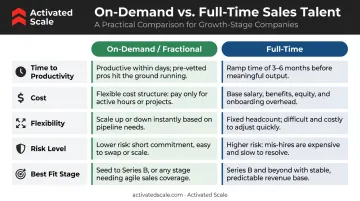
Quick Comparison
| Factor | On-Demand / Fractional | Full-Time |
|---|---|---|
| Time to productivity | Days to weeks | 40+ days to hire, then 5.7 months to ramp |
| Cost | $6,500/month retainer + performance pay (AE) | $150K–$200K+ OTE + benefits (~27% burden) |
| Flexibility | High — scale up/down as needed | Low — fixed commitment |
| Risk level | Low — defined contract with go/no-go checkpoints | High — wrong hire costs 6–12 months of salary |
| Best fit stage | Pre-PMF through early traction | Validated, repeatable sales motion |
Foundations to Lay Before Your First On-Demand Hire
This section is where most early-stage founders skip ahead too quickly — and pay for it in wasted retainer spend.
Even the best fractional rep can't perform in a vacuum. Without a documented process and a clear ICP, they'll spend their first weeks asking you questions you haven't thought to answer yet. According to Salesforce's State of Sales report, sales reps already spend 60% of their time on non-selling tasks. Poor infrastructure on your end makes that number worse — on your dime.
Document the Sales Process First
If you've been the only salesperson, the process lives in your head. Before activating anyone else, extract it. A new rep needs:
- Target account criteria: firmographic and behavioral signals that qualify a prospect
- Outreach sequence: channels, cadence, and messaging framework
- Discovery questions: the 5–7 questions that surface the core pain
- Qualification criteria: what makes a deal worth pursuing vs. walking away
- Documented responses to your top 3 objections — not improvised ones
Accuracy matters more than polish here.
Define the ICP in Operational Terms
"Mid-market SaaS companies" isn't an ICP — it's a category. A usable ICP looks like:
- Company stage: Series A–B, 50–200 employees
- Tech stack signals: Uses Salesforce + Outreach but lacks a data layer
- Buying trigger: Recently hired a VP of Sales or missed a revenue target
- Pain the product solves: Stated specifically, not generically
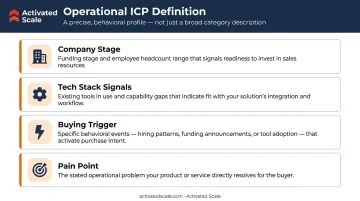
A rep should be able to prospect independently from this definition without pinging you for every targeting decision.
Build the Minimum Viable Asset Set
Before day one, prepare:
- One discovery call framework
- A pitch deck or product one-pager
- Responses to the three most common objections
- One customer case study or concrete proof point
Set up the CRM with a clean prospect list before the rep starts. A rep without proper tooling will spend their first two weeks building what should already exist. That's retainer money going toward administrative setup, not pipeline.
How to Source and Hire On-Demand B2B Sales Talent
Where to Find Fractional Sales Talent
Your sourcing options include:
- Freelance marketplaces like Upwork or Toptal for generalist options
- LinkedIn — search for "fractional AE" or "fractional SDR" to find professionals actively offering this model
- Investor networks — often the fastest path to a warm intro
- Specialized platforms built specifically for this use case
Activated Scale falls into that last category: a fractional sales talent marketplace for B2B SaaS startups. They connect founders with vetted, US-based sales professionals, many with backgrounds at Salesforce, Oracle, Datadog, IBM, ZoomInfo, and Zendesk. Placements happen in 7 days or less, sometimes within 48 hours.
What to Look for in a Fractional Hire
Unlike a full-time hire with months to ramp, a fractional rep needs to be useful fast. Prioritize:
- Relevant segment experience — they've sold to your exact buyer type and deal complexity before
- IC track record — prior individual contributor performance, not just management experience
- Availability matching your pipeline volume — a rep spread across four clients won't give you the focus you need
- Coachability — fractional engagements require fast context absorption and minimal hand-holding
Evaluate Competencies, Not Just Resumes
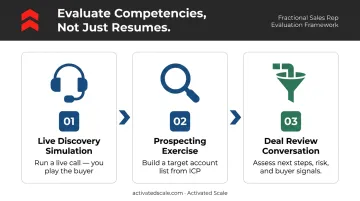
Three exercises that are more predictive than behavioral interview questions:
- Live discovery simulation: Have the candidate run a discovery call with you as the buyer. You'll learn more in 20 minutes than in a 90-minute interview.
- Prospecting exercise: Ask them to build a list of 5–10 target accounts from your ICP definition. How they interpret and apply the criteria tells you a lot about their judgment.
- Deal review conversation: Walk through a real pipeline scenario and listen for how they assess next steps, risk, and buyer signals.
Structure Compensation Correctly
The standard model is monthly retainer plus variable performance pay. Fractional AEs through Activated Scale typically carry a retainer of $6,500/month plus performance pay, substantially lower than a full-time AE OTE while keeping the rep financially engaged.
Pure variable pay structures rarely work when the sales cycle exceeds a month. The rep disengages before the economics make sense for them. Base retainer covers time; variable reflects meaningful upside for hitting pipeline and revenue targets.
Define conversion terms upfront. A 3-month initial contract with documented performance benchmarks (meetings booked per month, qualified pipeline generated) gives you the data to make a confident convert-to-hire decision. That structure also protects you from extending an underperforming engagement past its natural endpoint.
How to Manage and Scale Your On-Demand Sales Team
Managing fractional reps requires more deliberate structure than managing full-time employees. They aren't absorbing company context passively over time, so you have to provide it deliberately.
The Management Cadence That Works
- Weekly pipeline reviews focused on deal progression, not status updates. Where is each deal stuck, and what's the specific next action?
- Weekly or bi-weekly 1:1s with focused coaching on observed behaviors — call quality, objection handling, qualification rigor
- Shared CRM dashboard that gives both you and the rep real-time visibility into activity metrics and pipeline health
Activated Scale recommends a fixed weekly meeting to review market signals, challenges, and metrics — and they check in on performance against the SOW monthly to flag issues before they compound.
Setting and Tracking Performance Expectations
Define the metrics before day one:
- Outreach volume targets (calls, emails, LinkedIn per week)
- Meetings booked per month (qualified, not just scheduled)
- Qualified pipeline value generated by 30/60/90 days
Set explicit go/no-go checkpoints. If a rep isn't hitting the 30-day leading indicators, that's the moment to course-correct — not at month three when you've burned significant retainer.
Once your first rep is performing consistently, the question becomes when — not whether — to scale.
Scaling the On-Demand Model
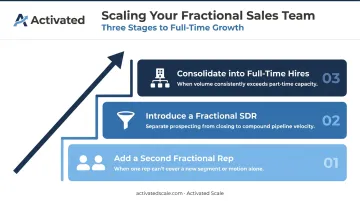
Scaling is a sequenced decision, not a reaction to pipeline pressure:
- Add a second fractional rep to cover a different segment or motion once the first is performing
- Introduce a fractional SDR alongside a fractional AE to separate prospecting from closing — this is where pipeline volume starts to compound
- Consolidate into full-time hires when deal volume consistently exceeds what part-time hours can support and the motion is fully documented
When a fractional AE's retainer plus performance pay approaches 60–70% of a full-time OTE — and the pipeline supports a full quota — it's time to convert.
Common Mistakes to Avoid
Activating a rep before the infrastructure is ready. No ICP, no documented process, no CRM means the rep spends their first weeks building what should already exist — the retainer burns, and the founder concludes fractional doesn't work. The model wasn't the problem.
Treating fractional reps as contractors rather than teammates. Reps embedded in your communication cadence and kept current on product updates sell with far more context. Keep them at arm's length and that context gap shows up in every buyer conversation.
Skipping the performance checkpoints. Without defined 30/60/90-day milestones and a clear go/no-go process, underperforming engagements drag on — and high-performing reps never get the conversion conversation they've earned.
Frequently Asked Questions
What is an on-demand B2B sales team?
An on-demand B2B sales team lets you engage experienced sales professionals — fractional reps, contract-to-hire talent, or external agency functions — on a part-time or contract basis. You activate, scale, or pause capacity based on pipeline needs and growth stage, without the overhead of full-time employment.
What is the 95/5 rule for B2B sales?
At any given moment, only about 5% of your target market is actively in-market and ready to buy — the other 95% aren't there yet. For on-demand teams, this means focused sales capacity pointed at the right in-market signals outperforms a large, always-on headcount at the early stage.
How is an on-demand sales team different from a traditional sales agency?
On-demand reps — especially fractional or contract-to-hire — operate as part of your team, sell under your brand, and build real pipeline relationships. Traditional agency vendors typically run disconnected campaigns with less integration into your actual sales process and customer relationships.
How much does it cost to build an on-demand B2B sales team?
Fractional AEs typically run $6,500/month retainer plus performance pay. Compare that to a full-time AE at $150K–$200K+ OTE, plus benefits that add roughly 27% to total compensation cost per BLS data. For early-stage companies, the difference is material.
When should a startup convert from fractional to full-time?
Convert when the sales process is documented, a fractional rep has validated the motion over 3–6 months with consistent pipeline, and deal volume exceeds what part-time hours can handle. A contract-to-hire arrangement makes this transition straightforward, since the rep is already proven and ramped.