
The cost isn't just financial. A wrong hire consumes 6–12 months of runway, demoralizes the team, and forces you to restart the search from scratch — often in a worse position than before.
Most advice on this topic focuses on finding a "great" VP of Sales. That's the wrong frame. The real question is finding one who fits your business — your current ARR, your team size, your sales motion, and where you need to be 12 months from now.
That's what this guide covers.
Key Takeaways
- A VP of Sales' primary job is building and managing a team — personal closing is the last priority, not the first
- Hire when you have a repeatable sales process, at least 1–2 reps in place, and revenue targets that need a team to hit
- The right fit combines stage-appropriate experience, a proven revenue track record, and familiarity with your buyer and deal size
- Structured interviews and reference checks, not gut feel, separate a strong hire from a costly mistake
- If you're pre-process or pre-team, a fractional VP of Sales can build the foundation before you commit to a full-time hire
What Does a VP of Sales Actually Do?
Most founders hire a VP of Sales hoping they'll "out-sell" them. That's not the job.
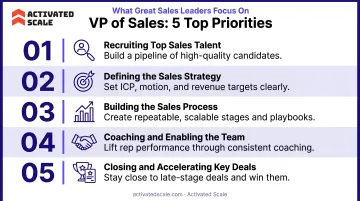
At any meaningful scale, the VP's primary function is building and managing a revenue organization — not carrying a quota themselves. SaaStr's foundational breakdown of the role makes this explicit: recruiting alone should consume 20%+ of a VP of Sales' time, and personal deal-closing ranks fifth out of five priorities.
The Actual Priority Order
- Recruiting and building the sales team — sourcing, evaluating, and hiring reps is the VP's most time-intensive job
- Coaching reps and assisting on key deals — improving rep performance and showing up in high-value opportunities
- Refining sales tactics and improving revenue per lead — tightening the process, not reinventing it from scratch
- Aligning with marketing and product — feeding pipeline quality feedback upstream, reporting results to the CEO and board
- Closing strategic deals directly — yes, this happens, but it's the exception, not the expectation
What the VP Is Not Responsible For
A VP of Sales cannot rescue a product with no market demand. They can't replace a broken go-to-market motion or serve as your primary closer on most deals.
Founders who hire with those expectations set the role up to fail before day one. The VP needs raw materials: some inbound, a rough playbook, and at least one or two reps already in place. Without that foundation, they're not scaling a system — they're trying to build one from scratch while being held to revenue targets.
That's what makes this role genuinely difficult to fill. It demands financial acumen, people management, tactical sales knowledge, and strategic thinking — and the right balance of those shifts as the company grows.
When Is the Right Time to Hire a VP of Sales?
Timing this hire wrong is how companies end up in the 70% failure statistic.
The "Too Early" Scenario
If the founder hasn't yet closed enough deals to understand the ICP, sales cycle, average deal size, and common objections, a VP of Sales will inherit chaos. There's no playbook to hand off, no reps to manage, no process to improve.
The VP ends up doing founder-level discovery work while being evaluated against executive-level metrics — a setup that fails almost every time.
OpenView recommends waiting until at least $1M ARR before making this hire. SaaStr adds that the right signal isn't a number — it's having 1–2 reps who are succeeding, even modestly, which proves the motion is repeatable.
The "Right Time" Signal Set
You're ready to hire a VP of Sales when:
- The founder is spending the majority of their time on sales and can't focus on the business
- The team has grown to 2–3 reps who need active management and coaching
- Revenue targets require more deals than one person can close
- You have funding or ARR to support the hire plus a small team underneath them
The Stage-Fit Problem
A company at $500K ARR needs a completely different VP profile than one at $5M ARR. SaaStr's "48 Types of VP Sales" framework makes this point emphatically: the top mistake founders make is hiring from the wrong company stage.
The two profiles look nothing alike:
- Early-stage ($1M–$2M ARR): Built teams from scratch, closed early customers personally, operates without infrastructure
- Later-stage ($10M+ ARR): Managed large org structures, optimized existing processes, ran structured pipeline reviews
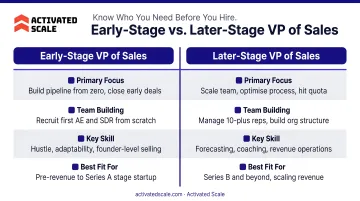
Screen for candidates with experience at your current ARR — or where you'll be in 12 months. Same ACV range, same buyer type, same inbound/outbound balance.
One Timing Caution Worth Repeating
"We just raised, let's hire a VP of Sales" is one of the most common early mistakes. Without a repeatable process and at least a small team in place, even a great VP won't have anything to build on. And given that finding the right candidate can take 12+ months, start the search 3–6 months before you think you need someone — not the week after a close.
What to Look for in a VP of Sales Who Fits Your Business
Resume credentials matter less than most founders think. What actually predicts success is matching three dimensions to your specific context.
Stage-Appropriate Leadership Experience
This is the single most predictive factor. A VP who managed a 40-person enterprise sales team will likely struggle at a 3-person startup — not because they're bad at their job, but because the job is fundamentally different.
What you're looking for is someone who has built a team from scratch, not just inherited one.
Good interview question: "What did the sales team look like when you joined, and what did it look like when you left?"
A candidate who grew a team from 2 to 12 reps tells a very different story than one who took over a 15-person org and added headcount. Both might be impressive — but only one is relevant to your situation.
Proven Financial Track Record
Unlike many executive roles, sales leadership has a clear success metric: revenue. Candidates should be able to speak in specific numbers.
Look for:
- Direct attribution to ARR growth (not "I was part of a team that hit $X")
- Quota attainment rates across their reps, not just their own performance
- Average deal size and how it changed over their tenure
- Rep productivity assumptions — can they model how many reps are needed to hit a target?
Red flag: Any candidate who can't attach specific dollar figures to their impact. Vagueness about revenue outcomes is a pattern, not a coincidence.
Product and Market Compatibility
A VP who has sold to the same buyer persona, in the same industry, at a similar deal size and sales cycle length will ramp faster. They already know the objections, the buying process, and the stakeholders — which means less time learning and more time building.
The trade-off is real, though. Hiring from a direct competitor shortens ramp but can bring baggage: customer conflicts, non-competes, or rigid playbook assumptions. Hiring from an adjacent space takes more onboarding investment but often brings fresher approaches.
Both can work. The one path that rarely does: hiring someone with zero familiarity with your buyer and expecting them to figure it out while simultaneously building your team.
Leadership Style and Culture Fit
Salespeople are skilled at selling themselves. A candidate who is charming and compelling in interviews may still be a poor people manager.
Listen for how they talk about their teams. "We-first" language signals a builder; "me-first" language signals an individual contributor who's been promoted.
- "We built a playbook that..." vs. "I came in and fixed their process..."
- "My reps consistently hit quota because..." vs. "I was always the top performer..."
- The VP who narrates their own deals more than their team's growth is showing you what they think the job is.
The VP who talks primarily about their own deals is telling you what they think the job is.
Red Flags to Watch For
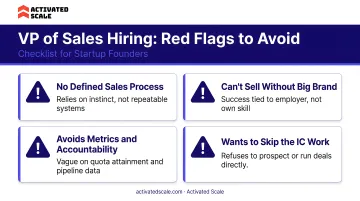
- No clear 30-60-90 day plan — or a generic one clearly recycled from a previous role
- Talks more about their closing ability than their team-building track record
- Shows little curiosity about your current sales process, gaps, or team
- Pushes a one-size-fits-all playbook without diagnosing your specific situation
How to Structure the Hiring Process
Gut feel is the enemy of a good VP of Sales hire. Salespeople are professionally trained to be likable and persuasive. A structured process is the only reliable defense.
Build a Scorecard, Not Just a Job Description
A job description lists responsibilities. A scorecard defines what success looks like at 30, 60, 90, and 180 days: it also weights the competencies you'll evaluate. Before you interview anyone, agree internally on what "great" looks like for your company at your stage.
Source from the Right Channels
General job boards produce volume, not quality. Focus on:
- Warm referrals from investors and board members
- Peer networks of other SaaS founders who've recently made this hire
- Specialist sales recruiters who know the difference between a Series A VP profile and a Series C VP profile
Run Structured Interviews with a Working Session
Use the same questions across all candidates and score them on rubrics. Google's structured interviewing research confirms this approach reduces bias and improves hiring accuracy.
For finalists, include a working session: ask them to walk through how they'd approach your current sales challenges or present their 30-60-90 day plan. The quality of their questions tells you as much as their answers.
Do the Reference Checks Others Skip
Call references the candidate did not provide — former peers, direct reports, or skip-level managers. Ask:
- How did they handle missing quota?
- What did the team culture look like under their leadership?
- How did they make decisions under pressure?
- Would you hire them again, and for what kind of role?
The last question is revealing. If former colleagues would re-hire them for a bigger company or a different stage (but not the same type of role), that tells you exactly where they fit.
How Activated Scale Can Help You Find the Right Sales Leader
For Seed to Series A B2B SaaS companies, there's a real gap between "we're not ready for a full-time VP of Sales" and "we need experienced sales leadership now." That gap is where most founders either wait too long or hire too fast.
Activated Scale's model is built specifically for that gap. Their try-before-you-buy approach (a 3-month initial contract with clearly defined goals) lets you assess whether a sales leader can actually perform in your environment before committing to a full-time hire with salary, equity, and the management overhead and culture risk that comes with it.
What the engagement looks like in practice:
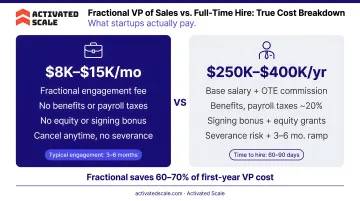
- Fractional VP of Sales engagements run 15–20 hours per week
- Monthly retainer is $12,000 per month plus bonus
- Compared to a full-time VP of Sales at $250,000–$400,000 OTE (plus benefits and equity), the cost difference is substantial
- No termination fees, no benefits costs, and free rematching if the fit isn't right
The talent network is pre-vetted through a three-stage screening process — application review, a pitch video assessment, and a subject matter expert interview. In 2024, Activated Scale accepted roughly 7% of applicants to the network.
Matching accounts for buyer persona, deal size, and industry — so early-stage founders aren't handed a candidate who spent the last decade selling to Fortune 500 procurement teams.
For companies that want to validate fit before making a permanent commitment, the option to convert to a full-time hire is built into the model. You get three months to see real performance in your specific environment before signing an offer letter.
Frequently Asked Questions
What is a 30-60-90 day plan for a VP of Sales?
A 30-60-90 day plan covers three phases: month one on learning (process, team, customers), month two on quick wins and pipeline building, and month three on executing forecasts and hitting early metrics. Ask candidates to present one in the interview — it's one of the most reliable evaluation tools you have.
When is it too early to hire a VP of Sales?
It's too early if the founder hasn't yet closed deals themselves, has no repeatable sales process, and has fewer than 1–2 reps in place. A VP of Sales needs something to scale — they can't build a revenue motion from zero while simultaneously being held accountable to growth targets.
What is the difference between a VP of Sales and a Sales Director?
A Sales Director manages day-to-day rep performance and sales activities. A VP of Sales carries broader executive responsibility — hiring strategy, revenue forecasting, board reporting, cross-functional alignment, and ownership of the revenue number at the organizational level.
How do you know if your VP of Sales hire isn't working out?
Early warning signs typically appear within 30–60 days: team morale declining, no progress on pipeline or process, inability to recruit additional reps, or evasiveness when asked about metrics. Acting on a misfit quickly is significantly less costly than waiting six months hoping things improve.
Should an early-stage startup consider a fractional VP of Sales before making a full-time hire?
For Seed to Series A companies without a proven sales process, a fractional VP of Sales can build the foundation, validate the playbook, and reduce hiring risk — all before committing to a full-time salary and equity package. It's the same logic as piloting anything else: confirm it works before you scale it.
What salary should you expect to pay a VP of Sales?
Base salaries typically range from $125,000 to $200,000, with most roles structured as a 50/50 base-to-variable split — putting total OTE at $250,000–$400,000. Early-stage hires also receive equity, and total compensation shifts meaningfully based on company stage, ARR, and the candidate's track record.