Introduction
Hiring your first VP of Sales is one of the most consequential decisions a B2B SaaS founder will make — and the odds aren't encouraging. According to SaaStr, roughly 8 out of 10 first VP of Sales hires at startups fail, with an average tenure of just 11 months. That's not a staffing setback. That's 12 months of lost momentum, a damaged board relationship, and a demoralized team you now have to rebuild.
The founder's dilemma is real: you've personally closed your first customers, revenue is moving, and investors are pushing you to "scale sales." But scale what, exactly? And who do you actually need?
This guide covers what you actually need to know before making the hire:
- When you're truly ready — and when you're not
- What candidate profile works at your stage
- How to run a process that filters out the wrong hires
- The red flags most founders miss until it's too late
- When a fractional VP makes more sense than a full-time commitment
Key Takeaways
- Hire to accelerate repeatability, not find it — you need proof of the motion first.
- Target stage-matched operators, not polished big-company executives.
- Start your search 6–12 months early — great candidates take that long to recruit.
- The wrong hire costs more than no hire. Board pressure isn't a good reason to rush.
- A Fractional VP of Sales is a legitimate bridge for pre-$1M ARR companies still proving the motion.
Signs You're Ready to Hire Your First VP of Sales
The Core Readiness Test
A VP of Sales is hired to accelerate a repeatable process — not to discover one from scratch. "Repeatable" means:
- 2+ reps consistently hitting quota — not just one strong performer carrying the number
- A defined ICP — you know who buys, why they buy, and what the deal looks like
- A predictable pipeline source — inbound, outbound, or partner-led, but not random
- A defined deal cycle — you can forecast close dates within a predictable window
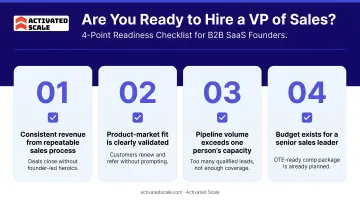
If those boxes aren't checked, a VP of Sales can't fix what isn't there. They'll spend their first six months trying to discover product-market fit instead of building the team.
The ARR and Timing Signal
SaaStr guidance points to $1M ARR as the threshold where a founder-led sales model starts to become a growth constraint. At stronger pipeline stages, some candidates now wait until $3M–$4M ARR before considering an early-stage move.
The search itself typically takes 6–12 months for a quality hire. To have someone in seat by month 18, start the search by month 6.
The Founder-Led Sales Exit Trigger
You're ready when the CEO being the primary closer is the bottleneck. Specifically:
- You can't take on more pipeline without dropping customer or product work
- The business needs team-building and process design, not more personal closes
- Your investors are right that the next stage requires a sales operator, not a sales founder
When You're Not Ready
Hiring too early is its own failure mode. A premature VP of Sales hire at an unproven stage burns cash, loses board confidence, and demoralizes the team you were hoping to build. If you can't articulate a repeatable pipeline, or if a $300K–$400K OTE package would strain your runway, wait.
What to Look for in Your First VP of Sales
The Right Candidate Tier
Resist the instinct to hire the most impressive resume in the room. A VP of Sales who scaled a $30M to $150M business at Salesforce or Oracle has never had to build without a brand name, a marketing machine, or an installed base. That's a different job entirely.
Target someone who has scaled from $1M to $10M ARR — a startup operator who's done the scrappy early work before and can do it again.
The "Hungry Director" Profile
The best first VP of Sales hire is often not a current VP. Look for:
- A regional sales director or senior manager who thrived under a strong VP
- Someone who helped build a team, not just managed one that already existed
- Ready to step up, more motivated, more coachable, and willing to take a role a seasoned VP would pass on
This person typically brings energy and a fresh network. Those two things matter more than whatever title they're leaving behind — and they directly affect how quickly you can build vertical fit into your early team.
Vertical and Motion Fit
SMB and enterprise sales have almost nothing in common — deal cycles, ACV, buyer dynamics, and pipeline velocity all differ sharply. A candidate who spent a decade on enterprise field sales will struggle in a high-velocity SMB motion, and vice versa.
Match the candidate to your actual customer profile: deal size, company size, buyer title, and sales cycle length. Getting this wrong is one of the most common — and most expensive — early sales hiring mistakes.
Must-Have Traits
| Trait | What It Looks Like |
|---|---|
| Recruiting instinct | Spends 25–50% of their time on talent, not just deals |
| Fighter mentality | Comfortable selling without brand recognition or existing playbooks |
| Coaching orientation | Builds reps up, doesn't just carry quota personally |
| Zero political tolerance | Gets things done without internal maneuvering |
The "Who's Coming With You" Test
Ask every finalist: "Which two or three salespeople would you recruit if you joined us?"
A VP of Sales with no answer to that question is starting from scratch. Building a team from zero takes far longer and costs far more than walking in with a trusted network already warmed up.
How to Run the Hiring Process the Right Way
Start With an Independent Advisor
Before engaging retained search firms or acting on board referrals, find a former VP of Sales at a comparable startup to serve as your sounding board. Investors and search firms have incentives to close the search quickly — that's not always aligned with finding the right person.
An independent advisor with no financial stake will ask harder questions and push back when finalists don't meet the bar.
Cast a Wide Net From Day One
Run three tracks simultaneously:
- Dream candidates — the ideal profile, knowing they may take 12+ months to recruit
- Realistic candidates — strong fits at the right stage, available in 6–9 months
- Stretch candidates — talented directors ready for their first VP role
Most top-tier VPs won't leave a strong position for an unproven startup on short notice. Parallel tracking protects you from a search that stalls because you aimed too high and waited too long.
Build a Structured Interview Process
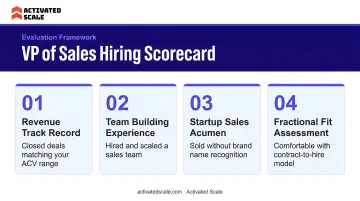
Use a hiring scorecard so every interviewer evaluates candidates against the same criteria — not gut feel. Core areas to probe:
- How they've built and managed pipelines from scratch
- How their current team is structured and how they coach reps
- Their 30-60-90 day plan for your specific stage and motion
- How they handle missed quarters and underperforming reps
HBR's research on hiring scorecards confirms that structured evaluation improves prediction accuracy and reduces bias in hiring decisions. Have finalists demo your product — how they pick it up cold tells you a lot.
Reference Checks Beyond the Provided List
Interviews only reveal what candidates choose to show you. Reference checks are where the real picture emerges — and where most founders cut corners. Call people who reported to the candidate and people they reported to — not just the references they hand you.
The most important question: "Would you work for this person again? Would you hire them?" Enthusiasm matters. A lukewarm response from a former boss is a signal worth taking seriously.
Know When to Wait
If there's genuine doubt about a finalist, wait. The political and operational cost of unwinding a VP of Sales hire three months in — severance, team disruption, board conversations — almost always exceeds the cost of a longer search. Use the extra time to tighten your scorecard, expand your candidate pool, or bring in a fractional sales leader to keep pipeline moving while you find the right fit.
Red Flags to Watch Out For
Most VP of Sales hiring mistakes are avoidable. The same three patterns surface repeatedly in searches that end badly — and knowing them ahead of time makes them easier to catch:
- No one to bring. A VP with 15+ years of experience who can't name a single person willing to follow them to a new company? That says something about how they've led. Probe it directly.
- The big-company reflex. Watch for candidates who treat brand recognition, an existing marketing budget, or a built-out SDR team as preconditions for success. Your first VP of Sales needs to build those things — not inherit them.
- Board pressure to check the box. Investors want the role filled, but their timeline isn't your reason to settle. Frame a deliberate, longer search as a strategic decision — because it is. The cost of a wrong hire made under pressure is measured in quarters, not weeks.
Onboarding Your VP of Sales for Early Wins
Set Expectations Before Day One
Ask your incoming VP to arrive with a written 30-60-90 day plan. This tests their preparation and gives you aligned benchmarks before they start. When Jason Lemkin's first VP of Sales at EchoSign doubled net-new sales within 90 days, the driver was a structured, pre-agreed operating plan executed from day one.
The plan should cover:
- How they'll assess the current team and identify gaps
- Initial pipeline priorities and what they'll tackle first
- First hires they want to make and why
Introduce Them to the Full Business
Before they get deep in pipeline, make sure they've met:
- Product team — to understand the roadmap and what's being built
- Marketing — to align on demand generation and messaging
- Customer Success — to learn what makes existing customers successful
- 2–3 current customers — nothing accelerates sales ramp like direct customer conversations
The faster they internalize why customers buy, the faster they can coach reps to close.
Define Success Metrics Upfront
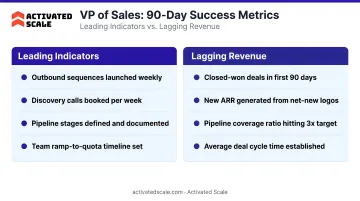
Agree on leading indicators for the first 90 days before chasing lagging revenue metrics:
- Pipeline created (volume and quality)
- Reps interviewed or onboarded
- Process documentation completed
- Forecast cadence established
Closed revenue in the first 90 days is rarely a fair measure of a new VP's impact. Most sales cycles run 30–90 days, so revenue results often reflect work done before they arrived — not theirs. Evaluate against leading indicators first, then revisit revenue outcomes at the 6-month mark.
When a Fractional VP of Sales Makes More Sense First
If you're pre-$1M ARR, still refining your ICP, or not yet confident your sales traction is repeatable, committing to a full-time VP of Sales at $300K–$400K OTE is a high-risk move. The cost of getting it wrong — severance, lost momentum, board friction — is significant.
A fractional or contract-to-hire approach lets you test sales leadership before locking in.
Here's how the costs compare:
| Option | Typical Annual Cost |
|---|---|
| Full-time VP of Sales (OTE) | $250,000–$400,000 + equity + benefits |
| Fractional VP of Sales | ~$96,000–$180,000 (retainer + bonus) |
Activated Scale connects B2B SaaS startups with vetted, US-based fractional sales professionals — with VP of Sales-level talent from companies like Salesforce, Oracle, and Zendesk — placed typically in 7 days or less. Engagements include:
- Cost: $12,000/month plus bonus
- Commitment: 3-month minimum
- Conversion: Option to hire full-time after testing the fit
For founders who aren't ready for a full-time VP hire but need senior sales leadership now, a fractional engagement preserves runway while still building pipeline and process.
Frequently Asked Questions
What makes a great VP of sales?
The best early-stage VP of Sales can recruit a team, coach reps, build repeatable pipeline from scratch, and sell without relying on a recognizable brand name. The key distinction: they build systems and develop people — not just close deals themselves.
What is another title for VP of sales?
Common alternatives include Head of Sales, Chief Revenue Officer (CRO), Director of Sales, or VP of Revenue. At early-stage startups, Head of Sales or Director of Sales often describe the same first senior sales leadership role.
When should a startup hire their first VP of sales?
The clearest signal is a repeatable sales process with 2+ reps hitting quota and roughly $1M ARR. If the CEO is still the primary closer and that's creating a growth bottleneck, it's time to start the search.
How long does it take to hire a VP of sales?
A thorough search takes 6–12 months from start to signed offer. Start the process 3–6 months before you think you need to — hiring under pressure shortens your bar, and a lower bar produces bad hires.
What is a typical VP of sales compensation at a startup?
Expect $300K–$400K OTE, typically structured 50/50 between base and variable, with performance upside beyond plan. Equity falls in the 0.5%–2% range depending on stage and candidate seniority.
Should you promote internally or hire externally for VP of sales?
Internal promotion preserves culture and rewards high performers — but only works if the candidate has demonstrated recruiting, coaching, pipeline management, and team-building skills beyond individual selling. If your best rep has never managed or hired before, they're likely to default to carrying a bag rather than building one.