
The problem is that this hire has a brutal failure rate. According to SaaStr, roughly 70% of first VP of Sales hires don't make it past 12 months. A bad hire doesn't just cost you money — it costs you six to twelve months of momentum at the exact stage when momentum compounds most.
This guide covers how to know when you're ready, what to look for, how to run the process, what to pay, and how to set your new VP up to succeed.
Key Takeaways
- Don't hire before you have 2 reps hitting quota and roughly $1M–$2M ARR — readiness matters more than funding
- You're hiring a builder, not a bag-carrier — the role is about installing process, not closing deals for you
- Avoid big-company operators who've never built from scratch — startup experience beats brand-name pedigree
- OTE typically lands between $200K–$300K at Series A, with equity historically in the 0.25%–1% range
- Consider a fractional VP of Sales through Activated Scale ($12,000/month plus bonus) as a lower-risk bridge before committing to a full-time hire
Signs Your Series A Startup Is Ready to Hire a VP of Sales
The "Too Early" Trap
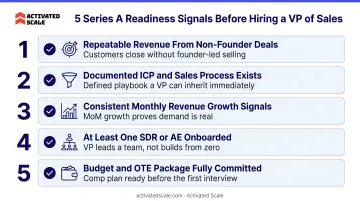
Hiring a VP of Sales before your sales motion is repeatable is one of the most common post-Series A mistakes. If you don't have a defined ICP, consistent monthly revenue, and at least two reps already in seat, you're paying VP-level compensation for work a senior AE or SDR manager should handle.
SaaStr is specific on this: don't hire a true VP of Sales until you have 2 reps hitting quota and roughly $1M–$2M ARR. Before that threshold, you're not scaling a motion. You're still discovering whether one exists.
The "Too Late" Trap
The opposite failure is more common and harder to see in real time. Founders who keep running sales themselves while also managing product, investors, and team operations don't just lose deals. They create a compounding problem:
- Pipeline visibility disappears as deals stall in their inbox
- No one is coaching or developing the junior reps
- Enterprise opportunities that require senior relationship management go nowhere
- The team lacks a clear cultural model for how to sell
By the time most founders realize they're too late, they've already left six figures of ARR on the table.
Readiness Signals to Look For
Before launching a search, verify you have:
- 2+ salespeople in seat, ideally with at least one hitting quota consistently
- A sales process that's repeatable — with documented stages
- Consistent monthly revenue with identifiable patterns in what's closing
- A value proposition that converts in the market without requiring the founder in every call
- Board and investor alignment on the need for a dedicated sales leader
The Cost of Getting It Wrong
A VP of Sales mishire at Series A doesn't just cost recruiting fees. SaaStr notes that a bad hire can set you back a year: sales typically decline during the transition, pipeline stalls, and you spend 3–6 months searching again while the business drifts.
If your VP earns $250K OTE and the hire fails at month 9, you've spent nearly $200K in comp alone — plus the opportunity cost of a full year's ARR growth.
The Fractional Alternative
Given that mishire risk, some Series A startups choose to validate fit before committing to a full-time hire. A fractional VP of Sales gives you access to senior sales leadership at a fraction of the cost while building pipeline and proving the model.
Activated Scale places pre-vetted fractional VPs of Sales at $12,000 per month plus bonus, with engagements typically starting at 3 months and the option to convert to full-time. The placement timeline is under 10 days, compared to the 2–4 months a traditional executive search typically takes.
What a VP of Sales Actually Does at a Series A Startup
The Builder, Not the Manager
The most important thing to understand about this hire: at Series A, you are not hiring someone to manage a working machine. You're hiring someone to build the machine.
The right candidate has to be comfortable with ambiguity, capable of designing a process before executing it, and willing to be hands-on in the early months.
According to SaaStr, the VP of Sales role at this stage is about scaling reps from 3 to 300, not discovering whether a sales motion exists. Your founder-led sales prove the motion works. Their job is to make it repeatable without you.
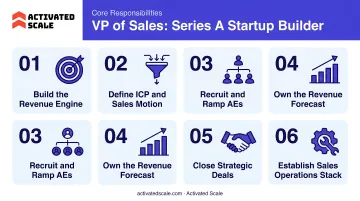
Core Responsibilities at Series A
- Define and refine ICP for scale — not just "who buys" but "who buys fast and expands"
- Build and hire the first wave of AEs and SDRs
- Implement or overhaul the CRM and document the full sales process
- Own pipeline forecasting and report to the board on revenue predictability
- Create the rep onboarding playbook so new hires ramp in weeks, not quarters
- Align cross-functionally with marketing on lead quality and product on deal blockers
What They're NOT There to Do
A VP of Sales at Series A should not be hired to go close deals on your behalf. The player-coach model — where the VP carries a quota alongside their reps — often backfires. It fragments their attention and creates the wrong incentive structure for building a team.
If you need someone to personally sell, hire an AE. The VP's leverage is multiplied through team output, not personal quota.
Stage Fit: Hire for Now, Not Series C
The builder who thrives at Series A is often not the right person to run a 50-person org at Series C. Hire explicitly for your current stage, not the company you hope to be in three years. The zero-to-one skill set is different from the 20-to-100 skill set — and conflating the two is one of the most common (and costly) VP of Sales hiring mistakes.
What to Look for in a VP of Sales
Startup Experience Over Brand-Name Pedigree
A VP who spent a decade at Salesforce or Oracle has learned to operate with extensive infrastructure, a full SDR team, pre-built playbooks, and a recognizable brand doing half the selling. Strip all that away, and the skills that made them successful there often don't.
a16z has written about this directly: big-company executives often face "rhythm mismatch" when they join early-stage companies. The support infrastructure they relied on doesn't exist, and rebuilding it from scratch isn't something they've had to do before.
Look for someone who has built — not just managed — a sales team at a comparable stage.
Must-Have Qualities
- Has personally built and hired a sales team before, even a small one — not just inherited one
- Matches your deal size: SaaStr flags a 3–5x mismatch as a major red flag — someone who's only closed $500K enterprise deals may not know how to run a $20K SMB motion, and vice versa
- Gets in front of customers themselves, especially in the first 30–60 days
- Can demo the product and handle technical questions without leaning on a solutions engineer for every call
- Works with marketing on pipeline quality and feeds product teams roadmap feedback — without friction
Red Flags to Watch For
- Asks for a large team before understanding the business or the current sales motion
- Has only ever managed steady-state revenue growth on a fully built team
- Can't articulate a clear 30/60/90-day plan when asked — or the plan is generic and doesn't reference your specific stage
- Has only worked at companies with $40M+ revenue where the VP role was operational, not foundational
Align Internally Before You Search
Knowing what to look for externally only matters if your leadership team agrees on it internally. Before the first interview, align your board on:
- VP vs. Director vs. Head of Sales — the right level for your current team size
- Must-have experience (deal size, stage, vertical)
- Non-negotiables vs. coachable gaps
- Comp range and equity budget
Discovering misalignment after you've made an offer — or worse, after someone's started — is one of the most expensive mistakes at this stage.
The Hiring Process: Step by Step
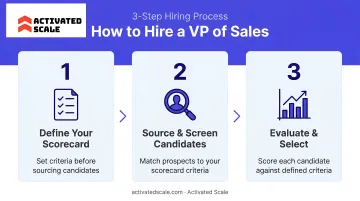
Step 1 – Define the Role Before You Write the JD
Build a hiring scorecard first. Document what success looks like at 30, 60, and 90 days before you write a single line of the job description. The scorecard should specify:
- Which skills are non-negotiable vs. trainable
- What the team structure looks like on Day 1 and at the 6-month mark
- The specific metrics the VP will own from the start
Companies that use structured, standardized interviewing are 5 times less likely to make a bad hire, according to SHRM research. The scorecard is what makes your process structured.
Step 2 – Source Candidates Strategically
Use one primary channel at a time: investor networks, a specialized recruiter, or a vetted sales talent platform. Running all three simultaneously creates inconsistent candidate quality and inbox chaos that makes decision-making harder, not easier.
Reference checks matter more here than in almost any other hire. Conduct live, 360-degree references with people who reported to the candidate, worked alongside them, and managed them — not just the names they hand you.
Step 3 – Evaluate and Decide
Rate every candidate against the same scorecard criteria. Charisma is real and dangerous: a VP of Sales who's great in an interview should push you to be more rigorous about scorecard evaluation, not less.
Keep these principles front of mind during finalist evaluation:
- Invite candidates to interact with your broader team, not just the hiring panel
- Share real business challenges instead of a polished pitch deck
- Expect the best candidates to ask harder questions than you anticipated — that's exactly what you want to see
VP of Sales Compensation and Equity at Series A
Cash Compensation
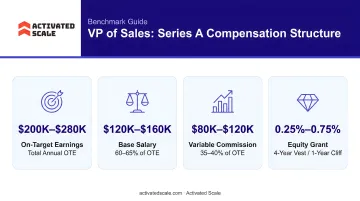
At Series A, VP of Sales total OTE typically ranges from $200K–$300K. According to Everstage's 2025 VP of Sales compensation guide:
- Base salary: $140K–$180K for Seed to Series A stage
- Base-to-variable split: Commonly 50/50 or 70/30
- Series B/C contrast: Base salary rises to $180K–$220K+ as the company scales
SaaStr recommends structuring VP of Sales comp as roughly 50% base, 50% bonus tied to company ARR goals, with 25%+ upside for overperformance. Geography affects these numbers — top-tier tech hubs command a premium, while other metros run 75–90% of those benchmarks.
Variable Pay Structure
Tie variable comp to 3–5 measurable KPIs only. Common choices:
- ARR growth (new and expansion)
- Team-wide quota attainment rate
- Pipeline coverage ratio
- New logo acquisition
Overloading the comp plan with six or more metrics creates confusion and dilutes focus. When reps don't know what to prioritize, everything suffers.
Equity
At Series A, VP of Sales equity grants typically range from 0.25%–1% on a 4-year vest with a 1-year cliff. The range reflects company stage, valuation, and how much of the option pool is already allocated.
Equity compensates for the risk of joining before revenue is predictable. It also ties your VP's long-term incentives directly to the company's outcome — which matters when you need someone rowing hard in year two, not just year one.
Note: Equity benchmarks shift with market conditions. Use current data from Carta or Pave to validate the range for your specific round size and valuation before finalizing any offer.
Setting Your VP of Sales Up for Success After the Hire
Before Day 1, have the following ready:
- CRM access, sales tools configured, and all documentation organized
- A structured week-one agenda covering stakeholder introductions, pipeline review, and process audit
- Written clarity on what 30/60/90-day success looks like — the same criteria from your hiring scorecard
After they start, watch for the most common early failure mode: founder interference. The person you just hired to run sales can't run sales if you're still approving every deal, sitting in on every call, or reversing their process decisions.
Put that into practice from week one:
- Delegate ownership of sales strategy and execution fully
- Set regular check-ins (weekly or biweekly) with a clear agenda
- Share information they need — product roadmap, investor expectations, board feedback — as a peer, not on a need-to-know basis
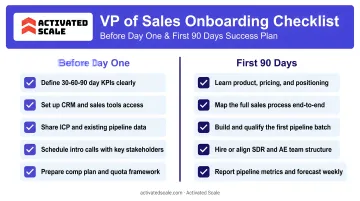
The onboarding period sets the tone for everything that follows. Founders who delegate early and share context freely give their VP of Sales the best shot at actually moving the number.
Frequently Asked Questions
Is VP of Sales a high position?
Yes. VP of Sales is a senior executive role that owns the entire revenue-generating function, including team structure, hiring, strategy, and forecasting. At most startups, it reports directly to the CEO and sits at the leadership table alongside product and finance.
How much equity should a VP of Sales get?
At Series A, equity for a VP of Sales typically falls in the 0.25%–1% range on a 4-year vest with a 1-year cliff. The exact number depends on company valuation, how much of the option pool is already committed, and what the candidate is being asked to leave behind.
Should a Series A startup hire a full-time or fractional VP of Sales?
If you're not yet at $1M–$2M ARR or haven't defined a repeatable sales process, a fractional VP can build pipeline and validate fit before you commit to a full-time salary. Platforms like Activated Scale offer vetted fractional VPs at $12,000/month plus bonus with a contract-to-hire option.
What should a VP of Sales accomplish in the first 90 days?
Days 1–30: audit the current pipeline, sales process, and team. Days 30–60: refine the playbook and begin hiring. By Day 90: demonstrate measurable pipeline growth and a repeatable sales motion that no longer depends on the founder.
What is the difference between a VP of Sales and a Head of Sales?
The titles are often used interchangeably at startups. VP of Sales typically signals more seniority, a seat at the executive table, and ownership of broader GTM strategy; Head of Sales tends to carry a more execution-focused scope without the same cross-functional authority.
How long does it take to hire a VP of Sales?
Most Series A founders report the process taking 2–4 months when done properly, accounting for alignment, sourcing, interviews, reference checks, and offer negotiation. Rushing this increases the risk of a costly mishire. Industry benchmarks suggest finding a truly great VP of Sales can stretch to 12–18 months if you're unwilling to compromise on fit.