The appeal is real: higher effective earnings, the ability to work across multiple clients, and control over your own trajectory. But the model has a learning curve. Variable pay structures vary widely, agreements carry risks that full-time offer letters don't, and landing quality engagements requires knowing where to look.
This guide covers everything you need to navigate that — what the role actually is, how engagements are structured, what you can realistically earn, the skills that matter, where to find opportunities, and what to review before signing anything.
Key Takeaways
- A B2B contract sales rep is an independent contractor hired to generate pipeline and close deals without becoming a full-time employee
- Hybrid retainer-plus-variable pay structures work better than performance-only in longer B2B cycles — most fractional roles follow this model
- Top contract reps stand out through self-directed prospecting, consultative selling, and fast ramp-up with minimal hand-holding
- Before signing, get incentive terms, trailing performance pays, clawback conditions, and termination notice confirmed in writing
- Specialized platforms — not general job boards — are where the best contract and fractional sales opportunities actually live
What Is a B2B Contract Sales Rep?
A B2B contract sales rep is an independent contractor hired to generate pipeline, run sales conversations, and close deals on behalf of a company — without taking on full-time employee status. This isn't a loosely defined freelance arrangement. It's a professional engagement with defined deliverables, accountability, and a compensation structure tied to performance.
What the Role Actually Involves
The core work mirrors what a full-time AE or SDR does:
- Prospecting and qualifying target accounts
- Running discovery and demo calls
- Managing deals through a CRM pipeline
- Closing revenue and handing off to customer success
The key difference in a contract context: you're doing all of this with less infrastructure and more independence. There's no onboarding cohort, no enablement team building your sequences, and often no established playbook to follow.
Contractor Classification — Why It Matters
The IRS doesn't accept a 1099 label at face value. It applies a three-factor test covering behavioral control, financial control, and type of relationship to determine actual classification status.
For contract reps, that means:
- You control how and when the work gets done
- You're responsible for your own taxes, tools, and business expenses
- You carry no employer-provided benefits
- You're free to work with multiple clients simultaneously
Misclassification creates complications for both sides — tax liability for the rep, legal exposure for the company.
Why Companies Hire Contract Reps
The motivations differ depending on which side of the engagement you're on:
For companies (typically Seed to Series A B2B SaaS):
- No benefits overhead or long-term headcount commitment
- Faster deployment than a traditional hire
- Ability to test a sales motion and validate ICP before building a full team
For experienced reps:
- Higher effective earning potential through incentive upside
- Freedom to carry multiple clients across industries
- Full control over your client mix and territory
Types of Contract Sales Rep Roles to Consider
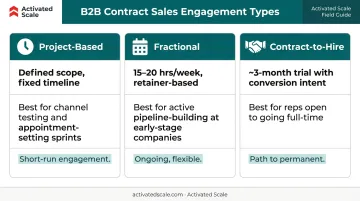
Three primary engagement structures dominate the market:
| Engagement Type | Structure | Best For |
|---|---|---|
| Project-based | Defined scope, fixed timeline | Testing a new channel, appointment-setting sprints |
| Fractional | Ongoing, 15–20 hrs/week, retainer-based | Active pipeline-building, early-stage companies |
| Contract-to-hire | ~3-month trial with conversion intent | Reps open to going full-time if fit is strong |
The Fractional Model in Practice
Fractional is the most common entry point for experienced reps. You function as a part-time AE or SDR — generating leads, running demos, closing deals — while maintaining the flexibility of independent work. Most reps carry one to three clients at a time.
Harvard Business Review noted that LinkedIn profiles identifying as fractional leaders grew from roughly 2,000 in 2022 to over 110,000 in 2024, reflecting real demand for senior expertise on a part-time basis across functions, including sales.
Fractional engagements frequently convert to full-time roles. On Activated Scale, a platform that matches experienced B2B reps with early-stage startups, roughly 65% of clients hire their fractional SDR or AE as a full-time employee after an initial contract period. Most engagements run eight months or longer before that decision point.
Industry Variation Worth Knowing
- SaaS and tech: Shorter cycles, strong emphasis on CRM hygiene and self-directed prospecting
- Healthcare and pharma: Higher pay at the top end, but domain compliance knowledge is non-negotiable
- Manufacturing and distribution: Long-established independent rep model with reps carrying complementary lines across defined territories
What B2B Contract Sales Reps Actually Earn
Earnings vary significantly by structure, seniority, and industry. Here's what the data shows.
Market Benchmarks
Glassdoor's data for contract sales representatives in the US (retrieved May 2026) shows:
- Estimated total pay: $70,000
- Most-likely range: $45,000–$108,000
- Base pay averaging $50,000 with ~$20,000 in additional variable pay
For context, the BLS reported a median annual wage of $100,070 for wholesale and manufacturing sales reps in technical and scientific products (May 2024), a useful employee-market benchmark for skilled B2B selling.
BLS data shows benefits represent roughly 24.7% of total compensation for sales occupations. Contract reps who don't build that premium into their rates are effectively working for less than equivalent employees.
Incentive Rate Benchmarks
According to RepHunter's incentive guidance, standard ranges by category:
- Manufactured products: 7–15% of sales price
- Gross-margin-based plans: 20–40%
- Service-based products: Can exceed 50% in some cases, since there's no manufacturing cost to absorb
- Lead generation only: Lower than full-cycle rates; often structured as a flat fee or fraction of full incentive
Rates shift based on who generates leads, sales cycle length, deal complexity, and whether exclusivity applies.
Retainer Ranges by Role
Based on Activated Scale's published compensation data for fractional sales roles:
| Role | Monthly Retainer Range |
|---|---|
| Fractional SDR/BDR | $4,500/month plus performance pay |
| Fractional AE | $6,500/month plus performance pay |
| Fractional VP of Sales | $12,000/month plus bonus |
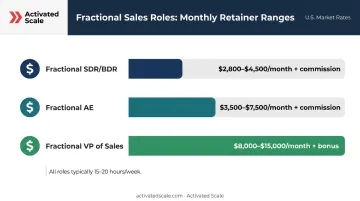
All roles typically run 15–20 hours per week. Incentive layers on top of the retainer.
Incentive Escalators and Clawbacks
Two contract terms that often catch reps off guard:
Escalators kick in when reps exceed quota, paying a higher rate on revenue above the threshold. The company only pays more when you overdeliver — so it's worth pushing for this structure in negotiations.
Clawbacks reverse incentives if a deal cancels or churns within a defined window. Legitimate risk management for the company, but read the conditions carefully before signing. Any clawback provision should be narrow, specific, and tied to clearly defined events.
Skills and Qualifications That Set You Apart
Contract reps don't get a ramp period. Where a full-time AE might have 90 days to find their footing, a contract rep is expected to be in prospect conversations within days. The Bridge Group's 2024 SDR planning data puts the standard SDR ramp at about three months — but clients hiring contract reps expect a fraction of that, often with minimal onboarding support.
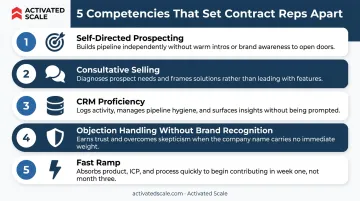
The Five Competencies That Actually Matter
- Self-directed prospecting — Building pipeline without marketing support or inbound leads. If you've only sold warm inbound, this will be a hard adjustment.
- Consultative selling — Multi-stakeholder B2B deals require more than product pitching. Discovery depth matters more here than in any other model.
- CRM proficiency — Clean data hygiene in Salesforce, HubSpot, or Outreach matters. Clients will scrutinize your pipeline management, not just your closed revenue.
- Objection handling without brand recognition — Selling for an unfamiliar brand means you're also selling credibility, not just the product.
- Fast ramp — Absorbing a product, ICP, and competitive landscape quickly — without hand-holding — is what separates experienced contract reps from everyone else.
Typical Background Profile
Most contract sales engagements want to see:
- 3–10+ years of B2B quota-carrying experience
- Familiarity with the target buyer persona (CIO, CFO, VP of Sales, etc.)
- A verifiable track record at a comparable average contract value
- References from prior contract or quota-carrying roles
Cross-industry experience is a genuine differentiator here — clients can tell when a rep has seen the same objections across five different products versus one.
Building Toward This Career
Meeting these requirements takes deliberate preparation. Here's where to focus before you pursue your first contract engagement:
- Document quota attainment from prior roles in a form you can share — percentages, absolute numbers, and timeframes
- Develop CRM skills to a professional level before positioning yourself as contract-ready
- Cultivate at least two references who can speak specifically to ramp speed and self-management
- Specialize in a buyer type or vertical — a rep who knows how to sell to CFOs or VP of Engineering commands better placement value than a generalist
How to Find and Land Contract Sales Opportunities
Where to Look
LinkedIn: Optimize your profile to reflect contract availability, past quota attainment, and the specific buyer types you've sold to. LinkedIn's 2024 Future of Recruiting data shows that skills-based hiring can expand talent pools by 10x, and that recruiters prioritizing skills see 24% higher InMail acceptance — which means your profile needs to lead with territory, vertical, CRM tools, deal size, and quota history, not just job titles.
RepHunter: Focused specifically on performance-based independent reps and manufacturers' representatives. Best for manufacturing, distribution, and rep-line opportunities (not SaaS).
Upwork: Listed over 2,100 appointment-setting roles at last count. Useful for project-based SDR or prospecting work, but not the right channel for full-cycle enterprise AE engagements.
Activated Scale for B2B SaaS Roles
Activated Scale is a talent marketplace built specifically to match experienced B2B sales professionals with vetted startups, primarily at the Seed to Series A stage. The platform places fractional SDRs, AEs, and VPs of Sales with companies that have defined revenue goals but haven't built a full sales team yet.
The vetting process stands out. Every rep goes through a three-step screening covering:
- Buyer experience: verified industry and persona alignment
- ACV history: confirmed deal size and complexity
- Live pitch assessment: evaluated against a proprietary case study
Matching is based on alignment between a rep's prior buyer experience and the client's actual ICP, which shortens ramp time considerably.
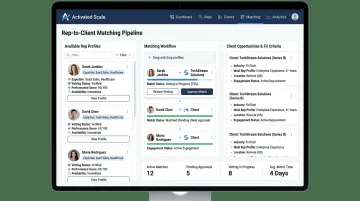
For reps with B2B SaaS experience who want fractional or contract-to-hire engagements, Activated Scale is a strong alternative to general job boards that have volume but limited signal.
How to Position Yourself
Once you've identified the right channels, how you present yourself determines whether you get a response. Vague positioning loses to specific, quantified claims — so before applying anywhere, build a short version of your sales story:
- The product category you sold and the buyer you sold to
- Your quota and what percentage you hit
- Average deal size and sales cycle length
- CRM and tools you've worked in
Use this summary in your LinkedIn headline, your outreach to hiring managers, and any platform profile where recruiters screen you. Four lines of specifics beat two pages of job titles every time.
What to Know Before You Sign Any Agreement
A B2B contract agreement is a legally binding document between an independent sales rep and a company that defines scope, compensation, contractor status, territory, and termination terms. Your protections are only as strong as what's written — anything verbal or assumed doesn't exist once a dispute starts.
Clauses That Require Your Full Attention
Incentive terms: Confirm the percentage, calculation basis (gross vs. net revenue matters), and payment timing. If "incentive" isn't defined with specificity, you're exposed.
Trailing incentives: What happens to deals in progress if the engagement ends? Without explicit language, some companies argue those incentives aren't owed. Some states' labor laws require earned incentives to be paid within a set number of business days after termination. Failure to comply can expose a principal to double damages and attorney fees. Know your state's rules before you sign.
Clawback provisions: Clawbacks tied to specific events (customer cancellation within 30 days, non-payment) are defensible. Open-ended clawbacks giving the company broad discretion are not — require specific conditions in writing.
Termination notice: How much advance notice does either party need to give? What counts as cause for immediate termination? These terms determine whether you have time to transition or get cut off without warning.
Contractor Classification — The Hidden Risk
The agreement must state independent contractor status, but the actual working arrangement has to reflect that independence too. If the company is directing your schedule, requiring you to use only their tools, or treating the engagement as permanent and full-time in practice, the IRS may view you as a misclassified employee.
Some states apply a stricter standard. The ABC test presumes employee status unless the hiring entity proves all three prongs: freedom from control, work outside the usual course of the hiring entity's business, and an independently established trade or occupation. B2B sales professionals working with companies in ABC test states should get a state-law review before signing — especially if selling is central to that company's core business.
Frequently Asked Questions
What do B2B sales reps make on average?
Glassdoor data (retrieved May 2026) puts estimated total pay for US contract sales representatives at $70,000, with a most-likely range of $45,000–$108,000. Full-time B2B reps in technical wholesale and manufacturing averaged $100,070 (BLS, May 2024) — but that figure includes benefits, which contract reps must price into their own rates.
What does a B2B sales representative do?
A B2B sales rep prospects and qualifies target accounts, runs discovery and demo calls, manages deals through a CRM pipeline, and closes revenue on behalf of the hiring company. In a contract context, they do this independently — often without marketing support or a pre-built playbook.
What is a B2B contract agreement?
It's a legally binding document that defines the rep's scope, compensation structure, contractor status, territory, and termination terms. Without specific written language covering incentive calculation, trailing performance pays, and clawback conditions, the rep has limited recourse if a dispute arises — so get everything documented before work begins.
What is the difference between a fractional sales rep and a contract sales rep?
"Contract sales rep" covers any independent sales engagement. "Fractional" refers specifically to an ongoing, part-time model where the rep commits a set number of hours per week to a single client on retainer — typically 15–20 hours per week alongside other client engagements.
Can a contract sales rep work for multiple companies at once?
Yes — working across multiple clients is one of the core advantages of the model. That said, reps should review exclusivity and non-compete clauses in each agreement carefully, particularly when clients operate in the same vertical or target the same buyer persona.
How long does a typical B2B contract sales engagement last?
Project-based engagements run a few weeks to a few months; fractional retainers commonly extend six months or longer, with Activated Scale reporting 80% of clients stay engaged for eight months or more. Contract-to-hire arrangements typically involve a defined trial window of around three months before a conversion decision is made.