

Introduction
Your product works. Customers are renewing. But sales have plateaued, and you're not sure why.
A full-time VP of Sales sounds like the obvious answer — until you see the numbers. According to 2024 compensation data from Betts Recruiting, VP of Sales base salaries at tech startups range from $185,000 to $275,000, with bonuses typically equal to 100% of base. That's $370,000–$550,000 in OTE before benefits, equity, or recruiting fees.
For a seed-stage company managing runway carefully, that commitment feels premature. But doing nothing while competitors build pipeline momentum isn't an option either.
Fractional sales leadership was built for exactly this gap.
This article covers what fractional sales leadership and management actually mean, who each model is designed for, what these professionals do day-to-day, and how to evaluate whether one fits your stage. One distinction is almost always overlooked: fractional sales leadership and fractional sales management are not the same thing. Hiring the wrong one can set you back months of momentum.
Key Takeaways
- Fractional sales leaders and managers are experienced professionals who work part-time across multiple clients, providing sales oversight at a fraction of full-time executive cost
- Leadership covers strategy, go-to-market planning, and team design; management handles daily accountability, pipeline reviews, and rep coaching
- Best fit: B2B SaaS startups with 2–10 salespeople who lack dedicated sales oversight
- Monthly retainer engagements average $9,651/month, per Vendux's 2024 State of Fractional Sales Leadership Report
- Most companies begin seeing process improvements within 30 days; meaningful pipeline results by month 2–3
What Is Fractional Sales Leadership and Management?
The Core Definitions
Fractional sales leadership is a part-time engagement with a senior sales executive — typically VP- or Director-level — who provides strategic oversight, go-to-market planning, team development, and process design. They're not a full-time employee. They split their time across a small number of clients, usually on a monthly retainer.
Fractional sales management is a part-time engagement focused on operational accountability. This person runs pipeline reviews, coaches reps weekly, manages hiring, holds the team to goals, and conducts one-on-ones — the full job of a sales manager, just distributed across multiple client companies simultaneously.
Both models give companies access to experienced sales talent they couldn't justify hiring full-time.
What It Is NOT
This distinction matters, because many founders conflate fractional with adjacent models:
- Not consulting — consultants advise; fractional professionals lead and are accountable for results
- Not coaching — coaching trains technique; fractional management actually runs the team
- Not an external agency — an external agency transfers your entire sales function to an outside team; fractional keeps ownership inside your company
Why This Model Has Grown
The number of fractional sales leaders in the U.S. and Canada grew from 5,000 in 2020 to 9,000 in 2024, according to vendor-reported data from Vendux. Two forces drove that growth:
- Remote work normalization made it practical — a fractional leader can run pipeline reviews and coaching sessions just as effectively from a home office
- Tighter capital markets made it necessary — startups managing runway need growth infrastructure without the full-time overhead
Fractional Sales Leader vs. Fractional Sales Manager: Understanding the Two Roles
The clearest way to frame the difference: fractional sales leaders work on the business; fractional sales managers work in it. That distinction isn't a formal industry taxonomy — most platforms use the terms interchangeably, which is exactly why companies end up with the wrong hire.
What Each Role Actually Covers
Fractional Sales Leader (VP/Director-level)
- Sets sales strategy and go-to-market direction
- Defines ICP, qualification criteria, and compensation structure
- Builds the sales playbook from scratch or overhauls an existing one
- Advises at the executive or board level
- Recruits and structures the team
- Best for: companies with no senior sales strategy in place
Fractional Sales Manager (Operational)
- Runs weekly team meetings and one-on-ones
- Manages rep performance and accountability
- Conducts pipeline and deal reviews
- Oversees CRM hygiene and process adherence
- Manages the hiring process for new reps
- Best for: companies with a team that lacks day-to-day management
Quick Comparison
| Fractional Sales Leader | Fractional Sales Manager | |
|---|---|---|
| Primary focus | Strategy, go-to-market, team design | Daily execution, accountability, coaching |
| Typical hours | ~10 hrs/week per engagement | 15–20 hrs/week per engagement |
| Reports to | CEO/Founder or Board | VP of Sales or CEO/Founder |
| Best suited for | No sales strategy in place | Team exists, lacks management |
| Retainer range | $12,000/month plus bonus | $4,500/month (SDR) or $6,500/month (AE) plus performance pay |
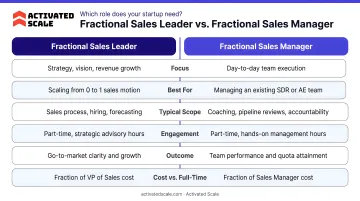
If your reps have no direction, you need a leader. If your strategy exists but no one is holding reps accountable, you need a manager. The table above is the fastest way to diagnose which gap you're actually filling.
Who Should Consider Fractional Sales Leadership?
The Primary Fit
The model works best when a company has enough sales activity to manage but not enough revenue to justify a full-time executive. Specifically:
- A founder who has been running sales personally and needs to hand it off
- A small sales team (2–10 reps) without a dedicated manager or VP
- A company that has raised funding and needs to scale pipeline quickly
Even without an existing team, a fractional sales leader can add real value — building the function from scratch, running first hires, and establishing the playbook before a full-time person steps in.
Two Strong Secondary Scenarios
- Growth has flatlined despite product-market fit, and the founding team can't pinpoint where the breakdown is — ICP, process, rep quality, or something else entirely
- You've raised and need to show pipeline traction fast, but a traditional VP of Sales search typically takes 12–18 months — and even after a hire lands, meaningful results rarely appear until 90 days in
When It's NOT the Right Fit
- Pre-product-market fit (founder-led discovery sales is still the right answer)
- Roles that genuinely require 40+ hours/week of embedded leadership
- Companies that need a long-term culture builder for 2+ years
For B2B SaaS founders at the right stage, Activated Scale connects you with vetted, US-based fractional sales professionals in 7 days or less. Talent comes from companies like Salesforce, Oracle, and Zendesk, and the try-before-you-buy model lets you assess fit before committing long-term.
Core Responsibilities: What Does a Fractional Sales Leader Actually Do?
This is where the value either materializes or doesn't. A good fractional sales leader arrives with a structured plan for their first 30–90 days — and the work breaks down across four core areas:
Strategy and Process
- Audits the existing sales process end-to-end (where do deals stall? where does the pipeline break?)
- Defines or refines the ICP, lead qualification criteria, and pipeline stages
- Builds a repeatable sales playbook tailored to your deal size and buyer profile
Team Development
- Recruits and interviews new sales hires
- Designs onboarding programs (typically structured around 30/60/90-day milestones)
- Runs coaching sessions and establishes clear performance expectations for reps
Pipeline and Performance Management
- Conducts weekly pipeline reviews and deal strategy conversations
- Tracks conversion rates, average deal size, cycle length, and activity volume
- Holds reps accountable to agreed activity targets — not just outcomes
CRM and Reporting
- Audits the sales tech stack and configures CRM workflows for visibility
- Ensures data hygiene so forecasting is actually reliable
- Provides regular performance updates to the founding team or board, translating numbers into decisions
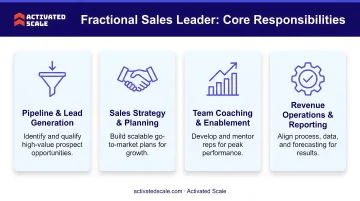
A strong fractional sales leader will also surface problems that go beyond sales — off-target pricing, product gaps, ICP misalignment. For early-stage founders, that cross-functional visibility often changes the direction of the business, not just the pipeline.
The Cost and ROI of Fractional Sales Leadership
The Cost Comparison
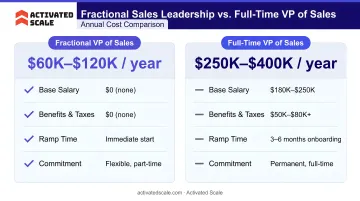
Full-time VP of Sales: $370,000–$550,000+ OTE (per Betts 2024 data), plus equity, benefits, and recruiting fees that can add another $30,000–$50,000 to the total.
Fractional sales leadership: Vendux's 2024 report puts the average monthly fee at $9,651, with retainer agreements making up 67% of all assignments. At the median, engagements run about $7,000/month for roughly 10 hours/week.
On an annualized basis, even a year-long fractional engagement at $9,651/month runs about $115,800 — less than a full-time VP's base salary alone, before OTE or benefits.
What Drives ROI Beyond Cost
- Speed to impact: A fractional leader can start in days — no 90-day recruiting process, no 6-month ramp
- Proven methodology: You're hiring someone who has already built sales functions, not learning on your company's dime
- Flexibility: Scale the engagement up or down based on actual business needs — Activated Scale clients operate month-to-month with no long-term commitment required
The Risk Reduction Angle
Month-to-month engagements eliminate severance risk entirely. The downside of a bad full-time sales leadership hire is significant — SHRM has noted that recruiting, hiring, and onboarding costs alone can reach $240,000 for a single bad hire. For a role that carries direct revenue accountability, the indirect costs compound even faster.
Fractional models don't eliminate the risk of a wrong fit, but they make it far less expensive to correct.
How to Choose and Hire the Right Fractional Sales Leader
What to Evaluate First
You're not hiring an employee. You're buying outcomes. That framing changes how you evaluate candidates.
Look for:
- 10+ years of B2B sales leadership experience, ideally in your industry or an adjacent one
- A documented engagement process they can walk you through — specifically how they assess a new team in the first 30 days
- Specific, measurable results at past clients: deals closed, teams built, processes improved — with numbers attached, not just titles held
Questions That Reveal Whether They're Right
- "Walk me through how you'd assess my sales team in the first 30 days."
- "How do you set goals with a new client, and how do you measure success?"
- "Tell me about an engagement that didn't go well. What happened?"
A fractional leader who can't honestly describe a failed engagement either hasn't done many engagements or isn't being transparent.
Red Flags to Watch
- Can't explain their onboarding methodology clearly
- Guarantees specific revenue outcomes before understanding your business
- Has so many concurrent clients that your engagement would get minimal attention
If you'd rather skip this vetting process entirely, Activated Scale pre-screens every professional before they reach a client. Their three-step process includes a case study pitch review evaluated by peers in the network and a video interview with a subject matter expert — checking for both communication quality and real-world sales experience.
Frequently Asked Questions
What is a fractional sales role?
A fractional sales role is any part-time, contract-based sales position (SDR, AE, manager, or VP) where the professional splits their time across multiple client companies. Companies get relevant expertise at a fraction of the cost of a dedicated full-time hire.
What is the difference between a fractional sales leader and a fractional sales manager?
A fractional sales leader operates at the strategic level: setting go-to-market direction, building the playbook, and advising leadership. A fractional sales manager handles daily operations — pipeline reviews, rep coaching, hiring, and goal accountability. The distinction matters when deciding what your company actually needs.
How much does fractional sales management typically cost?
Monthly retainers vary by scope and seniority. Vendux's 2024 data puts the average at $9,651/month for fractional sales leaders; operational management roles typically run lower. For reference, Activated Scale's fractional VP engagements are $12,000/month plus bonus — a fraction of the $370,000–$550,000+ OTE for a full-time hire.
How long does it take to see results from a fractional sales leader?
Most companies see initial process improvements and quick wins within the first 30 days. Measurable pipeline and conversion improvements typically appear by month 2–3, once new processes are embedded and rep behavior has started to shift.
Is fractional sales leadership right for a startup with no sales team yet?
It can work — a fractional sales leader can build the function from scratch, including hiring the first reps. That said, if product-market fit isn't confirmed yet, founder-led selling is the right starting point. Fractional leadership adds the most value once there's a team to manage or a process to build.
What are the 30-60-90, 3-3-3, and 2-2-2 rules in sales?
The 30-60-90 rule is a rep ramp plan: 30 days for learning, 60 for active application, 90 for independent execution. Fractional sales managers use it regularly when onboarding new hires. The 3-3-3 and 2-2-2 rules lack universal definitions — "2-2-2" most commonly means following up at 2 days, 2 weeks, and 2 months post-purchase. Treat both as loose frameworks, not fixed standards.