
Introduction
Growing revenue is the top priority for most B2B startup founders — but committing to a full-time sales hire before product-market fit is proven carries real financial risk. A single bad AE hire can cost over $50,000 once you account for recruiting fees, lost pipeline, and the drag of managing someone out.
Contract sales representatives offer a middle path. They bring professional sales execution without the fixed overhead of a full-time employee:
- No benefits or payroll taxes
- No severance risk
- No long-term headcount commitment
According to the Bureau of Labor Statistics, there were 11.9 million independent contractors in the US as of July 2023, representing 7.4% of total employment. Contract sales talent is a well-established labor model that B2B companies increasingly rely on.
This article covers what contract sales reps actually do, how they differ from full-time employees, how compensation works, and when hiring one makes strategic sense.
TLDR:
- Contract sales reps are independent contractors (1099) who execute your sales motion without the cost of a full-time hire
- They handle prospecting, pipeline management, and closing — not just one piece
- Common pay structures: retainer + performance pay, or performance-only — retainer fits longer sales cycles
- Best fit: early-stage startups testing markets, bridging hiring gaps, or validating a sales motion
- Platforms like Activated Scale can match you with a vetted rep in under 7 days
What Is a Contract Sales Representative?
A contract sales representative is a sales professional who works under a fixed-term or ongoing agreement rather than as a permanent employee. They are typically classified as independent contractors (1099) — self-employed individuals who manage their own taxes, expenses, and business operations.
The IRS applies three classification factors to determine whether someone qualifies as an independent contractor:
- Behavioral control — Does the company direct how work is performed?
- Financial control — Who manages the business aspects of the work?
- Type of relationship — Are there employee-type benefits or permanent arrangements?
The DOL's 2024 FLSA rule adds an economic-reality test: is the worker genuinely in business for themselves, or economically dependent on one company?
That distinction has real consequences. A contract rep who follows company-set hours, uses only company tools, and functions as a core ongoing team member creates misclassification risk — regardless of what the contract says.
Types of Contract Sales Arrangements
Contract sales engagements fall into three distinct models:
- Short-term project-based contracts — scoped engagements for a specific launch, market entry, or sales push
- Fractional/ongoing roles — part-time, embedded sales coverage that continues month-to-month
- Contract-to-hire — a defined trial period (typically 3 months) with the option to convert the rep to full-time based on performance
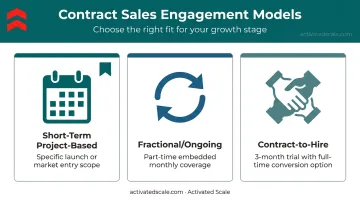
Contract-to-hire is particularly useful for startups that want to evaluate fit before committing to a full-time salary — it removes the guesswork from an otherwise high-stakes hiring decision.
Key Responsibilities of a Contract Sales Representative
Client Acquisition and Prospecting
Contract reps own the top of the funnel. They identify and target qualified leads through outbound outreach — cold calls, email sequences, LinkedIn prospecting, and industry events — without waiting for leads to be handed to them.
Because engagements are often time-bound, these reps need to hit the ground running. Experienced contract reps typically come with established outreach playbooks and don't need 90 days to get productive.
Pipeline Management and Deal Closing
Contract reps manage the full sales cycle: discovery calls, product demos, proposal delivery, and contract negotiation. They're accountable for closing revenue, not just generating activity.
Strong pipeline discipline is non-negotiable. Contract reps are expected to:
- Track all activity in a CRM
- Forecast pipeline accurately
- Report progress to the client company regularly
- Be measured on outputs, not hours worked
The Bridge Group's 2024 SaaS AE benchmark reported a median sales cycle of 5 months and median ACV quota of $800,000 — useful context when setting performance expectations for any sales hire, contract or full-time.
Relationship Building and Account Management
Post-sale responsibility doesn't disappear because someone is a contractor. Contract reps maintain client relationships, identify upsell opportunities, and serve as the primary point of contact for their accounts.
That external relationship only holds up when the internal one does. Contract reps who stay aligned with the hiring company on strategy and scope consistently outperform those who operate in isolation. Key habits that keep engagements on track:
- Schedule recurring syncs with the hiring team (weekly or biweekly)
- Flag scope changes early rather than absorbing them silently
- Share pipeline updates proactively — don't wait to be asked
Contract Sales Rep vs. Full-Time Sales Employee: Key Differences
| Factor | Contract Sales Rep (1099) | Full-Time Employee (W-2) |
|---|---|---|
| Employment status | Independent contractor | Employee |
| Benefits | None — rep arranges own | Health, retirement, PTO |
| Payroll taxes | Rep pays self-employment tax | Employer pays 7.65% FICA |
| Onboarding time | Faster (reps are self-directed) | Average 5.7-month ramp (Bridge Group) |
| Cost structure | Retainer + performance pay, no benefits burden | Base + OTE + benefits + recruiting cost |
| Flexibility | Scale up or down quickly | Long-term commitment, severance risk |
| Control | Evaluated on deliverables | Subject to company policies and direction |
The Real Cost Comparison
A full-time AE costs far more than the base salary alone. According to Betts Recruiting, tech AE base salaries run $75,000–$110,000 for under 3 years of experience, with OTE at roughly 2x base.
Stack on top of that: benefits (the BLS reports they represent 29.9% of private-industry employer compensation costs), employer payroll taxes, and recruiting fees — and the real cost climbs well beyond the headline number before you've closed a single deal.
Contract reps eliminate the benefits burden and reduce fixed-cost exposure while a startup is still validating its sales motion.
When Does Hiring a Contract Sales Representative Make Sense?
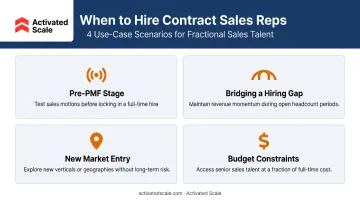
Contract sales reps aren't the right answer in every situation. They're most valuable in specific scenarios:
- Pre-product-market-fit stage — you need selling activity to gather signal, not a long-term headcount commitment
- Bridging a gap — your full-time search is underway (average time to fill: 41 days per SHRM), and you need coverage now
- New market entry — you need specialized expertise in a vertical or geography without redirecting existing team members
- Budget constraints — full-time OTE plus benefits isn't feasible yet, but revenue generation can't wait
A 3-month contract lets you evaluate a rep's actual sales skills, cultural fit, and market effectiveness before committing long-term. That matters more than most founders expect: the Bridge Group found 30% annual turnover among SaaS AEs and only 51% quota attainment across 172 B2B SaaS companies. A bad full-time hire is expensive. A contract engagement lets you find out before signing anything permanent.
Activated Scale's contract-to-hire model addresses this directly. B2B SaaS startups get access to vetted, US-based sales professionals with backgrounds from companies like Salesforce, Oracle, IBM, and Zendesk. Most clients connect with a qualified rep in under 7 days, sometimes within 48 hours for SDRs.
Roughly 65% of clients end up converting their contract rep to full-time, which is a reasonable outcome when the engagement actually works.
How Contract Sales Representatives Are Compensated
Three compensation models are common in B2B sales:
- Performance-only — a percentage of deal value with no base; works for shorter sales cycles with fast feedback loops
- Retainer + performance pay — a monthly base fee plus performance incentive; the standard for most B2B SaaS engagements
- Flat project fee — for defined, scoped deliverables with a clear endpoint
For B2B SaaS, the retainer + performance pay model is strongly preferred. Performance-only arrangements create disengagement when sales cycles stretch beyond 30 days — reps disengage and pipelines stall without consistent income.
Incentive Rate Benchmarks
The Bridge Group's 2024 SaaS AE benchmark reported a median performance pay rate of 11.5% of ACV at 100% quota attainment. SaaStr's practitioner framework puts traditional enterprise SaaS incentives at 8%–10% of first-year ACV, with more aggressive structures reaching 20%–25% for reps covering full-cycle responsibility including base and benefits costs.
For earnings context: ZipRecruiter reports the average US independent sales representative earns $100,576 annually, ranging from $31,000 to $164,500 depending on industry and deal size.
Tax Considerations for Contract Reps
Contract reps carry a heavier personal tax burden than W-2 employees:
- Self-employment tax: 15.3% (12.4% Social Security + 2.9% Medicare) per IRS Topic 554
- Quarterly estimated tax payments required when expected tax liability exceeds $1,000
- 1099-NEC issued (not a W-2) for payments of $600 or more
This tax burden should factor into compensation negotiations. Contract reps often price in their self-employment costs, which means their performance pay rates and retainers will look higher than a W-2 employee's gross pay on paper.
How to Find and Hire the Right Contract Sales Representative
What to Look for in a Candidate
Not every sales rep can operate as an independent contractor. The best contract reps share a few traits:
- Relevant industry experience and familiarity with your buyer persona and ACV range
- Documented quota attainment history (not just activity metrics)
- Ability to work without heavy management — they build their own pipeline and manage their own schedule
- Fit with your sales motion (inbound vs. outbound, SMB vs. enterprise deal sizes)
Where to Source Them
| Channel | Speed | Quality Control |
|---|---|---|
| Specialized platforms (like Activated Scale) | Fastest (days) | Pre-vetted, assessed candidates |
| LinkedIn / Professional networks | Moderate (weeks) | Self-reported experience, you vet |
| Freelance job boards | Moderate | Variable quality, high volume |
| Referrals | Variable | High trust, limited pool |
Activated Scale uses a three-step vetting process before matching candidates to clients:
- Application review — past experience with specific buyers and ACV ranges
- Pitch video assessment — reviewed by peers already in the network
- 30-minute video interview with a subject matter expert
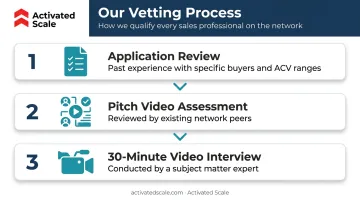
Only candidates who clear all three stages are matched to clients.
What Your Contract Agreement Should Cover
Have a lawyer review the final agreement. At minimum, it should include:
- Variable pay structure and payment terms
- Performance targets and timelines
- Territory or account ownership definitions
- IP and confidentiality clauses
- Termination conditions (notice period, cause vs. without cause)
Getting these terms in writing upfront prevents misaligned expectations — especially around incentive disputes and account ownership if the engagement ends early.
Frequently Asked Questions
How much do contract sales reps make in the US?
Income varies widely. ZipRecruiter reports an average of $100,576 annually for independent sales reps, with a range from $31,000 to $164,500. BLS data for wholesale and manufacturing sales reps shows a median of $74,100, rising to $99,710 for technical and scientific products.
How much does it cost to hire a contract sales rep?
For B2B SaaS, the retainer + performance pay model is standard. SDRs typically cost $4,500/month plus performance pay; AEs run $6,500/month plus performance pay. That's well below full-time AE total comp once you factor in base, OTE, benefits, and payroll taxes.
What is the difference between a contract sales rep and a full-time employee?
The core differences are employment status (1099 vs. W-2), cost structure (no benefits or payroll tax burden), and flexibility (contract reps can be engaged or wound down quickly). See the comparison table above for a full breakdown.
Can a contract sales rep work for multiple companies at once?
Yes, unless an exclusivity clause is included in the contract. Contract reps typically serve multiple clients simultaneously. If that's a concern for competitive reasons, address it directly in the agreement before signing.
What should be included in a contract sales representative agreement?
At minimum, cover:
- Compensation terms and payment schedule
- Performance expectations and timelines
- Territory or account definitions
- Confidentiality and IP clauses
- Termination conditions
Have legal counsel review it before signing.
Do contract sales reps receive employee benefits?
No. Contract reps are not employees and receive no benefits: no health insurance, retirement plans, or paid time off. They arrange those independently, which is why their compensation expectations typically run higher than comparable W-2 comp on paper.