
Introduction
B2B sales is unforgiving when you get it wrong. Unlike selling to consumers, you're navigating buying committees with a dozen or more stakeholders, sales cycles measured in months, and deals where a single misread situation can cost a quarter's pipeline.
For founders and early-stage teams, the stakes are especially high. You don't have the luxury of learning slowly. Getting your sales process right from the start determines whether you grow or stall.
This guide covers the full picture: what B2B sales actually is, how the process works step by step, the strategies that move deals forward, and practical tips for teams operating without a dedicated sales organization.
Key Takeaways
- B2B sales involves larger deal values, longer cycles, and multiple decision-makers — a fundamentally different challenge than consumer selling
- The sales process follows five core stages: prospecting, qualification, discovery, proposal, and close
- Account-based selling, social selling, and outcome-focused pitching consistently outperform generic outreach
- Early-stage teams should prioritize outbound before inbound — inbound content takes time to compound
- Fractional sales talent is a lower-risk alternative to premature full-time hiring for pre-PMF companies
What Is B2B Sales?
B2B (business-to-business) sales is the process of one company selling products or services to another company — not to individual consumers. That scope extends beyond finished products to raw materials, supplies, and professional services — anything one business sells to help another operate.
What separates B2B from consumer selling isn't just the buyer type. It's the deal structure:
- Deal sizes are substantially larger. The median annual contract value for private B2B SaaS companies hit $26,265 in 2024, compared to a global ecommerce average order value of roughly $158
- Multiple stakeholders are involved in every significant purchase
- Relationships drive long-term revenue through renewals, upsells, and referrals that B2C simply doesn't replicate
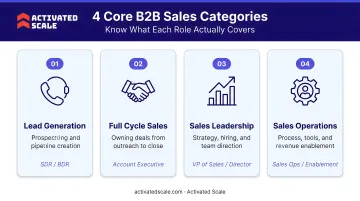
The Four Core B2B Sales Categories
| Type | Description | Example |
|---|---|---|
| Supplier/Producer | Selling raw materials or components to manufacturers | Steel supplier to an auto manufacturer |
| Distributor/Reseller | Selling finished products to wholesalers or retailers | Electronics brand selling to a regional retailer |
| SaaS/Services | Selling software subscriptions or professional services | CRM platform sold to a 200-person sales org |
| Government/Nonprofit | Selling to public sector agencies or charitable organizations | IT vendor winning a municipal contract |
Each category runs on a different buying process. Government contracts require formal procurement with strict compliance steps, while SaaS deals typically hinge on a demo or free trial that proves value quickly. Producer relationships, by contrast, are built on price consistency and reliability over years — not a single pitch. Understanding which model applies to your business shapes every sales decision that follows.
B2B Sales vs. B2C Sales: Key Differences
The most common mistake early-stage founders make is treating B2B like a bigger version of consumer selling. It isn't. Three differences define everything else.
Buying Committees, Not Individual Buyers
According to Forrester's 2026 State of Business Buying report, the typical B2B purchase now involves 13 internal stakeholders and 9 external influencers. In B2C, one person decides and moves on. In B2B, you're navigating a committee.
This changes how you sell. Every touchpoint needs to consider who else is in the room — IT evaluating security, finance scrutinizing ROI, legal reviewing contract terms. Winning one champion isn't enough if three others can kill the deal.
Sales Cycle Length and Deal Complexity
B2C transactions are immediate. B2B cycles span weeks to months because deals involve evaluation periods, budget approvals, and procurement processes. The Salesforce State of Sales 2026 report found that 57% of sales professionals say customers take longer to decide than they used to — and 67% say customers now require extensive education before committing.
Relationship Value vs. Transaction Volume
B2C companies win on volume. B2B companies win on depth. A single customer who renews, expands, and refers others can be worth multiples of their original contract value. That's why retention drives growth in B2B in a way it simply doesn't in consumer sales:
- Renewals compound revenue without new acquisition costs
- Expansions increase ACV from accounts you've already closed
- Referrals bring in warm leads that convert faster and cheaper
The B2B Sales Process: Step by Step
Step 1 — Prospecting and Targeting
Every strong pipeline starts with a well-defined Ideal Customer Profile (ICP). Build yours using firmographic data: company size, industry, revenue range, and geography. Layer in behavioral signals — who's hiring for roles that indicate budget or pain, who's recently raised funding, who's visiting your site.
Common prospecting channels:
- Cold email sequences
- LinkedIn outreach
- Inbound content and SEO
- Referrals from existing customers
- Industry events and conferences
The quality of your targeting directly determines pipeline health. 73% of B2B buyers actively avoid sellers who send irrelevant outreach — and poor targeting doesn't just waste time. It damages your brand with the exact people you're trying to convert.
Step 2 — Lead Qualification
Qualification frameworks like BANT (Budget, Authority, Need, Timeline) exist for a reason: unqualified leads are the single biggest source of wasted selling time. The Salesforce State of Sales found reps spend 60% of their workweek on non-selling tasks and poor qualification makes that worse.
Ask three questions early:
- Does this company have the problem your product solves?
- Is the person you're talking to authorized to buy or directly influence the decision?
- Is there a real timeline or trigger driving action?
If you can't answer yes to all three, qualify out or deprioritize. The pipeline looks better with fewer, higher-quality opportunities.
Step 3 — Discovery and Needs Analysis
Most reps rush discovery to get to the pitch. That's where deals quietly die.
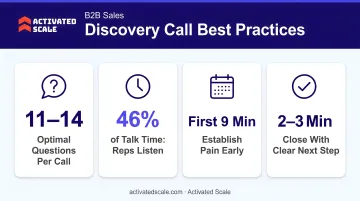
The goal isn't to explain what you do — it's to understand what the prospect actually needs first. Gong's analysis of over 519,000 B2B sales calls found success rates were highest when reps asked 11 to 14 targeted discovery questions, spread throughout the call rather than front-loaded at the start.
Good discovery surfaces the real problem, not the stated one. A prospect might say they need better reporting. The real issue is that their team can't justify spend to the CFO. Those are different problems requiring different solutions.
Step 4 — Solution Proposal and Handling Objections
A strong proposal maps directly to what the prospect told you during discovery. Not a feature list 4 hours."
Common objections to prepare for:
- Price: Reframe around ROI, not cost reduction
- Timing: Understand what would need to change internally for timing to work
- Competition: Ask what they've seen elsewhere that appeals to them — then address the gap
- Internal priorities: Find out what's ahead of this in the queue and work backward
Objections aren't rejections. They're questions asking for more information.
Step 5 — Closing and Post-Sale Follow-Through
Closing is a natural conclusion to a well-run process , not a separate skill you apply at the end. Watch for buying signals: asking about implementation timelines, requesting contract terms, looping in legal or procurement.
The close isn't the finish line. Consistent post-sale communication, solid onboarding, and quarterly check-ins drive the renewal and expansion revenue that makes B2B economics work. Expansions and referrals — the revenue that actually compounds — come from customers who felt supported after they signed.
Proven B2B Sales Strategies That Actually Work
Account-Based Selling
Rather than prospecting broadly and hoping something sticks, account-based selling (ABS) focuses your entire effort on a defined list of high-fit target accounts. Sales and marketing align on the same account list, coordinate their outreach, and personalize every touchpoint.
According to a benchmark study by the ABM Leadership Alliance and Momentum ITSMA, 84% of practitioners saw improved pipeline growth and 72% reported higher ROI than other marketing approaches. The investment in personalization pays off most at higher deal values — which is precisely where B2B sales lives.
Social Selling on LinkedIn
LinkedIn's Social Selling data shows that 75% of B2B buyers use social media in buying decisions, and social selling leaders create 45% more opportunities than peers with low social selling activity.
This doesn't mean mass InMail blasts. It means building a presence that earns trust before cold outreach begins: sharing useful insights, commenting meaningfully on prospects' posts, and creating content that signals genuine expertise. By the time your message lands in a prospect's inbox, they've already formed an opinion of you.
Solution Selling Over Feature Selling
The fastest way to lose a B2B deal is to pitch features at a buyer who cares about outcomes. Every capability you describe should be anchored to a specific result the prospect wants.
67% of B2B customers require extensive education before committing — they need to understand what changes for them, not what your product does in the abstract. Frame every conversation around that shift.
Customer Retention as a Growth Strategy
Acquiring a new customer costs 5 to 25 times more than retaining an existing one, according to Harvard Business Review. A 5% improvement in retention can raise profits by 25% to 95%.
Retention strategy in action looks like:
- Proactive check-ins before problems surface
- Quarterly business reviews tied to customer goals
- Product education that drives actual adoption
- Early identification of expansion opportunities
Data-Driven Pipeline Management
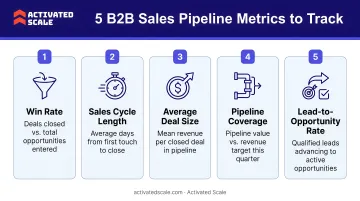
The teams that consistently hit quota track the same short list of metrics — and they act on what those numbers reveal:
- Lead-to-opportunity conversion rate — signals targeting quality
- Average deal size — benchmarks against your ACV targets
- Sales cycle length — reveals where deals stall
- Win rate — tests message-market fit
- Customer lifetime value (CLV) — measures the full value of your retention work
CRM hygiene and consistent data entry aren't glamorous, but they're what separates teams that iterate from teams that guess.
Practical B2B Sales Tips for Early-Stage Teams
Start With a Tight ICP
The most common early-stage mistake: targeting everyone. Cast too wide a net and you end up with vague messaging that resonates with no one.
Pick the segment most likely to close fastest with the least resistance, then own it.
For most seed-stage companies, that ICP only becomes truly clear after 40 to 50 real discovery conversations. You won't define it at a whiteboard. You'll find it in the patterns that emerge from talking to actual prospects at volume.
Prioritize Outbound Before Inbound
Inbound content compounds over time — HubSpot's research found that compounding blog posts generate 38% of blog traffic but typically take 12 or more months to reach that point. For companies raising seed to Series A, you don't have 12 months to wait.
Structured outbound — cold email sequences, LinkedIn DM outreach, targeted calling — generates pipeline feedback now. Test messaging across different segments. Double down on what gets replies. The data from early outbound also tells you what inbound content to build later.
Build a Repeatable Sales Playbook Early
Even if the founder is the sole salesperson, document everything: discovery questions that land, objections that come up repeatedly, messaging that resonates, deal patterns that win and lose. When Activated Scale's fractional AEs engage with early-stage clients, documenting the initial framework for a repeatable playbook is a formal part of the engagement — because tribal knowledge doesn't scale.
When you're ready to hire your first dedicated rep, that playbook is what makes them productive in weeks rather than months.
Know When to Bring In Experienced Sales Talent
Hiring a full-time senior sales rep before you have a repeatable motion is expensive. A bad sales hire can cost over $50,000 once you factor in lost time, missed deals, and recruiting again from scratch.
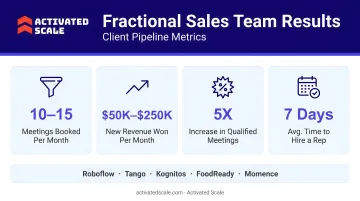
That's the gap Activated Scale's fractional model fills. Startups get matched with pre-vetted, US-based sales professionals (SDRs, Account Executives, Sales Directors) in 7 days or less, sometimes within 48 hours. Engagements run month-to-month with no long-term commitment, drawing from talent with backgrounds at Salesforce, Oracle, ZoomInfo, Datadog, and IBM.
Client results back this up:
- Average of 10 to 15 qualified meetings per month
- Some clients generating more than $250,000 in new revenue on a $25K ACV product
- 80% of clients stay on for 5 or more months
- 65% ultimately hire their fractional rep full-time after seeing real results first
Real-World B2B Sales Examples
SaaS and Technology
A project management software company sells a subscription to a 150-person professional services firm. The full cycle runs six to eight weeks and touches multiple stakeholders:
- Discovery call with the VP of Operations to define the problem
- Product demo for the broader team
- Security review by IT
- Legal redlines on the MSA
- Final CFO approval on budget
Professional Services
A staffing firm wins a recruiting engagement from a fast-growing startup. The sale is as much about credibility as process — case studies and referrals carry real weight. Key steps include:
- Scoping the search and aligning on role requirements
- Running a discovery session around culture fit
- Submitting a detailed proposal
- Negotiating placement fees and guarantee terms
Manufacturing and Supply Chain
A chemical supplier establishes a recurring contract with a mid-size manufacturer. Technical specs matter, but the real sales levers are pricing consistency, delivery reliability, and a relationship built over multiple procurement team interactions. Here, relationship longevity closes deals more reliably than any single pitch.
Frequently Asked Questions
What is B2B service sales?
B2B service sales refers to selling intangible offerings — consulting, software subscriptions, staffing, legal, or marketing services — from one business to another. Unlike product sales, service deals rely heavily on proof of expertise, case studies, and trust built through the sales process itself.
What are the 4 types of B2B?
The four main categories are: Producer/Manufacturer sales, Reseller/Distributor sales, Service/SaaS provider sales, and Government/Institutional sales. Each has a distinct buying process, stakeholder structure, and relationship dynamic.
How is B2B sales different from B2C sales?
B2B involves multiple decision-makers, longer cycles, and revenue built on renewals — B2C typically has a single buyer, a faster decision, and competes on volume. The other key difference: B2B relationships extend well past the initial sale, where expansion and retention drive most of the revenue.
What are the most important B2B sales metrics to track?
Five metrics tell most of the story: lead-to-opportunity conversion rate, average deal size, sales cycle length, win rate, and customer lifetime value. Tracked together, they show exactly where pipeline stalls and what needs fixing.
How long is a typical B2B sales cycle?
Deal size and industry both play a role, but the trend is clear: according to Salesforce's 2026 State of Sales, 57% of sales professionals say customers take longer to decide than they used to. With buying committees now averaging 13 internal stakeholders, longer cycles are the norm.
What are the biggest challenges in B2B sales?
The biggest friction points are buying committees (one skeptical stakeholder can stall a deal), long cycles where momentum dies between touches, and the persistent misalignment between sales and marketing on what actually qualifies as a lead worth pursuing.