Introduction
Many founders assume contract sales reps are essentially free until they close — just set a performance pay rate and let them run. That assumption gets expensive fast.
The actual cost is shaped by the compensation model you choose, the rep's experience level, and how the engagement is structured. Get any of these wrong and you're either overpaying for underperformance or burning through good reps before they ever close.
Understanding the full cost picture before you hire is what separates a profitable engagement from one that stalls your pipeline and drains your runway.
Key Takeaways
- Performance-only: 7–15% of closed revenue; works for short-cycle, transactional products only
- Retainer + performance pay: $4,500/month plus performance pay for SDRs or $6,500/month plus performance pay for AEs; suits 30–90 day B2B sales cycles
- Fractional model: defined hours per week with a monthly retainer; ideal for part-time embedded sales support
- Contract vs. full-time cost: no benefits overhead (~28–30% of comp) and no 5+ month ramp period
- Cycles past 60 days: require a retainer — performance-only structures drive rep disengagement
How Much Does It Cost to Hire a Contract Sales Rep?
There is no single flat rate. Cost depends on the engagement model, what you're asking the rep to do, and your industry.
The most common mistake isn't picking the wrong number — it's picking the wrong model. A founder who chooses performance-only for a 90-day enterprise deal will watch reps disengage before anything closes. One who adds a retainer without defining scope ends up paying for activity with no accountability.
Here's how each model works and what it actually costs.
Performance-Only Model
The rep earns a percentage of closed revenue. No base, no retainer, no payment until deals close.
Typical rates:
- B2B SaaS and service-based products: 10–20% of closed revenue (often calculated on net-new ACV)
- Physical/manufactured goods: 5–15% depending on margins and deal complexity
- Lead-generation-only roles: 6–10%
Best for: Early-stage startups with short sales cycles (under 30 days), transactional products, or founders with limited upfront cash who need to test whether the product sells at all.
The catch: SaaStr's B2B sales cycle benchmarks show that deals under $25K ACV average 90 days to close. Performance-only works when cycles are short — it collapses when they're not.
Retainer + Incentive Model
A modest monthly retainer is combined with a lower performance pay rate. The retainer offsets the rep's income uncertainty during longer ramp periods.
Typical costs:
- Fractional SDR/BDR: $4,500/month plus performance pay
- Fractional AE: $6,500/month plus performance pay
Best for: Companies with 30–90 day sales cycles that need consistent prospecting activity, not just closed deals. The retainer creates accountability on both sides — the rep commits to activity, the company commits to fair compensation during ramp.
Fractional Sales Rep Model
The rep works a defined number of hours per week (typically 15–20 hours) handling a specific function — outbound prospecting, demos, full-cycle closing, or account management. Pricing is monthly and often includes onboarding support.
Note: the SDR/BDR and AE rates above also apply here. The fractional model adds a senior tier:
- Fractional VP of Sales: $12,000/month plus bonus
The key distinction from a straight retainer arrangement is the defined scope. You're buying a set number of hours per week tied to a specific function, not just a compensation structure. This matters for startups that need a dedicated part-time sales presence without committing to a full-time hire.
Activated Scale matches B2B SaaS founders with vetted fractional sales professionals — SDRs through VPs — typically placing candidates within 7 days.
Key Factors That Affect the Cost of a Contract Sales Rep
Several variables move contract rep costs significantly — and understanding them upfront prevents mismatched expectations on both sides.
Rep Experience and Seniority
A rep with three years of SaaS AE experience and an existing network of your target buyers commands more than a generalist. That premium is usually worth it: experienced reps ramp faster, waste fewer leads, and already understand how enterprise procurement works before their first call.
For context, Betts Recruiting's 2024 Compensation Guide puts full-time SaaS AE OTE at $180K for 0–3 year reps, $250K for mid-market AEs with 3–5 years, and $300K for enterprise AEs. Fractional rates scale proportionally — you're not paying full OTE, but more experienced reps still price higher.
Scope of the Role
There's a significant cost difference between a rep who books meetings and one who closes deals:
- SDR/BDR (outbound prospecting, meeting booking): Lower retainer, lower incentive
- Full-cycle AE (outreach through close): Higher retainer, higher incentive
- Account management or expansion only: Often performance-based on expansion revenue
Define scope before you set compensation. Paying AE rates for SDR work burns budget fast. Expecting full-cycle closing at SDR rates pushes quality reps out the door.
Sales Cycle Length and Product Complexity
Sales cycle length directly shapes compensation structure. If a rep can't earn meaningful incentive within 90 days, they'll disengage — no matter how strong the pipeline looks.
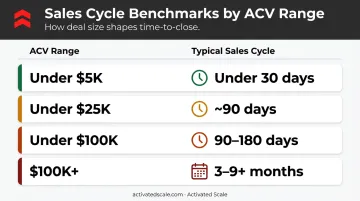
A quick reference from SaaStr's benchmarks:
| ACV Range | Typical Sales Cycle |
|---|---|
| Under $5K | Under 30 days |
| Under $25K | ~90 days |
| Under $100K | 90–180 days |
| $100K+ | 3–9+ months |
Complex products with higher ACVs require higher upfront compensation (either a retainer or activity-based incentives) to attract and retain quality reps through the full cycle.
Incentive Base and Margin Level
Incentive percentages mean different things depending on what they're calculated on:
- Gross revenue: Simple but disadvantages the company on low-margin deals
- Net-new ACV: Standard in SaaS; CaptivateIQ's enterprise software example uses 10% of net-new ACV at quota attainment
- Gross margin: More common in hardware or services where deal profitability varies
SaaS products support higher incentive percentages because margins are typically high. A 15% incentive on a $20K SaaS ACV is very different from 15% on a $20K hardware deal with 40% margins.
Full Cost Breakdown: What You're Actually Paying For
The performance pay rate is one line item. Here's the full picture.
| Cost Category | Frequency | Typical Range |
|---|---|---|
| Incentive payments | Recurring | 8–15% of closed ACV |
| Activity-based incentives | Recurring | $50–$200 per qualified activity |
| Onboarding & enablement | One-time | 10–20 hrs of internal time |
| Platform or agency fees | One-time or recurring | 18–20% of OTE or base salary |
| Contract-to-hire conversion | Periodic | Varies by platform/agency |
Incentive payments (recurring): The percentage of closed revenue or net-new ACV paid per deal. For SaaS, this typically applies to first-year ACV rather than full contract lifetime value.
Activity-based incentives (recurring): Optional payments for defined sales activities — booked meetings, created opportunities, completed demos. These matter when your deal cycle exceeds 60 days. Without them, performance-only reps leave before they can close anything.
A common structure: a small bonus (such as $100) per qualified meeting booked with an ICP, with higher bonuses for quota achievement.
Onboarding and enablement costs (one-time): Even contract reps need product training, messaging alignment, CRM access, and collateral review. Budget 10–20 hours of founder or sales lead time in the first two weeks, plus any tool access costs.
Platform or agency fees (one-time or recurring): Recruiting agencies typically charge 20% of OTE upfront. Platforms like Activated Scale charge an 18% conversion fee on base salary only if you convert the rep to full-time — and save founders 20+ hours of interviewing time per hire. There are no placement fees during the fractional engagement period.
Contract-to-hire conversion costs (periodic): If a contract rep converts to a full-time employee, plan for the conversion fee and any transition costs. Budget this as a milestone, not a surprise. SHRM reports average cost-per-hire at nearly $4,700, with total hiring costs potentially reaching 3–4x the position's salary when all factors are included.
Contract Sales Rep vs. Full-Time Sales Rep: What's the Real Cost Difference?
The true cost of a full-time sales hire goes well beyond base salary.
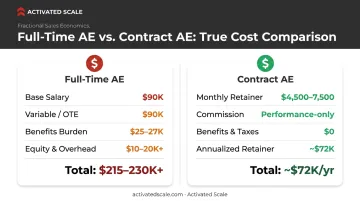
Full-time AE — fully loaded annual cost:
- Base salary (entry-level, 0–3 years): ~$90,000
- Variable/incentive at 100% attainment: ~$90,000 (50/50 split)
- Benefits burden (~28–30% of wages, per BLS December 2024 data): ~$25,000–$27,000
- Equity, management overhead, HR, tools: $10,000–$20,000+
- Total fully loaded: $215,000–$230,000+ per year
Contract/fractional AE — what you actually pay:
- Monthly retainer: $6,500/month plus performance pay
- Incentive on closed revenue
- No benefits, no payroll taxes, no equity, no long-term commitment
- Annualized at mid-range retainer: ~$72,000 in retainer costs plus performance pay
The numbers tell part of the story. The ramp period tells the rest.
Full-time AEs average 5–6 months to reach full productivity — meaning you're absorbing $90,000+ in salary and benefits before seeing consistent output. A fractional rep with activity-based goals is producing measurable pipeline from week one.
| Factor | Full-Time AE | Contract/Fractional AE |
|---|---|---|
| Time to productivity | 5–6 months | Week one |
| Annual cost (fully loaded) | $215,000–$230,000+ | ~$72,000 retainer + performance pay |
| Benefits & payroll taxes | Yes (~$25,000–$27,000) | None |
| Wrong-hire sunk cost | $35,000–$50,000+ | Minimal — exit at end of contract |
| Long-term commitment | Yes | No |
For startups still validating their sales motion, that wrong-hire risk is the real cost difference — and the contract model eliminates most of it.
What Most Founders Get Wrong About Contract Sales Rep Costs
Most of these mistakes aren't obvious until they've already cost you deals — or a rep.
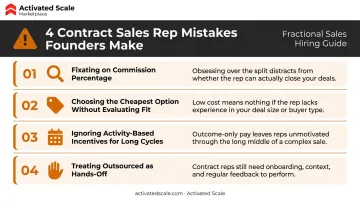
Fixating on incentive percentage while ignoring total engagement economics. A 10% incentive on thin pipeline pays a rep less than 15% on a well-sourced one. Reps run a business — if the math doesn't work for them, they move on.
Choosing the cheapest option without evaluating fit. A low-cost rep with no SaaS background will burn leads and stall deals, costing more in lost opportunity than a slightly more experienced rep who actually knows your buyer.
Structuring comp purely around closed deals when your cycle runs 60–90 days. Without activity-based incentives, reps leave before anything closes. It's one of the most common early-stage mistakes, and one of the easiest to fix.
Treating a contract engagement as "hands-off." Contract reps still need pipeline visibility, messaging feedback, and regular check-ins. Most fractional engagements need at least a weekly one-on-one to stay on track. Skip it, and mediocre results follow.
Frequently Asked Questions
How much does a contract sales rep cost?
The model determines the cost. Performance-only runs 7–15% of closed revenue for B2B SaaS; retainer plus performance pay is $4,500/month for SDRs or $6,500/month for AEs; fractional engagements run similar monthly rates with a defined hourly scope. Total cost shifts based on rep seniority, role scope, and sales cycle length.
What is a contract sales rep?
A contract sales rep is an independent contractor (1099) hired to sell on behalf of a company without being a full-time employee. They may work on incentive only, a monthly retainer, or a fractional basis — and are not entitled to benefits, payroll taxes, or equity.
What is a typical performance pay rate for contract sales reps?
Rates vary by industry and role scope. SaaS and service-based products typically support 10–20% incentives calculated on net-new ACV, while physical products generally fall in the 5–15% range. Full-cycle closers command higher rates than reps who only generate leads or book meetings.
Do contract sales reps charge a retainer fee?
Some do — particularly when the sales cycle exceeds 30 days or the role requires consistent prospecting. A retainer reduces the rep's income uncertainty during ramp and is offset by a lower performance pay rate, which also creates accountability on both sides.
When should a startup hire a contract rep instead of a full-time rep?
Contract reps are best suited for startups still validating their sales motion, companies with limited cash reserves, or teams that need to fill a gap fast. They work best when the sales cycle is under 60 days — short enough for reps to earn meaningful incentive early on — though longer cycles can work with a retainer added.
What's the difference between a contract and full-time sales rep?
Contract reps are independent contractors — no benefits, no payroll taxes, no long-term commitment. Full-time reps are employees with a base salary, benefits, and a 5–6 month ramp before producing real ROI. The fully loaded annual cost of an entry-level AE can exceed $215,000 when all costs are factored in.