
Introduction
Most early-stage B2B SaaS founders hit the same wall: they need a mature sales engine, but a full-time VP of Sales commands a base salary of $225,000 or more at the seed stage — before you factor in bonus, benefits, or equity. For a company at $300K ARR, that's not a hire, it's a gamble.
Fractional sales leadership often gets pitched as a budget-friendly workaround — and that framing undersells it. Cost savings are real, but they're not the main event. The bigger return is what experienced sales leadership actually does to your pipeline velocity, your team's execution, and your ability to build repeatable revenue processes before you're ready to staff up fully.
Below, we cover what fractional sales leadership delivers operationally — from faster pipeline development to structured hiring processes — and when it's the right move for your stage of growth.
Key Takeaways
- Fractional sales leaders provide VP-level expertise at a fraction of full-time cost — typically around $9,651/month vs. a $225K+ annual salary
- They embed with your team, coach reps, and drive pipeline outcomes from day one — with no lengthy ramp period
- Engagements scale up or down based on your growth stage, so you're never stuck choosing between full-time overhead and no leadership at all
- The model lets you validate strategic fit before committing to a full-time hire
- Platforms like Activated Scale connect companies with vetted fractional sales talent in 7 days or less
What Is Fractional Sales Leadership?
A fractional sales leader is a senior executive — VP of Sales, Head of Sales, or CRO equivalent — who works with your company part-time, typically 10–20 hours per week. They own sales strategy, coach your reps, define your ICP, manage pipeline reviews, and drive revenue outcomes without being on your full-time payroll.
This model fits a specific moment in a company's lifecycle:
- Seed-to-Series A B2B SaaS companies transitioning away from founder-led sales
- Startups with junior reps but no experienced leader to direct them
- Companies entering new markets or recovering from stalled growth
That lifecycle context matters because fractional sales leadership isn't a stopgap. It's a structured engagement designed to build the processes, team capabilities, and pipeline infrastructure that eventually support a full-time hire. Done right, you exit with playbooks, CRM hygiene, a hiring profile, and a functioning revenue motion — not a folder of slide decks with no follow-through.
Key Benefits of Fractional Sales Leadership
Each benefit below connects directly to metrics early-stage companies actually track: revenue growth, pipeline velocity, hiring efficiency, and team performance.
Cost-Effective Access to Senior Sales Expertise
The math here is straightforward, and it favors fractional.
According to Betts Recruiting's 2025 Executive Compensation Guide, the median base salary for a VP of Sales is $225,000 at the seed stage and $250,000 at Series A — with bonus structures that effectively double total cash compensation. That's before benefits, equity dilution, or the overhead of onboarding a senior hire.
By contrast, Vendux's 2024 State of Fractional Sales Leadership report puts the average monthly retainer for a fractional sales leader at $9,651, based on more than 1,000 assignments across the US and Canada. Annualized, that's roughly $115,000 — without the equity, benefits, or long-term commitment of a full-time hire.
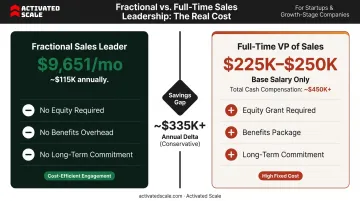
The practical implication: that gap in spend can go directly toward SDR headcount, outbound tooling, or demand generation — the things that actually feed pipeline.
KPIs this impacts:
- Total sales leadership spend
- Runway preservation
- Cost-per-hire
- Overhead reduction
When it matters most: This advantage is sharpest for seed-to-Series A companies generating enough revenue to need sales direction, but not yet enough to justify a $200K+ annual commitment. Bessemer Venture Partners' $0–$1M ARR playbook notes that hiring a VP of Sales too early can cost more than one-third of your first $1M ARR target — a meaningful risk for companies still finding their ICP.
Faster Time-to-Impact with No Learning Curve
A new full-time VP of Sales needs time — to understand your product, your buyers, your competitive positioning, and your existing team dynamics. The Bridge Group's 2024 B2B SaaS benchmark study puts average AE ramp time at 5.7 months.
That's for individual contributors. Executives who need to set strategy before they can execute anything take longer still.
A seasoned fractional leader walks in with pattern recognition. They've built GTM motions before. They've fixed broken pipelines. They know what good CRM hygiene looks like and what a weak ICP definition costs you in conversion rates.
From week one, a fractional leader can:
- Audit your current sales process — identify where deals are stalling and why
- Define or sharpen your ICP — align targeting with the buyers most likely to close
- Implement CRM structure — create pipeline stages, activity tracking, and hygiene standards
- Start rep coaching — identify skill gaps and build call review cadences
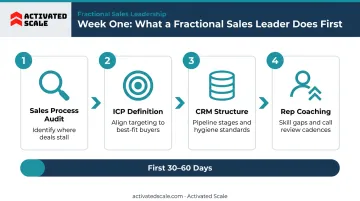
The structural improvements typically come within the first 30–60 days, well before a full-time hire would have finished their onboarding.
Activated Scale connects companies with vetted fractional sales professionals in 7 days or less — meaning the engagement starts almost immediately, not after a months-long recruiting process.
KPIs this impacts:
- Sales ramp time
- Pipeline velocity
- Lead-to-meeting conversion rate
- Deal cycle length
When it matters most: Any situation that requires immediate sales momentum — entering a new market, launching a product, or recovering from a period of stalled growth. These are the moments where a six-month ramp on a full-time hire is a luxury you don't have.
Scalable, Flexible Engagement That Matches Your Growth Stage
Full-time hiring locks you into a fixed commitment at whatever stage you're at. Fractional gives you a middle path.
A company at $300K ARR might need a fractional leader for 10 hours per week, focused on process-building and early pipeline structure. At $800K ARR, that same leader (or a specialist with a different set of skills) can scale to 20+ hours to manage a growing team, more complex deals, and a busier pipeline. The scope adjusts as your needs change, without renegotiating a full-time employment contract.
This flexibility solves a problem that trips up a lot of early-stage teams:
- Under-resourced: No sales leadership means no process, no coaching, no accountability
- Over-committed: A full-time executive at a stage that can't support the salary burns runway without return on that investment
There's also a meaningful try-before-you-buy dynamic. Companies can assess how a fractional leader performs before deciding whether to convert them to a full-time role. Activated Scale's model explicitly supports this pathway — 60% of clients ultimately convert fractional talent to full-time employees, which reflects strong match quality and the practical value of testing fit before committing.
KPIs this impacts:
- Revenue growth rate
- Sales team productivity per rep
- Win rate
- Cost-per-acquisition
This model is particularly well-suited to transition periods: scaling from 1–2 reps to 5+, preparing for a funding round, or recovering from the sudden loss of a key sales leader. These situations require fast recalibration — and fractional engagements are built around that kind of urgency.
What Happens When Fractional Sales Leadership Is Absent
The consequences of no sales leadership compound quietly, then suddenly.
Most founders find this out around the $500K–$1M ARR mark. Founder-led selling works early — Bessemer recommends closing the first 10–20 customers yourself to validate ICP and messaging. But past that threshold, the model breaks down. The founder can't manage pipeline, coach reps, close enterprise deals, and build product simultaneously.
What typically follows:
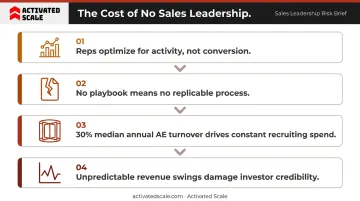
- Junior reps default to activity metrics that look busy but don't convert — no one is reviewing pipeline or coaching specific deals.
- Every rep sells differently with no playbook in place, making it nearly impossible to identify what's working or replicate it.
- Turnover compounds the problem. The Bridge Group's 2024 data shows 30% median annual AE turnover in B2B SaaS, with poor management as a primary driver — meaning constant recruiting spend and perpetually undertrained teams.
- Monthly revenue swings become a forecasting nightmare, and a credibility problem with investors, when there's no consistent process driving the pipeline.
The strategic cost is harder to measure but just as damaging. Without experienced sales leadership, companies struggle to build a go-to-market motion, align product and sales messaging, or respond to competitive pressure — and the longer that gap persists, the harder it becomes to close it with a full-time hire alone.
How to Get the Most Value from a Fractional Sales Leader
The companies that get the most out of fractional sales leadership treat it as a strategic engagement — not a weekly check-in.
Set Clear Ownership from Day One
- The fractional leader should own specific KPIs, not just activities
- Give them direct access to reps, CRM data, and customer calls
- Define the mandate explicitly: what does success look like in 90 days?
Build Infrastructure During the Engagement
- Sales playbooks and objection handling guides
- CRM stage definitions and hygiene standards
- Rep compensation plans tied to the right behaviors
- Hiring profiles for future sales roles
Review Outcomes Regularly
- Monthly milestone reviews
- Bi-weekly pipeline metric reviews
- Tie the leader's activities directly to revenue outcomes — not just process documentation
When the engagement ends, a full-time hire should inherit a working sales motion: defined stages, documented playbooks, and a team already hitting targets.
Conclusion
Fractional sales leadership is a strategic tool — not a compromise. Early-stage B2B SaaS companies get experienced leadership at a cost structure that fits their stage, with the flexibility to scale the engagement as the business grows.
Full-time hiring can't match the speed-to-impact.
The advantages compound: cost savings fund pipeline investment, faster ramp builds early momentum, and the try-before-you-buy model reduces the risk of a costly mis-hire. For startups ready to move beyond ad-hoc selling, it's one of the lowest-risk, highest-return moves available.
Activated Scale connects founders with vetted fractional VPs of Sales in 7 days or less — with a contract-to-hire path when you're ready to go full-time. Most founders are surprised how quickly they can go from zero sales structure to an experienced leader actively building pipeline.
Frequently Asked Questions
What does a fractional sales leader actually do day-to-day?
They coach reps, run pipeline reviews, refine the sales process, and develop go-to-market strategy — working directly with your existing team rather than operating independently. Expect regular deal reviews, call coaching sessions, and hands-on involvement in shaping how the team sells.
How much does fractional sales leadership cost compared to a full-time hire?
Fractional sales leaders average around $9,651 per month based on Vendux's 2024 US market data. A full-time VP of Sales commands a median base of $225,000 at seed stage, with total cash compensation often doubling that — plus equity and benefits that fractional engagements don't carry.
When is the right time for a startup to hire a fractional sales leader?
The trigger is typically when the founder can no longer manage sales alone and the company needs consistent pipeline — but isn't yet generating enough revenue to justify a full-time executive. For most B2B SaaS companies, that's the Seed to Series A window.
How is fractional sales leadership different from an external agency model?
Fractional leaders embed with your team and build capabilities you retain after the engagement ends. External agency teams manage the process independently, with little strategic integration. The key difference is ownership: fractional leaders build your sales motion, not a parallel one.
Can a fractional sales leader transition into a full-time role?
Yes, and many do. The fractional model functions as a structured try-before-you-buy arrangement: the leader proves impact, the company validates fit, and conversion to full-time happens once revenue and headcount support it.
How quickly can a fractional sales leader make a measurable impact?
Experienced fractional leaders deliver structural improvements — CRM hygiene, process clarity, rep coaching cadences — within the first 30–60 days. Measurable pipeline and conversion gains generally become visible within the first quarter.