
That's a missed opportunity. According to Forrester's 2025 State of Partner Ecosystems report, 67% of B2B decision-makers expect indirect revenue to grow by more than 30% year over year — and for early-stage SaaS companies, a structured partner program can become a meaningful growth channel without requiring a proportional increase in sales headcount or outbound spend.
This guide covers everything you need to build one deliberately: how to choose the right program type, confirm you're ready to launch, build the program step by step, structure compensation, and keep partners active over time.
Key Takeaways
- A SaaS partner program uses third parties (agencies, resellers, consultants, or integrators) to sell your product in exchange for agreed compensation.
- You need product-market fit, a defined ICP, and a repeatable sales motion before launching.
- The most common starting points are referral and reseller programs — not marketplaces.
- Top-performing B2B SaaS vendors offer partner incentives of 20–30%, with reseller margins in the same range.
- Start with one or two partners, prove the model works, then scale from there.
What Is a SaaS Partner Program and Why It Matters
A SaaS partner program is a structured initiative where a SaaS company collaborates with external parties — individuals, agencies, or businesses — to promote, sell, or extend their product in exchange for agreed compensation or mutual benefit.
The strategic value goes beyond incremental revenue. Partners provide:
- Geographic coverage without opening new offices
- Vertical credibility in markets where they already have trust
- Sales capacity that would otherwise require significant internal hiring
- Customer access to segments your direct motion doesn't reach
A partner program is not a shortcut, though. SaaS Capital found that 52% of SaaS companies use some form of channel program — but the same research noted that companies receiving the majority of revenue through partners had 3 percentage points lower net retention than those with primarily direct sales. Partners can extend your reach, but they require deliberate management to avoid retention trade-offs.
The programs that work are built to fill a genuine gap in the company's GTM strategy. That's a different starting point than chasing a faster revenue number.
Types of SaaS Partner Programs
Referral and Affiliate Partners
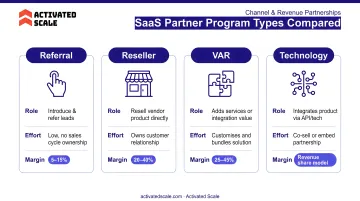
Customers, consultants, or agencies who recommend your product and earn a incentive per closed deal. This is the simplest starting point, ideal for early-stage companies that already have informal advocates in their customer base. Referral partners typically receive a one-time fee rather than recurring margin, making them simpler to manage administratively.
Reseller and Value-Added Reseller (VAR) Partners
Third parties who purchase or license your product and resell it — often bundled with their own services. Standard resellers typically earn 5–10% margin according to Bessemer Venture Partners, while VARs (who provide customization, implementation, or post-sale support) earn 20–30% margin. VARs are well-suited for entering new geographies or verticals where the partner already has established relationships.
Technology and Integration Partners
Complementary SaaS platforms that integrate with your product to deliver a better combined experience. Crossbeam's 2023 State of the Partner Ecosystem report found that integration users are 58% less likely to churn — making technology partnerships one of the most retention-positive motions available to SaaS companies.
A Note on Marketplaces
AWS Marketplace and Salesforce AppExchange are worth pursuing eventually, but neither is the right first move. Both require significant technical and legal overhead before you can list:
- AWS Marketplace: API integrations, public pricing dimensions, and KYC verification
- Salesforce AppExchange: Full security review and a lengthy due diligence process
These are mature-program plays. Get your core program running first.
Signs You Are Ready to Launch
Before investing time in partner recruitment, confirm you have these three foundations in place.
1. Product-market fit. Partners cannot sell what the market hasn't validated. The Sean Ellis PMF benchmark sets a clear bar: at least 40% of users should say they'd be "very disappointed" losing access. Without that signal, a partner program generates noise — not revenue.
2. A clear ICP and repeatable sales motion. Partners need a clear picture of who to sell to and what the buying journey looks like. If your own sales team can't consistently articulate the ICP, partners won't either. Bessemer explicitly lists a proven sales strategy and documented buying journey as prerequisites for launching channel partnerships.
3. Existing organic advocates. If customers or agencies are already informally recommending your product, that's the clearest signal a formalized program will succeed. Formalizing what's already happening is far easier than manufacturing partnerships from zero.
How to Build Your SaaS Partner Program Step by Step
Step 1: Map Your GTM Gaps
Identify specifically what your direct sales motion cannot reach — a geography, a vertical, a buyer persona, or a volume problem. This gap definition becomes the filter for every partner you recruit. Don't build a partner program because partners sound strategic; build one because you've identified a specific distribution problem that partners can solve better than direct sales.
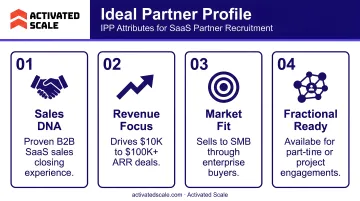
Step 2: Build an Ideal Partner Profile (IPP)
Just as you build an ICP for customers, define the characteristics of your best-fit partners. PartnerStack defines an IPP as a research-based description of traits found in best-fit partners, covering attributes like:
- Audience overlap with your ICP
- Existing credibility in your target vertical
- Business model compatibility with your pricing
- Willingness to actively sell vs. passively refer
The distinction between active sellers and passive referrers matters more than most founders expect. Partners who only refer occasionally won't move your revenue needle.
Step 3: Recruit Outbound — Don't Wait
Don't wait for partners to find you. Proactively identify two to five high-fit candidates based on your IPP and reach out with a value proposition that leads with what the partnership does for them. Partners evaluate dozens of program opportunities; if your pitch is primarily about what you need from them, it will be ignored.
Step 4: Run a Focused Pilot
Once you've signed your first partners, work closely with one or two before scaling. Use the pilot to refine your onboarding, co-sell motion, and compensation mechanics. Document everything into a repeatable playbook.
Bessemer recommends starting with a single partner to stress-test the motion. SaaStr suggests a wider pilot of five to ten adjacent-ecosystem partners. Either approach beats signing up twenty partners simultaneously with no playbook.
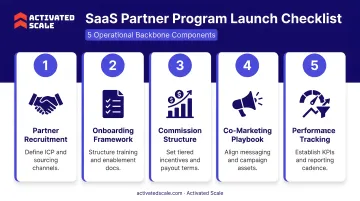
Step 5: Build the Operational Backbone
Before paying out your first incentive, have these in place:
- A dedicated landing page for partner sign-ups
- An intake form to qualify applicants against your IPP
- Tracking infrastructure — PartnerStack's Spark tier starts at $0/month plus a 10% processing fee on incentives paid; Impact.com's Starter tier is $30/month
- A clear monthly payout process with documented timelines
Operational sloppiness early on (late payments, unclear attribution, no escalation path) destroys partner trust faster than almost anything else.
Structuring Compensation and Incentives
Incentive Models
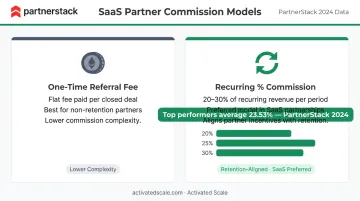
Two primary structures exist for SaaS partner compensation:
| Model | Best For | Typical Range |
|---|---|---|
| One-time referral fee | Partners not responsible for retention | Lower flat fee per closed deal |
| Recurring % incentive | Partners with ongoing customer relationships | 20–30% of recurring revenue |
PartnerStack's 2024 Research Lab data shows top-performing B2B SaaS vendors averaged 23.53% incentive, with 20%, 25%, and 30% as the best-performing offer ranges. Recurring incentives are generally preferred in SaaS because they incentivize partners to help retain customers, not just close them.
VAR and Reseller Margins
VARs typically receive 20–30% margin on the product, while standard resellers earn 5–10% (per Bessemer's 2023 SaaS channel guide). Set these margins carefully. The gap between your partner pricing and your direct list price needs to be wide enough to motivate partners without creating conflict that makes direct deals impossible to win.
Internal Sales Team Alignment
This is where many partner programs stall: account executives resist partner-sourced deals because their incentive is lower when partner margin is involved. The standard fix is comp neutrality — meaning AEs retire 100% of quota at list price even when the company nets only 80% after the partner's cut. Getting this wrong creates internal politics that kills programs from the inside.
Non-Monetary Incentives
Incentive isn't the only motivator, particularly for agency and consultancy partners. Ask your partners directly what they value. Common answers include:
- Co-marketing exposure and joint case studies
- Early access to new product features
- Dedicated support or faster escalation paths
- Inclusion in a visible partner directory
- Co-branded sales collateral
Enabling, Managing, and Scaling Your Partner Program
Partner Enablement Is the Real Work
The gap between a registered partner and an active one is almost always an enablement gap. Partners need:
- Product training and certification paths
- Battle cards for competitive situations
- Customer-facing collateral they can use in their own sales conversations
- A clear escalation path when deals get complex
The more self-sufficient you make your partners, the more revenue they'll generate without requiring constant hand-holding from your team.
Assign Dedicated Ownership Early
Early-stage teams often can't justify a full-time partner manager. A fractional sales professional with channel experience is a practical alternative who can own relationship-building, onboarding, and partner activation without the overhead of a full-time hire.
Activated Scale, for example, connects B2B SaaS startups with vetted fractional sales professionals (including those with channel experience), typically placing candidates within seven days at monthly retainers of $4,500/month plus performance pay for SDRs, $6,500/month plus performance pay for AEs, and $12,000/month plus bonus for VPs of Sales.
Track the Metrics That Matter
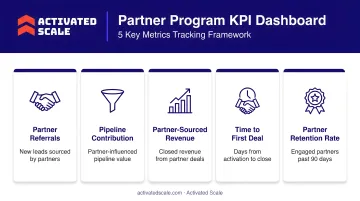
Crossbeam's 2023 partnership KPI research found that partner-sourced revenue was the primary KPI for 67% of partnership teams, with 74% of those teams hitting their goals most quarters. Track these metrics from day one:
- Partner-sourced revenue as % of total ARR
- Active partners vs. registered-but-dormant partners
- Partner-sourced pipeline value
- Partner conversion rate vs. direct sales conversion
- Average deal size from partner vs. direct
For context, companies with 10–49 employees averaged $100K in quarterly partner-sourced revenue targets — useful as an early-stage benchmark when setting your own goals.
Scaling Mistakes to Avoid
- Quantity over quality: Signing up too many partners early destroys program economics and your team's capacity to support them
- Ignoring channel conflict — without clear rules of engagement on overlapping territories or accounts, partners and your direct sales team will step on each other
- Set-and-forget compensation: Review your IPP and variable pay structure at least annually. What worked at $500K ARR won't work at $3M ARR
Frequently Asked Questions
What is a SaaS partnership?
A SaaS partnership is a formalized collaboration between a SaaS company and an external party (such as an agency, reseller, consultant, or complementary software provider) to jointly promote, sell, or extend the product. Unlike an informal referral, it includes defined terms, tracking, and a compensation agreement.
What is a typical SaaS sales salary?
According to Betts Recruiting's 2025 data, SDR base salaries run $55K–$75K and AE base salaries range from $70K–$145K for mid-market roles. Early-stage companies not ready for full-time hires can access comparable expertise through fractional sales platforms like Activated Scale, with SDR-level retainers at $4,500/month plus performance pay.
What are the most common types of SaaS partner programs?
Referral/affiliate, reseller, VAR, technology/integration, and channel partnerships are the most common types. Early-stage SaaS companies should generally start with referral or reseller programs — they require the least operational infrastructure — before expanding to VARs and technology partnerships.
When is the right time to launch a SaaS partner program?
After achieving product-market fit, defining a clear ICP, and establishing a repeatable direct sales motion. Launching before these foundations are in place typically produces activity without revenue, and burns the goodwill of early partners.
How do you measure the success of a SaaS partner program?
Core metrics: partner-sourced revenue as a percentage of total ARR, number of active partners (not just registered), partner-sourced pipeline value, and partner conversion rate relative to direct sales. Track the active-to-dormant partner ratio from day one — it's the clearest signal of how well your enablement is working.
How much incentive should you offer SaaS referral partners?
Referral incentives in B2B SaaS typically range from 20–30% for top-performing programs, based on PartnerStack's 2024 research. VARs receive margin discounts in the same 20–30% range, while standard resellers typically see 5–10%. One-time vs. recurring structures depend on whether the partner is responsible for post-sale retention.