
While fractional executives are increasingly discussed as a solution, most conversations focus narrowly on cost savings. What gets overlooked is the strategic edge fractional leadership delivers: compressed time-to-revenue, stage-aligned flexibility, and de-risked hiring decisions. This article breaks down the specific, measurable advantages fractional executives deliver to SaaS companies, and identifies precisely when those advantages matter most.
Key Takeaways
- Fractional executives deliver C-level strategic leadership part-time at 40-75% lower cost than full-time hires
- Seed-to-Series-A SaaS companies use fractional leadership to compress time-to-revenue while preserving runway
- 40% of full-time executive hires fail within 18 months—fractional engagements eliminate that replacement cost (200%+ of annual salary)
- Skipping fractional leadership at growth inflection points leads to founder burnout and stalled pipelines
What Are Fractional Executives?
Fractional executives are experienced C-level professionals—CMOs, CROs, CFOs, CTOs, COOs—who embed with a company part-time, typically working 10-20 hours per week on a contract basis. They provide strategic leadership and execution at a fraction of the cost of a full-time hire.
Early-stage and growth-stage SaaS companies use fractional executives in several situations:
- Validated product-market fit, but no budget or headcount for a full C-suite
- Interim coverage during a full-time executive search
- Bridge leadership while transitioning from founder-led to process-driven operations
Fractional executives are hired to move specific business metrics, not to fill org chart slots. They own outcomes: pipeline growth, ARR expansion, CAC reduction, burn rate optimization. They're accountable for results the same way full-time executives are, but with structural flexibility that aligns with early-stage realities.
That flexibility has driven real adoption. Demand for fractional executive roles has increased 57% since 2020, and fractional CMO adoption grew 245% in just two years. The market has matured—SaaS companies now have access to deep talent pools with proven startup experience.
Key Advantages of Fractional Executives for SaaS Companies
The advantages below are grounded in operational and revenue impact, not abstract leadership theory. Each one ties directly to the outcomes SaaS founders and investors track: MRR growth, burn multiples, pipeline coverage, and fundraising readiness.
These advantages are most significant for companies between Seed and Series B, where the gap between needed expertise and affordable headcount is widest.
Advantage 1: Senior Expertise Without the Full-Time Price Tag
A fractional CMO, CFO, or CRO typically costs 40-75% less than a full-time hire when accounting for base salary, equity, benefits, and recruiting fees. This enables early-stage SaaS companies to access senior leadership they otherwise couldn't afford.
In practice, this means a founder replaces months of misaligned hiring attempts by engaging a fractional executive scoped to a specific growth problem—building a sales playbook, preparing Series A financials, or establishing demand generation infrastructure.
The cost difference is substantial:
Full-time C-suite salaries at SaaS companies frequently exceed $200K-$300K in total compensation:
| Role | Median Salary | Typical Range |
|---|---|---|
| Chief Revenue Officer | $165,000 | $100K-$225K |
| VP of Sales | $160,000 | $115K-$185K |
| VP of Marketing | $155,000 | $137K-$173K |
| Chief Financial Officer | $140,000 | $82K-$227K |
But salary is only part of the equation. Total year-one cost—including benefits ($50K-$150K), taxes, and recruiting fees ($50K-$100K)—reaches $250K-$375K for a CFO and $450K-$800K for a CMO.
Fractional engagements capture most of that strategic value at 20-40% of the cost:
| Role | Monthly Retainer | Annual Cost |
|---|---|---|
| Fractional CMO | $5,000-$15,000 | $60K-$240K |
| Fractional CFO (Seed) | $3,000-$7,000 | $36K-$84K |
| Fractional CFO (Series A) | $7,000-$15,000 | $84K-$180K |
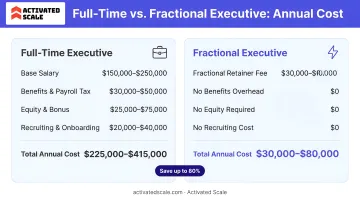
This cost structure directly extends runway. Carta data shows that seed-stage companies now average just 5.3 employees (down from 6.9 in 2021), and Series A companies average 15.6 employees (down from 17.6). At these lean team sizes, a single full-time C-suite hire at $250K-$400K represents an outsized percentage of total burn.
Investors at Seed and Series A increasingly scrutinize burn multiples—David Sacks' formula of Net Burn / Net New ARR. Benchmarks below 1.5x are "great"; above 3.0x is "bad." Fractional leadership keeps headcount lean while adding executive firepower, directly improving the efficiency ratio that determines fundraising success.
KPIs impacted: Burn rate, cash runway, headcount costs, operating efficiency ratio
When this advantage matters most: Pre-revenue or early ARR stages ($0-$3M) where every dollar of runway is critical. Also during fundraising prep, when a fractional CFO can clean up financials and build investor-ready models without requiring a permanent hire.
Advantage 2: Faster Time to Revenue Impact
Fractional executives arrive with cross-company pattern recognition, proven playbooks, and no ramp-up learning curve. They diagnose growth blockers and begin executing within days or weeks, not months.
Unlike a full-time hire who spends 60-90 days onboarding, a fractional CRO who has scaled five SaaS companies from $1M to $10M ARR already knows which pipeline levers to pull, which sales motions work, and which signals predict churn.
Why speed matters in SaaS:
Time-to-impact is a direct revenue variable. Every month without a functional sales system or demand engine is MRR left on the table.
Research shows that senior and executive hires require 6-12 months to reach full productivity. Fractional executives with prior startup experience compress this to weeks because they bring pre-built frameworks from previous engagements.
At $50K MRR, a one-quarter delay in building a repeatable sales motion costs roughly $150K in revenue and pushes the company's Series A timeline back by the same amount. That's a concrete reason to prioritize speed of execution over the comfort of a traditional hire.
KPIs impacted: Time-to-first-close on new accounts, pipeline build rate, sales cycle length, MRR growth rate, marketing-qualified lead (MQL) volume
When this advantage matters most: When a SaaS company is transitioning from founder-led sales and needs a repeatable revenue engine fast. Also when a critical hire (VP of Sales) departs and the company needs bridge leadership while recruiting.
Platforms like Activated Scale can connect SaaS companies with vetted fractional sales professionals in as few as 7 days, minimizing the gap between need and execution.
Advantage 3: Stage-Matched Flexibility That Grows With the Company
Fractional engagements are scoped to the company's current growth stage and adjusted as needs evolve. A SaaS company at $500K ARR needs different leadership than one at $8M ARR—fractional structures accommodate this shift without the friction of restructuring a full-time executive team.
In practice, fractional executives can be brought in for specific milestones: establishing a GTM strategy pre-launch, preparing for Series A, building a repeatable sales playbook. They can then be scaled back, converted to full-time, or replaced with a different functional leader as the company's needs change.
The cost of getting the hire wrong:
Locking in a full-time C-suite executive at the wrong growth stage is one of the costliest mistakes early-stage SaaS founders make. The numbers bear this out:
- 40% of externally hired executives leave or are terminated within 18 months
- Replacement costs reach 200-213% of annual salary
- A mis-hired CRO typically causes 9 months of broken strategy before the problem becomes undeniable
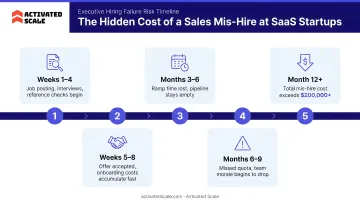
Add replacement time and the total lost execution runway exceeds one year—a significant chunk of the 18-24 months between funding rounds.
Fractional models function as a try-before-you-buy structure. No severance costs, no equity dilution, no sunk recruiting fees—just a defined engagement that lets founders evaluate fit before committing. Most run 6-18 months, with the option to convert to full-time once the role's scope and the executive's fit are both proven.
KPIs impacted: Win rate, customer acquisition cost (CAC), CAC payback period, net revenue retention (NRR), pipeline coverage ratio
When this advantage matters most: At every growth inflection point—entering a new market, moving upmarket to enterprise, preparing for fundraising, or scaling a sales team from founder-led to process-driven. The advantage peaks when the company is growing faster than its internal leadership capacity can support.
What Happens When SaaS Companies Skip Fractional Leadership
Many early-stage SaaS founders delay bringing in fractional executives, convinced they can manage strategy themselves or that a full-time hire can wait. That delay compounds — and the damage shows up faster than most founders expect.
Common consequences include:
- Pipeline stays inconsistent and tied to the founder's bandwidth. First Round Review's case study of Levels CEO Sam Corcos found that across 17,784 tracked hours over 5 years, he allocated just 5% of total time to strategy — while sales and operations consumed the rest.
- Financial modeling never gets past the basic spreadsheet. Without senior finance leadership, ARR cohort analysis and burn multiple visibility go unbuilt, which investors notice immediately.
- Sales motions go undocumented. Startup sales hire failure rates hit 50-70% — and climb higher before product-market fit — largely because there's no repeatable process for new reps to follow.
- Teams react to noise instead of setting targets. Without experienced leadership tracking weekly metrics and owning 90-day plans, burn climbs while results plateau.
- Founder burnout arrives early. 52% of founders report burnout, and many spend 50%+ of their time on non-core tasks — exactly the work fractional executives are built to absorb.
How to Get the Most Value from Fractional Executives
Fractional executive engagements fail when treated as loose advisory arrangements. Companies that see the strongest results structure them like internal executive roles, with clear scope, defined metrics, and regular accountability.
Value compounds when you:
- Define outcomes from day one — not "help with marketing" but concrete targets like "reduce CAC from $9K to $5K in two quarters" or "build a repeatable outbound sales playbook for the AE team by Q3"
- Review progress monthly against pre-agreed KPIs using a shared dashboard visible to the fractional executive, the founding team, and your board
- Prioritize internal capability-building over dependency — playbooks documented, team members trained, systems set up to outlast the engagement
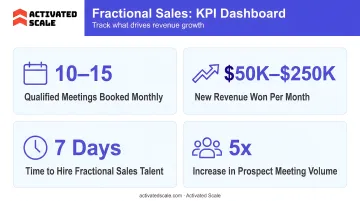
Activated Scale's try-before-you-hire model takes this further — companies evaluate fractional sales talent against real performance data before making any full-time commitment. 60% of clients convert their fractional sales professionals to full-time employees after the initial contract period, which means the engagement itself becomes a working interview.
Conclusion
The real value of fractional executives for SaaS companies goes beyond cost savings. What actually moves the needle is having senior leaders who own key functions, know which metrics matter at each growth stage, and leave behind documented processes that survive their departure.
The advantages of fractional leadership compound over time. Companies that bring in fractional expertise at the right growth stage build stronger foundations, close more revenue, and hit fundraising milestones faster than those waiting until the budget justifies a full C-suite hire.
Treat fractional leadership as an ongoing practice, not a stopgap. For founders ready to act on that, platforms like Activated Scale make it possible to hire vetted fractional sales leaders — from VP of Sales to Account Executives — in as little as seven days, without the commitment of a full-time offer.
Frequently Asked Questions
What types of fractional executives do SaaS companies most commonly hire?
The most common hires are CRO/VP Sales (revenue), CMO (GTM and demand generation), CFO (fundraising and financial modeling), and CTO (product and technical strategy). Seed-stage companies typically start with revenue roles, while pre-fundraise companies prioritize a fractional CFO. The right choice depends on where growth is stalling.
How much does a fractional executive cost compared to a full-time hire?
Fractional executives typically engage on monthly retainers ($3K–$15K) or hourly rates ($150–$500), which is 40–75% less than a full-time executive hire. Full-time CROs, CMOs, and CFOs can exceed $200K–$375K in year-one total compensation once benefits, taxes, and recruiting are factored in.
When is the right time for a SaaS startup to hire its first fractional executive?
The right trigger is when a specific growth function—sales, finance, or marketing—has become a bottleneck the founding team cannot address without senior expertise. This typically happens between $500K and $3M ARR, before the company can justify a full-time C-suite hire but after product-market fit is validated and repeatable processes are needed to scale.
How is a fractional executive different from a consultant or agency?
Fractional executives embed in the leadership team, owning outcomes and being held accountable for KPIs like pipeline, revenue, and burn rate. Consultants deliver recommendations and agencies execute tasks; neither owns strategic results the way a fractional executive does.
Can a fractional executive help a SaaS company prepare for fundraising?
Yes. Fractional CFOs are highly effective at fundraising prep—building financial models, cleaning up metrics, establishing ARR cohort analysis, and preparing data rooms that meet investor diligence standards. Fractional CMOs and CROs help demonstrate the repeatable revenue engine and predictable growth that investors want to see at Series A and beyond.
How long does a typical fractional executive engagement last for a SaaS company?
Engagements typically run 6-12 months, scoped around a specific growth milestone or functional build-out. Some convert to full-time roles once workload and budget justify it (60% conversion rate at Activated Scale), while others transition out once the playbook is built and an internal team is in place to execute.