

Fractional leadership solves this. It gives you senior-level expertise without the full-time commitment—executives who work part-time across multiple companies, delivering real outcomes at a fraction of the cost. Research shows the number of fractional leaders in the US doubled from 60,000 to 120,000 between 2022 and 2024, with LinkedIn fractional job postings surging from 2,000 to 110,000 over the same period.
This guide covers what fractional leadership is, when your business is ready, which roles deliver the highest ROI, and how to hire and onboard a fractional leader successfully.
Key Takeaways
- Fractional leaders are senior executives who work part-time across multiple companies, providing C-suite expertise at 30–40% of full-time cost
- Pattern-matched experience means fractional hires reach full effectiveness in 2 weeks, versus 3–4 months for full-time hires
- Match the role to your biggest growth constraint: Fractional CFO, VP of Sales, CMO, COO, or CTO
- Hire when decisions are stalling or revenue has plateaued and your core processes can support execution
What Is Fractional Leadership?
A fractional leader is an experienced executive who works with multiple businesses simultaneously on a part-time, retainer, or project basis. They typically commit 1-3 days per week to each client, bringing 15+ years of senior leadership experience without the overhead of a full-time executive.
This isn't consulting. Consultants advise from the outside; fractional leaders embed in your business, take ownership of outcomes, and function as real members of your leadership team. As Forbes Business Council notes, "A consultant tells you how to build a watch; a fractional leader builds the watch, then makes sure it keeps time."
Fractional leadership is also distinct from interim leadership. Here's how the three models compare:
| Model | Engagement Style | Timeline | Focus |
|---|---|---|---|
| Consultant | Advisory, external | Project-based | Recommendations |
| Interim Executive | Full-time, transitional | Under 90 days | Crisis or coverage |
| Fractional Leader | Embedded, part-time | 3–9 months | Building capability |
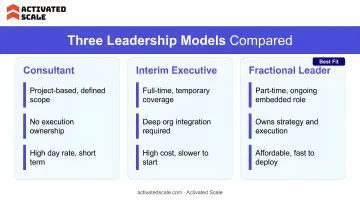
Interim executives step in during urgent transitions — covering a departure or managing a crisis — with a defined end date. Fractional engagements are ongoing and strategic, focused on building capability rather than firefighting.
Why the Model Has Exploded
The fractional executive market topped $5.7 billion globally in 2024, growing 14% annually. Nearly 1 in 3 mid-size businesses now employs at least one fractional executive. The model works because it matches how modern businesses scale: you need expertise at specific inflection points, not necessarily 40 hours per week of executive attention. Fractional leaders let you pay for what you need, when you need it.
Key Benefits of Fractional Leadership for Small Businesses
Cost Efficiency
Engaging a fractional executive eliminates the full financial burden of a senior hire—salary, benefits, equity, onboarding costs, and recruiting fees. You pay only for the hours or scope you need.
Full-time executive compensation (US market):
- CFO: $250,000-$400,000 total compensation
- CMO: $200,000-$350,000
- COO: $250,000-$400,000
- VP of Sales: $250,000-$450,000 (including on-target earnings)
Add 20% for benefits, plus $50,000-$100,000 for executive search and onboarding, and a full-time CFO easily costs $350,000+ in year one.
Fractional engagement costs:
- Fractional CFO: $4,000-$10,000/month ($48,000-$120,000/year)
- Fractional CMO: $5,000-$10,000/month ($60,000-$120,000/year)
- Fractional COO: $4,000-$12,000/month ($48,000-$144,000/year)
- Fractional VP of Sales: $6,000-$15,000/month ($72,000-$180,000/year)
Businesses save 30-40% on CFO costs by hiring fractionally. UK SMEs report 40-60% savings on executive labor. That difference protects cash flow and extends runway.
Immediate, Pattern-Matched Expertise
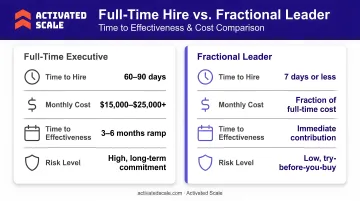
Full-time executives need 3-6 months to reach productivity. Senior or highly technical roles often take 6-12 months. During that ramp, they're learning your business, your market, and your systems—all on your payroll.
Fractional leaders skip that ramp entirely. 75% bring 15+ years of senior leadership experience, and they recognize patterns immediately because they've solved the same problems at other companies.
The speed advantage is measurable. A fractional VP of Sales reaches full effectiveness in roughly 2 weeks versus 3-4 months for a full-time hire. NOW CFO reports clients typically see double-digit improvements in cash-flow visibility and cycle times within the first 6 months. For a small business, that gap between "we have a problem" and "we're executing a solution" translates directly into revenue and competitive position.
Flexibility to Scale Up or Down
Full-time hires are fixed costs. Fractional engagements are variable, adjusting to business stage and need.
During a fundraising round, you might need your fractional CFO 3 days per week to build models and prepare materials. Post-close, you scale back to 1 day per week for monthly reporting. Launching a new product? Ramp your fractional CMO to full bandwidth for 90 days, then dial down once campaigns are live and performing.
This flexibility protects cash flow during slow periods and gives you surge capacity during critical windows—without renegotiating employment contracts or managing layoffs.
Access to Cross-Industry Experience
Fractional leaders work across multiple businesses simultaneously. That breadth delivers value internal executives can't match: they see what's working elsewhere, bring tested playbooks from other industries, and spot patterns your team might miss.
As MacGregor Black research shows, this "broader visibility of what is working elsewhere" can be more valuable than deep experience inside a single organization. An executive who has navigated the same growth challenge at three other companies will move faster and make fewer costly mistakes than one encountering it for the first time.
Reduced Hiring Risk
A bad executive hire costs 2-3x base salary once you factor in recruiting fees, lost productivity, and damaged morale. The numbers are hard to ignore:
- 75% of employers admit to making at least one bad hire
- 41% of companies lost over $25,000 from a single wrong hire
- Recovery takes 6-12 months for mid-level roles, over a year for senior positions
Fractional engagements reduce this downside. Most contracts run month-to-month or quarterly, so if the fit isn't right, you course-correct quickly without severance costs or legal exposure. And if the relationship works, you have an extended evaluation period before converting to full-time.
Top Fractional Leadership Roles for Small Businesses
Fractional CFO
When to hire: Once revenue is flowing and financial complexity grows—typically between $500,000 and $3 million in annual revenue.
What they do: Cash flow management, pricing strategy, tax planning, investor reporting, and preparing for eventual exit or fundraising. They build the financial infrastructure that lets founders stop guessing and start planning.
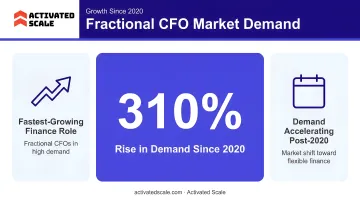
The numbers explain the demand: 51% of all C-suite talent requests are for CFO roles, up 103% year-over-year and 310% above 2020 levels. Over 70% of companies with revenues between $5M and $50M now use or consider fractional CFO services. The market is projected to reach $2.4 billion in 2026—making financial leadership the most common and proven first fractional hire.
Fractional CMO
When to hire: Once product-market fit is established and growth needs to be systematized—typically at Series A stage ($3 million-$10 million ARR).
What they do: Marketing strategy and execution leadership—positioning, channel selection, SEO, paid media, brand development, and performance tracking. They take marketing from "the founder posts on LinkedIn sometimes" to a repeatable growth engine.
Cost: $5,000-$10,000/month for mid-market companies; senior-tier fractional CMOs command $8,000-$22,000/month depending on scope. Most engagements run 6-12 months.
Fractional COO
When to hire: When strategic plans aren't translating into execution, or when the founder is overwhelmed managing day-to-day delivery.
What they do: Streamline processes, remove bottlenecks, and build execution discipline. Effectively, they own the gap between what leadership decides and what actually gets done.
Cost: $4,000-$12,000/month. Most useful for businesses where the founding team has strong vision but weak operational systems.
Fractional VP of Sales
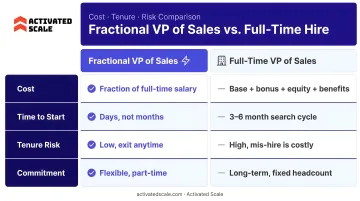
When to hire: When you're moving from founder-led sales to a repeatable, scalable revenue engine—typically between $500,000 and $5 million ARR.
What they do: Build pipeline, define sales process, hire and coach reps, and close early deals. They build the repeatable sales process that replaces founder hustle with a system that scales.
McKinsey research finds that 78% of companies with product-market fit still fail to scale, typically hitting a ceiling around $10 million ARR. The "Founder-VP of Sales" bottleneck—where the founding team is still running every deal—is the most common reason.
Cost: $6,000-$15,000/month, roughly 30-40% of a full-time VP of Sales hire. Average full-time VP of Sales tenure at startups is just 18 months, often less than 12 for early-stage companies. A fractional engagement de-risks that volatility.
Activated Scale connects B2B SaaS startups with pre-vetted fractional sales professionals—VPs of Sales, AEs, and SDRs—typically placed within 7 days. Clients report averaging 10-15 qualified meetings per month with no long-term hiring commitment.
Fractional CTO or CPTO
When to hire: Valuable for non-technical founders who need technology roadmap guidance, engineering hiring decisions, and technical risk management, but don't yet need a full-time technical executive.
What they do: Build technical strategy, oversee engineering hiring, manage vendor relationships, and ensure technology decisions align with business objectives.
Cost: $6,000-$15,000/month. Particularly valuable during product development sprints or platform migrations.
Is Your Small Business Ready for Fractional Leadership?
Signs You're Ready
You're ready for fractional leadership when:
- Strategic decisions are stalling because no one on the founding team has the expertise to evaluate options confidently
- Revenue or operations have hit a ceiling the founding team can't break through on their own
- You have specific, high-impact problems—scaling sales, preparing for fundraising, fixing cash flow, building marketing infrastructure—but not enough ongoing work to justify a full-time hire
- Your business has $500,000+ in revenue and foundational processes in place
Signs It's Too Early
Fractional leaders amplify existing momentum—they don't create it from scratch. If your business hasn't found product-market fit yet, or if foundational processes and data don't exist, the engagement will struggle.
Fractional leaders need something to work with:
- Customer data and CRM records
- An active sales pipeline
- Financial records and reporting
- Team members to coach and coordinate
Without these inputs, no fractional executive can deliver meaningful value.
Self-Assessment
Ask yourself:
- Is there a specific, high-value outcome I need delivered in the next 90 days — like building a financial model for Series A, generating 10 qualified demos per month, or streamlining a fulfillment process?
- Do I have the data and processes a fractional leader needs? Think CRM records, financial statements, documented workflows.
- Can I commit to treating this person like a real team member — with weekly check-ins, system access, and real decision-making authority?
Three yeses means you're in a strong position to get real results from a fractional engagement. The next step is figuring out which role to bring in first.
How to Hire and Onboard a Fractional Leader Successfully
Define the Outcome Before Hiring
The most common failure mode is bringing in a fractional leader without a clear problem to solve. The engagement should start with a specific, measurable outcome for the first 30-90 days—not a general mandate like "help us grow."
Good example: "Build and execute an outbound sales process that generates 10 qualified demos per month by Day 60."
Bad example: "Help with sales strategy."
Clarity creates accountability. Vague mandates create confusion and wasted budget.
Evaluate for Fit, Not Just Credentials
Look for fractional leaders who have solved the exact problem you face, ideally in the same industry or stage. Ask for references from comparable engagements.
Vetting platforms cut this process down considerably. For sales talent, Activated Scale pre-screens candidates with experience at companies like Salesforce, Databricks, and IBM, handling deal sizes from $10,000 to $100,000+ and selling to small businesses through enterprise. You can connect with vetted fractional sales professionals in as little as 7 days, sometimes the same day.
Set Up for Success from Day 1
Effective onboarding includes:
- Grant system access on Day 1—CRM logins, data, and key team introductions shouldn't wait two weeks
- Spell out decision-making authority: what they can act on independently versus what needs founder sign-off
- Lock in meeting cadence and KPIs upfront: weekly check-ins, monthly reviews, and specific metrics like pipeline growth or campaign ROI
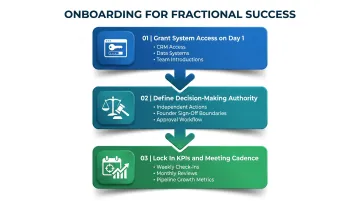
Accountability starts at onboarding, not after the first missed target.
Manage the Engagement Actively
Fractional leaders work best when the founding team stays engaged and treats the relationship as a true partnership. Set a regular check-in rhythm—weekly 30-minute syncs at minimum—and course-correct quickly if the engagement drifts from its original objectives.
Ask these questions at every check-in:
- Are we on track to hit the 90-day outcome we defined?
- What's blocking progress right now?
- Do you have the access, budget, or approvals you need?
- Are there scope changes we should address before next week?
Common Pitfalls to Avoid
Hiring Fractional When You Need Full-Time
If the workload genuinely requires 40 hours per week of dedicated focus and the role is central to daily operations, a fractional arrangement will underserve the business. Be honest about scope before signing a contract.
Failing to Manage Conflicts of Interest
Fractional leaders serve multiple clients simultaneously. Use clear contracts that address:
- Confidentiality and data protection
- Competitive exclusions (they shouldn't work for your direct competitor)
- Conflict resolution processes
Treating Fractional Leaders Like Vendors
Forbes HR Council research identifies this as the top failure mode: treating fractional leaders like consultants who offer advice from the sidelines. The engagement fails when fractional leaders are kept at arm's length, denied access to critical data, or excluded from key team conversations.
Fractional leaders need to be embedded like full team members to deliver results. That means:
- Granting decision rights, not just advisory access
- Including them in leadership meetings and internal communications
- Giving them the authority to execute on strategy, not merely recommend it
Frequently Asked Questions
What is a fractional leader in business?
A fractional leader is an experienced executive who works part-time across multiple companies, providing senior-level expertise without the cost of a full-time hire. Unlike consultants who advise from outside, fractional leaders embed in the business, own outcomes, and operate as genuine members of the leadership team.
How much does a fractional executive typically cost?
Costs vary by role and scope. Fractional CFOs typically run $4,000–$10,000/month; fractional CMOs $5,000–$10,000/month; fractional VPs of Sales $6,000–$15,000/month. This represents 30–40% savings compared to full-time executive total compensation, which ranges from $250,000–$450,000 annually depending on role.
What is the difference between a fractional executive and a consultant?
Consultants advise from the outside without operational accountability. Fractional executives are embedded in the business, own outcomes, and hold a seat at the leadership table. Where consultants hand off a report, fractional executives stay accountable for what happens next.
What fractional leadership role should a small business hire first?
It depends on your most pressing constraint. Hire a fractional CFO when financial complexity is growing or fundraising is on the horizon; a fractional VP of Sales when revenue growth stalls; or a fractional COO when daily operations are consuming the founder's time.
Can a fractional leader transition to a full-time role?
Yes. Many fractional engagements function as extended evaluation periods, and companies regularly convert strong performers to full-time once the need and budget align. It's a natural try-before-you-hire dynamic that reduces the risk of a costly mis-hire.
How long does a typical fractional leadership engagement last?
Engagements range from a few months for defined projects to 2+ years for ongoing strategic roles. Fractional CMOs and VPs of Sales typically run 6–12 months; fractional CFOs often continue longer. Duration should reflect whether objectives are being met, not an arbitrary end date.