
Introduction
You've just closed a funding round. The board wants a forecast. Your pipeline is a mess of spreadsheet exports and gut feel. And your sales and marketing teams are operating on different definitions of a "qualified lead."
This is the moment RevOps becomes real — not a buzzword, but an actual operational need.
The question most Seed to Series A founders hit at this point: do you hire a full-time RevOps professional, or go fractional? It sounds like a staffing decision. It's actually a financial and strategic one.
Get it wrong at this stage and you're burning runway on a slow-ramping hire who may not be the right fit, or leaving a critical gap in your revenue infrastructure while you wait to "afford" someone senior enough.
This article breaks down the real costs of each model, where each one fits, and how to decide without guessing.
Key Takeaways
- Fractional RevOps delivers senior-level expertise at roughly half the cost of a full-time hire, with faster time to impact
- Full-time in-house hiring carries hidden costs well beyond salary — recruiting fees, benefits, and a 3–6 month ramp before the role produces results
- Seed to Series A companies typically benefit most from the fractional model given budget constraints and evolving scope
- Start fractional, then convert to full-time as ARR and operational complexity grow — it's the lowest-risk path
- The right choice depends on your ARR, team size, and how clearly the role is defined
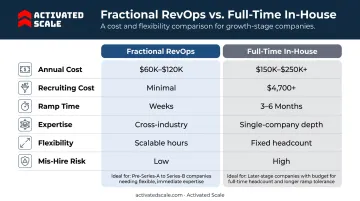
Fractional RevOps vs. In-House Hiring: Quick Comparison
| Dimension | Fractional RevOps | Full-Time In-House |
|---|---|---|
| Annual Cost | ~$60K–$120K | ~$150K–$250K+ all-in |
| Recruiting Cost | Minimal to none | ~$4,700+ average cost per hire (SHRM) |
| Ramp Time | Weeks | 3–6 months |
| Expertise Breadth | Cross-industry pattern recognition | Deep single-company knowledge over time |
| Flexibility | Hours scale up or down | Fixed headcount commitment |
| Risk of Bad Hire | Low — engagement is scoped and adjustable | High — especially at the senior level |
Who fits where: Fractional RevOps suits Seed to Series A companies, founder-led revenue teams, and organizations still defining what RevOps should look like. In-house hiring makes more sense post-Series B, once you have 40+ revenue team members and a complex, multi-function scope that needs daily embedded ownership.
What Is Fractional RevOps?
Fractional RevOps is senior revenue operations expertise delivered on a part-time or project basis. It operates at the strategic layer — pipeline governance, GTM alignment, revenue architecture — not task execution or CRM ticket work.
In practice, a company pays a monthly retainer or project fee for a defined set of hours, gaining access to a seasoned RevOps professional without adding permanent headcount. The engagement is scoped, measurable, and adjustable as the business evolves.
What a Fractional RevOps Engagement Covers
A well-structured fractional engagement typically addresses:
- Sales and marketing alignment — shared definitions, handoff points, and attribution logic
- CRM strategy and data governance — setup plus the ongoing rules that keep data clean over time
- Forecasting and pipeline visibility — building the cadences and categories that make revenue predictable
- Tech stack decisions — evaluating tools against actual needs, not vendor promises
- Cross-functional reporting — giving leadership a unified view of the revenue pipeline
Gartner's 2024 RevOps framework defines this function as an end-to-end model that integrates people, processes, and technology across sales, marketing, and customer success — not a renamed version of sales ops.
When Fractional RevOps Delivers the Most Value
The model works best at inflection points where strategic clarity is urgent but full-time commitment isn't justified:
- Immediately post-funding, when board-level forecasting credibility is suddenly required
- Before the first AE hire, when pipeline visibility doesn't yet exist
- During leadership transitions, when RevOps ownership has lapsed
- When RevOps strategy is undefined and the company needs to figure out what "good" looks like before building toward it
Use Cases Worth Knowing
These inflection points play out in predictable ways. Here's what they look like in practice:
A Series A startup just raised $8M with no defined pipeline methodology and no reliable data. Investors want a credible forecast at the next board meeting. A fractional RevOps engagement scopes the CRM, builds the forecast model, and delivers board-ready reporting within weeks — not quarters.
A founder at $1.5M ARR is personally managing the CRM and running pipeline reviews in a spreadsheet. Before the first AE hire, they need real visibility into the funnel. Fractional RevOps builds that foundation so the first rep inherits a functional system.
A company knows it needs a full-time RevOps Manager but can't define what the role should own. A 90-day fractional engagement surfaces the biggest gaps and produces a job description grounded in actual operational data — not guesswork.
What Is In-House RevOps Hiring?
Bringing on a full-time RevOps professional (typically a Manager or Director) means one person owns all revenue operations exclusively for your company. Over time, they accumulate deep institutional knowledge. In the first six months, they're still learning how your business works.
At early-stage B2B SaaS companies, this person is usually a team of one. Their scope spans:
- CRM ownership and administration
- Building and maintaining reporting infrastructure
- Sales and marketing process alignment
- Forecasting cadence management
- Revenue tech stack ownership
When In-House Makes Sense
Full-time RevOps hiring earns its cost when:
- The company has crossed 40+ revenue team members or $50M+ ARR, where RevOps decisions happen daily and require someone embedded in leadership conversations
- The role has a fully defined, permanent scope that would occupy someone 40+ hours per week without question
- Revenue operations is a genuine competitive differentiator — something that requires consistent, long-term ownership to maintain an edge
Below that threshold, you're often paying full-time cost for part-time need.
True Cost Comparison: What You're Actually Paying For
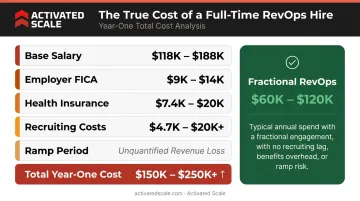
Salary is the number most founders anchor on. The real cost is much higher once you account for taxes, benefits, recruiting, and the months it takes a new hire to operate at full speed.
Full-Time In-House: The Full Cost Stack
According to the 2024 Revenue Operations Alliance community survey, average North American base salaries run $118,097 for a RevOps Manager and $170,779 for a Senior RevOps Manager. The VP/Director category averages $187,973.
Add the costs most hiring managers underestimate:
| Cost Component | Estimated Annual Impact |
|---|---|
| Base salary (Manager level) | ~$118,000–$188,000 |
| Employer FICA (6.2% SS + 1.45% Medicare) | ~$9,000–$14,000 |
| FUTA (6% on first $7,000) | ~$420 |
| Health insurance (employer share of ~$9,325 single premium per KFF's 2025 survey) | ~$7,400–$20,000 |
| Recruiting costs (SHRM benchmark: ~$4,700 average cost per hire) | ~$4,700–$20,000+ |
| Ramp time (reduced output for 3–6 months) | Real, unquantified revenue cost |
All-in, a RevOps Manager hire at the mid-level commonly runs $150,000 to $250,000+ in year one before accounting for ramp-period productivity loss.
Fractional RevOps: What the Market Looks Like
Fractional RevOps engagements typically structure around:
- Monthly retainers: $5,000–$10,000/month for strategic-only work; $8,000–$15,000/month when execution is included
- Project-based pricing: One named provider, On The Fly Ops, lists a RevOps Blueprint at $6,500 as a one-time project engagement covering lifecycle mapping, CRM logic audit, attribution review, and a roadmap handoff
Annual spend on a retainer model lands in the $60,000–$120,000 range, with no recruiting cost, no benefits overhead, and no ramp period.
The Risk Most Founders Underestimate
A bad full-time RevOps hire doesn't just cost money — it costs months. Recognizing the mis-hire, managing the exit, reopening the search, and ramping a replacement typically runs 6–12 months end-to-end. For an early-stage company, that's a real chunk of runway spent standing still.
Fractional engagements sidestep that risk. You define the scope upfront, measure output against clear deliverables, and if the fit isn't right, you adjust without a severance negotiation.
Speed to Value
A fractional RevOps engagement can surface quick wins — a CRM audit, a forecast framework, a pipeline stage fix — within the first two to four weeks. A full-time hire is typically still in onboarding through month three.
For Seed to Series A companies, that gap has direct revenue consequences.
Which Model Fits Your Stage? A Decision Framework
Answer these questions before you decide:
- What is your current ARR and revenue team size? Below $10M ARR with fewer than 15 revenue team members, full-time RevOps is rarely the right first move.
- Do you have enough defined scope to fill 40 hours a week? If you're uncertain, the answer is probably no.
- Is the RevOps role clearly defined, or are you still figuring out what it should own? If the latter, a fractional engagement defines the role before you hire for it.
- How quickly do you need results? Fractional wins on speed. Full-time wins on depth over time.
- Can your runway absorb a mis-hire? If not, de-risking the hire matters as much as the hire itself.
Situational Recommendations
Choose fractional if:
- You're Seed to Series A with a lean revenue team
- You need strategic RevOps without fixed payroll overhead
- You want to define the role before committing to a full-time hire
- You're VC or PE-backed and prefer OpEx flexibility over fixed headcount
Choose in-house if:
- You're past $50M ARR with 40+ revenue team members
- RevOps decisions require someone embedded in daily leadership operations
- The role's scope is fully defined and complex enough to occupy someone entirely
The Hybrid Path
For most scaling companies, the lowest-risk sequence looks like this:
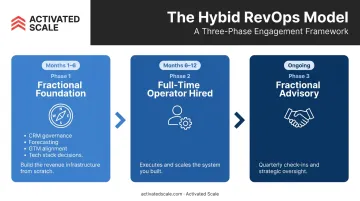
- Months 1–6: Engage fractional RevOps to lay the strategic foundation — CRM governance, forecasting framework, GTM alignment, tech stack decisions
- Months 6–12: Hire a full-time RevOps operator to execute and scale what's been built
- Ongoing: Fractional partner transitions to advisory or quarterly check-in role
The fractional engagement produces the job description and the operational baseline. The full-time hire inherits a working system instead of starting from scratch.
Why the First Standalone Hire Often Underperforms
The first dedicated RevOps hire at an early-stage company frequently struggles. It's rarely a skill problem. More often, they lack institutional context, peer accountability, and the organizational authority to push back on leadership decisions that create operational problems. A fractional engagement builds the foundation and helps define what seniority and scope the eventual full-time hire actually needs.
The same logic applies to your sales function. Activated Scale offers a try-before-you-buy model for fractional sales talent, giving you access to vetted, experienced sales professionals on a contract basis before committing to a full-time hire. Companies like Tango have used this approach to build their entire GTM strategy fractionally before scaling headcount — a natural complement to a fractional RevOps strategy.
Conclusion
Neither model is universally better. The right choice depends on where the company actually sits — not where it's headed in 18 months.
- Fractional RevOps delivers on cost, speed, and strategic clarity without full-time overhead
- In-house RevOps earns its keep through daily embedded ownership and institutional depth, once the company is large enough to justify it
For most B2B SaaS startups at the Seed to Series A stage, starting fractional is the smarter financial bet. It builds the operational foundation, reduces mis-hire risk, and keeps runway intact while the revenue engine takes shape. When the company grows into a full-time need, the fractional engagement has already done the work of making that hire more likely to succeed.
Match the model to where the company is now, not where it hopes to be.
Frequently Asked Questions
What is fractional RevOps?
Fractional RevOps is senior revenue operations expertise delivered on a part-time or project basis. It covers strategy, pipeline governance, CRM structure, and GTM alignment — without the cost or commitment of a full-time hire.
When should a company hire RevOps — full-time or fractional?
Fractional typically fits Seed to Series A companies, or those still defining what the RevOps role should own. Full-time makes sense once ARR and team complexity justify a dedicated operator — generally past $50M ARR or 40+ revenue team members.
How much does fractional RevOps cost?
Monthly retainers typically run $5,000–$15,000 depending on scope, putting annual spend around $60,000–$120,000. By comparison, a full-time in-house hire including salary, employer taxes, benefits, and recruiting commonly reaches $150,000–$250,000+ in year one.
How does RevOps help companies scale?
RevOps aligns sales, marketing, and customer success around shared data, processes, and goals — reducing friction, improving forecast accuracy, and creating a repeatable revenue motion as the company grows.
What is the hybrid RevOps model?
The hybrid model pairs a fractional RevOps leader for strategic direction with a full-time operator for execution — typically brought in after the fractional engagement has established the foundation. It allows companies to build operational capability without stalling progress during the full-time search.
How is RevOps different from marketing and sales?
RevOps sits between sales and marketing, not inside either function. It enforces shared definitions, clean data, aligned incentives, and a unified pipeline view — so both teams spend less time reconciling numbers and more time closing revenue.