

Introduction
Most founders underestimate how different hiring a salesperson is from any other hire. A bad engineering hire slows your product. A bad sales hire burns runway, damages early customer relationships, and can set your growth back by quarters — not weeks.
The dynamics are genuinely different. Sales candidates are skilled at selling themselves. Early-stage startups have none of the infrastructure that enterprise salespeople depend on. And the stakes of getting it wrong are highest exactly when you can least afford it: before product-market fit.
This guide is written for Seed to Series A founders — particularly those without a sales background — who are trying to build their first revenue team. By the end, you'll know when to hire, who to hire first, what to screen for, and which mistakes burn the most runway.
Key Takeaways
- Close your first 10–20 customers yourself before making any sales hire
- Hire a full-cycle AE who can prospect and close — not a VP of Sales
- Startup fit matters more than brand-name experience
- Fractional and contract-to-hire arrangements let you test the sales motion before committing full-time
- Reference checks with former managers (not peers) reveal what polished interviews hide
Why Sales Hiring Looks Different at a Startup
Enterprise salespeople are trained to work within systems. They get inbound leads from marketing. They have SDRs filling their pipeline. They sell behind a brand that opens doors. At a startup, none of that exists, and the adjustment is harder than most candidates admit upfront.
The Startup Sales Environment Is Different by Design
When a rep joins a startup, they face a completely different set of demands:
- Starting without a playbook, territory, or existing pipeline
- Adapting the pitch week to week as the product evolves
- Handling objections without a marketing team or case studies to lean on
- Building their own cadences, tracking their own deals, and figuring out what works as they go
The a16z piece on enterprise startup hiring documents this concretely. Gong hired three senior enterprise salespeople to pursue an upmarket motion. Eighteen months later, most of those deals had fallen out of the funnel.
Senior sellers alone couldn't replace a clear go-to-market commitment and a product that was ready for that market.
The Cost of Getting This Wrong
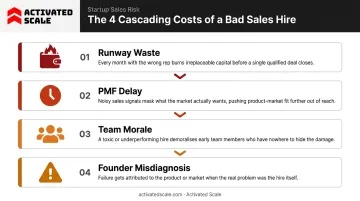
A bad sales hire at a startup doesn't just hurt pipeline. It:
- Wastes runway on salary, tools, and onboarding before the person is let go
- Delays product-market fit validation by months while you wait for results that never come
- Can demoralize the founding team when the hire underperforms despite genuine effort
- Sometimes causes the founder to conclude "sales doesn't work" rather than recognizing the real problem was premature or mismatched hiring
When Is the Right Time to Hire Your First Salesperson?
Close 10–20 Customers Yourself First
Jason Lemkin at SaaStr recommends that founders close at least 10–20 customers themselves before bringing in a dedicated salesperson. This isn't arbitrary — it's how you learn what actually needs to be taught.
By the time you've closed 10–20 customers, you'll know:
- Which customer profiles actually convert
- What objections come up every single time
- What the real sales cycle looks like (not what you assumed)
- Why customers buy — in their own words
Without this knowledge, a new sales hire is walking into a room with no map. They'll flounder, fail, and leave — and you'll have spent 6 months of runway learning that your ICP still isn't defined.
Signals That Indicate You're Ready
You're ready to hire your first salesperson when:
- Inbound interest is arriving consistently and you can't keep up
- Deals have closed that weren't driven by the founder's personal relationships
- You can describe your ICP, value proposition, and typical sales cycle clearly to a stranger
- The product reliably delivers on what you're promising to customers
Think of it as a documentation test: if you couldn't hand someone a one-pager and have them run a decent discovery call, the process isn't ready to scale yet.
The Capacity Trigger
Meeting the readiness signals above is necessary — but not always sufficient. Even with a repeatable process, there's a hard capacity ceiling.
Prospecting, demos, follow-up, and contract negotiation can easily fill a 40-hour week at moderate volume. When sales work is regularly pushing out product decisions or strategic work that only you can do, that's a concrete signal to bring someone in.
The Runway Requirement
Early sales hires need 6–9 months to ramp and produce measurable results. Don't hire as a last-ditch effort to save a struggling company. Hire when you have sufficient runway to give the role a fair shot — and still have time to course-correct if the first hire doesn't work out.
What Sales Roles Should a Startup Hire First?
The Three Common Options
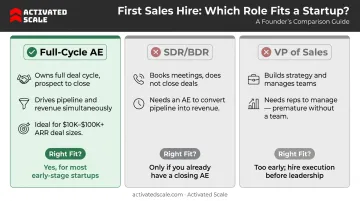
| Role | What They Do | Right Fit? |
|---|---|---|
| Full-cycle AE | Prospects, demos, and closes independently | ✅ Usually the right first hire |
| SDR/BDR | Generates pipeline but doesn't close | ❌ Too narrow — you need revenue, not just meetings |
| VP of Sales | Manages, forecasts, builds teams | ❌ Premature at most seed-stage companies |
Why a VP of Sales Is Usually the Wrong First Hire
OpenView's research indicates the VP Sales role is designed for growth and scale — not for launching a business. They suggest considering this hire after roughly $1M ARR, typically in year three for fast-growth SaaS companies.
The pattern is consistent: VP of Sales hires at early-stage startups frequently exit within 12–19 months. The mismatch is structural. Senior leaders from large companies expect brand recognition, established processes, and support staff. When those don't exist, the best candidates disengage and the ones who accept the role often lack the hands-on execution the company actually needs.
Start With a Full-Cycle AE
At the earliest stages, you need someone who can prospect and close — not someone who manages people who prospect, or someone who only prospects. A full-cycle seller who can run the entire motion solo is almost always the right first hire.
Look for someone who has worked at an early-stage company before, generates their own pipeline, and doesn't expect a marketing team to hand them leads.
Consider Fractional Before Going Full-Time
Before committing to a $120K+ full-time salary, consider engaging an experienced fractional sales professional to validate the motion and generate revenue first.
That's the model Activated Scale is built around — connecting B2B SaaS startups with vetted, US-based fractional sales talent from companies like Salesforce, Zendesk, and MongoDB.
Windsor used this approach to test their sales motion without a permanent hire. Their fractional AE increased average deal size 4x (from under $1.00 per video to $2.00–$2.50) before the company made any permanent hiring decisions.
The try-before-you-buy aspect extends beyond testing: 40% of Activated Scale's clients hire their fractional talent full-time after the initial engagement, making it a natural on-ramp to a permanent hire.
When to Graduate to a VP
Hire a VP or Head of Sales when:
- You have 2–3 AEs consistently producing
- You need someone to manage, forecast, and build process
- The problem is scale, not discovery
What to Look For in a Startup Sales Hire
Not every strong salesperson thrives at a startup. Before anything else, screen for the traits that predict performance in resource-constrained, fast-changing environments.
Non-Negotiables First
Comfort with ambiguity is the single trait that separates startup-ready salespeople from everyone else. You can probe for it directly in interviews:
- "Tell me about a time you built a sales process or territory from scratch."
- "How did you generate your own pipeline at your last company?"
- "What did you do when the messaging changed mid-quarter?"
Candidates who reference playbooks, SDR support, or brand pull as essential to their success are telling you something important.
Startup Experience Beats Brand-Name Experience
Someone who sold at Salesforce with a full SDR team, mature brand, and warm inbound leads will often struggle in an environment where they face "Who are you?" every day.
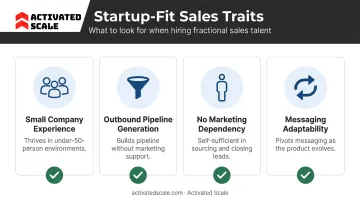
Prioritize candidates who have:
- Worked at companies with fewer than 50 people
- Generated their own outbound pipeline
- Sold without established marketing support
- Adapted messaging when the product changed
Coachability and Adaptation Speed
At an early-stage company, the product and pitch change constantly. The best startup salespeople treat those changes as information, not disruption. Ask candidates to describe a time when they had to rapidly adapt to new messaging or a new market — and listen for whether they led the change or just survived it.
Ask candidates to describe a time when they had to rapidly adapt to new messaging or a new market — and listen for whether they led the change or just survived it.
A useful follow-up: "Walk me through how you updated your pitch when the product shifted. What did you do differently in week one versus week four?"
Evaluate Actual Skills, Not Just Resumes
Include a practical component in your hiring process. Effective formats include:
- A mock discovery call with you or a team member playing the prospect
- A short pitch exercise based on your actual product
- Asking the candidate to build a 5-step outreach sequence targeting your ICP
Resumes predict how someone interviews. Interviews predict whether they'll accept the offer. Neither tells you whether they can actually sell your product to your buyers — a practical exercise does.
How to Structure Your Startup Sales Hiring Process
Defining the Role Before You Post
Before writing a job description, define what success looks like at 30, 60, and 90 days — in terms of specific pipeline and revenue outputs, not activity metrics. Not "made 50 calls per week" but "sourced 10 qualified opportunities and closed 2 deals by month three."
This clarity does two things: it attracts candidates who are outcome-oriented, and it gives you an objective framework to evaluate performance after they start.
Running a Lean, Fast Interview Process
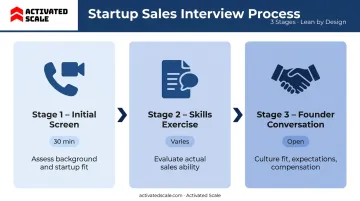
Top sales candidates have multiple offers and won't wait six weeks for a decision. A three-stage process works well for startups:
- Initial screen (30 min) — assess background, startup fit, motivation
- Skills exercise — mock call, pitch, or outreach sequence
- Founder conversation — culture fit, expectations, compensation discussion
Move fast. A drawn-out process signals disorganization — and the best candidates will accept another offer before you reach stage three.
Compensation Structure Basics
Once you're ready to make an offer, compensation structure becomes the deciding factor. Startup sales pay is typically structured as base salary + variable performance pay, with OTE (On-Target Earnings) as the number candidates benchmark against.
Current benchmarks from Betts Recruiting's 2024 data and the Bridge Group's 2024 B2B SaaS AE report:
- Entry SDRs: $50K–$65K base (US tech market)
- AEs: Median $190K OTE, split approximately 53% base / 47% variable
Note: these benchmarks reflect the broader US tech market, not exclusively Seed-to-Series-A companies. Early-stage startups often offer slightly below-market base in exchange for higher incentive upside or meaningful equity.
Common Sales Hiring Mistakes Startups Make
Hiring for Pedigree Instead of Fit
A Salesforce logo on a resume isn't a predictor of startup success — it may actually predict failure. Candidates from high-brand companies with full support infrastructure often have deeply embedded expectations about how sales is supposed to work. When those expectations meet a 10-person startup reality, the friction is real and usually fatal to the hire.
Evaluate for what the candidate actually did, not where they did it.
Skipping Reference Checks
Sales candidates are skilled at impression management — it's literally their job. Reference checks, particularly with former direct managers rather than peer references chosen by the candidate, can surface patterns that interviews won't reveal.
Three questions worth asking every reference:
- "How would you describe this person's approach when they didn't have marketing support or established leads?"
- "How did they handle a situation where the product or messaging changed significantly?"
- "Would you hire them again — and into what kind of environment?"
The answers to question three are often more revealing than anything else in the hiring process.
Rushing to Full-Time Before the Motion Is Proven
Many startups burn significant runway on a full-time sales hire before their outbound motion is validated, only to let the person go six months later with little to show for it. The failure often isn't the person — it's the timing.
The fractional or contract-to-hire path lets you answer the critical question first: does our sales motion work at all? Once you can answer yes, you have a much clearer brief for who to hire and what you're asking them to do.
Dresma.ai came to Activated Scale without a repeatable outbound strategy and left with a 5x increase in qualified prospect meetings. Scholar's App's founder noted their fractional hire outperformed their previous full-time employee. The pattern holds: validate the motion first, then hire to scale it.
Frequently Asked Questions
When should a startup make its first sales hire?
After the founder has closed at least 10–20 customers directly and can clearly articulate the ICP, value proposition, and sales cycle. The key readiness signals are a repeatable (if informal) process, closed deals that weren't relationship-driven, and enough runway to give a new hire 6–9 months to ramp.
What is a fractional salesperson and how does it work for startups?
A fractional sales professional works part-time or on a contract basis, giving startups access to senior talent without a full-time salary commitment. Activated Scale's try-before-you-buy model lets founders evaluate a seller's performance in a live environment before deciding whether to convert them to full-time.
How much does it cost to hire a salesperson for a startup?
Entry SDRs typically run $50K–$65K base in the US tech market. AE OTE at B2B SaaS companies has a 2024 median of approximately $190K, split roughly 53% base and 47% variable. Fractional arrangements lower upfront cost considerably — Activated Scale fractional AE engagements run $6,500 per month plus performance pay.
Should founders stop selling when they hire a salesperson?
Not immediately. Founders should stay actively involved during the early ramp period — co-selling on key deals, transferring knowledge about objections and buyer personas, and refining the playbook together. Gradually hand off execution as the hire ramps and the process gets documented.
What's the biggest mistake startups make when hiring salespeople?
Hiring before the sales motion is defined. When a startup brings on a full-time salesperson before they understand their ICP, their pitch, or their sales cycle, the hire almost always fails — and the startup draws the wrong conclusion about whether sales works at all.
How long does it take to hire a salesperson for a startup?
Traditional hiring timelines run 4–8 weeks for a direct search. That can be compressed significantly with a clear role definition and a fast, focused interview process. Platforms like Activated Scale can connect startups with vetted fractional candidates in 7 days or less, allowing founders to validate the sales motion quickly rather than waiting months to start learning.