The problem isn't finding salespeople. It's finding the right model to hire them — one that matches your budget, timeline, and risk tolerance at the Seed or Series A stage.
This post compares three approaches: traditional staffing agencies, Betts Recruiting, and Activated Scale. We'll break down cost, speed, candidate quality, and what happens when things go sideways — so you can make a clear decision before your next hire.
Key Takeaways
- Traditional staffing agencies charge 20–25%+ of first-year salary — $20K–$30K per hire — with no performance obligation after placement
- Betts Recruiting specializes in GTM roles but uses the same contingency model, making it expensive for budget-constrained early-stage startups
- Activated Scale offers a contract-to-hire model starting at $3,000–$3,500/month, with placements in 7 days or less and no fee if you don't convert
- For Seed-to-Series A founders, speed, flexibility, and runway alignment matter as much as talent access
Three Ways to Hire Sales Talent: What Each Model Actually Means
Each hiring model works differently — and what you're paying for (and what you're not) varies more than most founders expect.
Traditional Staffing Agencies
Traditional staffing firms — whether generalist or sales-focused — source candidates, present a shortlist, and collect a fee when you make a hire. Two fee structures are common:
- Contingency: You pay only on successful placement
- Retained: You pay an upfront engagement fee regardless of outcome
Either way, the agency's obligation ends at the hire. There's no ongoing accountability for whether the person actually performs.
Betts Recruiting
Founded in 2009 by Carolyn Betts Fleming, Betts is a GTM-specialized recruiting agency focused on sales, marketing, and customer success roles in tech. They operate primarily in major US tech hubs, and offer two products: traditional contingency-based recruiting and Betts Connect, a self-service talent platform with pre-vetted candidates.
Activated Scale
Activated Scale is a fractional and contract-to-hire sales talent platform built specifically for B2B SaaS startups. Founders get access to a network of 300+ pre-vetted US-based sales professionals — SDRs, Account Executives, and fractional VPs of Sales — drawn from companies like Salesforce, Oracle, IBM, Zendesk, Datadog, and ZoomInfo. Engagements start on a fractional contract basis, with the option to convert to full-time once fit is confirmed.
Cost Breakdown: What You Actually Pay With Each Model
The cost structures across these three models are radically different — and for early-stage founders, the difference can be six figures.
Traditional Staffing Fees
Contingency fees typically land between 20–25% of first-year base salary, based on BountyJobs marketplace data showing an average direct-hire agency fee of around 20–21.3%, with fees at or above 25% representing 35% of all marketplace placements.
For a $100K base AE:
- 20% fee = $20,000
- 25% fee = $25,000
Retained search adds another layer: firms like J. Patrick structure retained fees at 30–35% of first-year total cash compensation, billed in thirds — one-third at signing, regardless of whether a placement occurs.
Betts Recruiting Fees
Dover's 2026 review of Betts reports a contingency fee of 15–25% of first-year salary. Using their three-hire model scenario — a Sales Manager, Marketing Manager, and Customer Success Manager — the total fees land between $48,750 and $81,250. For a Series A company with 12–18 months of runway, that's a significant budget line.
Betts Connect, their subscription platform, reportedly costs around $2,000/month or $20,000/year per third-party sources. Betts doesn't publish pricing directly — you have to request it, which creates budget uncertainty at exactly the stage when founders need predictability most.
Activated Scale Pricing
Activated Scale structures pricing as a monthly retainer, not a lump-sum placement fee:
| Role | Monthly Range | Commission |
|---|---|---|
| Fractional SDR/BDR | $3,000–$3,500/month | Performance-based |
| Fractional AE | $3,500–$6,000/month | Performance-based |
| Fractional VP of Sales | $8,000–$12,000/month | Bonus-based |
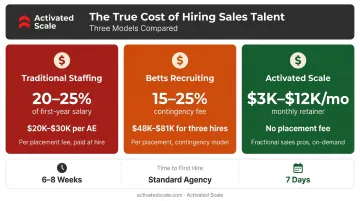
The entry point is $3,000/month for an SDR — with no placement fee, no termination fee, and free rematching if the fit isn't right. You only convert to full-time when you're confident. That's a different financial structure than writing a $25,000 check on day one.
The Hidden Cost: Vacant Seat = Lost Quota Capacity
The real cost of any hiring model includes what you're not generating while the seat stays empty. According to The Bridge Group's 2024 SaaS AE Benchmark Report, the median annual ACV quota for a SaaS AE is $800K — roughly $66,700/month in quota capacity per open seat. A 60-day search delay alone represents over $130K in untapped pipeline potential.
The placement timeline makes that math concrete:
- Traditional agencies: 6–8 weeks average to place
- Activated Scale: 7 days or less
A 7-week gap at $66,700/month isn't a minor inconvenience — it's roughly $116,000 in pipeline capacity you're not building.
Speed and Candidate Quality: Who Delivers Faster, Better Talent?
Time-to-Hire Comparison
- Traditional staffing: Typically 6–8 weeks from brief to offer, depending on seniority and market
- Betts Recruiting: Follows standard agency timelines; no published time-to-place figures
- Activated Scale: 7 days or less — sometimes within 48 hours — enabled by a pre-vetted network of 300+ professionals who are already screened and ready
The speed difference isn't marketing. It's structural. Traditional agencies start sourcing after you brief them. Activated Scale matches from a qualified pool that already exists.
Candidate Pedigree and Vetting Depth
This matters especially at the Seed stage, when you can't afford a hire who needs 6 months to figure out your product, buyer, and motion.
Betts brings genuine GTM network depth in major tech hubs and long-standing relationships in those markets. For companies in those geographies with Series B+ budgets, that relationship capital translates to faster warm introductions and candidates who already know the local talent scene.
Activated Scale draws from professionals with backgrounds at Salesforce, Oracle, IBM, Zendesk, Datadog, ZoomInfo, MongoDB, Intuit, and UiPath. Matching goes deeper than résumé logos: candidates are selected based on prior experience selling to similar buyer personas and comparable ACV ranges, so a placed AE has already navigated deals like yours before showing up on day one.

Roboflow's co-founder Joseph Nelson put it directly: "They dug through their personal network to find Roboflow's first sales hires. They're incredibly thoughtful with candidates, which creates a strong candidate experience."
Dresma.ai achieved a 5X increase in meetings with qualified prospects after engaging a fractional SDR through Activated Scale. Flock Homes' fractional SDR averaged 14 new meetings per month over a six-month period. Both outcomes trace back to the same cause: placing professionals who already knew how to sell in B2B SaaS environments before their first week on the job.
Risk and Flexibility: What Happens When the Hire Doesn't Work Out?
Hiring risk is underappreciated until it's personal. Here's how each model handles failure.
Traditional Staffing: The 90-Day Illusion
Most contingency agencies offer a 30–60–90 day replacement guarantee. If the hire fails, they'll find you another candidate. What they won't give back is the time — 3+ months of delayed pipeline, missed quota, and a team that had to absorb the gap. SHRM notes that bad hiring decisions can cost hundreds of thousands of dollars when recruiting, onboarding, and productivity loss are factored in.
The contingency model also front-loads your financial exposure. You pay the full fee at hire — before a single deal closes.
Betts Recruiting: Low Upfront, But Not Low Risk
No placement, no fee sounds attractive. But when a placement happens, you pay 15–25% in full immediately, with no performance contingency attached. Dover's review flagged inconsistent communication and service quality variation in user reviews — a real liability when your entire hiring outcome rests on one recruiter relationship at an early growth stage.
Activated Scale: Try-Before-You-Buy
Activated Scale's contract-to-hire model is designed around a simple premise: don't pay a full-time hiring premium until you know the person works.
Key risk mitigations:
- Monthly retainer structure — no large upfront placement fee
- No termination fees — exit the engagement if it's not working
- Free rematching — Activated Scale replaces the professional at no additional cost
- Proven match quality — 80% of clients continue working with their placed talent for 5+ months
Founders also save 20+ hours per hire on interviewing, since vetting happens before candidates reach you. Docvocate's founder described the experience this way: "Activated Scale helped us bring on an experienced salesperson. The speed with which we got her was exceptional. Not only did she have the experience selling to our buyer, but she could hit the ground running."
That speed advantage extends to flexibility, too. Traditional agencies are transactional — each new hire requires a new search and a new fee. Activated Scale's fractional model lets founders add, pause, or convert talent as the sales motion evolves. At the Seed-to-Series A stage, what you need in month three often looks nothing like what you needed in month one.
Which Hiring Model Is Right for Your B2B SaaS Startup?
Traditional Staffing: Best For...
Companies with established HR infrastructure, larger hiring budgets, and roles outside GTM or technical sales. If you're hiring for an ops or administrative role, traditional contingency search works fine. For an early-stage SaaS founder building a first sales motion from scratch, it's a poor fit — too expensive, too slow, and too disconnected from the SaaS sales context.
Betts Recruiting: Best For...
Series B+ startups that have capital to absorb 15–25% contingency fees across multiple GTM hires, a preference for agency relationships in specific tech hubs, and the hiring volume to justify the cost. If you're filling five GTM roles simultaneously in a major tech hub, Betts' network and specialization have genuine value. For a Seed-stage founder making their first or second sales hire, the fee structure doesn't fit the runway math.
Activated Scale: Best For...
Seed-to-Series A B2B SaaS companies that need to move fast without overextending budget. It's the right fit if you:
- Need revenue-generating sales talent placed within days, not months
- Want to validate a hire on contract before committing to full-time employment
- Are working with lean runway where a single bad placement sets back growth
- Need professionals who already understand your buyer and deal motion
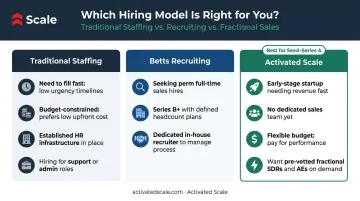
You pay as you go, convert only when confident, and skip the 15–25% contingency fee entirely. Companies like Roboflow, Momence, and SafeOps used this approach to build early sales teams without locking in headcount prematurely.
If that matches where you are, start by exploring Activated Scale's hiring options — placements start within 7 days, and the first step is a free 30-minute consultation.
Frequently Asked Questions
What is the most underutilized metric in recruiting?
Revenue-Per-Hire — measuring how much ARR or quota a placed sales professional is expected to generate — most HR teams never track. For GTM roles, it's the most direct measure of recruiting ROI and more actionable than cost-per-hire alone.
What is the 70/30 rule in hiring?
The 70/30 rule suggests hiring managers should move forward when a candidate meets roughly 70% of role requirements. It shortens time-to-hire and opens access to high-potential candidates who can grow into the remaining gap.
How quickly can Activated Scale place a sales professional?
Activated Scale connects founders with vetted sales talent in 7 days or less — sometimes within 48 hours. This speed comes from a pre-vetted network of 300+ US-based B2B SaaS sales professionals who are ready to engage before the matching process even begins.
What is the difference between fractional sales talent and traditional staffing?
Traditional staffing places full-time employees for a one-time contingency fee. Fractional sales talent, as offered by Activated Scale, engages experienced professionals on a part-time or contract basis — letting startups generate revenue without the full cost or commitment of a permanent hire.
Is a contract-to-hire model more expensive than direct hiring in the long run?
The monthly retainer rate can look higher than a pro-rated salary, but it eliminates the risk of a costly mis-hire. Industry estimates put bad hiring decisions in the hundreds of thousands of dollars — making the contract-to-hire model more economical for early-stage startups over the full hiring cycle.