Before you make your first sales hire, you need to understand what an SDR (Sales Development Representative) actually does versus what you assume they do. Get this wrong, and you'll waste a salary, hire the wrong person, or build a sales process that breaks the moment you scale it.
This article breaks down what SDRs actually do day-to-day, how the role fits into a lean startup sales motion, and when it makes sense to bring one on. No fluff, just what founders need to know before writing a job description or signing a contract.
Key Takeaways
- Founders and closers save time when SDRs qualify prospects before handing off sales-ready conversations
- SDRs, BDRs, and AEs serve different functions, each measured by distinct success metrics
- Most B2B startups don't need a full-time SDR until they have a repeatable process worth scaling
- A bad early SDR hire costs Seed to Series A founders months of runway and pipeline momentum
- Fractional or contract-to-hire hiring lets founders test the SDR function before a full-time commitment
What Is an SDR, and What Do They Actually Do?
An SDR is a sales professional responsible for prospecting and qualifying leads at the very top of your sales funnel. Their job is to fill your calendar with sales-ready conversations for someone else to close.
The Bridge Group's 2023 study of 365 B2B companies describes sales development teams as groups chartered with inbound qualification, outbound prospecting, or both [1]. That's the job in one sentence.
The outcome an SDR produces: a steady flow of qualified meetings for a closer (that's you, or your first Account Executive). Salesforce draws a clear line here: development reps generate and qualify opportunities and book meetings, while the Account Executive uses those opportunities to close [8].
Core Day-to-Day Activities
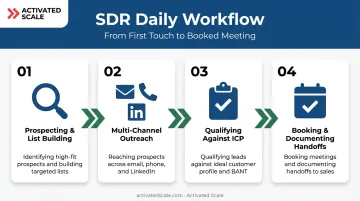
An SDR's week typically breaks down into:
- Prospecting and list-building: researching accounts and contacts that match your ideal customer profile
- Multi-channel outreach: sequencing email, calls, and LinkedIn touches to engage cold prospects
- Qualifying against your ICP: confirming budget, authority, need, and timeline (the classic BANT framework)
- Booking and documenting handoffs: scheduling the meeting and briefing the closer on context
What "Qualifying" Actually Means
Qualifying follows a structured filter, not a gut check. Before booking a meeting, a good SDR confirms the prospect has a real pain point, some authority (or access to it) to make a decision, and a timeline that isn't three years out.
In most early-stage startups, this role doesn't exist as dedicated headcount. The founder does it, blended with everything else. That changes once you have more qualified conversations to have than hours in the day.
Why B2B Startups Need an SDR Function
Here's the core problem: founders and early salespeople can't prospect, qualify, and close at the same time without something suffering. Usually it's pipeline quality.
Specialized qualification works. In a Gartner Peer Community study of 100 sales managers and executives, 88% rated SDR prospecting as very or somewhat effective [22]. The same study found the two most common handoff conditions were confirming the prospect's pain points (68%) and getting explicit confirmation of interest (61%) [22].
What Goes Wrong Without This Function
Skip a dedicated qualification step, and you'll likely see:
- Founders burning hours on calls with prospects who were never going to buy
- Inconsistent pipeline that spikes and disappears depending on how busy the founder is
- Missed follow-ups because nobody owns the top of the funnel
- No forecastable pipeline to show investors
That missing forecastable pipeline matters most for venture-backed B2B SaaS companies. Boards want predictable, forecastable pipeline. A proper SDR motion — even a lean one — is what makes that predictability possible.
This matters because it protects the scarcest resource in an early-stage company: founder time. Every hour a founder spends chasing unqualified leads is an hour not spent closing, building product, or fundraising.
How the SDR Process Works: From Prospect to Qualified Meeting
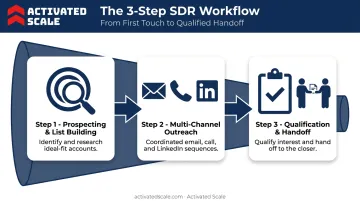
At a high level, the SDR workflow looks like this: source a list, engage prospects across channels, filter for genuine fit, and hand off to a closer. Three ingredients make this work:
- An ideal customer profile (ICP) defining who's worth pursuing
- A target account and contact list built against that ICP
- Messaging built around one specific, validated pain point
During the qualifying conversation itself, SDRs ask discovery questions to confirm need, urgency, and who holds decision-making authority. SDRs track everything in a CRM, and handoff notes keep the closer informed instead of starting from zero.
Step 1: Prospecting and List Building
SDRs identify target accounts and decision-makers using LinkedIn Sales Navigator, sales intelligence platforms, and inbound lead lists. This is research work — figuring out who fits the ICP before anyone sends a single message.
Step 2: Multi-Channel Outreach
Cold prospects don't respond to one email. SDRs sequence outreach across email, phone calls, and LinkedIn touches over several days or weeks, engaging people who haven't raised their hand yet.
Step 3: Qualification and Handoff
Once a prospect responds, the SDR runs a short qualifying conversation, documents the context in the CRM, and books a meeting with notes covering budget, timeline, and who else needs to sign off, so the closer starts each call already informed.
SDR vs BDR vs Account Executive: Where Each Role Fits
Titles here are inconsistent across the industry, which trips up a lot of founders. HubSpot defines BDRs as cold-outbound prospectors and SDRs as qualifiers of warmer inbound leads [6]. Salesforce takes a different stance, noting the terms are often interchangeable, and where companies do distinguish them, the split varies by company [8].
Here's a practical way to think about it:
| Role | Primary Focus | Success Metric |
|---|---|---|
| SDR | Qualifying inbound leads | Qualified meetings booked |
| BDR | Generating outbound opportunities | Pipeline created |
| AE | Closing deals | Revenue closed |
Why should founders care about this distinction? Because unclear ownership creates muddled accountability. If your "SDR" is also expected to close, you can't measure them fairly against either function.
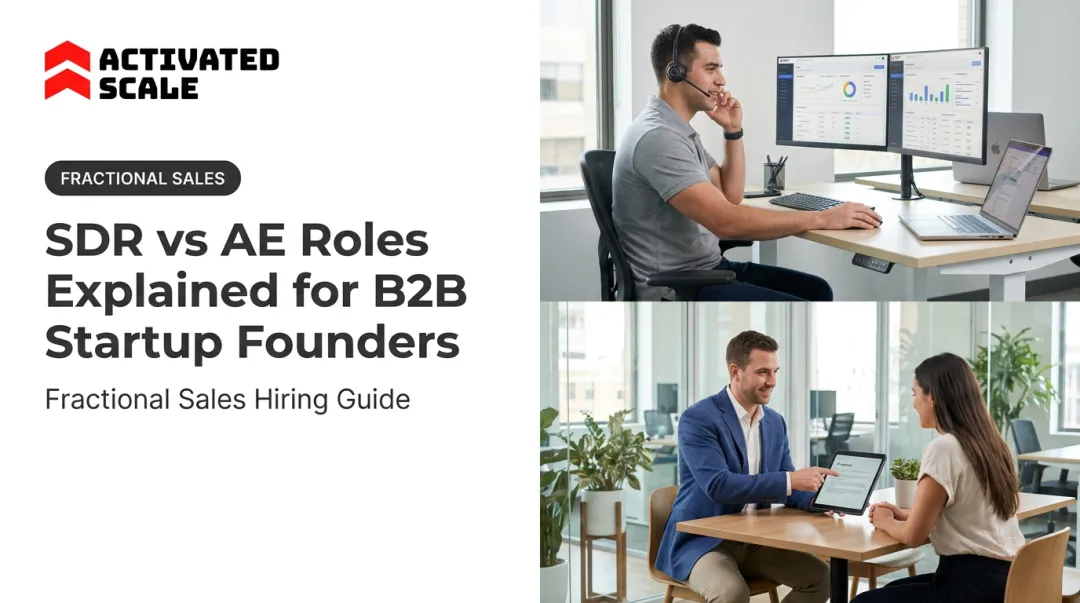
In most early-stage startups, one person (often the founder) wears all three hats until volume justifies splitting them out. That's fine, as long as you know which hat is on at any given moment. Fractional or contract-to-hire talent, like the SDRs and AEs placed through Activated Scale, lets founders test the split before hiring full-time.
When and How to Hire Your First SDR
The signal you're ready: founder-led sales is showing repeatable wins, but you no longer have enough hours to keep prospecting on top of everything else. SignalFire is direct about this — hiring an SDR before you have a repeatable process, defined ICP, and a pitch that resonates without heavy customization is a common failure pattern [25].
Check your closing capacity first. An SDR who books meetings you can't get to fast enough just creates a different bottleneck.
Two Common Paths
- Hire full-time in-house. More control, more commitment, longer time to fill. The Bridge Group reports SDR roles typically take 25-30 days to fill, followed by a ramp of roughly 3 months [75].
- Use a fractional or contract-to-hire SDR to test the function before committing to a salary and benefits package.
The risk of getting this wrong is real. A bad early sales hire doesn't just cost a salary. It costs months of runway, disrupts whatever pipeline exists, and forces you to restart the hiring clock.
This is the exact gap Activated Scale's model was built to close. Founders get connected with vetted, US-based fractional SDR talent in 7 days or less. They test fit during an initial contract period, then convert to full-time only once results are proven. It skips the 20+ hours of interviewing most founders sink into vetting candidates solo.
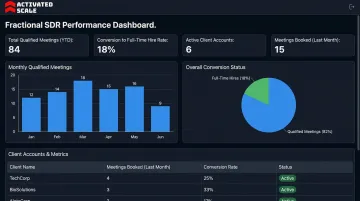
Real examples from Activated Scale's network: Flock Homes' fractional SDR averaged 14 new meetings per month over six months, and Althub's averaged 11 qualified meetings per month. Roughly 60% of Activated Scale's customers eventually convert their fractional SDR to a full-time hire, which suggests the try-before-you-buy model works more often than not.
Common Mistakes Founders Make With Early SDR Hires
Hiring before the process is validated. If you haven't personally proven the sales process and messaging work, an SDR can't fix that. They scale what exists. They don't create it from scratch.
Expecting an SDR to also close deals. This blurs qualification and closing into one job, and you lose the ability to measure either function properly. It also sets the SDR up to fail at whichever task gets less attention.
Measuring activity instead of outcomes. Sending calls and firing off emails feels productive, but activity isn't the goal. Salesforce lists booked meetings, completed meetings, and qualified leads as the metrics that actually matter [8]. Activity without qualified pipeline is just noise.
A few other pitfalls worth watching for:
- Ignoring the replacement lag if a hire doesn't work out — that's another 25-30 days to refill plus a 3-month ramp
- Hiring by title alone without specifying the actual charter (inbound vs. outbound, qualification threshold, handoff process)
- Skipping onboarding on messaging and ICP, which leads to early misalignment that's hard to unwind later
Frequently Asked Questions
What is the difference between an SDR and a BDR?
SDRs typically focus on qualifying inbound leads, while BDRs focus on outbound prospecting to generate new opportunities. In practice, these lines blur constantly at smaller companies where one person does both.
How much does it cost to hire an SDR for a startup?
In the US, median SDR base salary sits around $60,000, with median on-target earnings closer to $85,000 once incentive is included [13]. Fractional or contract models can lower that upfront cost while you validate fit.
When should a startup hire its first SDR?
Once founder-led sales shows a repeatable process but founder time becomes the bottleneck. If you're still tweaking messaging or ICP, it's too early.
Can I outsource my SDR function instead of hiring in-house?
Yes. Fractional or contract-to-hire SDR services let founders test the function with lower risk before committing to a full-time salary and benefits. This is often the smarter first move for pre-Series A companies.
What results should I expect from an SDR in the first 90 days?
Expect a ramp period of roughly 3 months before performance stabilizes. Early activity metrics (calls, emails, LinkedIn touches) should show up first, with qualified meetings following once messaging and targeting are dialed in.
Do early-stage startups need both an SDR and an Account Executive?
Not usually at the very beginning. Most early-stage companies combine both functions into one hire, or the founder handles both, splitting them only once meeting volume justifies a dedicated closer.