
This decision hits differently for founders than for larger companies. You don't have twelve months of runway to recover from a bad senior sales hire. You have a burn rate, a board update coming up, and maybe 18 months of cash in the bank.
The stakes are real. SaaStr founder Jason Lemkin has estimated that 70% of first-time VPs of Sales don't make it past their first year, a number that reflects how often founders guess wrong on their first sales leader.
This post breaks down cost, speed, risk, and long-term fit for both models, then gives you a stage-based framework for deciding.
Key Takeaways
- Contract-to-hire proves a rep can hit quota before you commit full-time
- Permanent hires pay off once product-market fit and process are proven
- Higher bill rates still beat equity dilution, severance, and sunk-cost hires
- The right call depends on funding stage, runway, sales cycle, and ICP fit
What is Contract-to-Hire for Startup Sales Roles?
Contract-to-hire means a salesperson works on a fixed trial period, usually 30 to 90 days, with an explicit or implied path to a full-time offer if they hit agreed metrics. The founder gets a live audition instead of a resume and a gut feeling.
For early-stage founders, this model solves three problems at once:
- Preserves runway during pre-revenue or early-revenue stages when every dollar matters
- De-risks the first sales hire by letting performance data replace interview instinct
- Validates messaging and ICP before locking into fixed headcount cost
Traditional staffing-agency contract-to-hire often comes with rigid conversion fees and long minimum contract periods, but fractional and try-before-you-buy models built for early-stage B2B SaaS work differently.
Activated Scale, for example, places experienced US-based sales talent on an initial contract basis, with conversion to full-time handled through founder-friendly terms rather than punitive agency clauses.
Use Cases of Contract-to-Hire
This model dominates in a handful of specific moments on a founder's timeline:
- Landing a first AE before Series A, when there's no sales leader yet and no proven playbook
- Testing an SDR motion before committing budget to a full outbound team
- Riding out a hiring freeze. A slower funding round tightens the budget, but the sales gap still needs covering
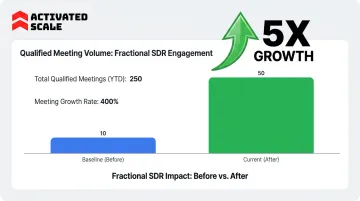
Take Dresma.ai. Co-founder Abhishek Kirti described the challenge plainly: "We didn't have a repeatable and scalable outbound sales strategy in place." Rather than hire a full-time SDR into a process vacuum, the company brought on a fractional SDR through Activated Scale.
The result: a 5X increase in meetings with sales-qualified prospects. The company validated its outbound motion before ever committing to permanent headcount.
What is Permanent Hiring for Startup Sales Roles?
Permanent hiring means a full-time sales employee with no fixed end date, full benefits, and often equity, brought on with the expectation of growing alongside the company. There's no trial clock running.
This model earns its cost when three things are true:
- The role builds institutional account knowledge that compounds over months and years
- Deals require deepening trust across multi-touch, relationship-driven sales cycles
- The company needs long-term team building, not just quota coverage
There's a meaningful difference between hiring a junior AE who can grow into a team lead versus bringing on an experienced VP of Sales to build the function from scratch. The former is a bet on potential. The latter is a bet on someone else's proven playbook, applied to yours.
Use Cases of Permanent Hiring
Permanent hiring fits once product-market fit is validated and a repeatable sales playbook already exists. At that point, the company needs to scale a team, not test one person.
Common scenarios:
- Series A companies formalizing their GTM org after proving the initial motion works
- Founders hiring a sales leader who will own long-term hiring, quota-setting, and forecasting
- Teams replacing founder-led sales with a dedicated hire who can own the full cycle long-term
Ramp time matters here too. Xactly cites an average of 3.2 months for new sales reps to reach full productivity, a real consideration when you're committing to a salary, benefits, and equity before knowing if the hire will pan out.
Contract-to-Hire vs Permanent: Side-by-Side Comparison
| Factor | Contract-to-Hire | Permanent |
|---|---|---|
| Cost | Higher bill rate, but no equity, benefits, or severance exposure | Lower stated salary, higher fully loaded cost once equity and benefits are counted |
| Speed | Can start within days | Full-cycle search often takes weeks to months |
| Risk | Low-risk exit if the motion doesn't work | Costlier, slower to unwind if the hire fails |
| Flexibility | Easy to scale up or pause with runway | Fixed headcount commitment regardless of revenue swings |
| Relationship depth | Better for shorter, transactional cycles | Better for long, relationship-driven enterprise cycles |
A few of these deserve a closer look.
On cost: the U.S. Bureau of Labor Statistics reports $35.92 per hour in total employer compensation for private-industry sales occupations, split between $25.70 in wages and $10.23 in benefits. That's before you add equity, ramp time, and the risk of a mis-hire.
A contract-to-hire bill rate looks steeper line by line, but it bundles taxes, risk, and margin into one number, without the long tail of hidden permanent-hire costs.
On risk: ending a contract-to-hire engagement means the contract simply lapses. Ending a permanent hire means severance conversations, morale impact, and a pipeline gap that can stall a quarter or more.
On relationship depth: if your sales cycle is 90 days of enterprise procurement with five stakeholders, continuity matters. If it's a 20-minute demo-to-close motion, it matters far less.
That's the trade-off Activated Scale's contract-to-hire placements are designed to test, letting founders start vetted sales talent within a week and convert top performers to permanent hires when the fit is proven.
Which Option Is Right for Your Startup?
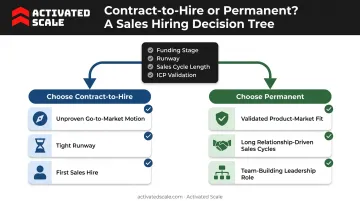
Weigh four factors before deciding: funding stage, runway, sales cycle length, and whether your ICP and pricing are already validated.
Choose contract-to-hire if:
- Your go-to-market motion is still unproven
- Runway is tight and every hiring decision needs an exit ramp
- This is your company's first sales hire
Choose permanent if:
- Product-market fit is validated and repeatable
- Sales cycles are long and relationship-driven
- The role will lead and build out a team, not just carry a quota
Real-World Example: De-Risking a First Sales Hire
Dresma.ai's situation is a useful template for how this plays out. The founder needed to validate an outbound motion before justifying a full-time SDR salary, but had no repeatable process to point to yet.
Instead of running a lengthy traditional search and hoping the resume matched the results, the team brought on a vetted fractional SDR through Activated Scale's try-before-you-buy model. That rep built the outbound infrastructure and developed customer-focused messaging, delivering a 5X increase in qualified meetings without the company committing to permanent headcount cost upfront.
That's the framework in action: prove the motion first, commit to the team second. If you're facing the same fork in the road, Activated Scale connects founders with vetted sales talent on a contract-to-hire basis in as little as seven days.
Conclusion
There's no universal winner between contract-to-hire and permanent hiring. They solve different problems at different stages.
The right call depends on validated demand, remaining runway, and sales cycle length, not which option looks cheaper on a spreadsheet.
Founders who tie their decision to real outcomes, like faster revenue validation, lower hiring risk, and a sales team built on proof, make the choice that fits their stage. That call rarely looks like the safest option on paper, but it's usually the right one.
Frequently Asked Questions
Do contractors get paid more than permanent employees?
Contract bill rates are typically higher per hour because they bundle taxes, risk, and margin into one figure. Permanent roles often carry a higher total cost once benefits, equity, and ramp time are factored in.
Is a contract-to-hire a good idea?
For founders whose sales motion or ICP isn't yet validated, contract-to-hire limits downside risk while still allowing conversion to full-time for reps who prove themselves.
What is the difference between C2C and C2H?
C2C (corp-to-corp) involves contracting through another business entity with no employer-of-record relationship. Contract-to-hire (C2H) is typically a W-2 arrangement with an explicit path to permanent employment.
How long does a contract-to-hire period typically last?
Most contract-to-hire sales engagements run 30 to 90 days, though this can extend depending on sales cycle length and how quickly performance can be fairly measured.
What happens if a contract-to-hire salesperson doesn't work out?
The engagement simply ends at the contract period, without severance or the complications of terminating a permanent employee, making it a lower-risk way to test fit.
Is contract-to-hire the same as a 1099 independent contractor arrangement?
No. Contract-to-hire is usually a W-2 arrangement with taxes withheld and often benefits eligibility, distinct from a 1099 contractor who manages their own taxes and has no built-in path to permanent employment.