Introduction
Your first Account Executive hire will either accelerate your revenue trajectory or set it back by months. There's rarely a middle ground.
A bad AE hire burns runway you don't have, eats founder hours you can't get back, and stalls pipeline growth right when momentum matters most.
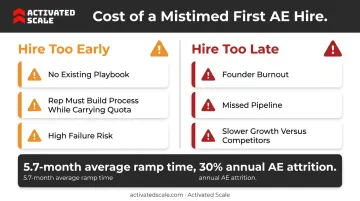
According to The Bridge Group's 2024 SaaS AE Metrics & Compensation Benchmark Report, the average AE now takes 5.7 months to ramp, and median annual AE attrition sits at 30%.
That means nearly a third of AEs leave within a year, often before they've fully paid back the investment in hiring and training them. For a startup with 12-18 months of runway, that math is brutal.
This guide breaks down exactly when to hire, what to evaluate, and how to de-risk the decision before you commit to a full-time salary.
Key Takeaways
- A SaaS AE owns the full sales cycle, from opportunity to close, unlike SDRs or AMs
- Wait for repeatable process, consistent pipeline, and founder bandwidth limits before hiring
- Weigh experience fit, sales motion, comp structure, and hiring model, not just resume pedigree
- Contract-to-hire and fractional models let you test an AE before full-time hire
What is a SaaS Account Executive?
An Account Executive owns the deal. Once a lead is qualified, the AE takes it through discovery, demo, negotiation, and close, converting pipeline into signed revenue, often in the $10,000 to $100,000+ ACV range typical of early-stage SaaS deals.
According to Salesforce's breakdown of the AE role, core responsibilities include:
- Discovery calls — uncovering pain points and confirming budget, authority, and timeline
- Product demos — tailoring the pitch to the prospect's specific use case
- Proposal and negotiation — structuring pricing, terms, and contract details
- Pipeline forecasting — tracking deal stages and predicting close dates for leadership
AE vs. SDR vs. AM (and Why Early AEs Do Both)
AEs, SDRs, and account managers get lumped together constantly, but they sit at different points in the customer lifecycle.
- SDRs prospect and qualify leads, then hand them off. They don't close deals.
- AEs take qualified opportunities and drive them to close.
- AMs manage existing accounts post-sale, handling renewals and expansion.
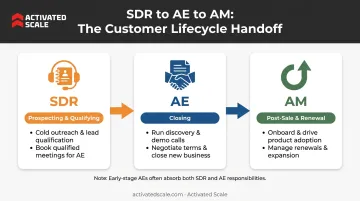
We cover the full comparison in the FAQ section below.
Here's the catch: most early-stage startups don't have a dedicated SDR yet. That means your first "AE" is often a full-cycle rep, someone who prospects, qualifies, demos, and closes without a hand-off.
If you're hiring your first sales role, expect to hire for this hybrid skill set, not a pure closer. This is exactly the kind of full-cycle talent Activated Scale's fractional AE network specializes in placing.
When & Why to Hire Your First SaaS AE
Founder-led sales is the default starting point for nearly every B2B SaaS company. You know the product, you know the buyer, and you can iterate on messaging in real time. That works until it doesn't.
The bottleneck shows up when you're spending more hours on sales calls than on product decisions, and pipeline starts slipping because you can't respond fast enough.
Readiness Signals to Watch For
- Consistent lead flow: inbound or outbound demand shows up reliably, not sporadically
- A repeatable process: even a rough version of your sales playbook exists, with defined stages and messaging that works
- Maxed founder bandwidth: you're triaging between product roadmap and sales calls, and something has to give
There's no universally agreed ARR threshold for making this hire. SaaStr founder Jason Lemkin notes that founders who've closed several customers themselves and built early repeatability are in a better position to expect a first rep to become productive within 60-90 days. The signal isn't a specific revenue number. It's proof that your sales motion works when someone other than the founder runs it.
The Cost of Getting the Timing Wrong
Hire too early, and you hand a rep a playbook that doesn't exist yet. They'll flounder trying to build one from scratch while also carrying quota, and most won't survive the ramp.
Hire too late, and you risk founder burnout, missed pipeline, and slower growth while your competitors scale their sales motion.
Given that average ramp already takes 5.7 months and industry attrition sits at 30% annually, a mistimed hire compounds fast. You don't just lose the salary, you lose months of runway waiting for a replacement to ramp all over again.
Key Factors to Consider When Hiring Your First SaaS AE
Hiring your first AE isn't like hiring your tenth. There's no established playbook to hand them, limited budget for a lengthy search, and no sales team to absorb a bad fit. Here's what actually matters at this stage.
Factor 1: Experience Level & Startup Fit
Enterprise pedigree looks great on a resume, but it doesn't always translate to startup execution. An AE who's only sold inside a mature process with dedicated SDRs, marketing-qualified leads, and established brand recognition may struggle when none of that infrastructure exists.
"0 to 1" adaptability matters more than years of experience at big-name companies. You want someone who's comfortable building process while also carrying a number.
The market is also trending toward more experienced AE hires overall. The Bridge Group's data shows average required AE experience climbing from 2.7 years in 2022 to 3.6 years in 2024.
That's a broad market trend, not a startup-specific rule. Still, it signals that pure "hungry generalist" hiring is getting harder to justify without some proof of sales competency.
Factor 2: Sales Motion & ICP Alignment
A candidate's past deal size and cycle length matter more than their logo list. An AE who closed $200K enterprise deals over 9-month cycles will likely struggle in a $15K SMB motion that closes in three weeks, and vice versa.
The specific question to ask: Has this candidate closed deals of similar size and cycle length to what you're selling right now?
Mismatched motion shows up fast in quota attainment and time-to-close. Someone trained on long enterprise cycles may over-qualify SMB leads and slow your pipeline down. Someone trained on transactional SMB sales might undersell an enterprise opportunity that needed more patience.
Factor 3: Compensation Structure (Base, OTE, Equity)
Getting comp right affects two things simultaneously: whether you can attract the talent you need, and how fast you burn cash doing it.
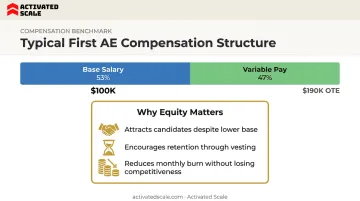
The Bridge Group's most recent data puts median AE OTE at $200K across 158 B2B companies, per their 2026 State of Sales research. Their 2024 SaaS-specific benchmark showed a median split closer to $100K base and $190K OTE, with pay mix around 53% base and 47% variable.
For cash-constrained startups, equity is a real lever:
- Lower base salary offset by meaningful equity can attract strong candidates who believe in the upside
- Equity vesting schedules naturally encourage retention through the ramp period
- Equity reduces monthly burn without sacrificing total comp competitiveness
Just don't use equity as a substitute for a livable base. Most experienced AEs still need enough cash comp to pay rent.
Factor 4: Full-Time Hire vs. Fractional / Contract-to-Hire
Committing to a full-time AE salary before you've validated your sales motion is a gamble. A trial or fractional engagement lets you test fit first.
This is exactly the model Activated Scale built its business around. Founders can bring on a fractional AE, often around 20 hours a week, to run outbound, work pipeline, and close early deals before deciding whether to convert them full-time.
This approach reduces the cost of a bad hire and protects your burn rate while you figure out whether your playbook actually works.
Factor 5: Coachability, Grit & Cultural Fit
At this stage, your AE isn't just executing a proven process. They're building it while closing deals at the same time. That requires resilience more than polish.
A useful interview technique: ask candidates to walk through a time they built something from scratch, a territory, a process, a book of business, with no existing playbook to follow. Their answer reveals how they handle ambiguity far better than a rehearsed pitch about their quota attainment at a previous employer.
Factor 6: Avoiding Common First-AE Hiring Mistakes
Founders repeat the same mistakes often enough that they're worth naming directly:
- Over-indexing on enterprise resumes: impressive logos don't guarantee startup fit
- Skipping a trial or pilot period: going straight to full-time without validating performance first
- Unclear onboarding plans: expecting a new AE to "figure it out" without a documented ramp path
Each of these mistakes tends to accelerate turnover. Given that industry attrition already sits at 30% annually, an unclear onboarding plan or a rushed hire only makes premature departure more likely.
How Activated Scale Helps You Hire the Right AE, Risk-Free
Every risk described above (timing, experience mismatch, comp uncertainty, cultural fit) becomes easier to manage with a try-before-you-buy model. This approach is the foundation of how Activated Scale works with early-stage founders.
Instead of committing to a full-time salary on a resume and a handful of interviews, founders get matched with vetted, US-based sales professionals on a fractional or contract-to-hire basis first.
What that looks like in practice:
- Access a curated talent network of AEs with backgrounds at Salesforce, Oracle, and IBM
- Convert top performers to full-time once you've seen real results in the field
- Match quickly, with clients like Windsor going from initial call to an active sales hire in 8 days
- Skip the lengthy interview grind and evaluate candidates who are already vetted
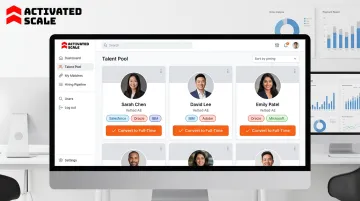
The results back the model. Windsor's fractional hire delivered a 4x increase in average deal size before converting to full-time, and Roboflow used Activated Scale to land its very first sales hires. Many clients follow the same path, converting their fractional talent to full-time after seeing results in a real deal cycle.
As Windsor's co-founder Pranay Prakash put it:
"We love this model of having somebody do a work trial with us. And that's exactly what Activated Scale gave us, the ability to have a contract to hire with somebody. You've already found the right people."
You get to watch someone run your actual pipeline before committing your runway to a hire.
Conclusion
Skip the resume that reads most impressive. Look for the AE who fits your specific stage, sales motion, and buyer: someone who can build process while also closing deals without dedicated support around them.
This decision doesn't end with your first hire either. Revisit your hiring criteria as you scale past AE number one and two. What worked for your founder-led motion won't necessarily work once you're managing a full sales team.
The safest path forward: de-risk the decision through trial-based hiring before committing to a full-time salary. Services like Activated Scale make this easy, letting you watch a vetted AE work your pipeline before extending a full-time offer. Then decide.
Frequently Asked Questions
What is an AE in SaaS?
An Account Executive owns the full sales cycle from qualified opportunity to closed revenue. They run discovery calls, deliver demos, negotiate terms, and close deals that SDRs or marketing have already surfaced.
What is the difference between an AE and an SDR in SaaS?
SDRs handle top-of-funnel work: prospecting, qualifying leads, and booking meetings. AEs take those qualified opportunities and own them through to close. SDRs don't typically carry a closing quota.
What is the difference between an AE and an AM (account manager) in SaaS?
AEs focus on acquiring new business and closing first-time deals. AMs manage existing accounts post-sale, driving renewals, resolving issues, and identifying expansion opportunities within current customers.
When should an early-stage startup hire its first AE?
Hire once you have consistent lead flow, a repeatable (even rough) sales process, and founder bandwidth that's maxed out juggling product and sales. There's no fixed ARR number. What matters is proven repeatability.
How much does it cost to hire a SaaS AE?
Median AE OTE benchmarks range from roughly $190K to $200K, according to Bridge Group's latest OTE benchmarks, typically split close to 50/50 between base and variable pay. Equity can offset cash comp for early-stage startups with limited budget.
Should my startup hire a full-time AE or try a fractional/contract-to-hire AE first?
A fractional or contract-to-hire AE is the lower-risk option for validating fit before committing to full-time pay. Activated Scale's contract-to-hire model, for example, lets you test performance on real pipeline before locking in a permanent salary.