Introduction
Picture this: a B2B SaaS founder is running four product demos a day, managing three open support tickets, and trying to close a deal that's been stalling for six weeks. There's no sales leader, no defined ICP, and the pipeline is a spreadsheet. This is the exact situation a sales advisor is built for — and it's more common than most people realize.
For senior sales professionals, it also represents a real career opportunity. Advisory roles offer something a single full-time position rarely can:
- Apply your expertise across multiple companies at once
- Build equity exposure without locking into one employer
- Develop pattern recognition faster by seeing more deal cycles, more ICPs, more failure modes
This guide covers what startup sales advisors actually do, what qualifications matter, how compensation is structured, and how to land your first engagement.
Key Takeaways
- Sales advisors provide strategic guidance to early-stage startups a few hours per month — not day-to-day execution
- Unlike fractional sales reps (who run outreach and close deals), advisors coach founders and build systems
- Equity compensation typically falls in the 0.1%–0.5% range; treat it as upside, not primary income
- The best sourcing channels are VC networks, accelerator communities, and platforms like Activated Scale
- Use the Founder Institute's FAST Agreement as your baseline contract template
What Does a Sales Advisor for Startups Actually Do?
A sales advisor is an experienced B2B sales professional who helps early-stage companies build a repeatable sales motion — typically a few hours per month, not full-time. The value is pattern recognition: the ability to look at a founder's pipeline, messaging, and process and quickly identify what's broken.
Core Responsibilities
Most advisory work clusters around these areas:
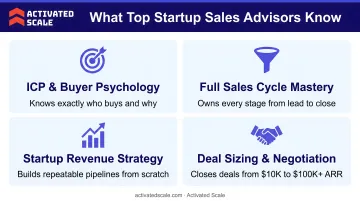
- ICP definition — helping founders get precise about who actually buys, why, and at what deal size
- Sales process design — reviewing and refining stages from prospecting through close, often starting from scratch
- Coaching founders through deal reviews, call recordings, and direct feedback on discovery and qualification
- Advising on CRM setup (commonly HubSpot or Salesforce) and which tools are actually worth the cost
- Connecting founders with relevant prospects, partners, or first-hire candidates when the network is there
According to a16z, Pilot's CEO ran sales solo for the company's entire first year, reaching 60 customers and roughly $250K ARR before making a single sales hire. A sales advisor during that stretch could have helped structure pilots, sharpen the ICP, and prep for that first hire — shaving months off the learning curve.
Advisor vs. Fractional Sales Rep: A Clear Distinction
These two roles get conflated often, but they serve different needs.
| Role | Mode | Time Commitment | Best For |
|---|---|---|---|
| Sales Advisor | Strategic/coaching | 2–8 hours/month | Founders who need a system, not a closer |
| Fractional Sales Rep | Execution | 15–20 hours/week | Startups ready to run outbound and close deals |
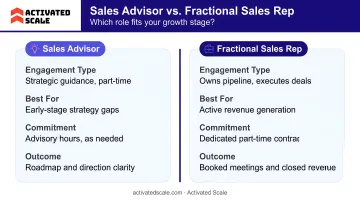
An advisor tells you what to build and why. A fractional rep builds it with you or for you. Both are legitimate — the question is where the startup's bottleneck actually sits. Activated Scale matches startups with fractional sales talent across both modes — from SDRs and AEs to VP-level advisory roles — depending on where founders need the most support.
Key Skills and Qualifications to Become a Sales Advisor
Being a strong individual contributor doesn't automatically make someone a good advisor. The role requires a different set of muscles.
The Baseline
Most effective sales advisors have:
- 7–10+ years of B2B sales experience, ideally including time at a high-growth startup or SaaS company
- A documented history of hitting quota — not just titles, but outcomes
- Some experience with founder-led or early-stage sales, where there was no playbook to inherit
- Familiarity with common startup CRMs and the ability to evaluate a sales tech stack quickly
The Activated Scale network, for context, draws from professionals with backgrounds at companies like Salesforce, Oracle, Zendesk, Datadog, IBM, and Udemy — people who have sold across deal sizes from $10K to $100K+ and into multiple buyer personas including IT, HR, marketing, and finance leadership.
Why Vertical Focus Matters More Than Broad Experience
Founders don't want a generalist advisor. They want someone who has sold to their exact buyer.
A startup selling compliance software to mid-market legal teams needs an advisor who has navigated that specific sale — the objections, the procurement process, the champions and blockers. Claiming to advise on "all B2B sales" is a red flag. Defining your "sandbox" — the buyer type, deal size, and sales motion you know deeply — makes advisory conversations credible.
Strategic Knowledge That Separates Good Advisors
Beyond personal selling experience, strong advisors understand:
- Pipeline math and forecast modeling at early stages
- How to design SDR/BDR functions from the ground up
- Compensation plan design that drives the right behaviors (not just revenue)
- When to hire the first sales rep versus when to keep selling as a founder
Communication and Coaching Skills
Technical knowledge only gets you so far. How you deliver that thinking matters just as much.
First Round's founder-led growth playbook emphasizes identifying growth levers and running focused sprints — exactly the structured approach advisors should model. Translating that into useful guidance means:
- Asking questions before offering answers
- Saying things founders may not want to hear
- Calibrating advice to the company's actual stage, not enterprise-scale frameworks
Before landing your first advisory role, build visibility where founders look. Publishing LinkedIn content on sales strategy, contributing to founder communities, or speaking at startup events signals credibility before any formal conversation begins.
How Sales Advisors Are Compensated
Equity: The Primary Currency at Early Stages
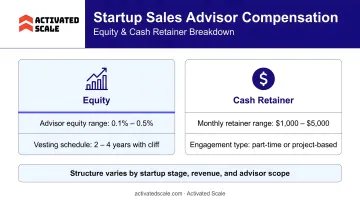
Equity is the most common compensation structure for startup advisors, and the most documented. According to AngelList, individual advisory shares typically range from 0.25% to 1% of total equity. Cooley GO places the standard range for a 24-month advisor grant at 0.15% to 0.75% of fully diluted stock. For early-stage sales advisors with moderate involvement, 0.1%–0.5% is a reasonable planning band.
Advisor equity typically vests:
- Monthly over 12–24 months
- Without a cliff (unlike employee options)
- As NSOs (non-qualified stock options) or RSAs, depending on the company's stage and valuation
The Founder Institute's FAST Agreement is the clearest starting point for structuring these grants. It uses company maturity and advisor engagement level to guide equity, and reduces the need for custom legal drafting.
Calibrating Equity Expectations Honestly
CB Insights reports that nearly 67% of seed-funded startups stall without exiting or raising follow-on funding. Crunchbase data from early 2025 shows only 36% of 2021 seed-stage companies had progressed beyond seed.
That means 0.25% in a company that never exits is worth nothing. Run the math before accepting an engagement:
- What's the realistic exit range if things go well?
- How much dilution will occur across future rounds?
- Do you actually believe in the company's market and team?
Equity is upside, not salary. Take the engagement because you believe in the outcome — the title is secondary.
Cash Retainers
Cash retainers are less standardized than equity and vary widely based on the startup's stage, the advisor's seniority, and how structured the engagement is. A few patterns are common:
- Later-stage companies are more likely to offer cash alongside equity
- High time-commitment engagements (regular calls, pipeline reviews, hiring support) typically warrant a retainer
- Seed-stage advisors often take equity-only initially, then negotiate cash once the company raises follow-on funding
- Hybrid structures — cash plus equity — are common when the advisor is contributing consistently over months
How to Find Startups That Need a Sales Advisor
The Most Productive Channels
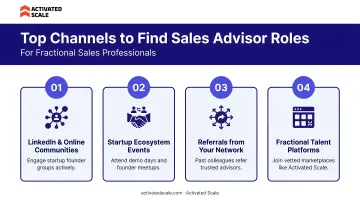
- VC platform teams — A 2022 study of 850 VC firms found 52.8% had platform teams covering business development and go-to-market support. These teams actively look for sales advisors to introduce to portfolio companies struggling with pipeline.
- Accelerator alumni networks — Y Combinator has funded 5,000+ startups; Techstars has worked with 11,000+ founders. Both communities include early-stage B2B companies actively seeking sales expertise.
- LinkedIn outreach — Target founders at seed-to-Series A B2B SaaS companies posting about sales challenges or hiring their first sales rep. That's exactly when advisory conversations make sense.
- Platforms like Activated Scale — Activated Scale connects pre-vetted B2B sales professionals with seed-to-Series A companies that need fractional talent and strategic guidance. It's a natural starting point for structured access to multiple startup opportunities at once.
Lead With Value, Not a Pitch
A comment on a founder's post about their discovery process, a quick review of their pricing page, or a free 30-minute call will open more advisory doors than any cold pitch about your credentials.
Treat it like any sales motion: the goal of the first interaction is to earn the second one — not to close.
Legal and Agreement Essentials
Never accept an advisory role based on a verbal equity promise or an email. Always get a written agreement.
What a Good Agreement Covers
- Scope of work: specific focus areas (outbound strategy, sales hiring, pipeline reviews) — not a vague "sales advisor" label
- Time commitment: defined hours or touchpoints per month, not open-ended
- Compensation: equity percentage, vesting schedule, grant type, and exercise window
- Confidentiality and NDA: you'll see pipeline data, pricing, and product roadmaps
- Conflict of interest: flag other advisory engagements, especially in adjacent verticals
- IP ownership: frameworks or playbooks you help build belong to the company
- Termination provisions: how the relationship ends if either side wants out
The FAST Agreement from the Founder Institute is the clearest standard template for both sides. It's neutral, widely used, and reduces custom legal work. Negotiate out any fixed time commitments that don't match how you prefer to structure advisory work.
How to Get the Most Out of Your Sales Advisory Role
Show Up Prepared
The advisors who create the most value in the least time arrive at every call having already reviewed:
- Current pipeline metrics and deal-stage distribution
- Recent wins and losses, with brief analysis of why
- Any changes to the team or product since the last conversation
This matters practically. If your engagement is four hours a month, you can't spend the first 30 minutes getting oriented.
Define Success Metrics at the Start
Before the engagement begins, agree on what a successful six months looks like. For example:
- A documented outbound playbook with tested messaging
- A ramped SDR booking qualified meetings independently
- A repeatable discovery framework the founder uses on every call
- A clear ICP hypothesis with evidence from at least 10 closed-won deals
Setting these benchmarks creates accountability on both sides and makes renewal — or graceful closure — straightforward. Without them, advisory engagements drift until everyone quietly stops showing up.
Frequently Asked Questions
Frequently Asked Questions
How much do sales advisors for startups charge?
Equity is the most common structure at early stages, typically in the 0.1%–0.5% range depending on company stage, advisor seniority, and engagement depth. Cash retainers are less standardized, becoming more common at later stages or for structured, recurring engagements.
What does a sales advisor for startups actually do?
A sales advisor helps early-stage founders build a repeatable sales motion — defining ICP, refining the sales process, coaching on live deals, advising on the sales tech stack, and occasionally making warm introductions. The scope is strategic and advisory, not day-to-day execution.
What is the difference between a sales advisor and a fractional sales rep?
A sales advisor operates at the strategy and coaching level, typically a few hours per month. A fractional sales rep is in active execution: running outreach, booking meetings, and closing deals on a part-time basis.
What qualifications do you need to become a sales advisor for startups?
Most effective advisors bring 7–10+ years of B2B sales experience, a demonstrable quota attainment track record, and deep expertise in a specific segment or buyer persona that matches the startup's target market. Prior SaaS or startup experience helps considerably, since advisors who've sold in resource-constrained environments understand the founder's reality.
How do I find startups that need a sales advisor?
VC platform teams, accelerator alumni networks (Y Combinator, Techstars), and LinkedIn outreach targeting seed-to-Series A founders are the most reliable channels. Platforms like Activated Scale also connect vetted sales professionals with B2B startups actively seeking fractional talent and strategic guidance.