
That's why many B2B startups are skipping the traditional full-time hire entirely — at least at first. Contract sales representatives offer a way to build pipeline, test sales channels, and generate revenue without locking into a permanent headcount commitment.
This guide covers everything you need to know: what a contract sales rep actually is, the different role structures available, how compensation works, what skills matter, what your agreement must include, and how to find and hire one.
Key Takeaways
- Contract sales reps are independent professionals hired to sell on your behalf without becoming full-time employees
- Compensation typically combines a monthly retainer with incentive — pure performance-only structures rarely work for longer sales cycles
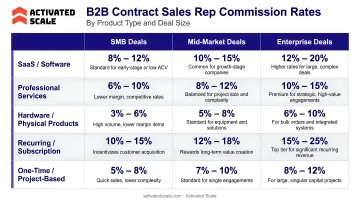
- Performance pay rates for independent B2B reps commonly range from 7%–15% of sales price
- Get a written agreement in place covering contractor status, incentive terms, territory, and termination before work begins
- Specialized platforms like Activated Scale can match you with vetted fractional reps in 7 days or less
What Is a Contract Sales Representative?
A contract sales representative is an independent sales professional hired to sell a company's products or services for a defined period or project — without becoming a full-time employee. They operate as independent contractors, meaning the hiring company doesn't withhold payroll taxes, provide benefits, or make a long-term employment commitment.
The distinction matters legally, not just practically. According to IRS Topic 762, worker classification turns on behavioral control, financial control, and the nature of the relationship — not just what you call someone in a contract.
Why Companies Use Them
For a company, the appeal is straightforward:
- No benefits burden — BLS data puts total private-industry sales compensation at $35.01/hour, with $8.65/hour going to benefits alone
- Faster deployment — no lengthy onboarding pipeline or notice period complications
- Lower risk — you pay for sales output, not a salary headcount
- Immediate access to experience — skilled reps available without a long-term budget commitment
For early-stage B2B startups, this model is especially useful for validating a sales motion before building a full team.
Why Sales Professionals Choose Contract Work
The other side of the equation: experienced reps who can manage their own pipeline often prefer this model too.
- Freedom to represent multiple clients simultaneously
- Higher effective earning potential through incentive upside
- Control over schedule, territory, and client mix
- 72.9 million U.S. independents chose this path in 2025, with 5.6 million earning over $100K
Types of Contract Sales Representative Roles
Not all contract sales arrangements are the same. The structure you choose should match your specific revenue need.
The Three Main Models
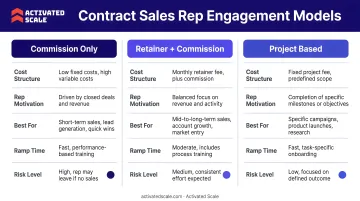
| Model | How It Works | Best For |
|---|---|---|
| Project-based | Defined scope — a product launch, outbound campaign, or event follow-up sequence | Testing a new channel or vertical without open-ended commitment |
| Fractional rep | Ongoing, part-time engagement — typically 15–20 hours/week on a monthly retainer | Seed to Series A companies building pipeline before a full-time AE hire |
| Contract-to-hire | Trial engagement (usually ~3 months) with clear intent to convert if goals are met | Companies that want to evaluate fit before making a full-time offer |
The Fractional Model in Practice
Fractional reps function like a part-time AE or SDR — they generate pipeline, run demos, and close deals without the overhead of a full-time hire. This model suits companies at the Seed to Series A stage that need revenue proof before committing to a full sales team.
Activated Scale connects B2B SaaS startups with pre-vetted fractional SDRs and AEs from its network. Notably, 65% of clients hire their fractional rep as a full-time employee after the initial contract — making it a natural contract-to-hire path as well.
Industry Variation
The fractional and project-based models apply across industries, though scope and pay vary considerably by sector:
- SaaS/tech: Emphasis on self-directed prospecting, CRM hygiene, and short sales cycles
- Healthcare/pharma: Typically requires domain-specific compliance knowledge and pays at the higher end of the range
- Manufacturing: The independent rep model is well-established here — reps usually carry multiple complementary product lines in a defined territory, compensated almost entirely on incentive
Compensation: What Contract Sales Representatives Earn
Pay structure for contract reps varies more than most people expect. The right model depends on your sales cycle, deal size, and how much risk each party can absorb.
Market Benchmarks
Glassdoor's data on U.S. Contract Sales Representatives shows a median total pay of $132K, with a likely range of $106K–$168K (based on 26 reported salaries, updated April 2025). That figure includes both base/retainer and variable pay.
For context, the BLS reports May 2024 median wages of $100,070 for technical and scientific wholesale/manufacturing sales reps — roughly 24% below the contract rep median, reflecting the premium contractors earn in exchange for flexibility and no benefits overhead.
Typical Compensation Structures
Most contract reps are paid through one of two structures:
1. Straight incentive — Rep earns a percentage of revenue closed. No base, no floor. Works in industries with short cycles and warm inbound, but creates disengagement problems when deals take 60–90+ days.
2. Retainer + performance pay (hybrid) — A monthly retainer covers time and activity; incentive rewards closed revenue. This is the more sustainable model for B2B SaaS.
Activated Scale recommends against performance-only arrangements for this reason: if your sales cycle exceeds a month, performance-only structures tend to disengage both the rep and the client.
Their published retainer ranges:
- Fractional SDR/BDR: $4,500/month plus performance pay
- Fractional AE: $6,500/month plus performance pay
- Fractional VP of Sales: $12,000/month plus bonus
Incentive Rate Norms
For independent B2B reps, RepHunter's incentive guidance provides useful published benchmarks:
- Manufactured products: 7%–15% of sales price, or 20%–40% of gross margin
- Service-based products: Can exceed 50% in some cases
- High-volume, large-deal work: Can drop to 1%–2%
- Lead generation only: Typically 6%–10%
Rates shift based on who generates leads, how long the sales cycle runs, the level of technical complexity, and whether exclusivity applies. Incentive escalators tied to quota attainment are also common, where reps who exceed a threshold earn a higher rate on incremental revenue above it.
Key Skills and Qualifications for Contract Sales Representatives
Contract reps don't get a ramp period. They're expected to produce quickly with minimal infrastructure, which means the hiring bar is meaningfully different from a full-time entry-level role.
Core Competencies
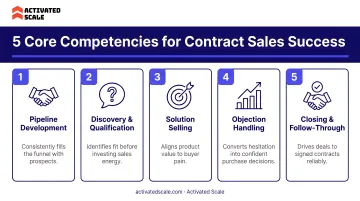
Companies hiring contract reps should prioritize:
- Self-directed prospecting — the ability to build pipeline without marketing support or inbound leads
- Consultative selling — especially for complex B2B products with multiple stakeholders
- CRM proficiency — Salesforce, HubSpot, and Outreach are the most common platforms; clean data entry is non-negotiable
- Objection handling — particularly important for startups selling without brand recognition
- Quick ramp — contract reps should be in conversations with prospects within days, not weeks
What Separates Contract Reps from Full-Time Reps
The standout quality in a strong contract rep is comfort with ambiguity. No playbook required — they write it themselves. They manage their own schedules, build their own call lists, and stay focused across multiple client environments simultaneously.
That multi-client experience is a genuine advantage. Reps who've sold across industries and buyer types bring pattern recognition that someone who's only worked one product in one vertical simply doesn't have.
Typical Background
- 3–10+ years of prior B2B sales experience
- Familiarity with the hiring company's buyer persona (CIO, VP of Sales, CFO, etc.)
- Proven track record with a comparable ACV
- References from prior contract or quota-carrying roles
Finding reps who check all these boxes is the hard part. Activated Scale matches startups on buyer persona and ACV alignment specifically. Their network includes reps from Salesforce, Oracle, IBM, Zendesk, Datadog, and Udemy — each screened through a three-step vetting process that includes a live pitch video reviewed by network peers.
What Goes Into a Contract Sales Representative Agreement
A verbal agreement is not an agreement. Before any rep makes their first call on your behalf, a written contract should be signed. This document defines what's expected, what's owed, and what happens when things go sideways.
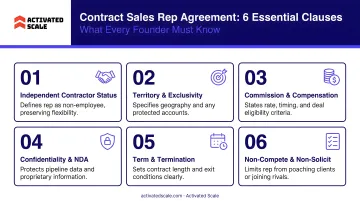
Contractor Classification Clause
The agreement must explicitly state that the rep is an independent contractor, not an employee. This has direct implications for tax treatment, benefits obligations, and legal liability. But stating it doesn't make it so — the actual working arrangement must reflect contractor independence.
If you're engaging a rep based in a state with strict worker classification rules, the stakes are higher. The ABC test used in some states presumes employee status unless the hiring company can prove all three criteria:
- The worker is free from the company's control and direction
- The work falls outside the usual course of the company's business
- The worker operates an independently established trade or business
Compensation and Incentive Terms
This section is where most disputes originate. Cover all of it:
- Incentive percentage and whether it's calculated on gross or net revenue
- Payment timing (net-30 after invoice? After customer payment clears?)
- Treatment of discounts — especially discounts the rep negotiates to close a deal
- Clawback provisions for deals that cancel or churn within a defined window
- Trailing incentives — what the rep is owed on deals in progress at termination
Some states' labor laws require all earned incentives to be paid within a set number of business days of termination, and incentives not yet due must be paid within a set window of becoming due. Principals who fail to comply can face double damages plus attorney fees. Verify your state's incentive payment rules before drafting termination terms.
Territory and Exclusivity
Define whether the rep has:
- A geographic territory (for example, a specific US region only)
- A vertical or segment restriction (for example, healthcare buyers only)
- Exclusivity within that territory — and what happens when an overlapping account surfaces
Additional Critical Clauses
| Clause | What to Cover |
|---|---|
| Termination | Notice period required; incentive owed on in-flight deals |
| Non-compete | Scope, duration, and geographic limits |
| Non-solicitation | Restriction on poaching your employees or customers post-engagement |
| Confidentiality | Protection of pricing, product roadmap, customer lists |
| IP assignment | Any sales materials, scripts, or process docs created belong to the company |
| Dispute resolution | Governing state law; arbitration vs. litigation |
As a general best practice, contractor agreements should reflect the rep's control over their own hours and work location. Payment tied to milestones, incentives, or project completion reinforces contractor status — hourly or weekly rates can blur that line and invite reclassification risk.
How to Find and Hire a Contract Sales Representative
Sourcing Channels
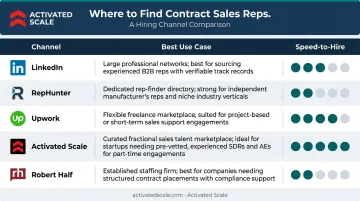
| Channel | Best Use Case |
|---|---|
| Direct sourcing for project-based or fractional roles; large talent pool but requires screening effort | |
| RepHunter | Performance-only independent reps for territory or channel coverage, especially in manufacturing |
| Upwork | Project-based prospecting, appointment setting, or sales support tasks |
| Activated Scale | Vetted fractional SDRs and AEs for B2B SaaS startups; contract-to-hire pathway available |
| Robert Half | General contract-to-hire staffing; not sales-specific |
Sourcing independently costs less upfront but requires significant screening time. A platform with pre-vetted candidates trades a placement fee for speed and lower hiring risk — a worthwhile swap when you need someone ramped quickly.
What to Evaluate When Screening Candidates
Before you post a role or reach out to candidates, build a clear scope of work. Define the ICP, target territory, expected CRM, activity expectations, incentive trigger, and reporting cadence. Vague briefs attract the wrong people.
Once your scope is defined, evaluate candidates on:
- Relevant quota attainment — not just that they hit quota, but that they hit it selling to a similar buyer at a comparable ACV
- References from contract engagements — can prior clients speak to their self-management and ramp speed?
- Demonstrated pipeline generation — how do they build their own lists? What prospecting tools have they used?
- Comfort with ambiguity — ask what the first 30 days looked like at their last contract role
The Contract-to-Hire Pathway
For companies not ready to commit to a full-time sales hire, the contract-to-hire model is a practical hedge. Run a defined engagement — typically three months — with clear goals. If the rep hits the metrics, you convert. If not, the engagement ends cleanly, no messy termination process required.
Activated Scale structures this explicitly: startups engage a fractional rep, evaluate fit across both sales performance and culture, and convert to full-time when the rep hits their KPIs. The conversion fee is charged at the point of hire, not upfront — and 65% of clients do make that conversion.
Frequently Asked Questions
What is a contract sales representative?
A contract sales representative is an independent professional hired to sell on behalf of a company for a defined period or project, without becoming a full-time employee. They handle their own taxes, receive no employer-provided benefits, and typically work with multiple clients simultaneously.
How is a contract sales rep different from a full-time sales rep?
The main differences are employment status, pay structure, and commitment. Contract reps are independent contractors — usually paid on incentive or a retainer-plus-performance-pay model — with no long-term commitment from either party. Full-time reps receive a salary, benefits, and employment protections.
What variable pay structure is typical for contract sales representatives?
Most contract reps work on straight incentive or a retainer-plus-performance-pay hybrid. For independent B2B reps, performance pay rates on manufactured products typically range from 7%–15% of sales price, with escalating tiers tied to quota attainment common for higher-volume engagements.
What should be included in a contract sales representative agreement?
At minimum, the agreement should cover:
- Independent contractor classification and performance pay rate
- Payment timing and trailing performance pay terms
- Territory, exclusivity, and termination provisions
- Non-solicitation, confidentiality, and IP assignment
- Dispute resolution
Treat it as a risk-control document, not a template formality.
How do I find a contract sales rep for my startup?
Define a clear scope of work first. Then source through LinkedIn, RepHunter for performance-only territory reps, or Activated Scale for pre-vetted fractional talent. Prioritize candidates with proven quota attainment and the ability to ramp without heavy hand-holding.
Can a contract sales rep convert to a full-time employee?
Yes, and many companies structure the engagement with exactly that intent. A contract-to-hire clause formalizes the conversion terms, including the timeline, performance criteria, and any fees owed to the sourcing platform. It's one of the most practical ways to reduce hiring risk in a first sales hire.