
Introduction
Remote and hybrid sales teams are now the default, not the exception. Approximately 78% of workers with remote-capable jobs now operate in hybrid or fully remote arrangements, and Gartner's latest research confirms that 61% of B2B buyers now prefer a rep-free buying experience, showing that buyers expect digital-first experiences before ever talking to a rep.
Yet the leadership skills that worked in a physical office don't automatically translate. For B2B SaaS startup founders building their first sales team from scratch, the challenge is compounded: you're constructing the sales process and the remote team at the same time, without an established org to lean on.
This post covers what it actually takes to lead remote sales teams well — from accountability structures to coaching cadences to scaling talent without ballooning headcount costs.
TLDR:
- Remote sales leadership demands more intentional communication than in-person management
- Outcome-based accountability outperforms activity surveillance every time
- Weekly 1:1s, call coaching, and public recognition build trust across distance
- Strong leadership practices let remote sales teams outperform their in-office counterparts
- Fractional sales talent is a faster, lower-risk path to building remote sales capacity
What Makes Virtual Sales Leadership Unique
Virtual sales leadership differs fundamentally from in-person management. The absence of passive oversight—no shoulder-taps, no hallway check-ins, no reading the room during a team lunch—forces leaders to be far more intentional about communication, visibility, and culture-building.
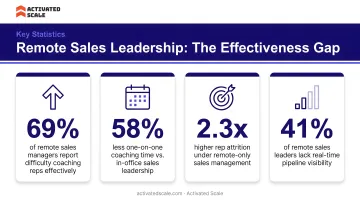
Only 15% of leaders say they are "very effective" at leading remote and hybrid teams, according to McKinsey's State of Organizations report. This gap is critical because managers account for 70% of the variance in team-level engagement, making leadership quality far more influential than work location in determining outcomes.
The Startup Challenge Multiplier
For B2B SaaS startup founders, this challenge compounds. You're building sales processes and a remote team at the same time, without the infrastructure of an established sales org to lean on:
- No playbook to hand a new rep
- No veteran AE to model behavior
- No sales ops team to configure dashboards and reporting
That means founders must simultaneously develop their own sales leadership skills while creating the very systems their remote reps need to succeed. Every decision—from CRM setup to 1:1 cadence—becomes both a strategic choice and a potential failure point.
Essential Skills Every Virtual Sales Leader Must Develop
Leading remote sales teams demands a distinct skill set. These competencies aren't optional—they're the foundation for building trust, maintaining accountability, and driving performance when your team is distributed.
Emotional Intelligence and Empathy
Emotional intelligence becomes critical in remote settings where you can't read body language or pick up on subtle in-person cues. Gallup found that 80% of employees who received meaningful feedback in the past week are fully engaged—regardless of location.
The key word is meaningful, which requires leaders to adapt their approach to each rep's communication preferences.
One rep might need Slack feedback immediately after a demo; another prefers written notes ahead of your weekly 1:1. Remote leaders must tune into these preferences and demonstrate empathy through personalized communication rather than a uniform approach.
Clear, High-Quality Written and Verbal Communication
Remote leaders rely heavily on written channels—Slack, email, async video—making precision and tone more important than ever. Text strips away sentiment and context, creating risk for miscommunication.
The cost is real: miscommunication costs U.S. businesses an estimated $1.2 trillion annually, according to Grammarly's 2024 State of Business Communication report. The same research found that 100% of knowledge workers experience miscommunications at least weekly, with 25% reporting multiple instances daily.
For anything sensitive or complex — performance concerns, objection handling, deal strategy — default to synchronous communication: video or voice calls. Save async for status updates, process documentation, and routine information sharing.
Decisiveness Under Distributed Conditions
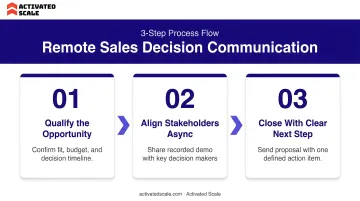
Without the ability to read a room or hold impromptu hallway decisions, virtual sales leaders must communicate decisions proactively. Changes to quotas, territory assignments, or process shifts can create confusion and resentment if not explained transparently.
Effective remote leaders handle decision communication by:
- Documenting decisions in writing with the rationale behind them
- Inviting questions through structured channels (a dedicated Slack thread, a standing agenda item)
- Setting a response window so reps in different time zones don't interpret silence as ambiguity
Adaptability and a Growth Mindset
Remote-first sales environments change quickly. Tools evolve, reps' home situations shift (childcare issues, relocations, health concerns), and pipeline strategies may need to pivot based on emerging buyer patterns.
Leaders who model adaptability—openly acknowledging when something isn't working and iterating publicly—build more resilient remote teams. When a rep sees their manager admit a forecasting model failed and propose a new approach, it signals that experimentation is expected — not punished.
Building Trust and Accountability Remotely Without Micromanaging
Trust is the foundation of remote work, yet only 54% of managers strongly agree they trust remote employees to be productive, and only 57% of remote employees feel trusted by their manager. The gap is structural, but reinforcing management fundamentals can raise trust by nearly 30 percentage points.
Distinguish Between Accountability and Surveillance
Tracking activity metrics obsessively—logins, call counts, screen time—without context erodes trust. Reps feel monitored rather than managed, and performance suffers.
Outcome-based accountability works differently. Focus on pipeline generated, meetings booked, and deals advanced—the metrics that tie directly to business goals.
Buffer found that 75% of remote workers are measured on output and impact rather than time logged. That same group reports significantly better career growth perceptions than those tracked by hours.
Shift from:
- "Did you make 50 calls today?"
- "Why were you offline between 2-3pm?"
To:
- "You booked 8 meetings this week—what's working in your outreach?"
- "Pipeline looks light in mid-market accounts. What support do you need to fill that gap?"
Establish Clear Expectations Upfront
The most effective virtual sales leaders document and communicate expectations explicitly: response time norms, CRM hygiene standards, 1:1 cadences, and what "good" looks like for each role. Reps have a shared reference point regardless of their time zone.
Example expectations document should include:
- Response times: Slack messages answered within 2 hours during working hours; emails within 24 hours
- CRM hygiene: All calls logged same day; deal stages updated within 24 hours of status change
- Meeting cadence: Weekly 1:1s (30 minutes), bi-weekly pipeline reviews, monthly team calls
- Performance benchmarks: 10 qualified meetings per month for SDRs; $50K pipeline generated monthly for AEs
Regular 1:1s as the Trust-Building Engine
Structured one-on-ones serve dual purposes: performance visibility for the leader and a confidential channel for reps to raise blockers. Gallup recommends 15- to 30-minute weekly conversations as the ideal cadence, noting these have greater impact than longer but less frequent sessions.
Structure your 1:1s to go beyond deal updates:
- First 10 minutes: Rep-led updates on deals, pipeline, blockers
- Next 10 minutes: Leader-led coaching on specific challenges (call recording review, objection handling, deal strategy)
- Final 10 minutes: Career development and well-being check-in
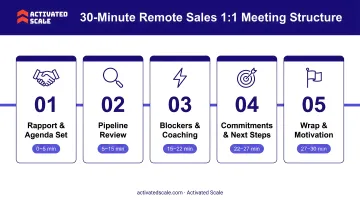
The structure matters less than the follow-through. Only 16% of employees say their last conversation with their manager was "extremely meaningful"—which means most managers are running 1:1s without making them count. Show up prepared, reference previous conversations, and close each session with a clear next action.
Virtual "Ride-Alongs"
Join reps on live or recorded sales calls—as a silent observer or active participant—to stay close to real selling behavior. Done consistently, it signals that you're coaching, not just checking numbers.
Tools like Gong, Chorus, or basic Zoom recordings make this straightforward. A simple repeatable approach:
- Review one call per rep per week
- Flag specific moments, not general impressions
- Tie feedback to observable behavior ("At 4:12, you moved past the objection before it was resolved")
Recognizing Wins Visibly and Consistently
In a remote setting, celebration doesn't happen organically. There's no open floor plan where a closed deal gets a reaction. Buffer found that 37% of remote workers say getting recognized by leadership is more difficult when remote.
Virtual leaders must actively create moments of recognition:
- Shoutouts in Slack channels dedicated to wins
- Acknowledgment in team meetings with specific detail ("Jordan closed the $75K deal with Acme—her persistence through three pricing rounds paid off")
- Monthly "rep spotlight" emails highlighting individual contributions
- Small rewards (gift cards, swag, extra PTO) for hitting milestones
Communication and Coaching Best Practices for Remote Sales Teams
Remote sales teams fall apart quietly. Without deliberate communication structure, reps drift into silos, coaching stalls, and motivation erodes before you notice the warning signs.
Set a Communication Rhythm, Not Just a Communication Tool
Having Slack doesn't mean you're communicating well. Effective remote leaders establish a communication cadence so reps always know when and where to get information and when they'll be heard.
Practical communication rhythm:
- Daily async standups: Brief Slack updates on priorities and blockers (takes under 5 minutes per rep)