
 With Virtual Assistants](https://file-host.link/website/activatedscale-qplyam/assets/refined-images/1780075636446000_e039491a49714dcb8f9b589833a18434/360.webp)
Many founders turn to virtual assistants to handle sales tasks. When structured correctly, VAs can free senior reps from busywork, scale outbound volume, and keep your CRM clean—without the overhead of full-time hires. But there's a critical distinction most startups miss: not all remote sales support is created equal. A VA handles tasks; a fractional salesperson owns outcomes.
This guide walks through how to build a remote sales team using virtual assistants: what they can (and can't) handle, how to hire and onboard them, which KPIs to track, and the common mistakes that waste time and money.
Key Takeaways
- Virtual sales assistants handle prospecting, CRM updates, email sequences, and meeting coordination—tasks that consume up to 70% of a seller's time
- Build the team by defining roles, writing sales-specific job descriptions, and onboarding with ICP context
- Manage distributed teams with CRM platforms, sequencing tools, and communication software—no micromanaging needed
- Track output-focused KPIs: prospects researched daily, sequences launched weekly, reply rates, and meetings booked monthly
- Know the difference: VAs execute defined tasks; fractional salespeople own pipeline and revenue outcomes
Virtual Sales Assistants vs. Fractional Salespeople: Know the Difference
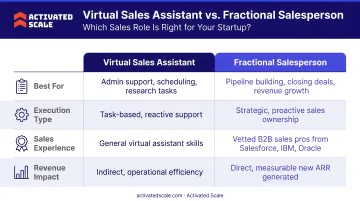
The term "virtual sales assistant" gets used loosely. There's a spectrum. On one end, a VA handles administrative and operational support—data entry, calendar management, CRM hygiene. On the other end, a fractional salesperson runs discovery calls, owns pipeline targets, and closes deals.
Most early-stage B2B SaaS companies need both, but conflating them creates misaligned expectations and wasted budget.
Two Primary Scenarios
Scenario 1: You have sales reps, but they're drowning in non-selling tasks. Sales reps spend only 30% of their time actually selling—the other 70% goes to admin work, CRM updates, and research. In this case, hire a VA to handle the operational load and free your closers to focus on revenue.
Scenario 2: You have no sales team yet and need someone to own revenue generation. That's not a VA role—it's a fractional sales hire. You need pipeline ownership and the strategic judgment to close deals.
Once you've identified which role you actually need, the sourcing model matters just as much as the hire itself. For startups in Scenario 2, platforms like Activated Scale connect you with pre-vetted fractional sales professionals from companies like Salesforce, Oracle, and Zendesk. These professionals can start within days, operating on a try-before-you-buy basis that's fundamentally different from how traditional VA platforms work.
Sales Tasks You Can Delegate to Virtual Assistants
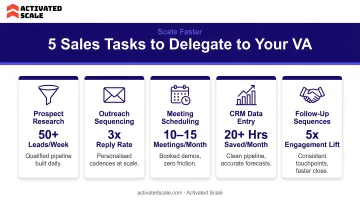
Lead Research and List Building
VAs excel at the most time-consuming part of outbound: researching target accounts, identifying decision-makers, pulling contact data using tools like Apollo or LinkedIn Sales Navigator, and building segmented prospect lists.
This requires process and attention to detail, not strategic judgment. A well-trained VA can deliver hundreds of qualified contacts weekly, enabling your closers to focus on conversations instead of spreadsheets.
CRM Management and Data Hygiene
Reps spend approximately 25% of their workweek—about 10 to 11 hours—on manual CRM data entry. For a team of 10 reps, that's 2.5 full-time sellers doing nothing but logging data.
VAs can handle:
- Updating deal stages after calls
- Logging meeting notes and next steps
- Enriching contact records with firmographic data
- Ensuring data consistency across HubSpot, Salesforce, or other platforms
Clean CRM data isn't just administrative—it's strategic. CRM data decays at 30% per year, and poor hygiene directly impacts forecast accuracy and pipeline visibility.
Email Sequencing and Outreach Support
VAs can load prospects into sequencing tools like Outreach, Salesloft, or Apollo, personalize templates at scale using research they've gathered, and manage multi-touch follow-up cadences.
This enables higher outreach volume without burning out your closers. Campaigns with advanced personalization achieve reply rates up to 18% (compared to a 9% average for generic templates). A VA trained on your ICP can deliver that personalization consistently.
Appointment Setting and Calendar Management
VAs can qualify inbound leads, respond to interested prospects, and coordinate scheduling—ensuring no meeting falls through the cracks. This is valuable for founders and AEs who need to maximize time spent on qualified calls, not calendar Tetris.
Reporting and Pipeline Analytics
Once scheduling runs smoothly, the next bottleneck is visibility. VAs can pull weekly pipeline reports, track activity metrics (emails sent, calls made, meetings booked), and identify emerging trends—giving sales leaders the data they need without spending hours in spreadsheets.
Organizations with rigorous forecasting processes see 21% higher quota attainment and 18% higher win rates. A VA managing reporting cadences makes that rigor scalable.
How to Build a Remote Sales Team With Virtual Assistants: Step by Step
Step 1: Define Your Sales Team Structure and Roles
Before hiring anyone, map your sales function to your stage. For early-stage B2B SaaS, identify whether you need:
- Top-of-funnel support (SDR/prospecting)
- Mid-funnel coordination (appointment setting, follow-up)
- Operational backbone (CRM hygiene, reporting)
Document specific task lists for each role. Vague job descriptions lead to mismatched hires. Be explicit: "Research 50 target accounts per day using Apollo, document key decision-makers in HubSpot, and flag accounts meeting ICP criteria A, B, and C."
Step 2: Write a Sales-Specific Job Description
A VA job description for sales roles requires different elements than general admin roles:
- Confirmed experience with your core tools: CRM (HubSpot, Salesforce), sequencing software (Apollo, Outreach), data tools (ZoomInfo, LinkedIn Sales Navigator)
- Written fluency and the ability to personalize outreach at scale
- Time zone overlap: specify hours needed for async updates and sync meetings
- Measurable KPIs: prospects researched per day, sequences loaded per week, meetings booked per month
Clarify whether the role is task-based (execute defined processes) or outcome-based (own a metric like meetings booked). For pure task execution, a VA works. For outcome ownership, you need a fractional sales professional.
Step 3: Choose the Right Hiring Channel
You have three main options:
Freelance platforms (Upwork, Fiverr): High volume, variable quality, requires extensive vetting. Best if you have time to screen 20+ candidates and run paid trials.
VA agencies: Pre-screened candidates, faster start, higher cost. Good for operational roles where process adherence matters more than sales judgment.
Fractional sales talent platforms: For pure sales execution roles—running outbound, booking meetings, owning pipeline—a fractional sales professional typically gets to productivity faster than a generalist VA who needs sales training. Platforms like Activated Scale connect you with reps from Salesforce, Oracle, and Zendesk backgrounds on a contract-to-hire basis, so you can validate fit before committing to a full-time hire.
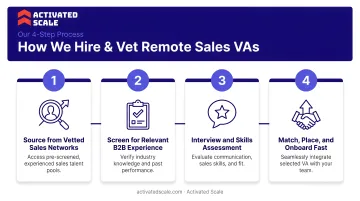
Step 4: Build a Structured Hiring and Vetting Process
Structured hiring processes are twice as effective at predicting job performance compared to unstructured interviews. A bad hire, by comparison, can cost up to $240,000 in lost productivity and recruitment expenses.
Minimum vetting steps:
- Written application screening (communication quality check)
- Short skills test (research a mock account, write a personalized outreach email)
- Video interview (assess clarity, professionalism, cultural fit)
- Paid trial task before committing (1-2 days of real work)
90% of employers using skills-based assessments reported a reduction in mis-hires, and 81% reduced time-to-hire. Don't skip the trial—it's the only way to validate execution quality.
Step 5: Onboard With Sales Context, Not Just Process
VA onboarding for sales roles must go beyond tool logins and SOPs. VAs need to understand your ICP, the product's core value proposition, common objections, and why prospects buy—or don't. Without that context, outreach sounds generic and results suffer.
Put together a four-part documentation package before day one:
- ICP one-pager covering firmographics, buyer personas, and core pain points
- Competitor positioning summary explaining how you differentiate
- Messaging playbook with value propositions, talk tracks, and personalization guidelines
- Tool access checklist with logins, permissions, and walkthrough recordings
Step 6: Establish Communication Rhythms
Remote sales teams need over-communication, particularly when someone is new to your process. Structure your cadence:
- Daily async update in Slack: activity log (prospects researched, sequences launched, replies received) plus any blockers
- Weekly 30-minute sync to review metrics, adjust strategy, and give feedback
- Shared dashboard for real-time pipeline visibility in your CRM or a lightweight tool like Notion
Clear rhythms prevent bottlenecks and keep VAs aligned without constant check-ins.
Managing and Measuring Your Remote Sales Team's Performance
Set Sales-Specific KPIs From Day One
Hours worked and tasks completed tell you nothing in sales. Track outputs that connect directly to revenue:
- Prospects researched per day
- Sequences launched per week
- Reply rates (target: 3-5% for cold email)
- Meetings booked per month (outbound SDRs average 15 meetings monthly)
- Pipeline value generated
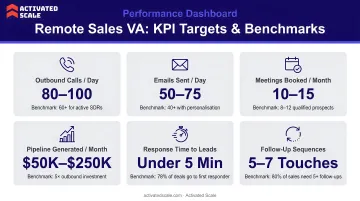
Use these benchmarks to calibrate expectations. If your VA is booking 5 meetings per month when the average is 15, dig into why—list quality, messaging, follow-up cadence, or skill gaps.
Use a Lightweight Management Cadence Without Micromanaging
Structure accountability without surveillance:
- Submit a short weekly metrics summary (5-10 minutes)
- Run a 20-30 minute video sync for feedback and strategy adjustments
- Hold a monthly review to assess KPIs, document wins, and close skill gaps
Reps receiving excellent ongoing coaching are 50% more likely to hit quota. The cadence keeps everyone aligned without requiring constant check-ins.
Provide Structured Feedback Using a Simple Framework
Use the Start/Stop/Continue method for weekly feedback:
- Start: What should the VA begin doing? (e.g., "Start including specific pain points in your opening lines")
- Stop: What should they stop? (e.g., "Stop using generic subject lines")
- Continue: What's working? (e.g., "Continue your research depth on target accounts")
This balances correction with encouragement and works well for remote workers who miss informal feedback signals.
Scale the Team Based on Performance Data, Not Instinct
Use KPI data to decide when to add headcount, reassign tasks, or promote a high-performing VA. Create a simple performance scorecard:
| Metric | Target | Actual | Status |
|---|---|---|---|
| Prospects researched/day | 50 | 62 | ✅ |
| Sequences launched/week | 3 | 2 | ⚠️ |
| Reply rate | 4% | 5.2% | ✅ |
| Meetings booked/month | 12 | 11 | ✅ |
A VA hitting green across 3+ metrics for two consecutive months is a reliable signal to expand their scope or bring on a second VA to increase volume.
Common Mistakes to Avoid When Building a Remote Sales Team
Hiring VAs Before Defining What "Good" Looks Like
The most common failure point: hiring without a clear performance baseline. Founders lack clear expectations, VAs have no definition of success, and the whole engagement unravels in frustration.
Before your first hire, define KPIs and write SOPs. Document what excellent output looks like:
- Sample prospect lists with correct data fields populated
- Messaging templates approved for your ICP
- CRM entry standards with field-by-field examples
Treating Sales VAs as Interchangeable With General VAs
Sales VAs need familiarity with CRM tools, outreach platforms, and B2B prospecting methodology. Hiring a general admin VA for a sales role and expecting them to self-direct wastes time and money.
Fix: Hire for sales-specific experience or budget extra onboarding time to train general VAs on sales tools and processes.
Skipping Onboarding Because "It's Just Research and Outreach"
Insufficient context about the ICP, product positioning, and messaging leads to low-quality output that can actively damage your brand with prospects.
Invest in onboarding upfront. A VA sending 200 generic emails per week does more harm than good — one week spent ensuring they understand your market, buyers, and value proposition will save months of damage control.
Frequently Asked Questions
What tasks can a virtual sales assistant handle for a B2B SaaS startup?
VAs typically handle top-of-funnel tasks like prospect research, CRM updates, email sequence management, appointment setting, and pipeline reporting. Closing conversations and strategic sales decisions require a more experienced sales professional, not a VA.
What is the difference between a virtual sales assistant and a fractional salesperson?
A VA executes defined tasks under direction (research, data entry, scheduling). A fractional salesperson owns a portion of the sales process independently—pipeline targets, discovery calls, quota responsibility. Choose based on whether you need execution support or outcome ownership.
What are the 5 Cs of sales?
The 5 Cs are Customer-Centricity, Communication, Closing, Consistency, and Continuous Learning. Remote sales teams apply these by prioritizing buyer needs, maintaining clear async communication, using structured close frameworks, following repeatable processes, and iterating based on performance data.
What is the 10-3-1 rule in sales?
The 10-3-1 rule means for every 10 prospects contacted, 3 will show interest, and 1 will convert, a 10% close rate. Use it to set realistic outbound volume expectations and benchmark whether your VA's outreach is over- or underperforming.
How do I measure the ROI of a remote sales VA?
Track VA cost against the pipeline value of meetings booked and deals influenced. Key metrics: cost-per-meeting (monthly VA cost ÷ meetings booked) and revenue-per-VA-hour (pipeline generated ÷ hours worked).