
They don't.
Hiring the wrong role first doesn't just cost you a few weeks of onboarding. It burns runway you don't have, delays your first real revenue, and can stall your entire go-to-market motion before it even starts. A 2023 Gartner survey of sales leaders found that 88% rated their SDR prospecting function effective at generating pipeline, but that only holds true when the role is scoped correctly and paired with the right closer.
This guide breaks down what SDRs and AEs actually do, what they cost, and how to decide which one your startup needs first.
Key Takeaways
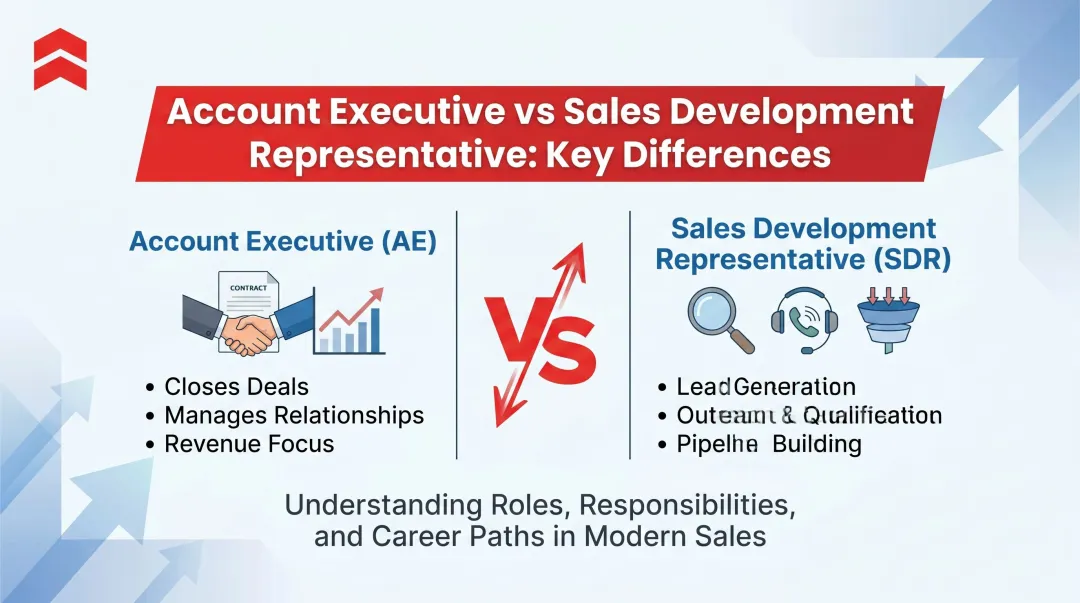
- SDR builds and qualifies pipeline; AE closes deals and owns quota
- AE pay leans heavily variable (~$190K median OTE, ~50/50 base-to-variable); SDR pay skews more fixed
- Match the hire to your bottleneck: unworked leads mean SDR first, unclosed demos mean AE first
- Fractional or contract-to-hire talent lets you test either role before committing to a full-time salary
SDR vs AE: Quick Comparison
Here's the side-by-side comparison founders actually need when planning a budget and a hiring sequence.
| Dimension | SDR | AE |
|---|---|---|
| Core job | Outbound/inbound prospecting, lead qualification, booking discovery calls | Running demos, building proposals, negotiating, closing signed contracts |
| Success metric | Meetings booked, qualified pipeline generated | Closed-won revenue, quota attainment, deal velocity |
| Hire when | Founder-led outbound/inbound volume exceeds your bandwidth | Qualified leads or demo requests are being missed or delayed |
Cost & Compensation
Account executive pay runs higher than SDR pay, weighted far more toward incentive.
The Bridge Group's 2024 SaaS benchmark study, which surveyed more than 170 B2B SaaS companies, found AEs earn a median on-target earnings (OTE) of $190,000, split roughly 53% base and 47% variable. Median annual quota sits around $800,000 in ACV.
SDR compensation runs considerably lower on both ends, and the pay mix leans more toward fixed salary since SDRs are measured on activity and qualified meetings, not closed revenue. Budget for your AE hire as the bigger financial commitment, before signing bonuses or ramp time even factor in.
Core Responsibilities
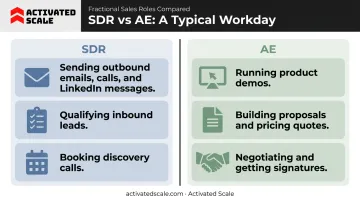
An SDR spends their day:
- Sending outbound emails, calls, and LinkedIn messages to target accounts
- Qualifying inbound leads against your ideal customer profile
- Booking discovery calls and handing qualified meetings to a closer
An AE spends their day:
- Running product demos and discovery calls
- Building proposals and pricing quotes
- Negotiating terms and getting signatures
What Is an SDR?
A Sales Development Representative (SDR) owns the top of your funnel. Their job is prospecting, qualifying, and booking meetings, not closing them.
Most founders start out doing this work themselves: cold emails, LinkedIn messages, inbound follow-up. It works for a while. Then leads start piling up, follow-ups get pushed to tomorrow, and tomorrow becomes next week.
That's the moment a dedicated SDR earns their spot. A focused SDR builds a predictable, repeatable pipeline, so you (or your first AE) can spend time closing instead of chasing replies.
You'll also see the title BDR (Business Development Representative) used interchangeably. Don't get hung up on the label. What matters is whether the role is scoped for inbound response, outbound prospecting, or both. Your motion determines the split, not the job title.
Use Cases of SDR for Startups
An SDR typically becomes the first sales hire between seed and Series A, once inbound leads or target account lists start outpacing what a founder can personally work.
Picture this: you're doing 100% of outbound yourself, squeezing in 20 emails a week between customer calls and product meetings. Sound familiar? Watch for these signs:
- Follow-ups get pushed to tomorrow, and tomorrow becomes next week
- Warm leads from last month never get a second touch
- Inbound leads and target accounts keep outpacing what you can personally handle
That's a lead-qualification problem, not a closing problem, and it's exactly what an SDR fixes. As the Gartner research cited earlier shows, a properly resourced SDR function drives effective pipeline generation. It works because prospecting finally gets the dedicated attention founders can't sustain alongside everything else on their plate.
What Is an AE?
An Account Executive (AE) owns the back half of your funnel: demos, proposals, negotiation, and getting signatures. Once a founder is doing all of that on top of cold outreach and legal redlines, something has to give.
A dedicated AE improves win rates and shortens sales cycles simply by being able to focus. They're not context-switching between a follow-up email and a board deck. They can spend a full day navigating a buying committee and handling objections.
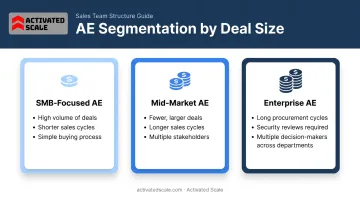
Scope the role to your deal size:
- SMB-focused AEs handle higher volume, shorter cycles, and simpler buying processes
- Mid-market AEs manage fewer, larger deals with longer cycles and multiple stakeholders
- Enterprise AEs navigate long procurement cycles, security reviews, and multiple decision-makers across departments
Hiring an SMB-style closer for six-month enterprise cycles (or the reverse) is a common, expensive early mistake.
Use Cases of AE for Startups
An AE becomes necessary once you have a validated flow of qualified leads, from an SDR or strong inbound, but you can no longer personally close every deal. At that point, many founders test the role with a fractional AE, brought in through a marketplace like Activated Scale, before committing to a full-time hire.
The warning signs are specific: demo requests are growing, but your response time is slipping from hours to days. Deals that should close in three weeks are stalling at six. Prospects who were ready to buy go quiet because nobody followed up fast enough.
A common benchmark among startup sales advisors: keep closing personally until you've landed roughly 10 to 20 customers. Then hand the role to a dedicated AE, staying close to the process until that rep consistently hits quota. That range gives you enough signal on what's actually selling before you let go of it.
SDR vs AE: Which Should You Hire First?
There's no universal answer. The decision comes down to five factors: current lead volume, average deal size, sales cycle length, how much of your own time selling eats up, and how many months of runway you have left.
Even well-known companies split on this. According to SaaStr's reporting on Brex's sales build-out, the company hired six AEs before its first SDR, relying on inbound demand until deal volume justified a dedicated prospecting hire.
Once the SDR function was built and optimized, outbound eventually drove roughly 80% of total revenue. Match your sequence to your own pipeline reality, not someone else's playbook.
Hire an SDR first if:
- Inbound leads or target account lists are piling up with nobody qualifying them
- You're missing follow-ups because prospecting keeps losing to other priorities
- You don't have enough qualified pipeline to keep a closer busy
Hire an AE first if:
- You already have qualified leads or demo requests going unclosed
- Deals are stalling because buyers aren't getting enough attention
- Pipeline exists, but nobody's dedicated to turning it into revenue
If you're pre-product-market-fit or genuinely unsure: test before you commit. A fractional or contract-to-hire sales professional, like the model Activated Scale runs, lets you validate whether an SDR, an AE, or both actually move your revenue before you sign a full-time offer letter you can't easily unwind.
Whichever path you take, most startups eventually need both roles. The mistake is hiring both before validating either one first.
Real-World Example: How One B2B Startup Solved Its SDR vs AE Dilemma
Flock Homes, a proptech startup, faced a familiar problem: the founding team was fielding sales conversations personally, but nobody had time to consistently work outbound or follow up on every inbound lead. Pipeline was inconsistent, and it wasn't clear whether the fix was more prospecting or a dedicated closer.
Rather than guess and make a costly full-time hire, the team brought on a fractional SDR through Activated Scale to test the pipeline-generation theory first.
The results answered the question. Over six months, the fractional SDR averaged 14 new meetings set per month — volume the founding team couldn't match on their own while running the rest of the business.
The engagement gave the team clarity on where the real bottleneck was before committing to permanent headcount. — Nicola Montagno, Director of Revenue Operations at Flock Homes
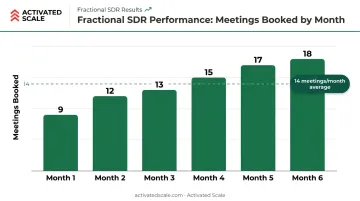
The takeaway: testing a role before committing to it removes the guesswork, and the risk, from your first sales hire.
If you're facing the same SDR-versus-AE question, book a strategy call with Activated Scale to talk through a fractional or contract-to-hire option that fits your stage.
Frequently Asked Questions
What are SDR and AE roles?
An SDR handles pipeline generation and lead qualification; an AE is the quota-carrying closer who owns revenue. They sit at opposite ends of the sales funnel, and most startups eventually need both.
How long does it take to get from SDR to AE?
Timelines vary by company. Industry benchmarks suggest roughly one to two years before AE promotion, with fast-track programs moving quicker.
Is SDR harder than AE?
They're demanding in different ways. SDR work requires volume and resilience against constant rejection; AE work requires negotiation skill, strategy, and managing multi-stakeholder relationships. Neither is objectively harder.
Do early-stage startups need both an SDR and an AE?
Most eventually do, but hiring both on day one rarely makes sense. Sequencing based on pipeline maturity and budget matters more than filling both roles simultaneously.
Can one person do both SDR and AE jobs?
Yes. Many early-stage startups run on "full-cycle" reps who prospect and close. It works at low deal volume, but specialization typically improves conversion once pipeline grows.
When should a startup hire its first salesperson?
The trigger is usually lead volume outpacing founder bandwidth, whether that's unworked leads or stalled deals. A fractional or trial hire is a low-risk way to confirm the need before a full-time commitment.