What's changed isn't the concept. It's the context around it.
AI adoption, shifting hiring economics, and founder demand for faster go-to-market results have compressed the timelines in which fractional leaders can deliver. The model is evolving rapidly, and the companies paying attention are gaining a measurable head start.
This article breaks down five structural trends reshaping fractional sales leadership—and what they mean for B2B SaaS founders making decisions about their revenue function right now.
Key Takeaways
- Fractional sales leadership has expanded well beyond startups into mid-market and PE-backed companies
- Proactive early engagement—before revenue stalls—is replacing reactive, crisis-driven hiring
- AI tools have compressed the time fractional leaders need to diagnose problems and deliver results
- Deep B2B SaaS specialization is now the baseline expectation for fractional sales leaders
- Try-before-you-buy models are giving founders access to senior sales talent without full-time hiring risk
Trend 1: Mainstream Adoption Is Expanding Well Beyond Startups
Fractional sales leadership started as a startup-specific solution. The assumption was simple: early-stage companies can't afford a full-time VP of Sales, so they borrow one part-time. That framing no longer holds.
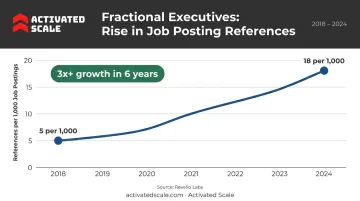
Revelio Labs found that references to fractional work in new executive job postings rose from 5 per 1,000 in 2018 to 18 per 1,000 in 2024—more than tripling in six years. That growth cuts across company sizes and stages.
Mid-market companies are engaging fractional CROs during leadership transitions and market expansions. PE-backed businesses are using them to accelerate portfolio company GTM execution. Enterprise divisions are bringing in fractional leaders to test new markets without disrupting existing teams.
The cultural shift matters as much as the numbers. Leadership flexibility used to signal budget constraints. Now it signals strategic sophistication: specialized expertise, accessed at speed, with no equity commitments or organizational disruption from a lengthy full-time ramp.
Real indicators of this shift:
- Fractional CROs appearing in investor meetings as credentialed GTM leads
- PE firms encouraging fractional leadership across portfolio companies during rapid-scale periods
- Founders citing fractional leadership as a deliberate operating model choice, not a stopgap
Activated Scale's own client base reflects this shift. SVP of Growth Niko Hughes has worked across approximately 35 Seed to PE-backed teams, and senior platform talent like VP Sales Chad Vanags specializes explicitly in growth-stage and mid-market GTM strategy.
The companies engaging fractional sales leaders today span seed rounds to PE portfolios. What they share isn't a funding stage — it's urgency around GTM execution and a preference for proven expertise over a long hiring process.
Trend 2: Proactive Early-Cycle Engagement Is Replacing Reactive Hiring
The old pattern was predictable: a founder ran sales themselves, results plateaued, they hired a VP, it didn't work, and six months later they brought in a fractional leader to fix the damage. That sequence is expensive, slow, and increasingly avoidable.
Forward-thinking founders are now engaging fractional sales leaders before the problem becomes acute.
What Early Engagement Actually Looks Like
Instead of arriving as a turnaround resource, fractional leaders are being brought in at the beginning of the sales buildout:
- Building the first sales playbook before scaling headcount, so new hires ramp into a working system rather than a blank page
- Validating ICP and go-to-market assumptions before investing in a full team
- Establishing CRM discipline early, before the pipeline data becomes unmanageable
- Designing onboarding frameworks that accelerate ramp time for every subsequent hire
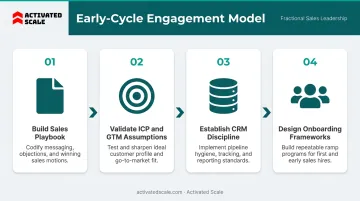
Mistakes made at the playbook stage cost a fraction of what it costs to fix a broken sales motion 12 months later. Founders who cycle through two or three sales configurations often spend 18+ months on a problem an experienced fractional leader could resolve in 60–90 days.
The Fundraising Angle
There's a fundraising dimension driving this trend that doesn't get enough attention. Clean pipeline data, documented processes, and repeatable revenue metrics tell a stronger story to investors than founder-driven chaos. More Seed and Series A founders are engaging fractional sales leadership specifically as part of their fundraising preparation—building the revenue infrastructure that gives investors confidence before the pitch, not after.
Carta's analysis of startup compensation data found that sales roles represented 19.9% of new startup hires in 2024, up from 14.8% in 2020. Sales infrastructure has become a higher priority earlier—and fractional leadership is one of the fastest ways to build it.
Trend 3: AI and Data Tools Are Reshaping the Fractional Leader's Toolkit
The role of a fractional sales leader has expanded because of what's now possible with AI. These executives don't just set strategy—they activate tools that make the entire sales function smarter and faster from day one.
Salesforce's 2024 research across 5,500 sales professionals found that 81% of sales teams were experimenting with or had fully implemented AI—and teams using AI were 1.3x more likely to report revenue growth than those that weren't.
AI Capabilities Now Embedded in Fractional Engagements
- Predictive lead scoring to prioritize outreach by conversion likelihood
- AI-driven call analysis for real-time coaching on objection handling
- Automated follow-up sequencing to reduce pipeline drop-off between touchpoints
- CRM health monitoring to flag stale deals before they go cold
- Buyer intent data to time outreach around active purchase signals
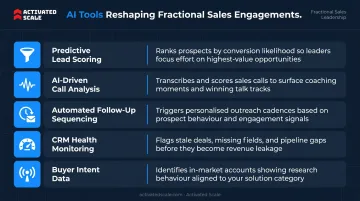
What used to take weeks of observation and pipeline review to diagnose now takes days with the right data in place. Fractional leaders use AI to compress their ramp-up period—directly countering the concern that a part-time leader can't move fast enough to matter.
The Cross-Client Intelligence Advantage
That speed advantage compounds when you factor in cross-client exposure. Fractional leaders working across multiple clients simultaneously spot patterns across companies at similar growth stages and with similar buyer profiles. Combined with AI-driven pattern recognition, that breadth of experience makes their strategic input sharper than what a leader embedded in a single organization typically brings.
They're also leaving stronger infrastructure behind. Automated workflows, AI-configured CRM pipelines, and documented playbooks become assets the internal team can operate independently. The engagement ends, but the systems stay.
Trend 4: Deep Industry Specialization Is Becoming the Baseline Expectation
The generalist fractional sales leader is losing ground fast. Companies—particularly in B2B SaaS—now expect fractional executives who arrive already knowing the terrain.
For B2B SaaS specifically, the baseline entry bar includes:
- Understanding product-led growth dynamics and how they interact with outbound motion
- Familiarity with enterprise deal cycles, multi-stakeholder buying committees, and procurement timelines
- Hands-on experience with renewal economics, net revenue retention, and expansion revenue strategy
- Experience with the buyer profiles and objections specific to the market
This expectation is grounded in data. Forrester's 2024 research found that an average B2B purchase involves 13 people across at least two departments, and that 86% of B2B purchases stall before completion.
Navigating that complexity requires direct prior experience—not a learning curve at the client's expense.
Why Specialization Cuts Ramp Time
A fractional leader who already knows the ICP, the common objections, and the competitive landscape can diagnose problems within days. A generalist needs weeks to get to the same starting point. At the fractional engagement timelines most companies operate on, that gap is costly. One path delivers pipeline improvements in the first 30 days; the other spends those 30 days in orientation mode.
What This Means for Evaluation Criteria
When assessing fractional sales leaders, companies should treat these as non-negotiables—not nice-to-haves:
- Documented track record in your specific sector (not adjacent sectors)
- Proven experience at the same revenue stage you're currently at
- Methodology that matches your sales motion (transactional vs. enterprise, inbound vs. outbound, PLG vs. sales-led)
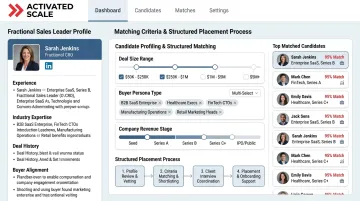
Activated Scale builds this specificity into its matching process—profiling candidates by deal size ranges ($10K–$50K, $50K–$100K, $100K+), buyer persona familiarity (CIO, CMO, CFO, CHRO), and company size sold into. That depth of profiling means founders spend less time vetting and more time closing.
Trend 5: Try-Before-You-Buy Models Are Reducing Hiring Risk
The traditional binary—hire a full-time VP of Sales or go without senior sales leadership—is breaking down. In its place, flexible engagement models are giving founders something they've never had before: the ability to evaluate senior sales talent against real results before making a long-term commitment.
How These Models Work Structurally
Activated Scale's contract-to-hire model illustrates how this works in practice. An initial fractional engagement is structured as a monthly retainer—$4,500/month plus performance pay for SDRs, $6,500/month plus performance pay for AEs, or $12,000/month plus bonus for VPs of Sales. The engagement begins fast: in one documented case, a client went from initial call to active sales talent within 8 days.
Once placed, the fractional leader operates inside the company's environment—building outbound motions, iterating on messaging, and closing deals. Performance data—not interview impressions—drives the decision to convert to full-time. Approximately 60% of Activated Scale's customers hire their fractional sales talent as full-time employees after that initial contract period.
Why This Matters at Seed and Series A
A failed full-time senior sales hire at the Seed or Series A stage is costly—in compensation, severance, burned pipeline, and the organizational reset required to recover. The try-before-you-buy model shifts that risk profile entirely.
Founders build confidence in the leader's approach, cultural fit, and actual results before committing to a full-time salary, benefits package, and equity grant. The fractional leader, in turn, gets to evaluate the company's product maturity and leadership quality before accepting a permanent role—a mutual evaluation that a standard interview process rarely enables.
As one sales professional placed through Activated Scale described it: they were "testing a potential future employer prior to joining them full time"—a mutual evaluation that produces better long-term fit than a standard interview process ever could.
What's Driving These Trends Simultaneously
These five trends aren't happening in isolation. Several macro forces are accelerating all of them at once.
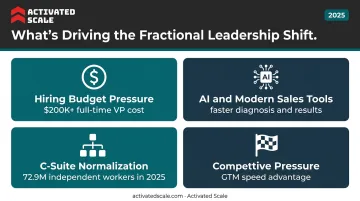
Four macro forces are pushing this shift:
- Hiring budget pressure: A full-time VP of Sales commands well over $200K in total cash compensation at scaling-stage US startups—before benefits, bonuses, and equity. For a Seed-stage company, that's often more than half the headcount budget for the entire sales function.
- AI and modern sales tools: Better data access lets fractional leaders diagnose problems and show results faster, making the model more defensible to boards and investors who once questioned whether a part-time leader could drive meaningful outcomes.
- C-suite normalization: The same logic that made fractional CFOs and CMOs commonplace is now extending to the revenue function. According to MBO Partners, the US independent workforce reached 72.9 million workers in 2025, including 5.6 million earning over $100,000—a growing share of them experienced sales executives choosing fractional work deliberately.
- Competitive pressure: As more startups adopt fractional leadership and gain GTM speed advantages, the pressure on competitors to match that pace builds. Early movers are closing pipeline while late adopters are still debating their first sales hire.
Future Signals: What to Watch in the Next 1–3 Years
A few developments worth tracking as the fractional sales leadership market matures:
Coordinated fractional C-suites are an emerging pattern—companies engaging a fractional CRO, CMO, and CFO simultaneously rather than in isolation. This gives scaling businesses enterprise-grade strategic alignment without full payroll overhead. It's still early, but the infrastructure for it is forming.
Specialized fractional talent networks with verified track records will likely formalize further. The current market still requires considerable founder effort to vet and evaluate candidates. Platforms that compress this processwill gain ground by offering sector-specific placement, documented performance history, and fast matching timelines. Activated Scale's 7-days-or-less connection model reflects where the market is heading: speed and specificity over lengthy search processes.
Try-before-you-buy contracts will become standard, with most B2B SaaS founders expecting it as the default engagement structure—not a differentiator—when making their first senior sales hire.
For Seed and Series A founders, the window to get ahead of this shift is now. Fractional sales leadership is moving from "alternative option" to the expected first move—and the platforms, talent networks, and engagement models to support it are maturing fast.
Conclusion
The five trends covered here—mainstream adoption, proactive early engagement, AI-enabled toolkits, deep specialization, and risk-reducing engagement models—make one thing clear: fractional sales leadership is no longer a niche workaround. It has become a strategic operating model that B2B SaaS companies are using to build more disciplined, scalable revenue functions from the ground up.
The companies acting on these trends early are gaining compounding advantages: faster go-to-market execution, stronger investor readiness, leaner cost structures, and better-organized sales teams.
Founders who engage fractional sales leadership proactively—before the revenue problem becomes acute—are building more durable revenue engines than those who arrive at the decision reactively.
If your pipeline has plateaued, you're spending most of your week on sales with flat results, or you're approaching a funding round without clean revenue metrics, those are signals worth acting on now. Waiting until the quarter is already lost rarely changes the outcome.
Frequently Asked Questions
Is fractional sales leadership only suitable for startups?
No. While the model originated in the startup world, mid-market companies, PE-backed businesses, and enterprise divisions now actively use fractional sales leadership—particularly during leadership transitions, market expansions, and rapid-scaling periods where speed and specialization matter more than full-time commitment.
How quickly can a fractional sales leader make an impact?
Most fractional sales leaders begin diagnosing process gaps immediately and deliver measurable pipeline improvements within the first 30–60 days. Sustained revenue growth and improved conversion rates typically become visible within 90–120 days of a structured engagement.
What is the difference between a fractional sales leader and a sales consultant?
A sales consultant advises and exits without owning results. A fractional sales leader embeds into the team, runs pipeline reviews, coaches reps, and takes accountability for outcomes. They operate as a working executive—not an outside voice delivering a report.
How is AI changing what fractional sales leaders can do?
AI tools—predictive lead scoring, call analysis, automated sequencing, and CRM health monitoring—allow fractional leaders to diagnose problems faster and coach more precisely. The result: measurable improvements delivered in shorter engagement windows than manual approaches ever allowed.
What does it typically cost to hire a fractional sales leader?
Fractional sales leaders typically charge between $2,000 and $15,000 per month depending on seniority and scope. That compares to well over $200,000 in total cash compensation for a full-time VP of Sales at a scaling-stage company—before benefits, bonuses, and equity.
How do I know when my B2B SaaS startup is ready for fractional sales leadership?
Key signals include: revenue has plateaued despite active outreach, you're spending more than half your time on sales with flat results, there's no documented repeatable process, or you're approaching a funding round and need clean revenue metrics.