Introduction
Most B2B SaaS founders become their company's first salesperson by default. Between writing cold emails, chasing follow-ups, updating the CRM, and booking discovery calls, the product work gets squeezed into whatever hours are left. That's a real problem — not just for productivity, but for growth.
The sales work piles up fast. According to Salesforce, sales reps spend 60% of their time on non-selling tasks, and research from HubSpot shows the average sales professional spends only 2 hours per day on active selling. For a founder who's also responsible for product, hiring, and fundraising, those numbers are unsustainable.
On-demand sales support offers a practical alternative: access to experienced sales talent (fractional reps, external teams, or contract-to-hire professionals) without committing to full-time headcount before you're ready. What follows breaks down the models available, what these engagements actually deliver, and how to figure out if the timing is right for your stage.
Key Takeaways
- On-demand sales support gives B2B startups flexible access to experienced sales talent — no long-term hiring commitments required.
- Coverage spans the full top-of-funnel: prospecting, outreach, appointment setting, and pipeline management.
- For founders buried in sales tasks, it's faster and lower-risk than a full-time hire.
- Fractional talent, agencies, and contract-to-hire each fit different stages and budgets.
What Is On-Demand Sales Support?
On-demand sales support refers to any external resource — people, services, or expertise — that a company activates when needed to drive sales outcomes, without adding permanent headcount.
The key distinction from traditional sales support is flexibility. An in-house sales team is fixed overhead: salaries, benefits, management time, and ramp periods whether the pipeline is active or not. On-demand models scale with business need — a product launch, a new outbound campaign, a geographic expansion — and scale back just as easily.
One distinction matters here: on-demand sales support is focused entirely on revenue generation — prospecting, pipeline building, outreach execution, and appointment setting. Post-sale support and customer service are separate functions with different goals.
Three Things That Define a True On-Demand Model
- Flexible scope — engagements can expand or contract based on campaign phase or budget
- External delivery — the resource sits outside your payroll, reducing overhead and hiring risk
- Revenue focus — the work directly connects to pipeline activity and new business, not account management or support tickets
Types of On-Demand Sales Support for B2B SaaS Startups
Fractional Sales Talent
Fractional sales professionals — SDRs, Account Executives, Sales Directors, or VP-level talent — work part-time or project-based for a company. They bring experience, hit the ground running, and don't require the ramp time of a new hire.
This model works particularly well for startups that need experienced salespeople immediately but aren't ready to commit to a full-time salary and benefits package. Activated Scale connects B2B SaaS startups with pre-vetted, US-based fractional sales talent — SDRs, AEs, Sales Operations, and VP of Sales — typically within 7 days, sometimes same-day. Their network includes professionals with backgrounds at Salesforce, Oracle, IBM, Zendesk, and Datadog.
External Sales Development (BPO/Agency)
Agencies and business process firms provide dedicated outbound teams — cold calling, email outreach, LinkedIn prospecting, and sequence automation — on a retainer basis. This suits companies that need consistent lead flow but prefer not to manage individual reps directly.
The tradeoff is real: you get less control over rep quality and less ability to tailor outreach to your specific ICP and messaging. For early-stage companies still refining their pitch, that gap matters.
Contract-to-Hire Sales Professionals
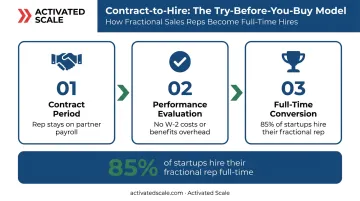
This hybrid model lets a sales rep start on a short-term contract — typically 3 months — before either party commits to a full-time employment relationship. It's designed to reduce the risk of a bad first sales hire, which is one of the more expensive mistakes an early-stage company can make.
Activated Scale's contract-to-hire model (they call it "try-before-you-buy") works exactly this way. During the contract period:
- The salesperson stays on Activated Scale's payroll — no W-2 processing costs, no benefits overhead
- You pay a conversion fee only if you decide to hire full-time
- About 85% of startups using this model end up hiring their fractional rep full-time after seeing results
Sales Support Tools and Automation
"On-demand" also includes software-based resources — CRMs, sales engagement platforms, lead enrichment tools — that provide always-on pipeline support without human headcount. They handle the repetitive mechanics of outreach well. What they can't do is adapt strategy on the fly, read a prospect's hesitation, or build the kind of trust that closes a $50K deal.
Key Functions: What On-Demand Sales Support Actually Does
Lead Generation and Prospecting
On-demand reps take over the time-consuming top-of-funnel work: researching ideal customer profiles, building prospect lists, and initiating first contact. This frees founders and senior reps to focus on what actually moves deals forward: conversations and closing.
HubSpot's sales research shows that 25% of sales professionals cite reaching decision-makers as a major prospecting challenge. Fractional reps with relevant buyer experience shorten that path considerably.
Appointment Setting and Pipeline Management
Fractional reps qualify inbound and outbound leads, book discovery calls, and keep the pipeline moving. Consistent pipeline activity compounds over time: by Month 3, Activated Scale's fractional SDRs typically book 10–15 meetings per month with qualified prospects. For startups targeting small businesses, that number often reaches 13–22 per month.
Sales Outreach Execution
On-demand professionals execute multi-channel outreach using proven playbooks built from experience at companies like Salesforce and IBM. By days 16–45 of an engagement, Activated Scale's reps are already testing and iterating messaging across:
- Email sequences — structured cadences tailored to each buyer segment
- Cold calling — direct outreach to decision-makers with relevant talk tracks
- LinkedIn — connection-based outreach for higher-touch prospects
CRM Maintenance and Pipeline Visibility
On-demand support keeps customer data clean, logs interactions, and ensures the pipeline reflects reality. For founders who need pipeline visibility without personally managing CRM hygiene, this alone saves several hours per week.
Customer Follow-Up and Relationship Nurturing
On-demand teams handle post-demo and post-proposal follow-ups, keeping deals warm while the founding team focuses elsewhere. On lean teams juggling multiple priorities, slow follow-up is one of the most common reasons deals go cold.
Benefits of On-Demand Sales Support for Early-Stage Companies
Speed to Revenue Without Hiring Risk
Traditional hiring is slow. The average time-to-fill for open roles was 41 days in 2024 according to SHRM — and that's before onboarding and ramp time. Startups using on-demand models can have experienced sales talent working their pipeline in days.
Activated Scale clients save 20+ hours of founding team time per salesperson on interviewing alone, since the vetting and matching process happens on the platform's side.
Cost Efficiency vs. Full-Time Headcount
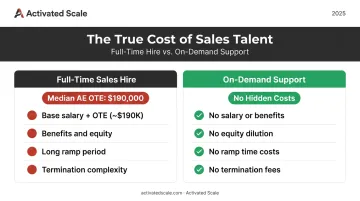
Full-time sales hires carry substantial costs beyond base salary. The Bridge Group's 2024 SaaS AE benchmark report puts median AE OTE at $190,000 — up from $167,000 in 2022. Add benefits, equity, tools, management overhead, and ramp costs, and the true cost of an underperforming first hire is significant.
On-demand models avoid most of that overhead:
- No salary or benefits during the contract period
- No equity dilution for a role you're not sure will work
- No ramp time costs when experienced talent arrives ready to execute
- No termination complexity with month-to-month, no-minimum structures
Flexibility to Scale Up or Down
On-demand support adapts to business cycles. A startup can increase outreach capacity ahead of a funding push or product launch, then dial back during slower periods — without the HR complexity of headcount changes.
Access to Talent You Couldn't Otherwise Afford
On-demand platforms give early-stage companies access to professionals with enterprise-grade experience. That includes reps who've built pipeline at Salesforce, managed complex cycles at Oracle, and run outbound programs at Zendesk. Hiring that background full-time at Seed stage usually isn't in the budget — but accessing it fractionally puts that experience within reach from day one.
When (and When Not) to Use On-Demand Sales Support
Right Time to Bring In On-Demand Support
On-demand support delivers clear value in these situations:
- Founders spending most of their time on sales tasks instead of product, strategy, or fundraising
- Post-PMF with no repeatable sales process — you know the product works, but outbound is inconsistent
- Preparing to scale outbound before committing to full-time reps
- Testing a new ICP or market segment without redirecting existing sales resources
- Needing speed — a board presentation, a funding push, or a product launch requiring pipeline fast
When On-Demand Support May Not Be the Right Fit
That said, not every situation calls for external sales resources:
- Pre-PMF startups: Founder-led discovery conversations produce learning no outside rep can replicate. Handing off that stage means handing off the insight.
- Long-cycle enterprise accounts: Relationships requiring consistent, named reps with deep product knowledge built over months don't fit the flexible engagement model well.
- No clear brief in place: A vague ICP, undefined success metrics, or no feedback loop almost always produces low ROI.
The model amplifies good processes. It doesn't create them from scratch.
How to Choose the Right On-Demand Sales Support Partner
Define Your Needs First
Before evaluating providers, answer three questions:
- Which part of the funnel needs help? Top (prospecting), middle (qualification, demos), or closing?
- What does your ICP look like? Company size, industry, buyer persona, deal size?
- What does success look like in 90 days? Meetings booked, pipeline created, revenue generated?
The more specific your answers, the faster a partner can deploy and produce results.
Evaluate for Industry Fit and Track Record
Look for partners with:
- Demonstrated B2B SaaS experience, not a generic sales agency background
- Talent that has sold to your specific buyer persona at comparable deal sizes
- Named client references or case studies — not just testimonial quotes on a homepage
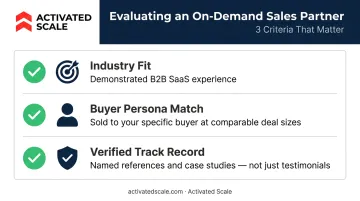
Activated Scale's vetting process covers exactly these criteria: a three-step screening that reviews buyer persona experience, a live pitch video assessment, and a subject matter expert interview. Activated Scale's 80% client retention rate — meaning 80% of clients use Activated Scale talent for 5+ months — is a practical signal that the matching process works.
Once you've confirmed the right fit, make sure the contract terms protect you if things don't go as planned.
Prioritize Speed to Start and Low Commitment Entry Points
Early-stage companies should default toward providers that offer:
- Fast onboarding — days, not months
- Month-to-month terms — no lock-in before results appear
- Transparent pricing — no hidden fees or ambiguous contracts
- $0 termination fees — so you can exit without financial penalty if it's not working
For Seed and Series A companies, these terms mean you can test, learn, and adjust without burning runway on a contract that outlasted its value.
Frequently Asked Questions
What is the role of on-demand sales support?
On-demand sales support handles revenue-generating activities — prospecting, outreach, appointment setting, and pipeline management — so founders and senior reps can focus on closing deals. It adds external sales capacity without requiring a permanent headcount addition.
How is on-demand sales support different from hiring a full-time sales rep?
On-demand support offers flexibility, lower cost, and faster activation with no long-term salary commitment. Full-time reps make more sense once you have a proven sales process and are ready to build an in-house team.
When should a B2B SaaS startup consider on-demand sales support?
Key trigger points: the founder is overwhelmed by sales tasks, the company has product-market fit but no repeatable outbound process, or the team needs to test outbound at scale before committing to full-time hires.
What tasks can on-demand sales support handle for a startup?
Tasks typically include lead generation, prospect list building, multi-channel outreach (email, phone, LinkedIn), discovery call booking, CRM data management, and post-demo follow-up.
How quickly can on-demand sales support start generating results?
Fractional talent from specialized platforms can start within days. With Activated Scale's model, reps spend the first two weeks on onboarding and messaging development, with active outreach beginning around day 16. Most clients see consistent meeting bookings by month 3.
Is fractional sales support cost-effective for early-stage companies?
For most Seed-to-Series A companies, yes. You avoid salary, benefits, equity, and ramp costs tied to full-time hires, and can scale the engagement up or down based on pipeline needs — with no termination penalties.